
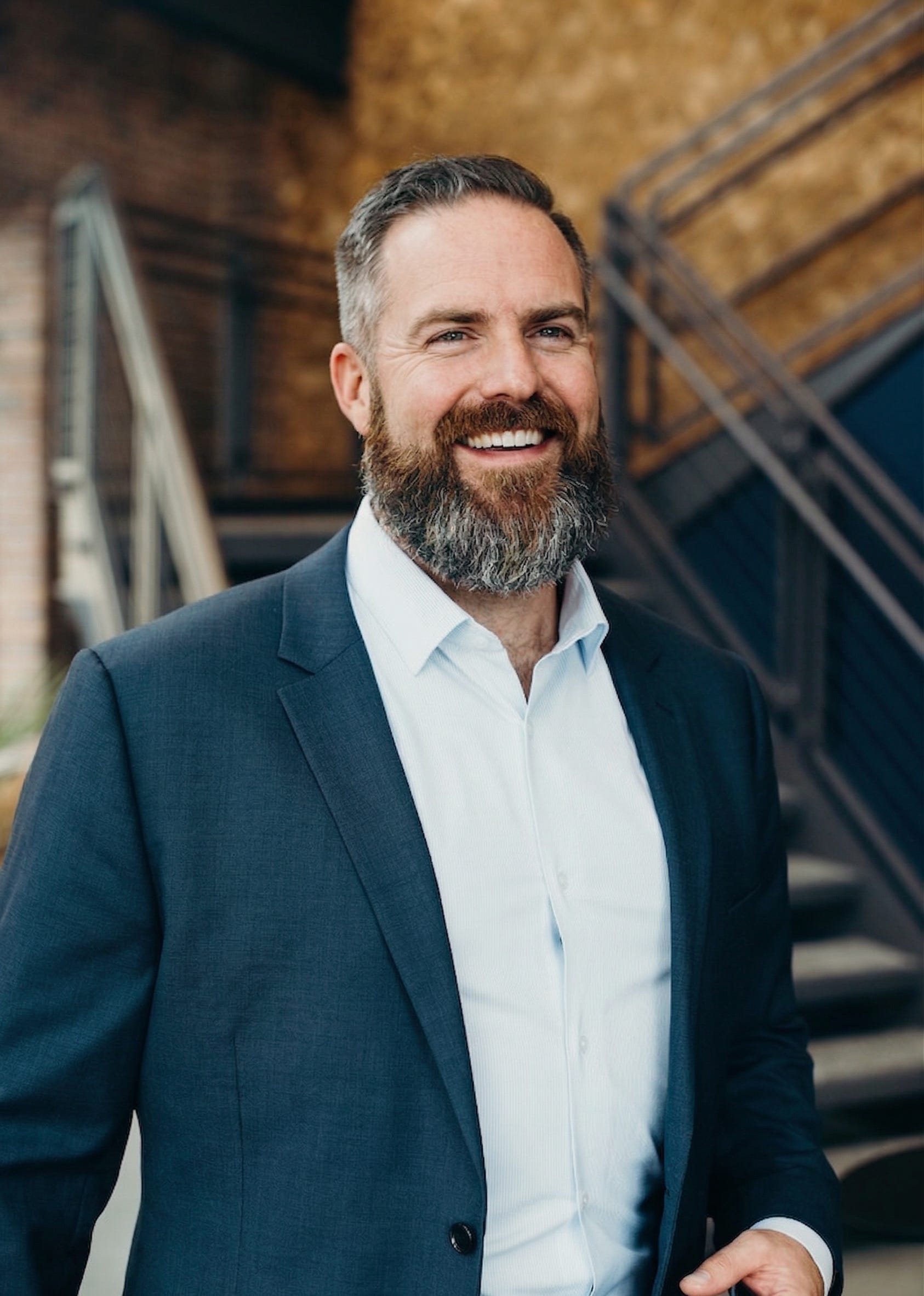
Dustin Snyder is the founder and Chief Advisor at Wayforward Associates, a national organizational consulting firm specializing in workforce diagnostics and change management. He personally developed Strategic Workforce Insight Mapping and has deployed it across the United States - from family businesses at generational transition to divisions of Fortune 500 multinationals. His practice bridges clinical psychology and executive leadership, with a client portfolio spanning manufacturing, healthcare, professional services, aerospace and defense, and beyond. He serves on the American Welding Society's Advisory Committee and the Harvard Business School Research Advisory Group.
His book Sink or SWIM introduces his diagnostic methodology he developed to show that an organization’s dysfunction isn’t random, but the predictable output of environmental factors that simply haven’t been identified yet.
Listen to “Atlas SWIMs” below, or on Apple Podcasts, Spotify, YouTube, Amazon, Pandora, or wherever you get your podcasts. The episode transcript is shared below the embed.
TechXY Turbo - Podcast Transcript - (E12)
Frank: Welcome to another episode of TechXY Turbo. My name is Frank and I am your host.
Frank: Dustin Snyder is the founder and chief advisor at Wayforward Associates, a national organizational consulting firm specializing in workforce dynamics and change management. He personally developed strategic workforce insight mapping and has deployed it across the United States from family businesses at generational transition to divisions of fortune 500 multinationals.
His practice bridges clinical psychology and executive leadership, with the client portfolio spanning manufacturing, healthcare, professional services, aerospace and defense, and beyond. He serves on the American Welding Society’s Advisory Committee and the Harvard Business School Research Advisory Group.
Dustin, it’s really great to have you on TechXY Turbo. Thank you for doing this. I’m really looking forward to the conversation. How are you today?
Dustin: I’m great. Thanks for having me. This is this is going to be fun. Great.
Frank: And just so everyone knows, we’re doing something a little different. Usually we come on with some set questions and themes, but, Dustin, you and I met, we had coffee, and already talked. Also you just came out with the book and I happened to read it for the episode.
So this really gives a good opportunity to talk about an author’s fresh work and go back and forth on questions. I don’t get this opportunity all the time, so I’m really looking to dig into this. For those listening who may not know your background or this book, can you give just a brief update what you’re doing in the world, and what is Sink or SWIM that we’ll be talking about on the show?
Dustin: Yeah, sure. So, Sink or SWIM is the title of the book. It’s a play on words that with swim as an acronym for Strategic Workforce Insight Mapping - what Wayforward does with workforce insight mapping as a way to leverage within organizations. The science is called human systems theory and human systems theory, a concept that I would love to say that I very intentionally got into. But as I lay it out in the book, I really accidentally stumbled into this.
Five years ago, I was president of a manufacturing division of a larger company and had about 600 employees and was there for a turnaround effort. And that engagement, I did not start out understanding these concepts. I started out with a traditional command and control leadership style, and it seems very obvious now looking back. But, drumroll. People don’t like to be controlled. And I figured that out the hard way. I can I can be a little bit reductionist about it, but when we started listening to our employees, really when we started to understand the perspective of vantage points within the organization that were not very visible to leadership, things started to take off.
So I knew going into that organization that we were trying to sell the division and when we did, that there would be an exit and that was always the mission. So I had some soul searching to do when that mission accomplished. And I started to dig into the science behind why what we had done there worked.
I did that because I was surprised myself. I wouldn’t have believed you if you’d have told me how fast things turned around when we started doing the things that we were doing. And so I was very curious as to, like, were we onto something? Was there something to this? And that’s when I found that there was this whole field of science called human systems theory, and that there were all these different scientific disciplines, whether it was psychology or anthropology or behavioral economics or all these other fields, had kind of reached this same conclusion from different directions, that human behavior is a hard science, and that it can be mapped and that you can understand cause and effect why the people within your organization are engaging in the behaviors that they are.
Frank: Fascinating and certainly seems to make sense with the breakthroughs that we’ve had in analytics data. So from your application of this, are you finding this as universally successful? Is it something that you have to be a big organization? Is there any prerequisites for this to work, or can this work anywhere in any organization?
Dustin: I believe this can work anywhere. I’ve applied this in every industry that I can think of in organizations with different geographies, different workforces, different missions, different ways of doing things. It’s understanding the variables in our environment. And as much as we like to think that we’re captains of our own ship and that we’re making our own decisions all day long, we as human beings are very much reacting to the things around us.
And so when you’re able to map that environment, it’s very easy to see that the behaviors we engage in are outputs of a system, and you can change things within that system to create different behavioral outcomes for the group of people that make up an organization.
Frank: So you are a natural for a tech podcast. And in my world, this is what we’re looking to do. We’re looking to define all the variables. But let me let me ask a little question. So, you know, in my experience, in business and tech, there are rational actors, but there’s also the subconscious and so much of our communication is non-verbal. Since people react unconsciously a lot, how do you account for those variables which are, I know part of behavioral science. How do you bring that in when you’re dealing with people who are reacting to emotion or other feelings?
Dustin: That’s actually exactly what I’m talking about. As much as we think we’re making rational decisions, there’s a ton of things happening before we get to the point where we rationalize our decision. We have already made our decision before we are assigning words to it and articulating it and putting rational thought to it.
And so much of it is driven by emotion, the way that we tend to form our conclusions, the way that our brain works, metaphor and story and those sorts of things are creating feelings for us. And we have that subconscious reaction that you’re talking about. So we have leadership teams that think if they just explain it better, we will react differently.
But that’s not the case. We are having reactions based on our lived experience and our environment.
Frank: Yeah, there’s there’s this great scene in the movie In the Company of Men where it one of the characters is screaming at a deaf woman. It’s like the ultimate metaphor for when you want to be heard, but you’re completely missing the point.
What about the cases of maladaptive types as there’s a lot of research that in the C-suite you have sociopathic behavior types. Do you account for those? Is that noise in the system or does the system design architecture kind of account for that?
Dustin: Well, I’m I’m not a clinician, so I can’t pretend to be able to diagnose someone as a sociopath or something like that. But what I look for is genuine interest in understanding what’s going on. Most of the leadership teams that I work with, my clients kind of fall into two different buckets.
There are there are the ones that are good, and they they inherently recognize the value of this kind of thing. They understand that it’s an investment in making their organization better. Those are usually the companies that are growing. Maybe it’s a leadership transition and they’re looking to really bolster the side of the business, and they just don’t have the tools to measure it financially and actually assign metrics to this thing that they’ve believed was a soft science for a long time.
Then the other side of the coin is those businesses where things aren’t going well, where perhaps the leadership team does not have the awareness of the value around human systems, and in those instances, I find that they reach out to me to do the workforce insight mapping because they’re at a specific pain point.
And if they’ve reached out to me, it’s generally because they recognize that they are missing something, that there is a piece of the equation that they’re not understanding in order to, because they’ve tried all the usual traditional HR things, they’ve done, the retraining they’ve done, the progressive discipline, they’ve done the culture initiatives, the engagement surveys, and it’s not changing the outcome for them in their organization.
So knowing that, when a leadership team sits down with me and says, “Hey, we can’t quite put our finger on what the problem is and we need help mapping it”. You can usually tell when that’s genuine or when it’s that the board is breathing down my neck and I need to do something. So it’s the language that they tend to use around it. I have developed a sense for when it’s a box checking exercise and when it’s genuine. If it’s a box checking exercise, I just don’t get involved because they need to want to act on what they’re about to learn. And it’s an exercise that takes a lot of emotional maturity. And I have a lot of clients talking about that in my book who have been through the workforce insight mapping process that it it takes some emotional intelligence on leadership’s part.
Frank: Makes a lot of sense. I mean, I was thinking a lot about how people make these life changes and it almost sounded like that was happening at the organization level in the book. One of the things I found useful coming to this for the first time is that you gave a lot of examples and maybe you can give one now.
I think there were a few instances of, like you said, what might appear to be a people problem. I think you used attendance or maybe machine safety. Talk about that. And it’s really interesting because then once you have the insight, like it looks totally different. And I think with children you see that sometimes, right? If you don’t have the full picture and then once you get it, so can you give like an example of how your framework might reveal what looks like people problems and give an example.
Dustin: So this was actually one of the areas where I first started to stumble into these realizations that led me to to these methods. There were kind of two things that happened very close together for me. The first one was that I started to get this sense that tightening down on the strictness of the attendance policy didn’t actually make a difference in how many people were absent on any given day in the organization.
I’ve worked in my past lives when I’ve been in in house, in a corporate environment, and I’ve worked in a number of dysfunctional organizations where absenteeism was very high. And when I looked at the research, the research actually shows that the stricter the attendance policy, the worse the attendance.
So you can give people fewer absences that they’re allowed to take before they start getting in trouble. And it will actually make them be absent more often. And so that’s pretty counterintuitive, right? Like the stricter the attendance policy, the worse the absenteeism gets when that’s not the intent, you’re trying to control the absenteeism.
So that was a really interesting, counterintuitive thing for me to realize. And that set me on this path of thinking, doing some self-reflection of when do I not come to work? Because I realized, like the absence of managing the absenteeism, managing the behavior is not getting us anywhere. So why are people absent in the first place
Like, okay, if they’re genuinely sick, if if your car genuinely breaks down, if your kid breaks his arm at school and you have to pick him up, of course those are the major things, but that’s not really what we’re talking about when we’re in leadership positions where absenteeism is a problem, because those things are relatively few and far between for most people.
When you have a significant portion of the workforce that’s absent on any given day, that’s a systemic problem where they’re choosing to not be there. And that’s what we want to deal with with these attendance policies and such. The voluntary absences when we don’t want to come to work. And so I asked myself the question: why don’t they want to be here?
Then I thought about it from my own experience, like I would come to work sick as a dog. I mean, pre-COVID, back when we were allowed to be sick at work.
Frank: Totally.
Dustin: Because I cared about what I did and it was a part of my identity. I was dedicated to accomplishing the outcome that I wanted to. And I felt like I’d be letting the team down if I wasn’t there. So I would come in when I was sick, but when I would call in, and I would call in, it was because I didn’t want to be at work.
It was because something had happened the day before, whether it was my boss who ticked me off or a project we were working on, direction changed and all this work had just gone down the drain or something. Disengaged me in real time. That made me say, no, I’m not going to.
I’m not going to deal with this today. And when I came to that realization, like if I consider myself a high performer, I’ve risen up through the ranks of leadership like I’m an effective employee who doesn’t care if he’s sick or not and will come to work even if he’s not feeling well. If I come off when I don’t want to be here, or call off when I don’t want to be here, of course your average person is going to—
Frank: —especially if it’s unconscious, right? Or they’re not realizing it’s at a conscious level, what’s what’s happening. Right?
Dustin: I don’t know that I had ever even thought about it consciously before until I sat down and did that self-examination. So if I if even I do it, of course the average person is going to do that. And so then I started to examine the question of why don’t they want to be here? What’s happening on a day to day basis that is disengaging them and operating from the assumption that most people don’t get up in the morning and think, I’m going to do a really crappy job at work today, or I just don’t care.
Most people want to feel accomplished. Most people want to go home at the end of the day and think they did something with their time. They don’t want to think their career is a waste. Most people are reasonable and want to accomplish something every day. When I decided to operate from that assumption and then started looking at the environment, I started to see there were a lot of things in people’s way, like there were things that made their life harder than it needed to be.
There were things that got in the way of them accomplishing the expectations that we placed on them. And so when I started mapping their environment and understanding where they were sitting, it started to become really obvious that there were things that were disengaging people that we just didn’t see in our day to day because we’re up in the corner office, we’re up in the boardroom, and it’s just not part of our visibility day to day, right?
Frank: Yeah. I was talking to a data engineer, and he told me that he analyzed a lot of 911 calls and in aggregate it totally changed his opinion on the call because he got to see all the data points. I think part of what’s interesting is, yes, you’re a traditional HR consultant, but you’re also a data storyteller.
So one of the questions is, assuming good intent, because I agree a lot of people do mean well, but do they have the data maturity to be able to make these changes, or is that why they need a diagnostic like this, environmental mapping?
There’s a ton of data, but I don’t know. I’ve seen a lot of places where they methodically map it. Like as much as this is an HR assessment, you’re also helping them with data maturity. Is that part of it that you’re seeing too?
Dustin: Yeah, I think that is a big part of the value. The first piece of it is this paradigm shift. And that’s a lot of what’s in the Sink or SWIM book — having helping a leadership team or an organization start to take a systems thinking lens when it comes to human behavior. There’s a bunch of studies that are referenced in, I want to say it’s chapter eight in the book, about when you train an organization on systems thinking, when you train the middle management on it, how significantly better the results get.
And there are software company examples, there’s health care, there’s manufacturing, it’s that paradigm shift. Like once you see the system, you can’t unsee it. You immediately start looking at behavioral outcomes. That way, you know, if it’s just 1 or 2 people, if it’s just Dustin and Frank that are, you know, being jerks, okay, there’s character flaws, but when it’s a significant number of your employees engaging in a certain type of behavior, that is a systems outcome.
So once you see the system, you want to start and you map the system and understand the cause and effect, you start to connect these dots from income input to output of the system. Organizations can start to look at things differently and start to capture KPIs a little bit differently. Understand what kind of measure, what kinds of things are resulting in the outcomes that they’re getting.
Because a lot of these behaviors like you look at employee turnover, for example, your top performing employee leaves. That has zero impact on an accounting accounting for all their concerns. Finance. There’s zero impact there that has no effect in the P&L, while in actuality it has a massive effect on the P&L because you’ve just lost your best person.
We don’t tend to measure human behavior in organizations and the way that it contributes to our financial outcomes. But once you start to measure these things, it becomes very obvious.
Frank: Yeah. Coming from staffing, turnover is one of the things we talk about with customers, the cost of an employee leaving but also the cost of not hiring. I think it can be hard to see these costs. In my experience, I think one of the effective data tools I’ve used have been various diagnostics for employees, like whether it’s MBTI, Hogan, some of these are great, but where I felt the gap is on the behavior side.
So these diagnostics, do they need to mature? Do you think what we’ve used in the past with HR, whether it’s DiSC or any of the ones I’ve mentioned? So those still have a place or will your system give new context to using diagnostics for individuals?
Dustin: I think the simple answer is yes. What I’m doing is at a systems level. I’m doing things at a macro level. I do very little when it comes to like executive coaching or interpersonal dynamics. I help organizations understand human behavior at scale, and that doesn’t replace coaching and or personality assessments.
I’m a certified Myers-Briggs practitioner. I love doing that kind of thing because it’s it’s fun. But where where the workforce insight mapping comes in and understanding human systems theory, it gives you more context for those sorts of things. So I’ll use the example of something that I see in pretty much every organization I work in is a concept called behavior modeling.
You see the same behaviors cascading down through the organization. Leadership behaves in a certain way, and the directors learn to behave that way because they’re they’re modeling what a successful behavior looks like in this environment. It’s it’s the same thing children do when looking at adults.
How do I how do I function in the world? We don’t read the manual. Nobody buys a car and reads the manual. You learn to drive by doing and you learn to drive by observing. And so people are doing the same thing within the organization. They say, okay, this is the most successful person above me. Here’s how they’re behaving. I’m going to mimic that in order to also be successful in this environment. And then your direct reports start to do the same thing. And back to unconscious behavior. We don’t even realize we’re doing it and it gets all the way to the front line. For example, I came into a client organization once where they were frustrated about accountability being an issue with frontline employees.
When I did the Workforce insight mapping and connected these dots, I actually ended up having to join some of these executive meetings with their senior executives, and you could see the total lack of accountability in the way that the executives interacted with one another, and I was able to connect the dots for them and show them that the front line actually learned this from you indirectly.
You could see the blood drain out of their faces, like oh my God, we are actually creating this behavior in our organization.
Frank: Yeah, that was one of my favorite parts of the book and of course its logical right? I thought about modeling as a parent, like I personally grew up in a generation where there’s still a work home shift, but in the world since COVID and remote work, has this been degraded? Have remote work and hybrid exacerbated these problems, or just made the data muddier to tell what’s going on? Because I’ve had some some challenges with some hybrid teams.
I see some people in the office more, like I just physically see and interact them more. So my guess is my data set is much higher with some of these people.
Dustin: Yeah, I’ve worked with a few. I’ve worked with fully remote organizations that are remote native. I’ve worked with hybrid organizations and the problems are different. I wouldn’t say that remote organizations are less connected than in-person organizations. It just depends on what they do. A thing that I like to say is that the system is always working perfectly. It’s just that we don’t design it intentionally.
It’s producing the outcome it was designed to produce. We just kind of rolled the dice and didn’t design a system intentionally to produce the outcomes that we want. So, if we think about a fully remote organization, I hire a new employee, fully remote. Okay. Maybe they live in Nashville and I hope they’re around for a while, 4, 5, or 6 years.
I hope they stick with the organization and they’re very productive during that time. So what would it cost me as the director of that department to buy a flight to Nashville and to meet that person, take them out to lunch, maybe meet their spouse. It’s, what, a $150 plane ticket, round trip? We have direct flights to Nashville from Buffalo. And the cost of a lunch. So if I spend a few hundred dollars on that person, starts to forge an emotional connection, forge a relationship with them, and I’m able to learn about them, what their hobbies are, what they do for fun when they’re not at work, and what’s important to them.
That’s a few hundred dollars investment upfront for somebody who I hope is going to be around for six years and probably is much more likely to if I forge an emotional connection at the beginning. But we don’t always engage in behaviors like that. We hire them, they’re remote. We launch right into it.
We don’t spend any time creating a connection in the beginning, and then we wonder why we don’t have a long term loyalty outcome. The HR field is a great example. We’ve moved a ton of things to a very transactional space. We’ve outsourced a lot of the benefits administration. We’ve moved things to 800 numbers or AI chatbots and things like that. And then we’re confused why there’s no loyalty in the relationship with our employees.
Frank: Fascinating. The other thing I’m struck with is we’ve mentioned systems thinking, systems design a lot of times. But if if we were to go on LinkedIn or Indeed, I would imagine not a lot of jobs would have those competencies or skills. Do we need to go back to more organizational development now that you’ve identified a system that brings into mind enterprise at scale, design at scale, it seems to me this is very important.
At larger organizations, I’ve seen this more, but particularly for midmarket and small businesses, how do they account for that? Or is it through consultants that they bridge when they don’t have these skills in-house?
Dustin: It’s absolutely a competency that an organization can develop. There’s this really good banker study. It’s referenced in the book where they did a longitudinal study where they studied the organization’s outcomes for four months, and then they trained everybody in a leadership role on systems thinking, and then they studied next the outcomes over the next 16 months.
It was like night and day as far as the productivity outcomes, effectiveness outcomes, quality outcomes, things like that. What I think is I’m not anti-tech by any stretch of the imagination. Like—
Frank: Oh, we’ve established you are a tech person, a tech storyteller.
Dustin: Yeah. I mean, I have an enterprise account with Anthropic, that’s how I do my analysis. I love it, it saves me a ton of time. I’m very much tech forward and encourage my clients to be that way, too. But I think what we forget a lot of the times. And if there’s a software developer listening out there somewhere, I bet they’re going to agree with me.
Like, we need to slow down up front and be more intentional about the outcome that we want. I think too often in leadership roles, we we want to dive right into it and we want to feel like we’re doing something and we don’t want to look silly asking the really simple, dumb questions up front. So we forget to design the system to produce something intentionally and we just start doing stuff.
Frank: Is the corporate drive to lead proactively, assertively, in contrary with systems thinking and intentional design?
Dustin: I think a lot of times it is. People are in leadership roles because they’re smart. And because they can come to conclusions faster than others might be able to. And that I think there’s a tendency to reward quick decision making, quick idea generation, and the quick solution.
We tend to reward that behavior much more than we reward intentional thinking and contemplation around design. Because we’re afraid of inaction. We’re afraid of designing things by committee and stuff like that. There are genuine reasons to not want to go slow.
But, the military has a great saying, as I’ve had the great opportunity to to work with some folks on the military side of things. They have this saying, slow is smooth and smooth is fast. And so it’s just understanding, breaking it down into its parts and understanding exactly which components are going to produce which outcomes to move the system along.
That helps you avoid sloppy execution.
Frank: Yes. And for those who don’t know, you’ve promised multiple books so there’s more to come. And what’s interesting, this feels like something that can be programed. Like if I sit down with you and get the download out of your brain, all the human systems volumes you still have. This can be programmed. If so, would you want it so if your work evolves and grows in the world, would you want, whether a practitioner or customer, to use an AI bot to automate your system? Or is this something that can’t be automated because there’s more to it than that. It’s more art and science.
Dustin: There is actually an outfit out of MIT that is capturing the same science and using it to do it online, like an AI chatbot that would capture your responses and then do essentially the same analysis that I’m doing, though I think that hasn’t been as impactful as this.
Without workforce insight mapping method, it skips the trust building up front. And there’s still a lot of, having been an HR person in large multi thousand person organizations and doing the engagement surveys, there’s still a lot of distrust in what’s confidential, and that your responses are not being tied back to you.
And whether or not that’s accurate, it’s reality that people don’t trust it. So, I don’t think we want to hand off our human systems knowledge entirely to automation, because I think that’s the wrong thing to leverage tech for in our organizations, you know, to to outsource the humanity of our organizations to tech. There’s a lot of trust building up front with the workforce.
It’s not a long timeline, but it is very high touch. I take very intentional steps because I recognize where a lot of that distrust comes from. And I see how HR can erode. HR and management in general can erode trust with its workforce, the people who are technically your customers.
If your customer doesn’t trust you, you’re doing your job wrong. I don’t know if that directly answers your question, but like the the analytics side, I leverage tech to do that.
Frank: Essentially, yes. I mean, what I was thinking, your book answers it. I think it’s we’re not there yet by a long stretch. And you give many examples where an AI bot would not pick up the cues, whether environmental cues or visuals. The other thing is, in my own experience, having the conversation, it may not even be the question that you’ve planned.
You might say something to the person, or two weeks later they send something back to you. Oh, thank you for doing this. That because humans are not fully programable yet. There’s too much, art to us, right? Soul. So I think in your book there are many examples.
Which leads to another question. I work with a lot of tech founders, and they have small teams and sometimes very small resourcing. They’re trying to raise funding, but they have problems. So how would this scale to someone at that level, like when they’re really in building mode and they haven’t hired a lot of employees yet and they’re still kind of moving so fast that the data is changing very rapidly.
Dustin: I’ve done this for some small organizations with I think the smallest I did was maybe 12 or 14 people, and there was a personal relationship there. I was a little wary about doing it in that small of a group. But I did genuinely trust that the founders wanted the information and were going to act on it.
Because they had actually seen workforce insight mapping done for their clients. And they were like, would you do this thing for us? And it worked out great, frankly. So, it can be done for small teams and I think you can learn the competencies. There’s an aspect of who’s doing the thing that’s important.
It doesn’t necessarily need to be me, but if it is someone internal in the organization, it needs to be somebody that people trust to be a steel trap with regard to confidentiality and to be very objective because you need to be able to trust the data. You can’t jump to conclusions every time I’m in the middle of a client engagement.
I think that I have got it figured out, cracked the code, that I’ve got a conclusion. By the time I get to the end of the process, I’m doing the analysis. The data always proves me wrong. The employees prove me wrong. That I jumped to the wrong conclusion. And so there’s a there’s a reservation of judgment that needs to happen during it.
So yes, I think it does definitely apply to to smaller organizations. But the smaller the team, the much more intimate the process becomes. So you got to really have the emotional intelligence and you have to have promised yourself upfront that what you learn, you genuinely act.
Frank: You mention sometimes working with the team. Do you follow a train-the-trainer model, and is there maintenance involved. If you go away, do they need to do this again in a year, five years, or is that still kind of evolving as you’re as you’re rolling it out.
Dustin: I’ve had a handful of clients want to do it again after a year or so to see if they’ve really moved the needle. The way that I engage is I don’t necessarily want to do that. Maybe that’s silly. You know, a client who’s very happy the first time around. Wants to offer me another big fat check to come do it again. But I’m very much of the belief that if they still need me, like 90 days, like 3 or 4 months after we’ve begun the action plan that came out of the workforce insight mapping, then I haven’t done my job. Like, I don’t want to stick around.
With a couple of my first client engagements five years ago, when I started doing this, I did linger a little too long and it didn’t feel great. So I very much have clear rules of engagement around what I’m going to do. How long it’s going to take and what the actual finish line looks like.
So I really encourage teams and I’ve developed enough close relationships with the CEOs that I’ve worked with over the past few years that I help them understand how to go back and look at whether they’re making a difference. They should have the KPIs in place to understand if they’ve made change based on the based on the SWIM report.
Frank: I’m very proud to sit on the board with CCNY and with nonprofits based on what I’m learning, the budgets there are even tighter. Their constraints are real and in some ways different than what we face in private sector and even government. Any specifics for nonprofits that you’d call out, or is this equally applicable to the nonprofit space?
Dustin: I’ve done this with a bunch of nonprofits. I try to give back to so annually, I try to do it pro bono once a year for a small nonprofit. On the pricing side, I cut them a break too because like you said, budgets are tight. They’re trying to do some good in the world, and they deserve access to this kind of information about their organization, too.
But no, nonprofits are very, very similar. I’ve done this with nonprofits in the healthcare space, in the education space, in the financial space. And they’ve they’ve benefited immensely. There’s at least one nonprofit CEO that’s quoted in my book about how this moved the needle for their organization to change in ways that they couldn’t have before.
Frank: Great. So we’ve talked a lot about this. And again the book is Sink or SWIM, and I’d encourage people to read who are interested in business strategy, leadership, HR. But tell us what’s coming and when the new volumes are coming. What do you have planned coming the rest of this year? Next year? Beyond?
Dustin: The funny thing is the book kind of starts out in maybe too wordy of a way telling people that this is actually the second book that I wrote, even though it came out first. So I kind of had to take a spoonful of my own medicine a couple of years ago because if one of my client CEOs told me that they couldn’t delegate or they couldn’t develop a successor, I would tell them that’s crap—we are going to reverse engineer what you do.
I had spent a couple of years thinking that this methodology was dependent on a lot of my experience and judgment in order to deploy human systems theory through workforce insight mapping. I got to a point where I realized I wouldn’t believe this if it was coming from another CEO.
And it was the first person that I had hired to come on with me and do this. Really smart guy who had worked for me in the past. I expected him to probably be someone I would learn from and who would make this process better. But it wasn’t going well at first, and so that’s when I had the realization that I need to really reverse engineer the nuance of this and set someone up for success because I’m getting this outcome.
It’s not a character flaw, it is a system design. I need to design the system to set the team up for success on this. And so I basically wrote the field manual with every little piece of how to do workforce insight mapping. I got to a point where I realized I’d written a lot about the how and not a lot about the why.
Why does this work? What is this science behind it? So I started writing on that topic, and I sat down with a colleague of mine who’s worked for Harvard Business School and Cornell University on editing research papers on this topic. She noted that there’s really two distinct works here and one of them should probably be a book.
That’s where Sink or SWIM came out of. Nearing completion, the manuscript is done and with an editor for Learn to SWIM, which is the field manual on exactly how to do this if you are an internal practitioner who want to do workforce insight mapping inside your organization. The third volume will be a taxonomy of intervention, we learn about the human systems, we’ve mapped it out, we understand why people are acting the way that they are behaving, the way that they are. What do we do about it? That will really be the third piece on how to intervene and change things.
Frank: Great, and thinking of the future and roadmap beyond your volumes, you said you’re an early adopter of tech yourself. You’re on LinkedIn. You do a lot with video. What tech are you looking forward to to help you do even more?
Dustin: I really look forward to more wearables. The way that that I leverage AI right now, Claude through Anthropic is pretty extensive, but that still requires me to sit down and type something out and have a have a back and forth on the keyboard or with my thumbs.
Frank: Do you use voice a lot? Have you started using voice?
Dustin: I haven’t, but.
Frank: That’s a really powerful force multiplier.
Dustin: Yeah. So I think for some of the other stuff, like in my personal life, when it comes to my athletic training to some other pursuits outside of work, I would be very excited to have, I kind of think of Captain Jean-Luc Picard and being able to just tap the badge on my chest and give a command, and then all of a sudden … the ultimate human system.
Frank: Yeah. And speaking of that, I think we agree there is a role for the humans, but there are going to be AI agent workers, there are going to be humans managing them. By definition, I would think these inputs are different and not that your framework can’t accommodate them, but are you set up for half the workforce to be AI agents or will that muddy, or do you not know yet what that would do to the model results?
Dustin: I think that that’s a that’s actually a really cool question, but I think that we’re already starting to see that. I mean, so I’d say about half of my client base is in some kind of blue collar industry like manufacturing. And so you’ve already seen a lot of automation happen, like physical automation of production lines and things like that.
Take automated welders. With the American Welding Society relationship that I have, people are afraid of automation or AI taking jobs. But I don’t see any organizations that are letting welders go. If anything, they would take any welder they could that was competent and had a decent character.
But you still see them adding automation alongside those people. And the strongest welders in the field are becoming programmers, certified welding inspectors. They’re moving into areas where they are overseeing the robots, where they’re becoming the person who identifies whether we can do the quality of the work that is specified in the contract so that we can bid on this aerospace contract if we want to.
That’s really elevating what people are able to do. And it’s freeing them from repetitive things. As someone who once ran a manufacturing company, anytime there was automation, it’s not that we wanted to limit or eliminate jobs. It was let’s get rid of the repetitive things that are causing repetitive motion injuries and giving our people shoulder pathology.
And even if you to take the humanity out of it, you know how much a back surgery costs or a shoulder surgery costs from worker’s compensation standpoint? Even if you don’t care about the people and them not getting injured, you’re going to save money by doing this, and then you’re going to free up the people who understand the work to do their best and highest, and contribute a lot more value than they would have if they were just producing widgets.
Frank: Yeah. I also think, ironically, some of AI automation will lead to more of a melding of manufacturing and knowledge workers. I’ve been at many places and they’re often siloed. Right. But now we have manufacturing workers who are programing robots. And like you said, they’re in some ways closer to AI that what knowledge workers are using. So their worlds are coming closer together. And it’s important because the full system relies on both and helps break the silo thing.
Another question—for those who don’t know, you’re very you’re into weightlifting and athletics. Does this pursuit of high achievement and high margin where data is critical, inform your work? Is that part of like the draw between the two? Or are those completely separate? I was curious at the the margins where you’re at, which are very, very high inn terms of the data. Did you find that coming into your work or vice versa?
Dustin: I think the thing that I love about the sports that I enjoy—strongman, Muay Thai, shooting sports—I find that that’s uncommon in executive spaces. Most folks, I’d say, are more into, like, endurance sports, like running or triathlons or cycling, things where data is also very important.
But the activities that I like to have data on are less the longitudinal type of data in endurance sports, but more like the cause and effect when it comes to technique. With some lifts, there’s a very quick succession of events, movement, and balancing moments of explosive power between moments of relaxation all within a second or two. Understanding that I think, I dig the systems thinking, once you see the system, you can’t unsee it.
Frank: You can see the matrix.
Dustin: Yeah, exactly. Pretty much because everything turns green. That’s what I really like about it. But, yeah, that is important. And you got to the training periods and recovery and periodization when you really dial into the math like the outcome that you get is the system is always working perfectly. You’re getting the outcome you’ve designed.
Frank: Right. I remember when I first got into weightlifting, I was very young. I remember it felt like the most liberating activity in the world. What you did, you got out, you know, to an extent, I mean, there’s genetics, of course. So I really enjoyed the conversation. I think many of the listeners will will really want to dig in.
For those who may want more, get in touch with you, where should they go? Where’s your book at?
Dustin: I’m on LinkedIn. I can’t really keep my mouth shut. I’m always spewing out what I’m thinking. Dustin Snyder on LinkedIn, the guy with the the picture with the beard. And the firm’s website is Wayforward @ https://wayforward.work. It’s really easy to find the book and more information on workforce insight mapping from there.
Frank: Great. Really appreciate having you. Thanks so much for being here. Until next time. Cool. Thanks everyone.
Dustin: This is great. Thank you. You asked really good questions.
No posts
Comments
Nothing yet. Say the first thing.
Sign in to join the conversation.