
The average number of teams since the NCAA Tournament expanded to 64 teams in 1985 that are considered “bid stealers” in March by winning their conference tournament when the team would not have received an at-large berth to March Madness.
Since the NCAA Tournament expanded to 65 teams in 2001, mid-majors have produced “bid stealers” at better than a 3-to-1 ratio over power conferences.
This season, with the ACC, Big Ten, Big 12, and SEC all expected to have 8+ teams in contention for an at-large spot…A bid stealer will more likely come from a mid-major conference
Based on Bart Torvik’s Conference Tournament Simulator, three teams currently outside the bracket aggregate (Bracket Matrix ) have nearly a 25% chance of winning the conference tournament, which could cause the current regular season leader of these conferences to move into the field as an at-large team.
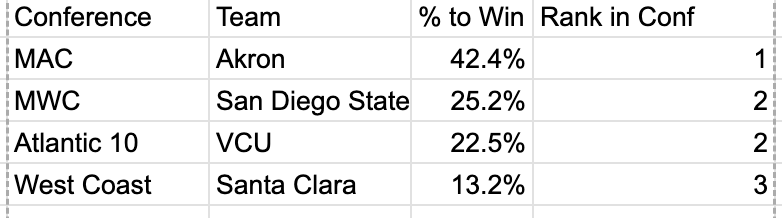
Compared to the major conferences, teams likely needing an automatic berth have a very small chance of securing it.
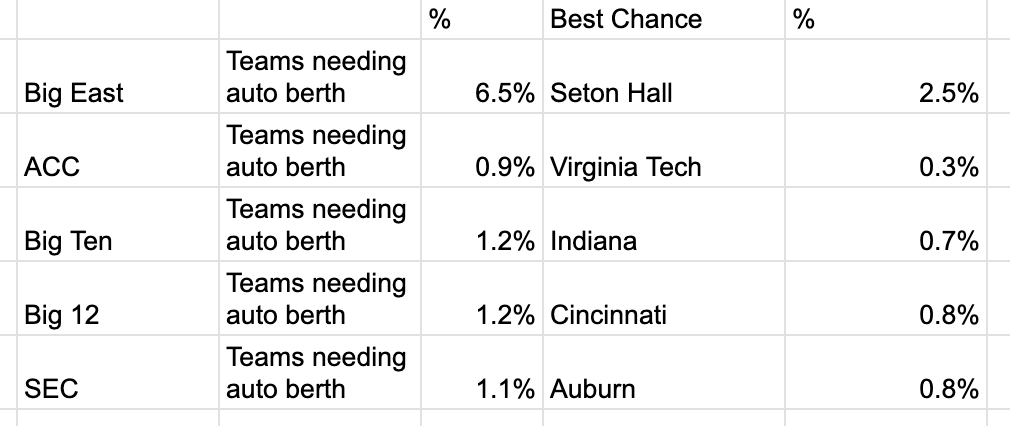
What does all this mean for the Bubble in early March?
The biggest debate could be if Miami (Ohio) loses and does not get the MAC automatic bid, are they more deserving of a bid than a 15-loss Auburn team, or a 13-loss Indiana team? Bruce Pearl said on Saturday about undefeated Miami (Ohio): “If we’re selecting the 68 best teams, then Miami (Ohio) is going to have to win their tournament to qualify as a champion. Because as an at-large, they are not one of the best teams in the country.”
Most college basketball fans believe in the inclusivity of the sport, in which 365 teams, the largest Division I team sport, all have the same chance to compete in a 68-team single-elimination tournament to crown the national champion so Pearl’s comments naturally spread on social media.
The NCAA published March Madness Selection 101, which goes in-depth on how the NCAA Selection Committee votes in the 37 best at-large teams into the Field of 68.
Note: They usually finish voting by Saturday and will put in a contingency bracket if Saint Louis does not win the Atlantic 10 automatic berth on Sunday or even if Miami (Ohio) doesn’t win the MAC automatic berth on Saturday night.
Because of this process, Miami (Ohio) and teams from the Atlantic 10 and Mountain West Conference will likely need to be voted in for an automatic berth, regardless of the tournament's outcome, making these conference tournaments one of the most intriguing questions of this year’s bracket.
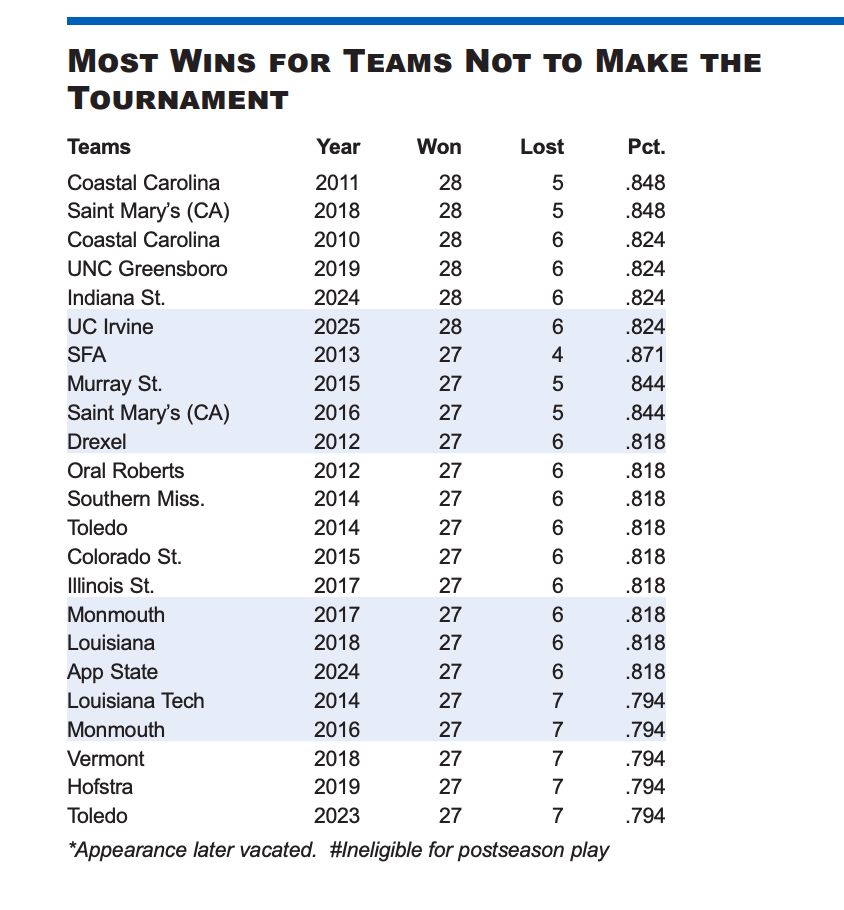
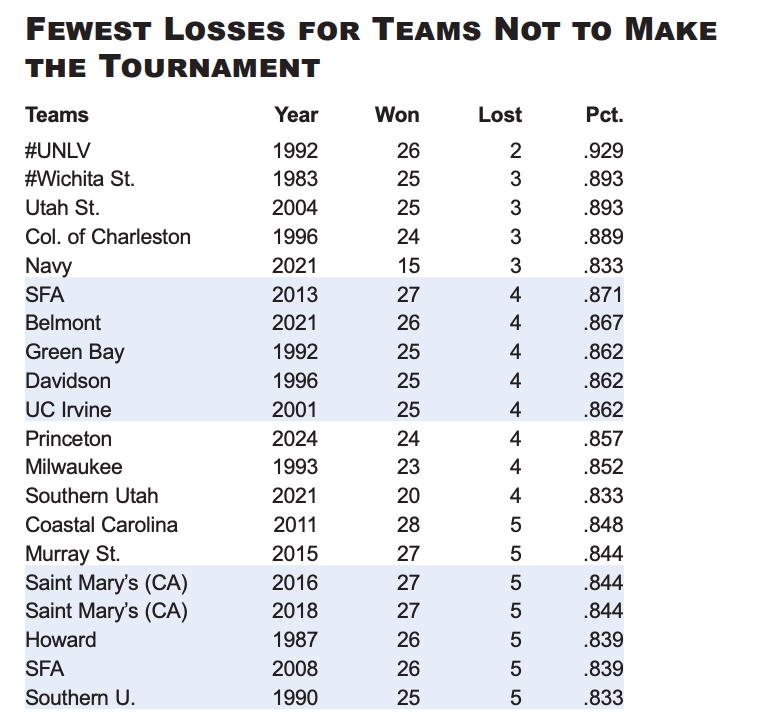
For Miami (Ohio), if the Redhawks were left out of the NCAA Tournament…They would set the record for the most wins and fewest losses1 for a team to not make the NCAA Tournament.
Not in their favor - 2 of the 6 teams with 28+ wins have been mid-major teams left out of the last two NCAA tournament cycles (Indiana State 2024, UC Irvine 2025)
Another 2 of the 6 teams were Coastal Carolina teams in 2010 and 2011, whose records included 3 non-D1 wins2 like the Redhawks have this season.
Does the selection committee have too many metrics at its disposal?
7 different ranked metrics plus Q1+Q2 wins and SOS, etc to consider for each team
First, with all these metrics, selection committee members can use a data point to make an argument against a team that could, in theory, benefit a team in their conference…
Second, with all these data points, they can find warts in many of the resumes of the bubble teams
In the case of Miami (Ohio), the committee's predictive metrics (KenPom, BPI, and Torvik) place them outside the Top 75.
In fact, Miami (Ohio) is lower in all three predictive metrics than Minnesota (AD Mark Coyle is in his final year on the committee) and Syracuse (Outgoing AD John Wildhack is on the committee for the first time), and certain predictive metrics are behind Oklahoma State and Georgetown, who both have representatives on the selection committee.
In all likelihood these four teams (Minnesota, Syracuse, Oklahoma State, Georgetown) will not be considered by the NCAA Men’s Basketball Committee but the argument that could be made in the room by any committee member is that Miami (Ohio) would have been 15-14 if they played in a major conference can be backed up by multiple metrics used by the committee.
Obviously, if this argument takes traction, selection committee members could make the case for Auburn, which, despite only being 15-14 with two more regular season games, could be deserving of an at-large tournament berth based on a win at Florida and a neutral-court win over St. John’s….Despite being on track, unless they win at Auburn on Saturday, for a 16-loss season and set the record for the most losses for an at-large team and possibly the lowest winning percentage for an at-large team since the expansion in 1985.
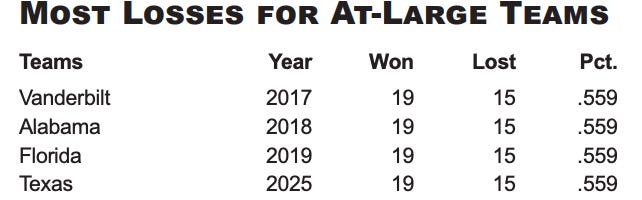
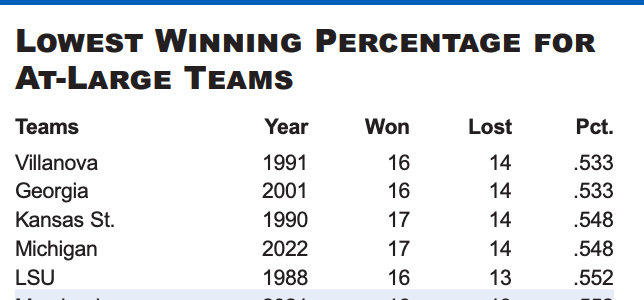
2025 Ohio State (17-15), 2023 Oklahoma State (18-15) and 2022 Oklahoma (18-15) were all First Four Out teams, and looking at similar resumes with a heavy focus on resume (Auburn’s likely best argument for inclusion), these teams match up with the 2026 Auburn team.
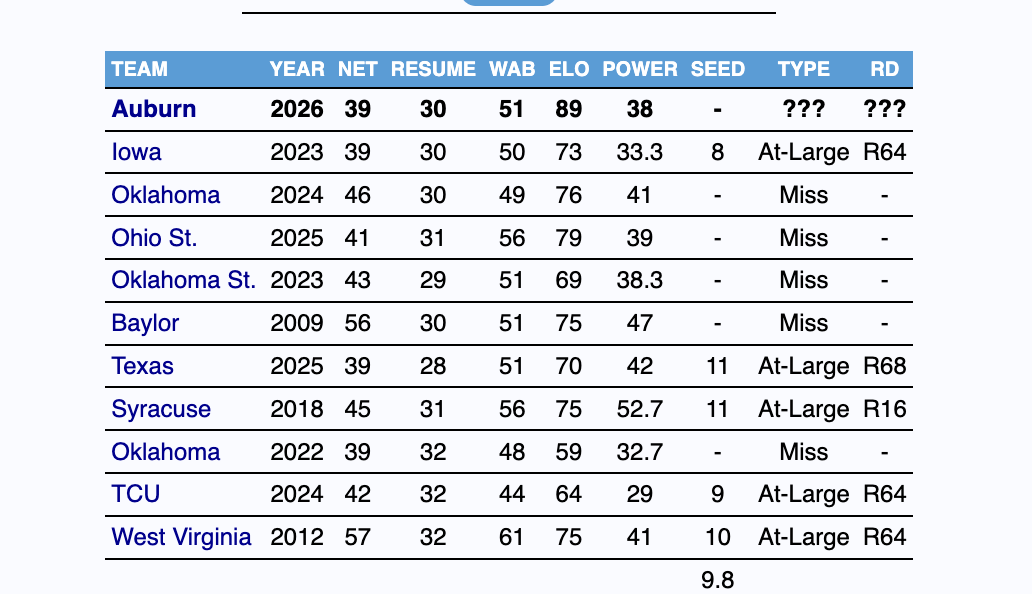
Dan Gavitt told CBS Sports and other media outlets about last year’s selection process: "I think fans would be probably pretty surprised that the selection of the at-large teams was probably more highly correlated to a team's WAB ranking than it was their NET ranking."
If that is the case again this year, the committee would use the Wins Above Bubble resume-based metric as a tiebreaker for selection, which could benefit mid-major teams like Miami (Ohio), Saint Louis, and Santa Clara because it shows they have performed better on their schedules than an average bubble team.
But the thing about WAB, especially in the case of Miami (Ohio), is that a loss or two in their remaining games to any MAC team besides Akron will likely push their WAB into bubble territory.3 Therefore, it is possible if Auburn won at Alabama on Sunday and had a strong Quad 1 win in the SEC Tournament while Miami (Ohio) suffered two Quad 3 or Quad 4 losses - Auburn might have a higher WAB by Selection Sunday.
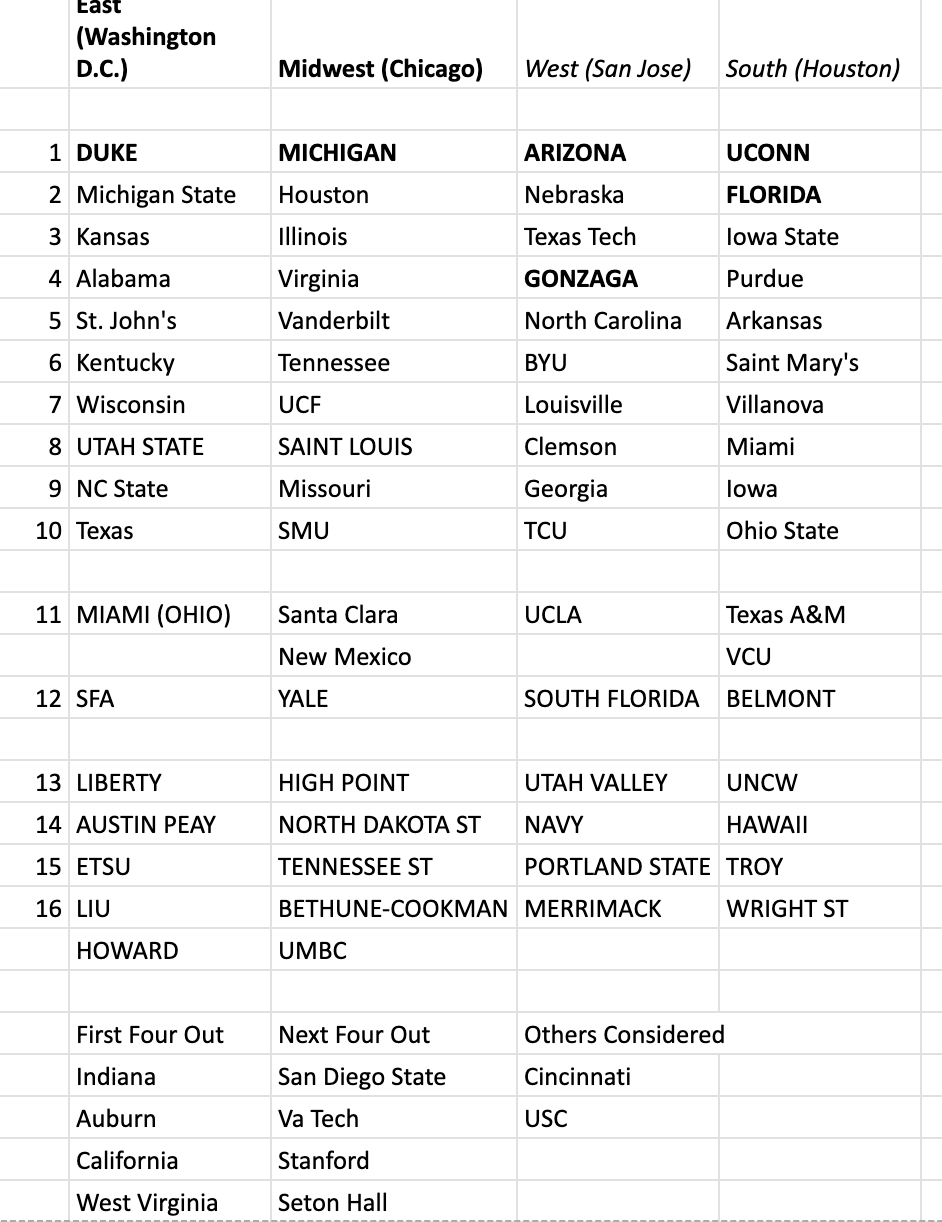
Here is my current bracket as of Tuesday, March 3
Three of the last four teams in my bracket ended up being mid-majors (Santa Clara, VCU, New Mexico)
With bid stealers likely to come from mid-majors, there is a high likelihood that UCLA, Ohio State, TCU and SMU could end up in Dayton
If WAB trumps Quad 1 wins it should favor mid-major teams like Santa Clara and VCU right now….However, if the committee decides in a bubble discussion that Quad 1 wins trump WAB - ACC teams like California, Stanford and Virginia Tech are intriguing teams with some good wins on the wrong side of the bubble right now
Torvik, added last season, is the best evaluation tool the Men’s Selection Committee has to look at current performance and there you can see a team rising like Cincinnati (#32 in Torvik) vs WAB where Cincinnati is #66
If the Bearcats win their next three games vs BYU and at TCU and the subsequent first game in the Big 12 tournament- Cincy could make the case that they have a Top 40 WAB and were only being punished for some of their losses vs Eastern Michigan, at Xavier, vs Georgia4 they played out without G Jizzle James
Since the bracket reveal on Saturday, Feb. 21: then-No. 1 seed Iowa State, then-No. 2 seeds Illinois, and Purdue have gone a combined 1-7.
Duke, Michigan, Arizona, and UConn are now the clear No. 1 seeds even if they don’t win their conference tournament
Theses losses has created a logjam between No. 2 seed lines and No. 4 seed lines, so it will be interesting how the committee breaks the tie between these teams
For scheduling, BYU can only play in the South or West Regional because of religious reasons (will not play on Sunday in the Sweet 16 round)…The Cougars likely will drop a seed line or two because of needing to play Thursday-Saturday during the first weekend and avoiding conference rematches for the third time
To achieve the fewest losses (2) Miami (Ohio) needs to win one of their last two regular-season games before the MAC Tournament.
The NCAA does not include non-D1 wins in a team's selection criteria, but it does include the wins in the official NCAA record book, so, for example, Coastal Carolina (2010, 2011) had only 25 D1 wins and 3 non-D1 wins each season, as Miami (Ohio) does this season.
WAB considers the average bubble team to be #45 in the NET…Usually, around this ranking in the WAB, you will see the Wins Above Bubble number go from positive to negative…Every game has a value between 0-1 n the WAB based on the opponent’s net ranking, so a Q3 or Q4 loss or vice-versa Q1 win, especially on the road, could substantially move your WAB ranking by 7 to 10 spots….
https://www.cbssports.com/college-basketball/news/wins-above-bubble-ncaa-tournament-selection-committee-seeding/
These three losses currently costs Cincinnati -1.97 in the WAB ranking so Torvik and NET are metrics better accounting for their improved play in the last couple of months.
Comments
Nothing yet. Say the first thing.
Sign in to join the conversation.