
Four years ago, in the summer of 2022 during a sweltering London heat wave, a new fandom friend handed me a clear 3x4 inch plastic card sleeve, decorated with shiny little stickers. Inside, framed by the stickers, was a picture of a polar explorer.
This charmed me immensely. I kept him in my bag, and then went home and ordered supplies to make more, to keep one in each purse. Other people in the fandom began doing it too, although they weren’t clear on where or how the tradition had originated—by this point it was coming to them secondhand.
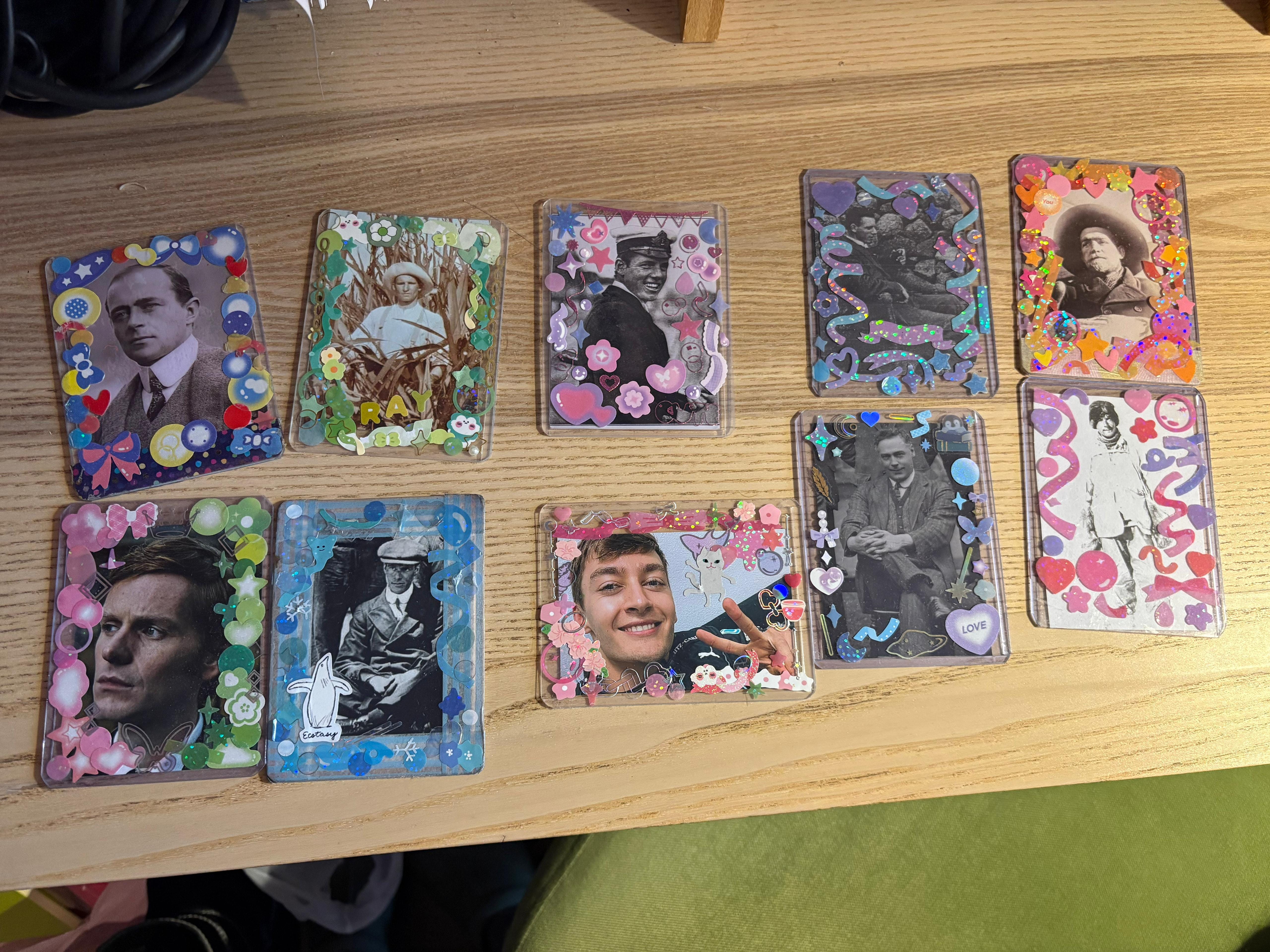
The person who’d given me the card had been inspired by their time as a Kpop fan. Small images of idols called photocards have long been a collectible item in Kpop fandoms—being offered randomly with CDs, DVDs, or other merchandise items, fans will buy more items in order to receive the photocard they want—and fans are super creative about storing and decorating them.
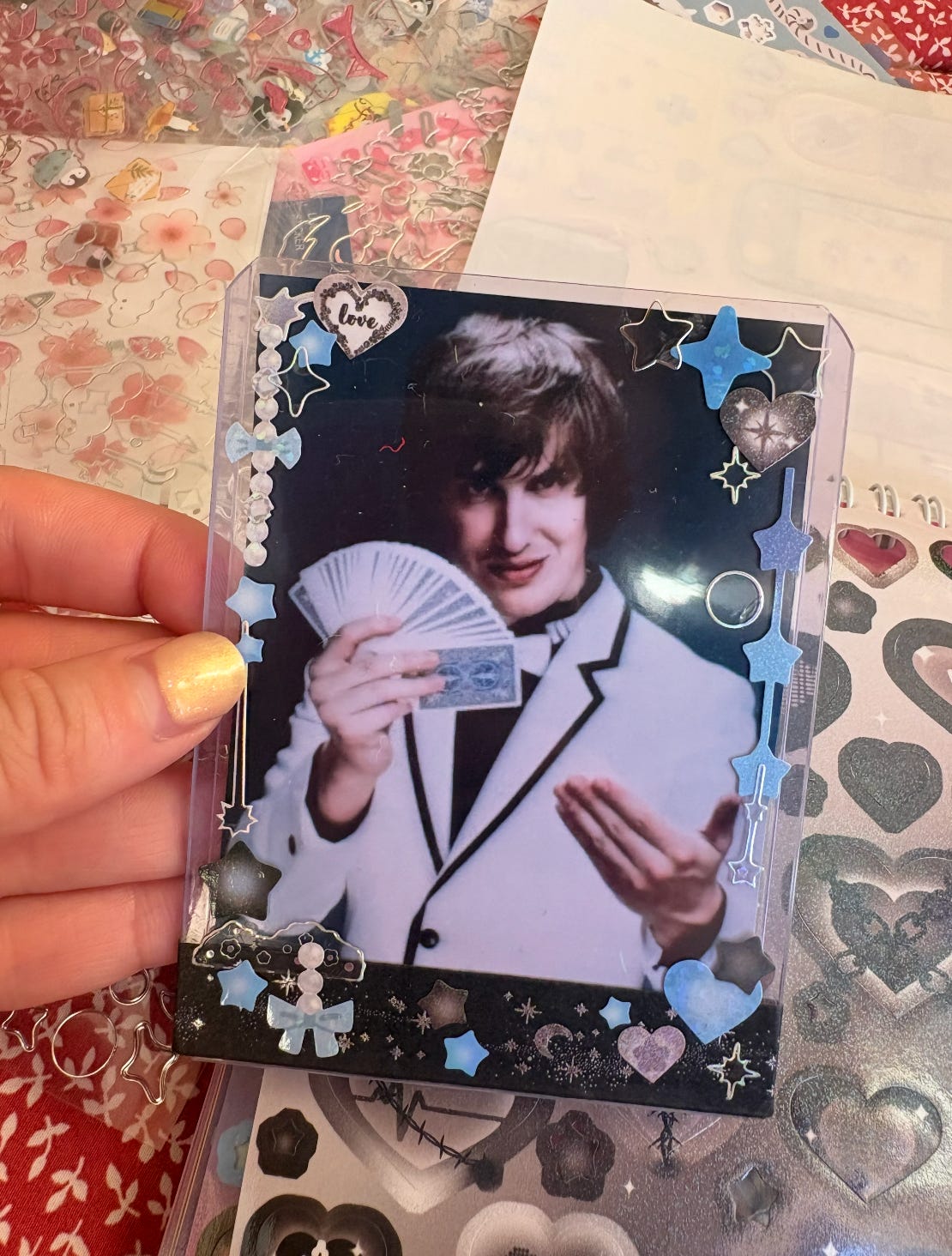
Toploaders are the basic unit of photocard storage, and as inspired by kawaii Japanese decoden trends, fans began to customize the shiny sleeves with stickers and themed designs.
Watching my history-obsessed friends adopt this fun activity for guys who are definitely not in Kpop bands is what inspired me to develop my theory of movable practices in fandom.
Essentially: fan practices that are invented and pioneered in one fandom can be, and frequently are, ported over to other fandoms, brought there by fans who move from one context of enthusiasm to another.
Seems obvious, right? But sometimes we miss the forest for the trees. Fanfiction is a huge genre now, but once upon a time it was a practice pioneered in one fandom (Star Trek) before some of those fans picked it up and took it elsewhere (Star Wars, Starsky & Hutch).
Yes, people wrote Sherlock Holmes pastiches and plenty of other kinds of transformative literary works before then, and after, but fanfiction as we know it today—its tropes, its distribution process, its specific DNA makeup of narrative, emotional, and erotic content—had a very specific origin. After it was invented, whenever it sprang up independently again—such as in the Xena fandom of the 90s, known as a “feral fandom”—it was soon reincorporated into the main, dominant branch, which slowly grew to encompass more areas of pop culture.
I digress—anyway, over the past year or two, I’ve seen people on X.com, aka Context Collapse Central, refer derogatorily to fans who are “kpopifying” a fandom. Or asking stuff like “When did all these toploader fans begin liking [SPORT]/[PRESTIGE DRAMA]?”
This is a new way of calling fans “immature and girly” — but with a different connotation, I think, than the taxonomic identification “Tumblresque fandom,” as used in this tweet I saw discussing my current fandom:
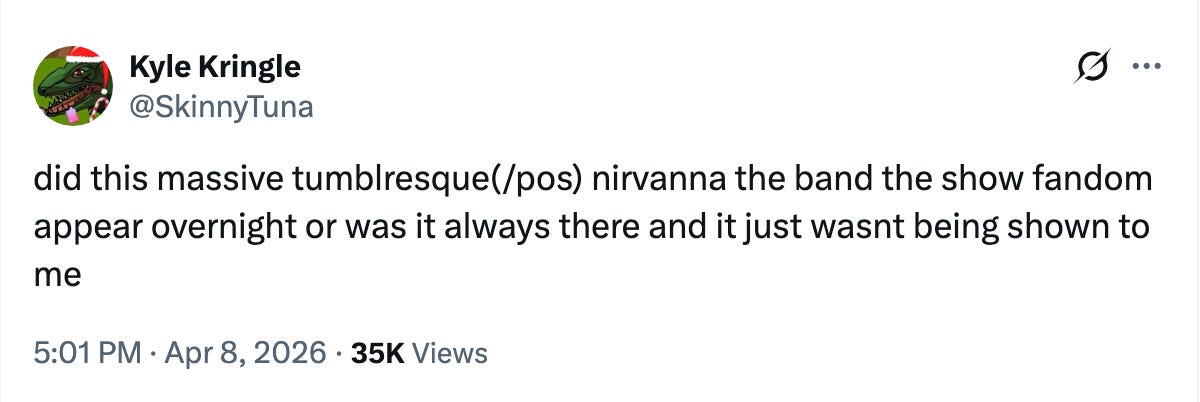
Tumblresque refers to: gay shipping, cartoony fanart, queer representation discourse, fan video edits to pop songs.
“Kpopifying” certainly has some overlap, especially as it pertains to comprising a set of young and female fans, but I think the main difference is that the paradigmatic Kpop fandom is a celebrity-focused commercially consumptive fandom, while the paradigmatic Tumblr fandom is a story-focused transformative fandom.
Kpop, for the last ten years or so since the demise of the Western boyband when One Direction fell, has been a very common “baby’s first fandom.” It’s big, it’s popular, it’s easy to get into and join online communities for, teen girls like it. Naturally when those girls grow up they take the things they learned, and the things they liked to do, into whatever new fandoms they join.
This ties into how previously separate domains of fandom have been brought together by social media platforms. A Kpop fan, past or present, is probably also a fan of TV shows, books, films, actors, and/or sports, utilizing practices from all of those arenas indiscriminately on whatever it is they’re obsessed with.
Fanfiction as a practice may have originated in media fandom,1 but today Kpop RPF (Real Person Fanfiction) is a hugely popular genre; and conversely the newer practice of toploader deco, originating in East Asian pop music fandoms, has been carried out and moved to other spheres of fandom including TV and film.
Devotional, idol-focused practices like toploaders have a lowly place in the hierarchy of fandom, connected as they are to youth, femininity, and untrammeled eroticism. Even when fans are making toploaders of Matt Johnson or Paul McCartney or Christopher from the Sopranos, the practice still carries with it the larger, perilous connotation of the mindless, undiscerning commercial worship closely associated with Kpop in the eyes of the public.
Importantly, not all movable practices are wholly positive: many observers of Heated Rivalry’s rapid growth and various boundary-crossing dramas noted that some of the more intense parasocial behavior and acts of fan-on-fan aggression seemed modeled after the kinds of discord often sown within large, young pop music fandoms, where that kind of thing is more commonplace and even encouraged as a marketing tactic.
So “toploader fan” as descriptor can also imply a level of 2020s digital delusion, untoward parasocial behavior, and unrestrained fannish id, the same way “Tumblr fan” can evoke the figure of the 2010s SJW bogeyman.
Which is unfortunate, because I love toploaders, and I think they are a tremendously delightful fan practice. It’s really fun to decorate a little guy and carry him around. It’s a particularly great thing to do in a group, at a meetup or party, as a kind of communal fannish arts-and-crafts session. You should try it!
“Media fandom” is an archaic, vague, but still useful term to refer to the founding generation of fanfiction-fanart-fanzines-fanvids-conventions fandom that evolved from female-dominated 60s-70s Trek circles. AO3 is a product of media fandom, as is the related current explosion of M/M romance.
No posts
Comments
Nothing yet. Say the first thing.
Sign in to join the conversation.