
If you’ve ever tried to look up a union scale number by browsing through one of the “wage tables” or “schedules of minimums” that are published by the WGA, DGA, and SAG-AFTRA, then you know that they are…less than user-friendly.
It’s not that there isn’t any logic to how these “official” guild-published tables and summaries are organized; it’s that the logic is absolutely useless to at least 99.99% of the people who use these documents. That’s why many larger companies require some junior member of the business affairs, production, or finance team to create and/or maintain a one-to-two-page “cheat sheet” summarizing that company’s executives’ most frequently referenced minimums, and why many more companies employ at least one executive who is able to obtain copies of such cheat sheets from friends at larger companies.
I first attempted to create my own tables of key union minimums while working on the first edition of my book, published in 2018. For the second edition, published in 2024, the WGA and SAG-AFTRA tables were well-organized, but slightly off due to a combination of author errors, rounding errors, and the WGA electing to divert 0.5% from its wage increase to PH&W.1 The DGA tables were…a noble effort. I tried very hard and spent many, many hours trying to crack them. I made real progress! I didn’t quite get there.
When I decided to launch this Substack, I figured it was time to conquer these damn things once and for all — if not for the benefit of the readers who had already seen me go through two close-but-no-cigar efforts in my books,2 then for the satisfaction and utility of creating for myself a reference tool that organized all of this information exactly as my own brain preferred.
This is that reference tool. The full set of tables is available only to subscribers, but you can check out a few samples below.
Spend enough time staring at tables of WGA minimums and you’ll realize that, although they are individually defined for each pairing of platform type and budget range, the whole system pretty much comes down to a “broadcast/A-level streaming” tier and a “cable/B-level streaming” tier. I experimented with two different ways of organizing this information, unsure of which I should use, until I realized that any given person might prefer one format or the other depending on how their brain worked, which meant I should just publish both:
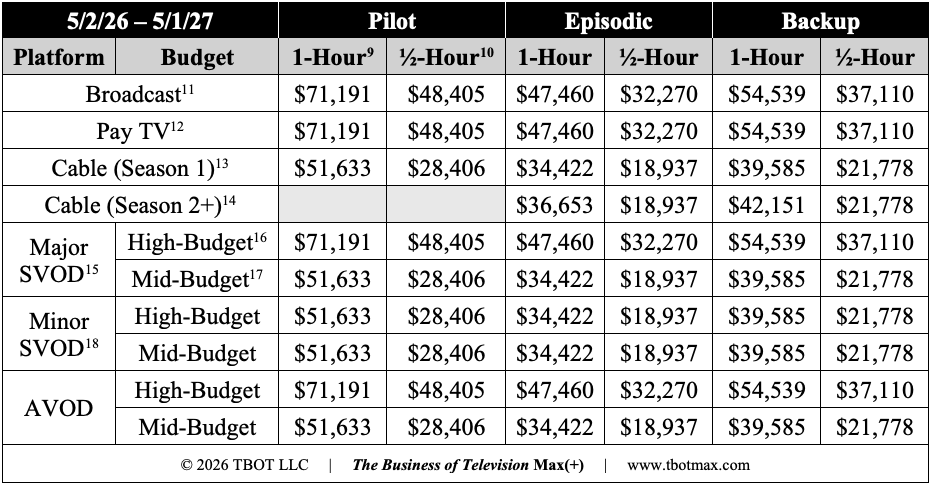
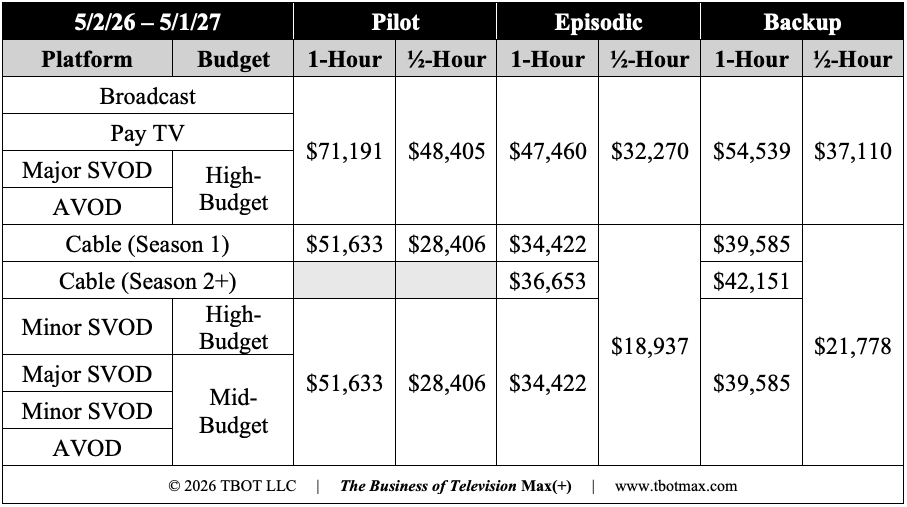
Here’s the full list of WGA rate tables:3
Minimum Scale Weekly Compensation
Major WGA Money Breaks
Pilot and Episodic Script Minimums by Platform
Pilot and Episodic Script Minimums by Fee Grouping
Upset Prices and Minimums for Rewrites, Polishes, Stories Only, Teleplays Only, Formats, and Bibles
One of the things that makes the DGA’s wage tables so difficult to read is the density of numbers on every page, which is a function of the DGA’s uniquely complex, budget-sensitive, and platform-specific approach to minimums. That’s why I start by defining specific “High Budget,” “Mid-Budget,” and “Low-Budget” tiers, broken out by program length and platform type:
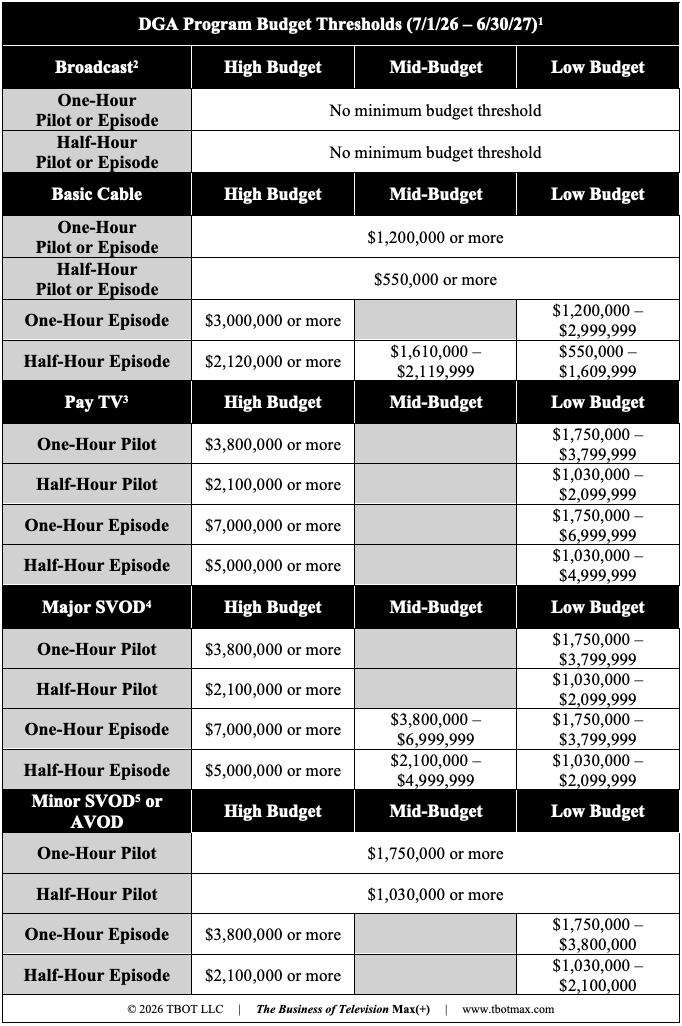
That makes life much easier for the other seven DGA rate tables on the list:4
DGA Program Budget Thresholds by Program Length and Platform Type
Standalone Pilot Directing Minimums
Episodic Directing Minimums for One-Hour Programs in Broadcast and Basic Cable
Episodic Directing Minimums for One-Hour Programs in Streaming and Pay TV
Episodic Directing Minimums for Half-Hour Programs in Broadcast and Basic Cable
Episodic Directing Minimums for Half-Hour Programs in Streaming and Pay TV
Straight-to-Series First Episode Directing Minimums for One-Hour Programs
Straight-to-Series First Episode Directing Minimums for Half-Hour Programs
There’s one table. It’s actually quite helpful, given how many different SAG-AFTRA minimums there are (and how few of them actually matter for most working executives). So I’m going to save it for subscribers.
But if you’ve been on the fence about subscribing, would 40% off the first year of your monthly or annual subscription help you with your decision? Because if so:
Pension Health & Welfare (i.e., union-negotiated benefit plans). In this case, specifically to the WGA Health Fund.
At least 99.99% of whom did not notice it.
With just 6 footnotes, thanks to that first table.
Comments
Nothing yet. Say the first thing.
Sign in to join the conversation.