
I spend an ungodly amount of time using AI. 38 hours per week as an AI systems coach. 16 hours a week on my personal brand. A good portion of both of those building with Claude, image generating with Higgsfield, testing out ChatGPT and researching how others are using all the new features out there. I’ve tried and tested almost every use case there is, and dozens of them have me wondering how I lived without them.
But after 400+ hours (primarily in Claude and ChatGPT), there are 5 things I would never use AI for, no matter how much time it would save or money it would make.
5 refusals I think have heavily contributed to my success in life so far. 24, $100,000 invested, an income stream from my personal brand built on the side of a full-time job I love, a social life that’s gone from severely neglected to genuinely fulfilling, and a brain that actually thinks for itself. I haven’t ’made it’ by any means, and my life is far from perfect, but I’m miles ahead of where I was 3 years ago.
If you’re on a similar path to me, using AI to open up better career opportunities, become a more intelligent and well-rounded person, and build toward long-term time freedom, financial freedom, purpose and impact rather than quick money, here’s the advice I would give you.
Every time I sit down the write these newsletters, I want to use AI. Every single time.
I hate the first 10 minutes staring at the page wondering how to start a new section. I hate the pressure that pounds into my mind when I see just how much better others are doing at this whole ‘creator-educator’ thing than me. I hate the constant pull to do anything else on a Sunday morning than force myself into a flow state.
But I also love it.
Maybe that makes me insane. But here’s how I see it.
We’re living through an era of obsession. Obsession with efficiency. Obsession with productivity. Obsession with dopamine and convenience and short-term gratification. And we’re seeing the effects.
Social media addiction is the obvious one. But look a bit closer and you’ll see that cars are all sporting that same sleek look, and buildings are turning from patterned cathedrals with detailed door handles into sleek grey boxes made of the same materials.
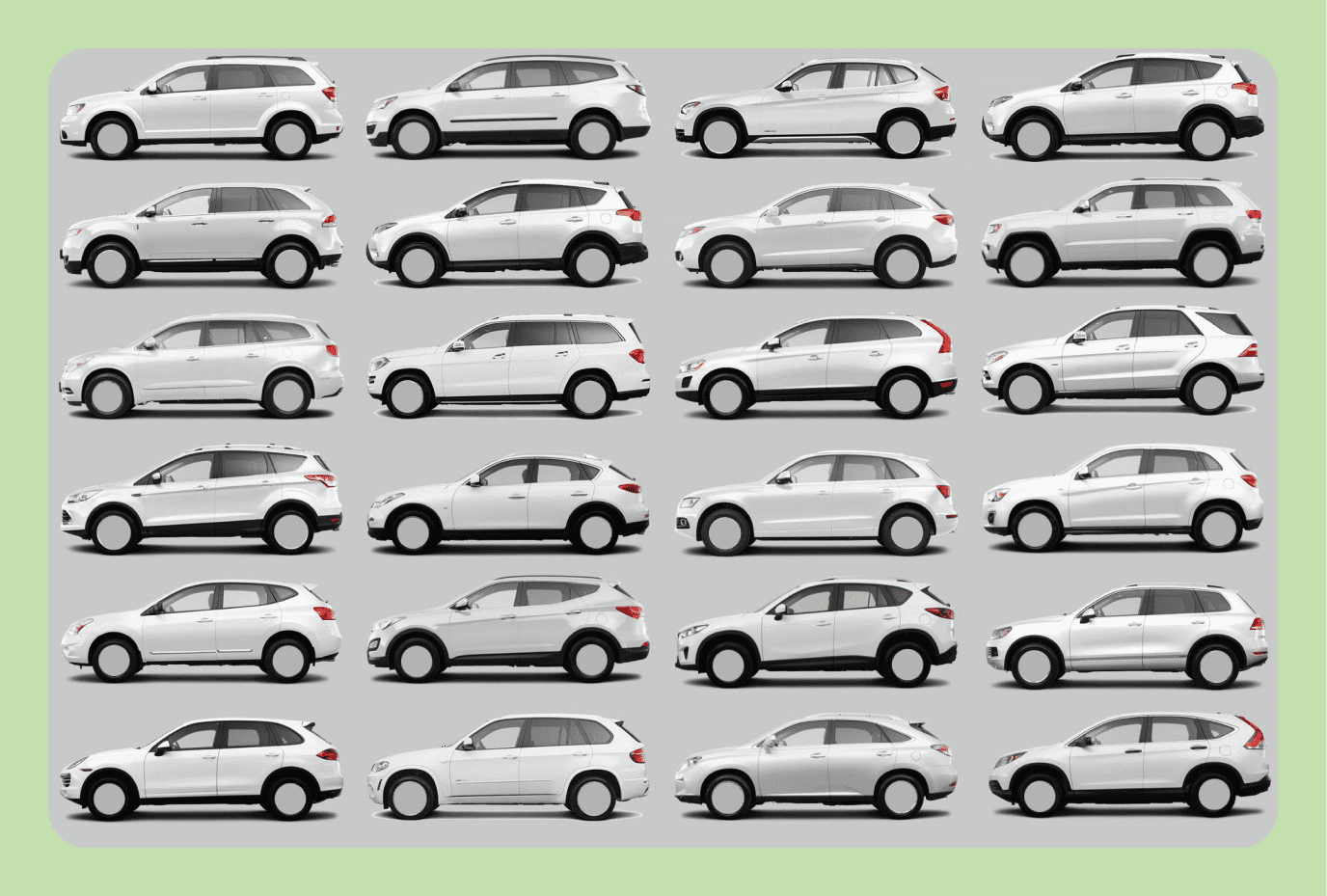

This isn’t a bad thing. It’s efficient in terms of time, money, and emissions. But like society, I think a lot of us as individuals are losing the incentive, and even the ability to intentionally invest time and energy to create something truly worthwhile.
Because you can skip the climb and get a helicopter to the top of a mountain. But that doesn’t mean you should.
You can spare the cooking and get UberEats delivered to your door in the next 10 minutes. But that doesn’t mean you should.
You can get Claude to write the very next post you put on Substack or Instagram.
You can ask NotebookLM to teach you about the history of fashion and why skinny jeans keep trying to make a comeback despite being a human abomination.
You can use ChatGPT to make that decision instead of pondering over it for two months. Move or stay. Break up with them or push through. Start the business, find a new job or stay in the cushy one.
But it doesn’t mean you should.
In many areas, we need to first struggle in order to succeed.
You cannot share your perspective with conviction until you write and rewrite a paragraph enough times to gain clarity on your own thoughts, learnings or perspectives. AI can’t do that for you.
You cannot understand a concept or retain information until you go beyond just reading a summary and actually internalise it and connect it to your own mental models. I don’t need to remind you of the hours you spent reading high school textbooks just to get to the exam and realise you should’ve put down the highlighter and done those practice exercises instead.
You cannot make a decision with no regrets unless you come to that decision in your own time, after picking it apart from every angle and realising you already knew what you wanted to do the whole time. AI can’t create that confidence for you.
So yes, you can use AI to do almost everything faster, cheaper and better now. But it doesn’t mean you should.
You can’t use AI to build discipline. You can’t use it to create the identity shift that comes from sitting down for two hours and putting in the work. And you can’t use it without giving up the climb up the mountain, where is where the learnings and conversations and the rolled ankles that actually makes the view at the top worth it happen.
Differentiate between the two.
If your goal is purely to reach an outcome, use AI.
But if your goal is to learn, grow, experience and practise discipline, maybe reconsider.
Why do you read my work on here? Honestly, stop and ask yourself why you do it. Why don’t you just get AI to write you a weekly AI update? Why don’t you spend your precious time reading a different AI newsletter? Why do you actually care what I have to say?
When I look at the creators I admire most and really think about these questions, there’s three answers I land on.
I like them. I like their personality, or their writing style, or the analogies they use to explain things. They seem like a good person, I can feel their authenticity and I want to support them. And while I could find this information anywhere else, their passion and the way they explain things makes what they share just click in my brain in way passively reading never could.
Consuming their content feels like a valuable use of my time and energy, because I know they invested their own time and energy into it. Whether that’s time spent learning every aspect of the topic themselves, having actual experience in the field or curating information with a type of taste that AI could never replicate, I now get the benefits without having to do any of that myself.
They have a point of view. They don’t just go with the crowd or hand over tips and tricks. They actually stand for something. Most of the time, it feels like we see the world in the same way and because of that I trust and value their opinion. But even when I disagree with them, I respect them, because their opinion is backed by real thought and justification and I get to question my own beliefs.
It’s 2026. Anyone can build a product (physically or digitally) and deliver it anywhere in the world, which is why personal branding is the biggest moat that exists right now. And for me, these three things is what turns someone from a ‘content creator’ I forget about into a ‘personal brand’ I take inspiration from, actively look to for advice, and would happily invest my money into.
But imagine you automate your entire content creation process with AI. AI scans for trends, looks for viral posts and plans your content for the week. It writes your 3 reel scripts, ready for you to read from your teleprompter, then hand back to Claude to edit. It creates your 4 carousels, generating upload-ready files without you touching a thing. And finally, it hands you the captions, schedules all of them, then delivers a performance report 7 days later before repeating the entire process again.
You can do this right now. It’s 100% possible.
But I don’t think I’d like you, because I wouldn’t even know you. I don’t think consuming your content would feel like a good use of my time, because my bullshit detector could sense that it wasn’t actually coming from you. And I don’t think I’d buy from you, because I have no idea what you actually believe or whether I can even trust you.
Right now, it’s you vs the AI influencers. I don’t care about AI influencers. But I do care about you.
So use AI to build your personal brand. But don’t use AI to just create content.
This is probably a very unpopular one, but I will not track and categorise my income and expenses by doing anything other than manually writing them into my Excel spreadsheet. Yes, I’m aware I’m basically a boomer.
But the reason is pretty simple, and it applies to way more than just finances.
Manually completing my finance tracking sheet keeps me aware and emotionally invested in exactly what I’m spending and receiving in a way that AI never could. It’s very different seeing that you’ve made $6k and spent $4k in a month, than it is to force yourself to write that you spent $300 on your morning matcha with cold foam.
And this isn’t hard. I’ve been using this template from Coplenty for the past 3 years. I spend about 15 minutes each Sunday inputting my numbers, and I review it fully during my monthly decision days, where I look at trends, compare my income, spending and saving, review my previous months, and decide if I need to adjust anything.
Tracking for me isn’t about restriction. After having a very complicated relationship with money growing up, I’ve actively worked on never making myself feel bad for the decisions I made in a month. Instead, it’s simply a form of data collection. Financial anxiety is cognitive overhead. It’s headspace you could be using to solve hard problems. And for me, financial anxiety comes from not knowing where my money is coming from or going to.
Having full visibility over my income and expenses makes me feel empowered and confident in my decisions on when to save, when to spend and how to cut down without feeling deprived. And when I make ‘bad’ decisions, I can pick up on them instead of letting them slide unnoticed for months.
Where I do think AI is helpful is with financial strategy and research. Just 3 weeks ago, I used Claude Fable 5 to review my financial situation, including my investment strategy, Superfund (the Australian version of a 401k), and patterns from my budgeting spreadsheet. I added a new ETF to my portfolio, realised I should definitely change my super, and saw a few opportunities to redirect funds to improve my long-term financial position. Now that I’m on track, I’ll keep using my manual spreadsheet to execute.
There’s no one right way to do this, but if becoming financially responsible is a goal for you, and real behaviour change is something you’ll need in order to achieve that, I think manual tracking is worth considering.
Do you remember the early days of ChatGPT? Asking it to brainstorm a good pickup line. What to make with the ingredients in your fridge. What the meaning of life is. It was a glorified search engine.
I hope we never, ever return to that. For reasons much more significant than just not using it to its full potential or even the critical thinking crisis.
I think we often forget that using AI has a real environmental impact. And I need to give a shoutout to my friend Bree here, because she reminded me of this fact as we drove to watch the sunset at Mt Tamborine last week.

Every time we use AI, we’re adding demand to the computing resources of Anthropic, OpenAI, Google, the owner of whatever platform you’re using. That compute generates enormous heat, which needs water to cool it. Researchers at UC Riverside estimate a single 100-word AI response can consume around 500ml of water, roughly a small bottle. It also drives demand for more data centres, which puts pressure on local power grids and pushes electricity prices up for the people living around them.
Is this a reason to stop using AI alltogether? When we look at the potential upside for innovation and humanity and environmental solutions in the long term, I don’t think so.
But it is 100% a reason to stop using it for stupid sh*t. I am not perfect at this by any means (I’m lowkey writing this to myself). You don’t need AI to tell you how to respond to that Hinge message or tell you how to dress for the weather. You don’t need it to create a habit tracker dashboard that could work perfectly fine on Notion or in a $25 product from a local business.
Use it to create value, to save you time, or to make you more money so that you can use the abundance you create for yourself to play your part - donating to charities, buying local goods and organic produce, and using your platform to educate those around you, as I will endeavour to start doing more of myself.
Author’s note: the environmental and societal impacts of AI are something I’m currently looking to educate myself on. If you have any recommendations on credible resources, I’d welcome you to reply to this email or share them in the comments.
I don’t think the biggest limitation of AI is the hallucinations or cost or even creativity. I think it’s that AI has no purpose. Hear me out.
You work to survive. To make money so that you can have shelter and put food on the table. But if you’re fortunate enough to be reading this on an iPhone or laptop, you probably work for so much more than that.
Maslow’s hierarchy of needs tells us that once we have our basic survival needs met, we start seeking higher order needs. Things like respect, achievement, recognition and self-actualisation.
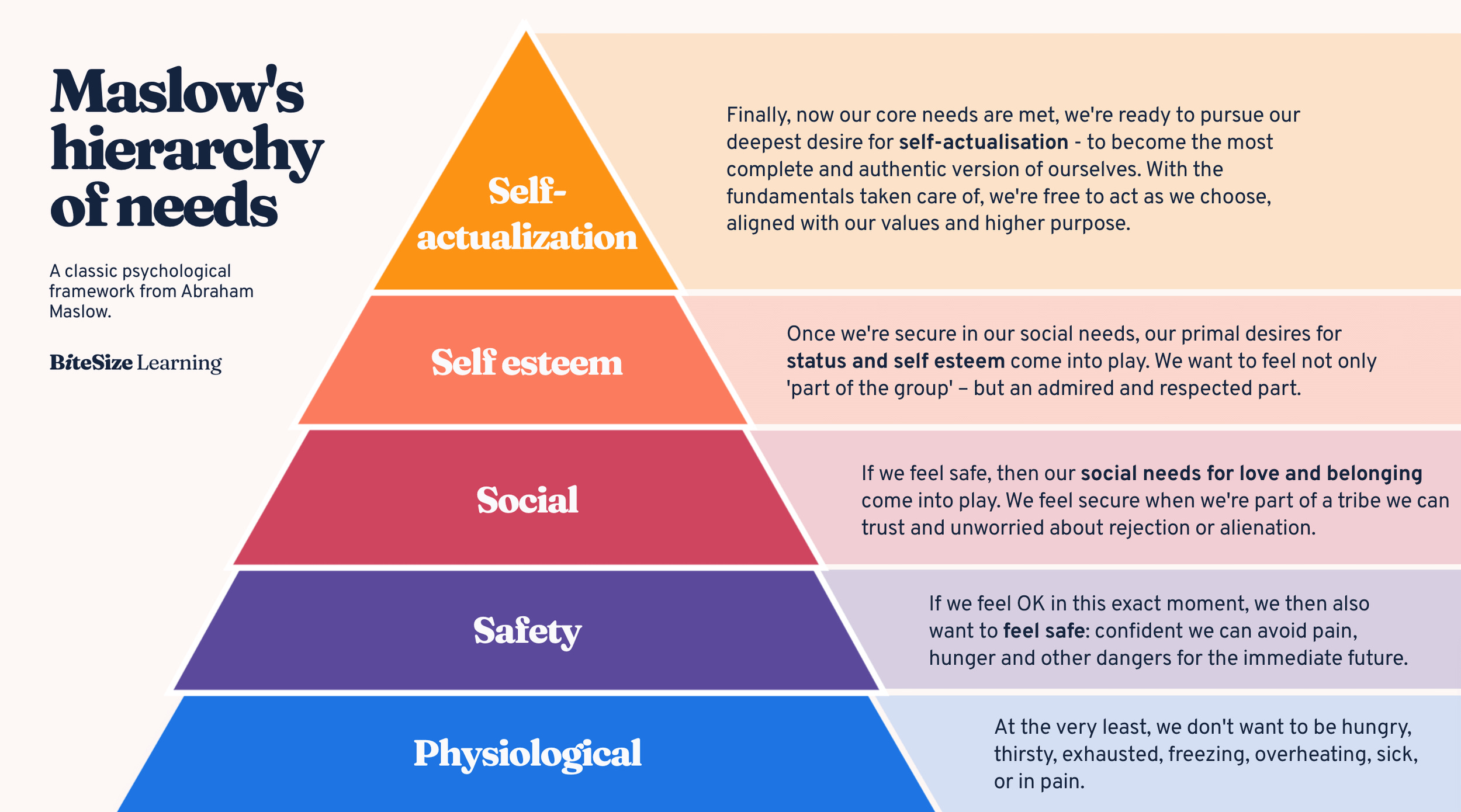
So you work because you want to survive. But you put effort into your work because you are driven by specific goals. And through that effort, the time and thought and emotional investment, you innovate. You bring new products or services or ideas or even content into the world.
AI cannot innovate, and that’s the whole problem. Innovation is what has kept us progressing as a human species, improving our quality of life more in the last 200 years than in the 100,000 before it. Matt Ridley’s The Rational Optimist is a brilliant book on this.
Without humans, AI is useless and it always will be. Even when we reach AGI, AI does not have goals or visions or desires. It doesn’t have innate creativity or the shower thoughts. It doesn’t go down rabbit holes at 2am when it finds a topic that’s too intriguing to ignore.
And that is why I don’t believe a solo founder with 100 AI employees who never take time off and cost a fraction of human labour will ever beat a team of 10 who yes, waste time talking and eating and feeling unmotivated and running late in traffic, but who actually care about what they are creating.
In a social sense, you’ll get very different results by brainstorming with AI (which naturally is not great at divergent thinking) vs being in a room of others in your industry or your target audience, having conversations, picking up threads organically and returning to your office with your spark renewed. Even if the ideas were the same, the passion you gain from talking about the thing you’re obsessed with with others just as interested cannot be replicated with AI.
There are five points in here, but writing them out I noticed the same theme running under all of them.
AI will make you efficient. It will save you time, and make work easier, and reduce the friction that comes from doing more than just existing in this world. But AI will never be the thing that changes your life. Only you, your brain, your discipline, your authenticity, can do that.
AI is the helicopter to the top of the mountain. Sometimes that’s exactly what you need and you should absolutely take it. Just know what you’re trading when you do, because you don’t get the climb back.
So use AI. Please do, I’ve seen just how much it can do. But consider holding off, or at least using it more consciously, when it comes to the use cases we just explored.
I think we can have some really important conversations about this topic, so if you agree, or disagree with any of these, or would add anything to this list, share them in the comments. And if you’ve been chatting about AI with any colleagues, peers or friends, share this with your group chat so you can see what everyone thinks. (Plus, it helps this newsletter grow so I can keep producing better content for you).
And if this is how you want to use AI, deliberately, with the effort left in, that’s more or less what the paid side of this newsletter is. There are almost 100 of us in there now, actually building the things I write about instead of outsourcing the thinking. It’s $18 a month and the link is below if you’d like to support the newsletter.
No posts
Comments
Nothing yet. Say the first thing.
Sign in to join the conversation.