
Welcome to the 1,097 of you who have joined us since our last newsletter, it’s great to have you. Quick heads up, this edition contains a free skill (probably the best one I’ve shared to date), so make sure to read all the way to the end to grab it. Enjoy!
There are two types of content creators on the internet.
(I use the word “content creator” very loosely, to mean anyone who puts their writing or thinking out into the world as a means to create better opportunities for themselves: more leads, a better job, a new income stream, etc.)
Type 1: The Artist. You’ve been told the secret to growing online is consistency, passion and patience. So you show up and post every day about the things you’re passionate about, giving up the social drinks and Netflix binges to dedicate your evenings to the art. You trust the process. But in the back of your mind, you wonder whether it’ll ever actually pay off, never quite sure why one post takes off but the other 99 just disappear into the void.
Type 2: The Scientist. Here, you treat content as a chemical reaction. You’ve looked past the surface and seen that behind almost every creator who “blew up” is an intricate game plan. You’ve accepted the harsh truth that passion and consistency on their own aren’t enough, and you’ve become obsessed with hunting for the recipe - the patterns and psychology - behind the posts that actually work.
I spent four years as the Artist. And I was a starving one.
I posted every week for four years straight and clawed my way to about 13,000 followers. It was absolutely brutal.
Then this year something changed. In eight days I gained 3,674 new followers on Instagram and got a new job directly off the back of my content. I wrote about the whole experience on Substack and gained 6,483 subscribers that week (if you joined me from that newsletter, you’re the best). I kept showing up on both, and in the last 60 days I’ve grown to 27.5k Instagram followers and over 19,000 of you here on Substack, with more than 10,000 people now working through the free Claude MBA I made.
This experience confirmed the suspicion I’d been circling for a while. Content is simply a game of pattern recognition.
If you can find the patterns in the topics that do well, the formats that engage a cold audience, and the angles people actually stop for, then take those patterns and use them in your own way, you grow. If you can’t, you stay stuck.
For a long time I hated that idea.
I wanted to be appreciated for my own perspectives and passions. I wanted to be unique. For people to care about me and my ideas. Studying what worked and borrowing from it felt like copying, like I was cheating, like I wasn’t a real creator unless I pulled everything out of my own head fully formed.
But two years ago I read Steal Like an Artist by Austin Kleon, and it completely broke that belief apart. Nothing is truly original. Every idea you’ve ever loved is just older ideas recombined into something that feels new, and every innovation is a remix of what came before. And once you see it you can’t un-see it. Steve Jobs, The Beatles, Michael Jordan all just paid close attention to what already worked and ran it through their own filter.
It’s also a far better way to create things than the two alternatives I’d been bouncing between: asking AI to invent content ideas from thin air (which gives you exactly the generic slop you’d expect), or pouring hours into a post that was always going to flop because the topic or format was wrong before I’d written a word.
Today I want to show you what this process of pattern recognition, finding and exploiting high-potential topics and angles, looks like in practice.
Don’t get me wrong, this isn’t perfect. What worked for someone else doesn’t always work for me. But it’s increased my hit rate from about 1 in 10 to closer to 1 in 4. Add that up over a year of posting and it’s no small difference.
You can do this manually. That’s how I started
Scrolling page after page of people in my niche, saving and screenshotting anything that worked. Then digging back through my own old posts to reverse-engineer why the good ones were good. Reviewing my analytics and trying to manually decipher exactly what it meant. And somehow manually combine everything together to figure out my content strategy.
But the better approach I’ve been using the past month is stop trying to be the analyst myself, and create a board of content advisors instead. A group of “people” (in this case, agents) whose sole job is to help me make better decisions.

Mine runs through Metricool, connected to Claude. (I run mine in Cowork, but it works in a normal Claude chat too. More on the setup at the end.)
If you’ve never heard of it, Metricool is an all-in-one social tool, scheduling and analytics in one place, but the best bit of all is that it connects natively to Claude. That’s what lets Claude read your real numbers, and the numbers of your competitors, instead of guessing or doing it manually.

I don’t say yes to many sponsors, but I’m excited to share this one with you because this setup is what’s helped me balance full-time work with growing my personal brand. If you’re trying to do the same, it’ll probably save you from 3 weekends doomscrolling and vibe coding your own analytics dashboards too.
So here are the four advisors I lean on.
Once you’ve met all four advisors, I’ll give you the exact setup I use to run the whole board in one go, ready to paste straight into Claude, plus a free trial so you can use it with your own account this afternoon.
“Bad artists copy, good artists steal.” - Pablo Picasso
There are two problems I run into as someone who does not create content as a full time job.
First, the time problem. I don’t have time to create three pieces of content a day to find out what hits. I need to lean on the creators who are actual experts in this area and make a living figuring out what works.
Second, the doomsrolling problem. Sitting down at 6.30pm with no idea what to even post about, and spending the evening doomscrolling for “inspiration” instead of actually creating.
The scout is the advisor who helps me solve both, by stealing like an artist.
Through Metricool’s connection with Claude, I can point it at the top accounts in my niche and have it pull their best-performing posts from the last few months, then hand me back the patterns underneath: the formats, the hooks, and the topics that perform best. That lets me see what my Instagram is already rewarding and run it through my own filter. The point is never to copy anyone, just spot the patterns, take elements from different creators, and combine them to create your own style.
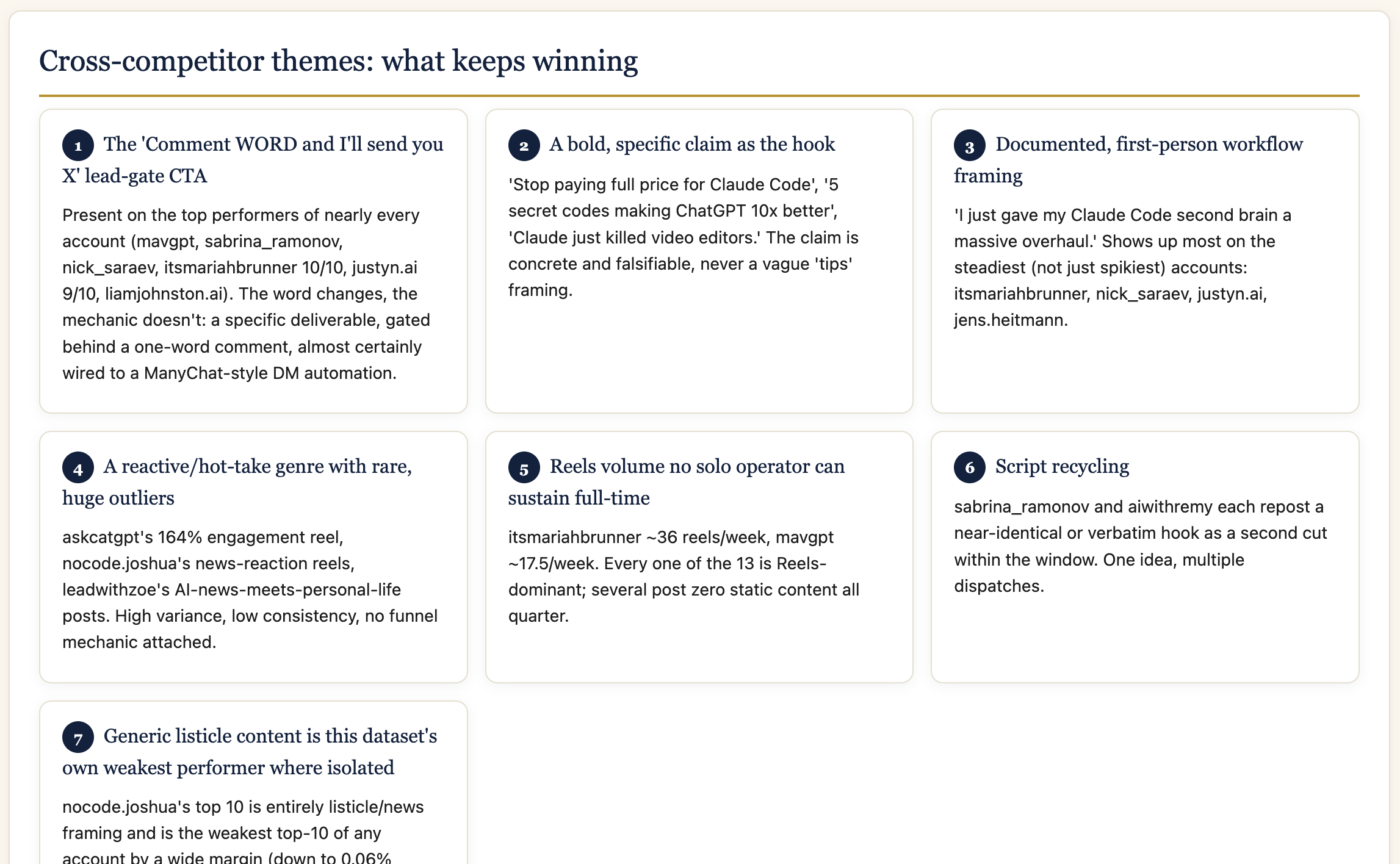
To do this, first add your ‘competitors’ in Metricool. Head to your analytics and add them under the Instagram section.
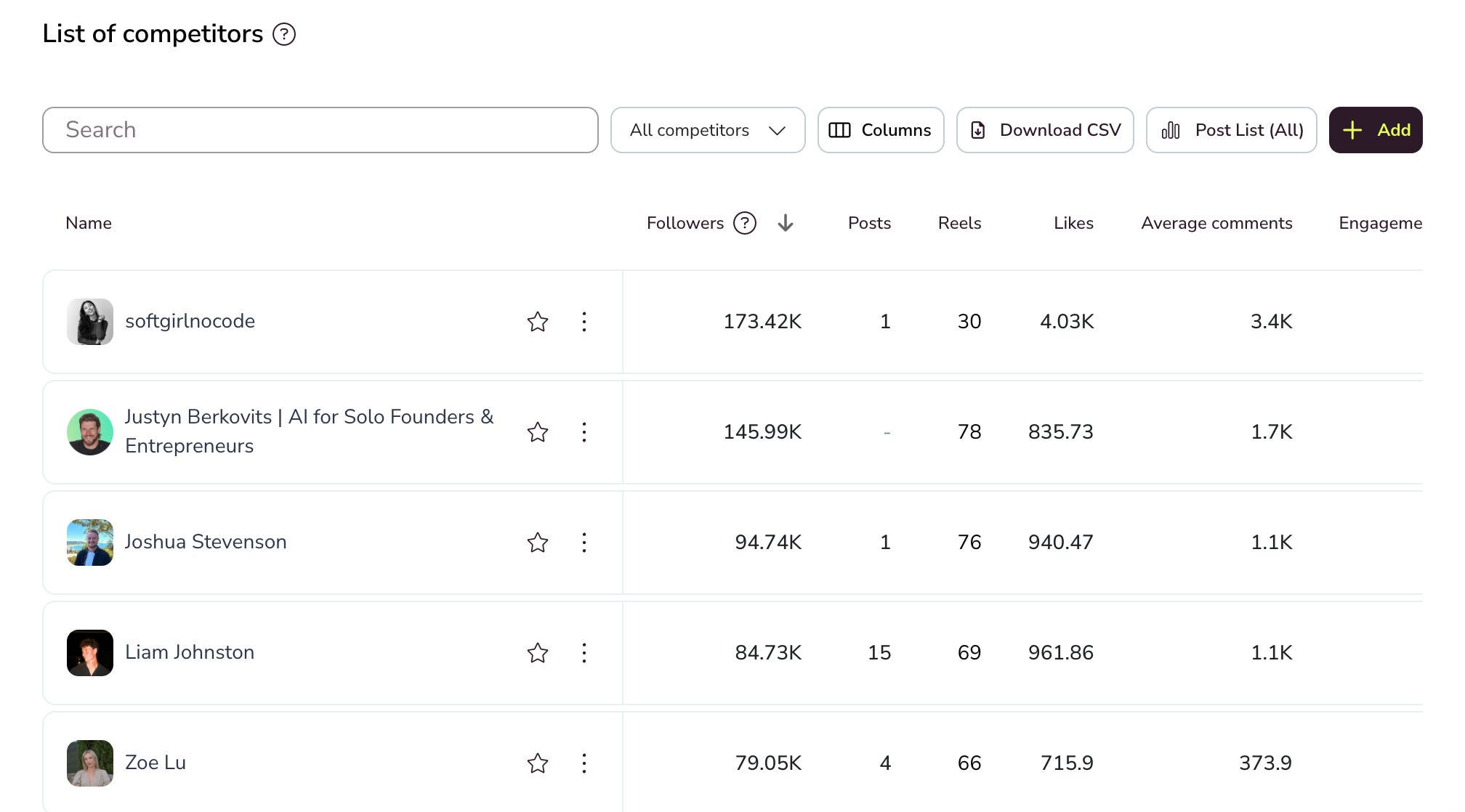
Side note, don’t actually think of fellow creators in your niche as your competitors. There’s more than enough attention, followers and money to go around - respect them and even consider opportunities to collaborate.
Then with Claude and Metricool connected, use this prompt:
Using my Metricool account, analyse the top-performing posts from the last 90 days for my competitors. Pull BOTH feed posts/carousels AND Reels (they're separate connectors in Metricool, so don't skip Reels).
For each account, give me:
- The 10 best posts by engagement, with the format (reel, carousel, static) and the topic in one line each
- Any hooks or opening lines they've reused more than once
- Their posting frequency and the formats they lean on most
Then step back and tell me: across all of them, what topics and formats keep winning? Group them into themes. I don't want to copy anyone, I want the recurring patterns worth putting my own spin on.
Connect these to my own content strategy and suggest how we can improve my own reach and engagement.
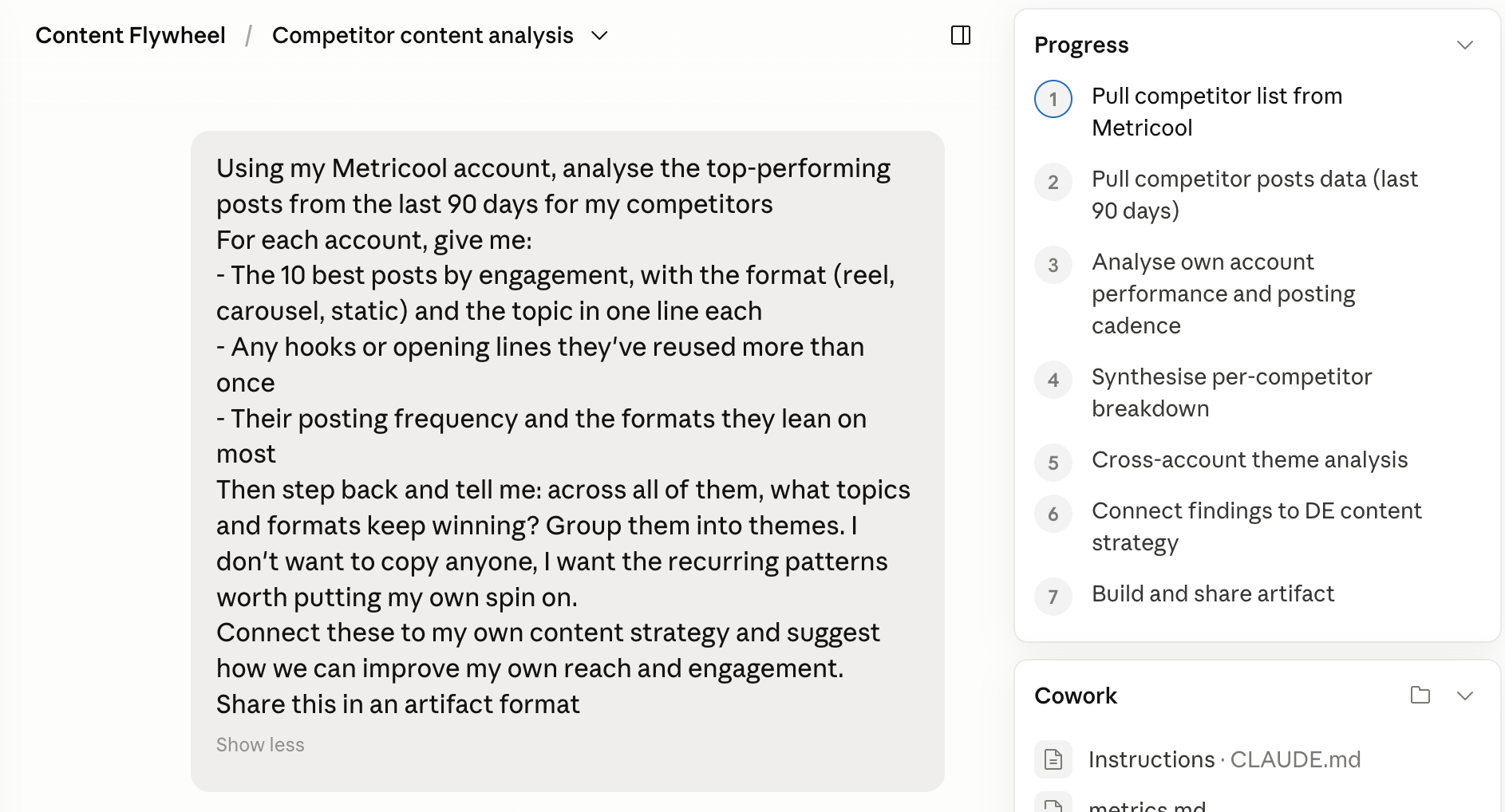
Cowork will map out a number of steps it will follow to complete this task:
The first time I ran this across 13 accounts in and around my niche, Claude found that the same four-part format kept outperforming no matter the follower count:
A bold, specific claim in the hook
A short first-person story
One actual system the viewer could use
And a “comment [word] and I’ll send it to you” CTA at the end.
Accounts with a million followers and accounts with sixty thousand were running the identical framework. The thing that flopped was the generic “here are the top 10 AI tools” listicle with nothing attached to it.
This is just 20% of the dashboard Claude generated for me (included in the prompt at the end of this newsletter).
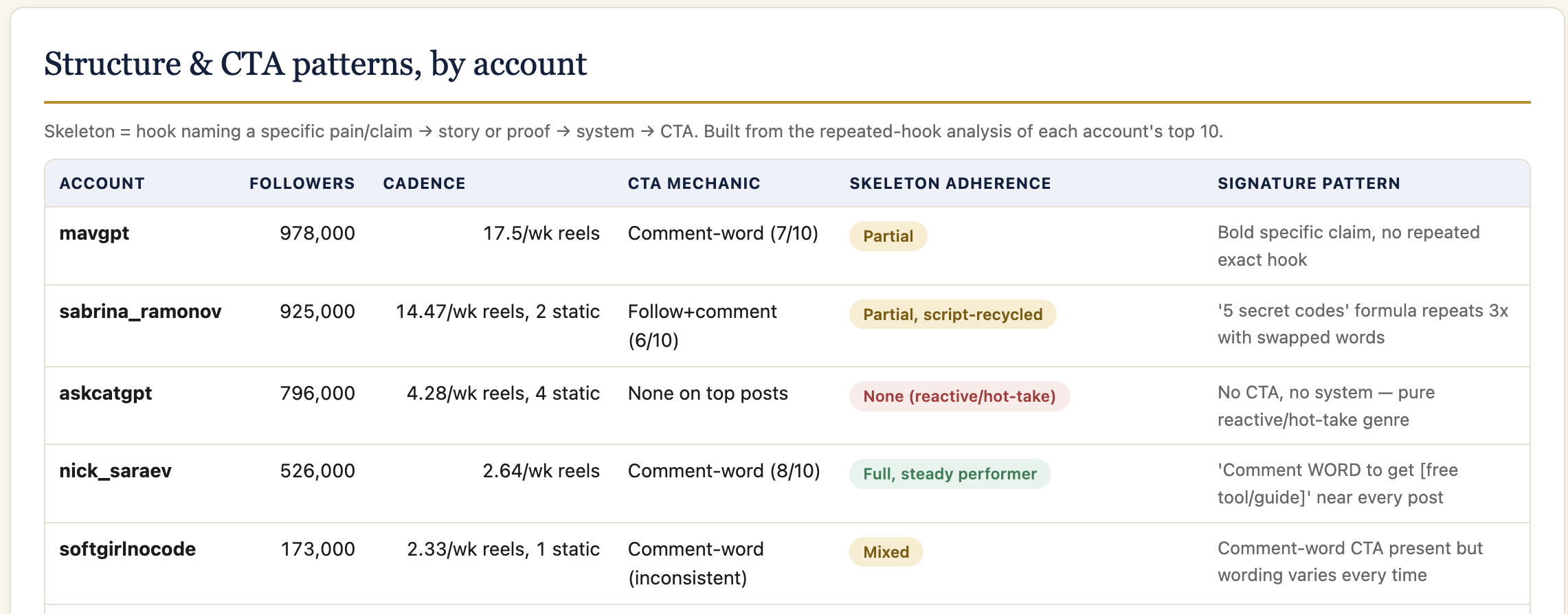
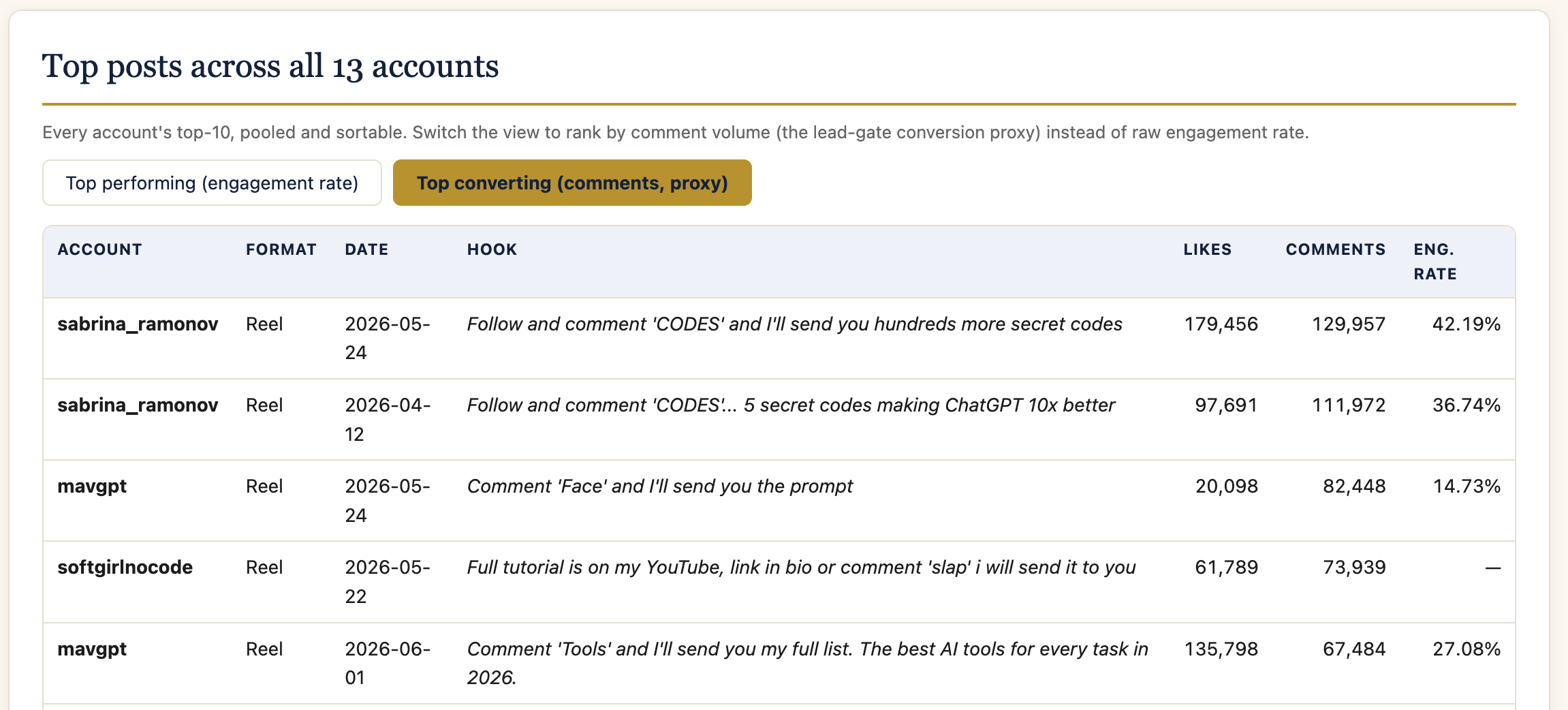
It also found that repetition works more than you’d think. One account reposted the exact same Reel, same hook word for word, a few weeks apart, and it landed in their top 10 both times. Proof you can reuse a winner verbatim instead of always starting fresh.
What you’re looking for here are the consistent outperformers across:
Topics
Hooks (look for both the text on screen and the spoken hooks)
Formats (not just reel vs carousel, but what type of reel - ie. yapping vs green screen, highly vs minimally edited, etc.)
Call to actions (follow vs Manychat comment vs share)
I’d also recommend doing this with creators not in your own niche. I often look to creators in the personal branding, personal finance and self development space for inspiration. Taking their formats and applying them to my niche creates a unique combination that performs well but feels fresh, and differentiates me from what everyone else is doing.
“Nothing is original. Steal from anywhere that resonates with inspiration or fuels your imagination. Devour old films, new films, music, books, paintings, photographs, poems, dreams, random conversations, architecture, bridges, street signs, trees, clouds, bodies of water, light and shadows. Select only things to steal from that speak directly to your soul. If you do this, your work (and theft) will be authentic. Authenticity is invaluable; originality is nonexistent.”
Jim Jarmusch
“We do not learn from experience... we learn from reflecting on experience.” - John Dewey
If you spend 30 minutes each fortnight looking back at what performed poorly in order to avoid repeating it, then reviewing what performed well so you can double down, there is no possible way you won’t improve.
Consistency is not key. Iteration is. Getting 1% better every day, instead of just doing the same thing.
This is why the second advisor looks inward.
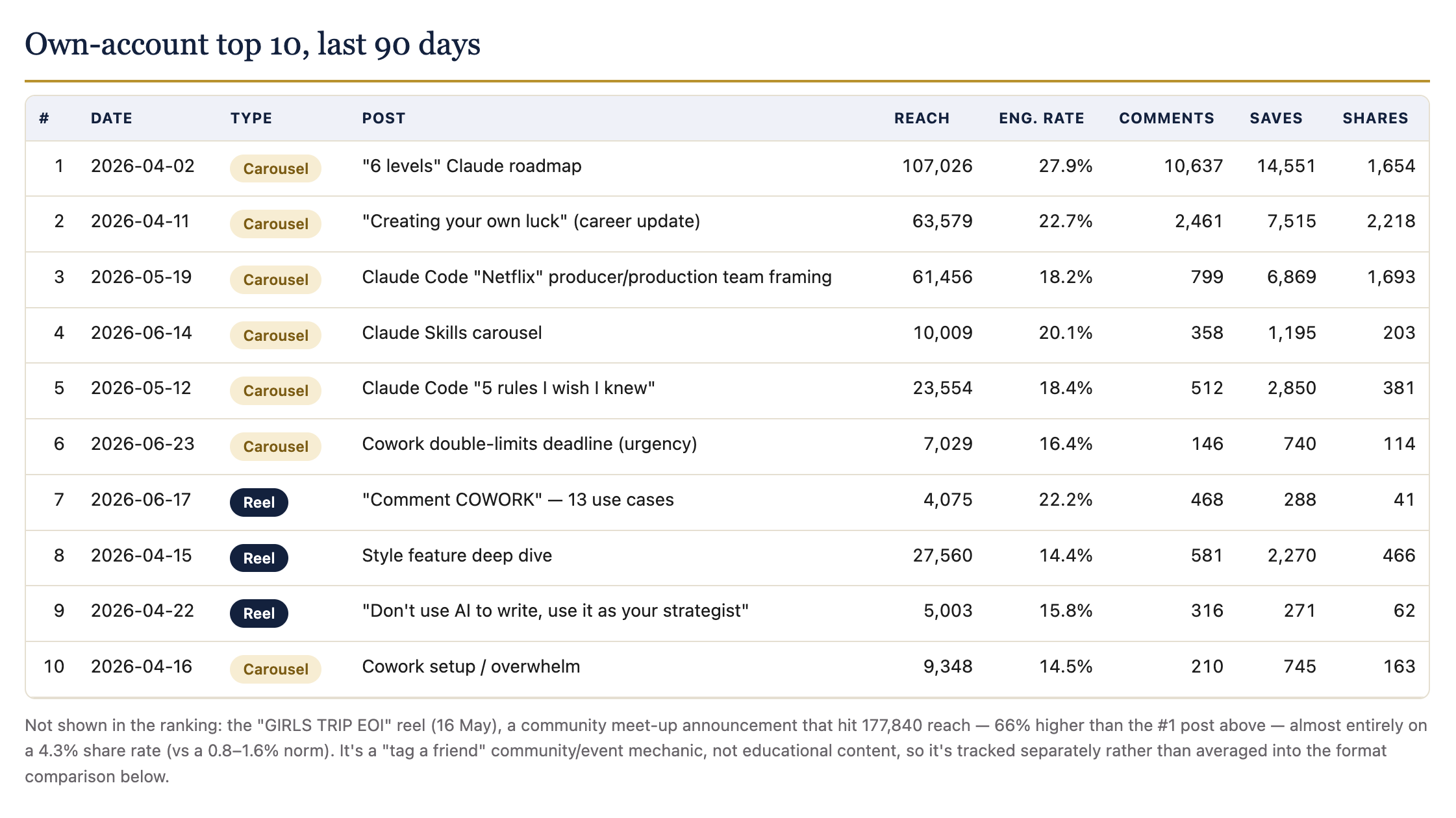
I have Claude use the Metricool connector to read back through my own posts, find my top performers, and tell me what they actually have in common underneath the surface numbers.
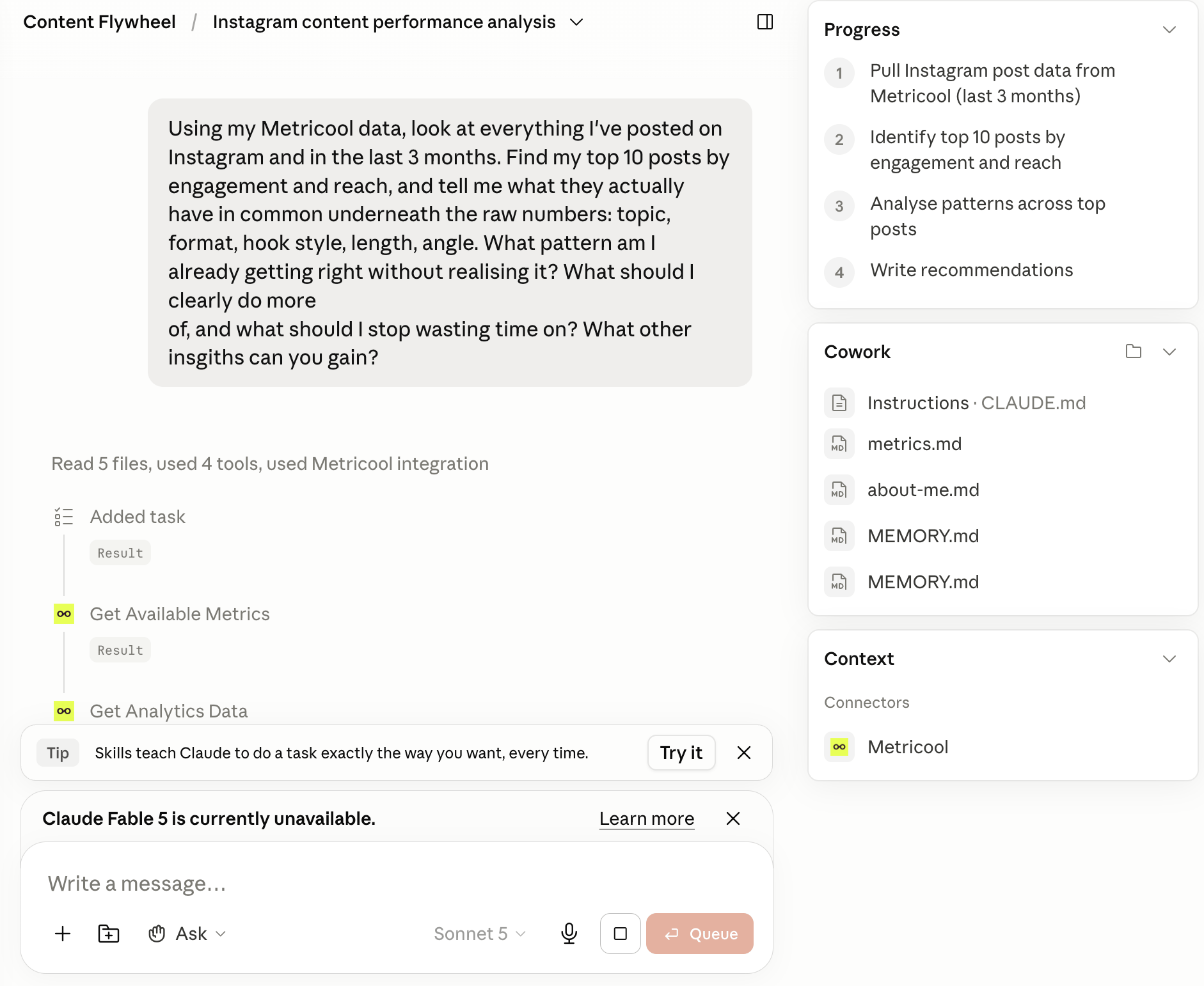
Using my Metricool data, look at everything l've posted on Instagram and in the last 3 months. Find my top 10 posts by engagement and reach.
Tell me what they actually have in common underneath the raw numbers: topic, format, hook style, length, angle. What pattern am I already getting right without realising it? What should I clearly do more of, and what should I stop wasting time on? What other insigths can you gain?
Make sure you're not only filtering to carousels, but also reels.
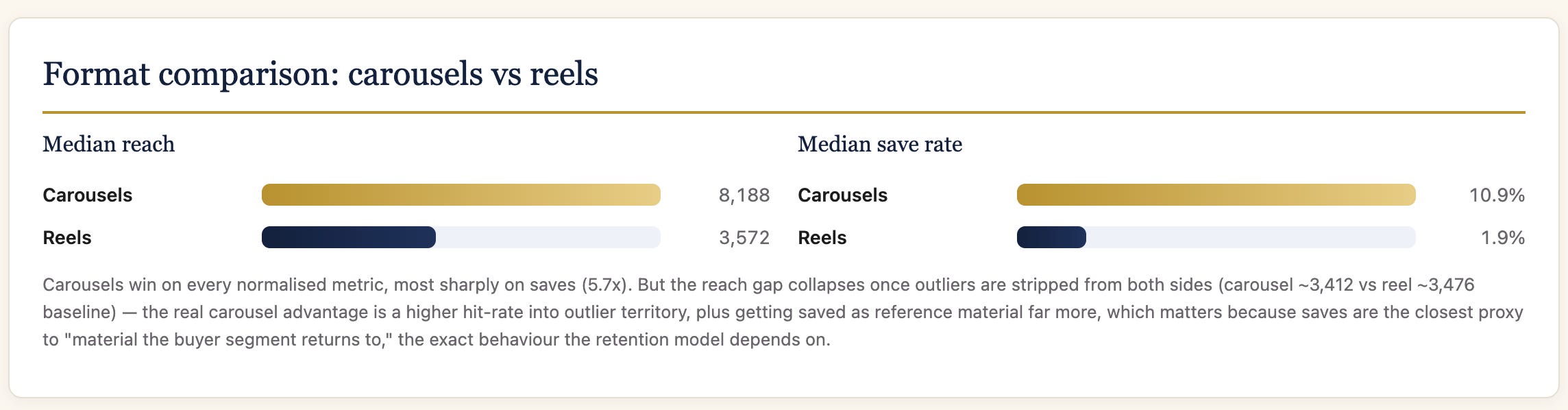
A really good example here, almost every piece of traditional advice recommends posting reels for growth. But my carousels beat my reels, and not by a little.
Claude found that they get saved more than five times as often, and every single time I’ve posted the same idea as both a carousel and a Reel, the carousel wins.
This is the half of pattern recognition that is so underrated. You’re sitting on months of your own data, where every post is a tiny experiment your audience already voted on, and most of us never go back to read the results.
The most powerful part comes when you take these insights and add them to your own existing content skills. For example, I started off with one skill for content repurposing. Over time, I identified two distinct patterns in what made a carousel perform well, and added two paths to that repurposing skill. Now, each newsletter is converted to one step-by-step carousel, and one bigger picture carousel.
Do they perform well every time? No. I don’t even use them both every time. But it’s a starting point taken directly from the data that gives me the best shot of getting my work to more people.
“Do the best you can until you know better. Then when you know better, do better.”
Maya Angelou
"Never emulate a strategy without understanding the goal it was built to achieve." - Unknown
Finding what’s working and chasing it is how you go viral, but it isn’t how you grow. I learned that the hard way.
There’s a real difference between posting for virality and posting for actual business or career growth. Virality is reverse-engineering top posts and jumping on trends. Growth asks harder questions.
Are you even on the right platforms?
Is your content moving people from viewer to follower to fan, or just stacking up views that go nowhere?
Is it pulling in the right people, or the lovely (not) men who decide to show up the one time out of 400 that you posted a video with a bit more cleavage (unfortunately speaking from experience)?
This is why the patterns from the first two advisors don’t always go straight into my content plan. They usually feed into my strategy first.
If you followed the Claude MBA series, this builds on the content system from phase 3. The audience research, the belief interview, and the strategy brief you built are the Strategist, and this is where you add to it with live patterns.
You tell it what’s winning in your niche and what’s winning for you, then ask it to pressure-test both against your positioning and your goals and tell you which patterns are worth including and which are just noise that don’t serve your long-term goals.
If you haven’t done the Claude MBA, just give Claude a voice note on your brand, target audience, positioning and content strategy, then use this prompt:
Here are the patterns from my niche and my own top content: [paste the Scout and Historian outputs].
Pressure-test them against my positioning, my audience and my goals. Tell me which of these patterns are worth my time and on-brand for me, and which are noise that would pull me off course even though they "work" for others. Be specific about the ones that work for them but are wrong for me, and why.
Then give me 3 content pillars these patterns support.
I follow that up with:
Would you suggest any changes to my skills based on these findings? Go deeper into analysis if you need to. Do not change any skills, only give your specific proposed changes and reasoning.What performed well for someone else won’t always work for your personality, audience or style of expression.
My entire niche runs on Reels. Often, hype and FOMO reels. Everyone on my competitor lists posts mostly Reels. If I’d just followed what works, I’d have replaced half my content calendar towards reels and tried to keep up. But my own numbers had been telling me for months that the carousel is the format my people actually save, share and follow me for. And hype is most definitely not a part of my content strategy.
That’s the difference between a board of advisors and a competitor analysis. A competitor analysis tells you what’s popular. Advisors tell you what’s popular and right for you.
“Whenever you find yourself on the side of the majority, it is time to pause and reflect.”
Mark Twain
“Artificial intelligence is no match for natural stupidity.” - Albert Einstein
The last seat is the one I’m most careful with, because this is exactly where people misuse AI.
I do not let it write my content, and I never will. I don’t think you should either, because you know that you can smell AI writing from a mile away. Even with all the work I’ve done to reduce these tendencies and build specialised skills, I’m still waiting for the day Claude gets a script 100% right. Your actual voice and beliefs is what makes your content unique from other creators and generic AI slop.
What the idea generator does instead is take the proven patterns and my strategy and hand me a list of angles to get my ideas flowing: starting points grounded in what already works and what fits my strategy.
Choosing the right topic is honestly half the battle in creating a viral post. This which stops the doomscrolling and blank page syndrome, so by the time I sit down to write I’m building on something that’s more likely to be in demand
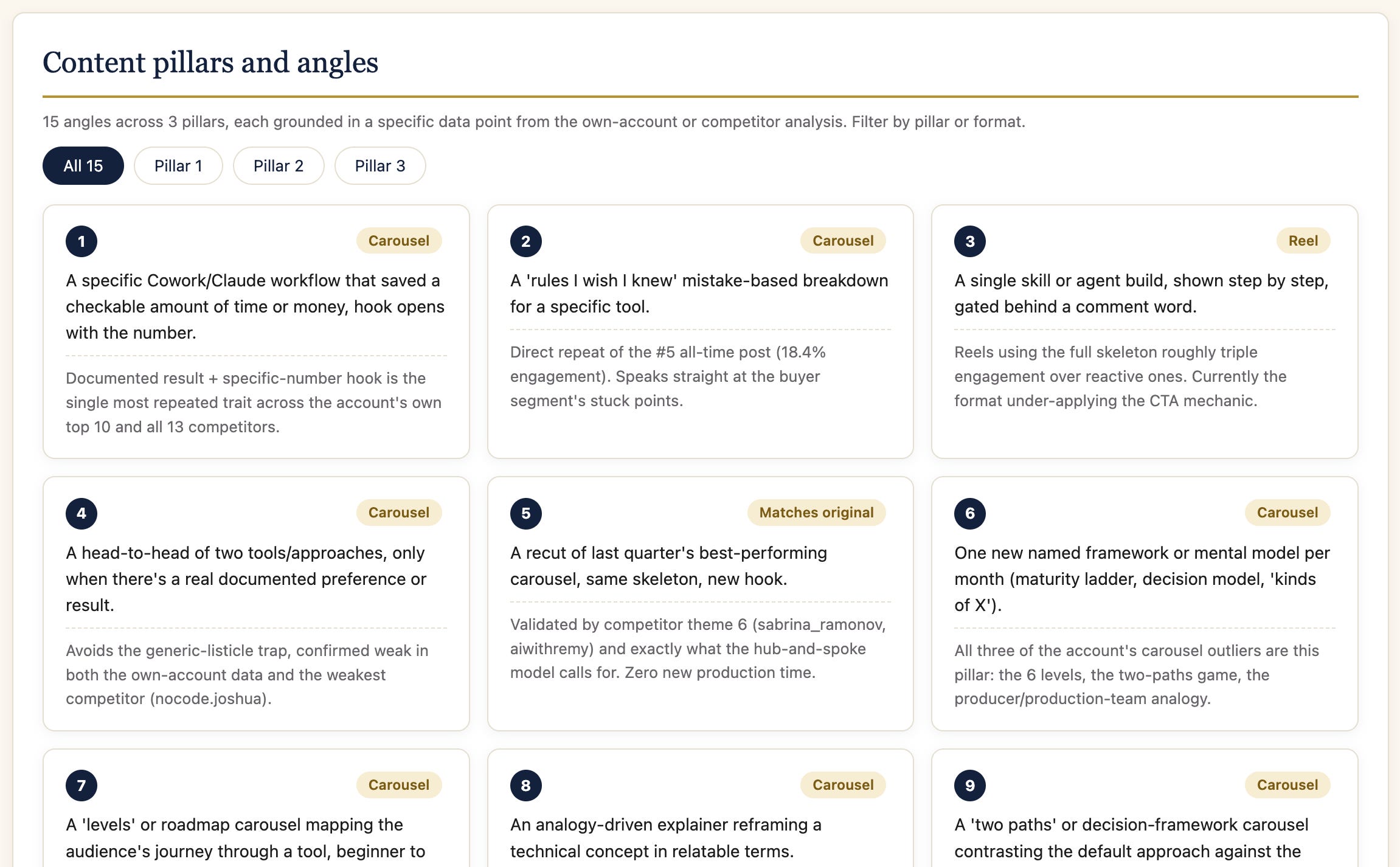
And because Metricool schedules your posts as well as tracks them, once the board hands me the angles I want to run, I can line the prep my content in the same place, without leaving the workflow to go copy-paste captions into Instagram at midnight.
The patterns and the planning can come from the data. The thinking has to come from you, because that’s the only part that was ever going to set you apart.
"To be yourself in a world that is constantly trying to make you something else is the greatest accomplishment."
Ralph Waldo Emerson
The best thing about this board: the Scout, the Historian, the Strategist, and the Idea Generator is that not one of them writes a post or has a thought for me. What they do is the boring, time consuming work. What AI is actually meant for.
I’m still the Artist. The difference is that this year I finally gave her a Scientist to work with. The four years before that, I just never looked at the data that was sitting right there the whole time.
At the start I promised I’d give you everything you need to run your own board this afternoon, without building it yourself. So if you want to set it up, this is where I’d start.
1. Create a Metricool account.
You can start free here, or use TAYLA for 30 days of Metricool Premium here:
2. Connect your own accounts in Metricool, so the Historian has something to read.
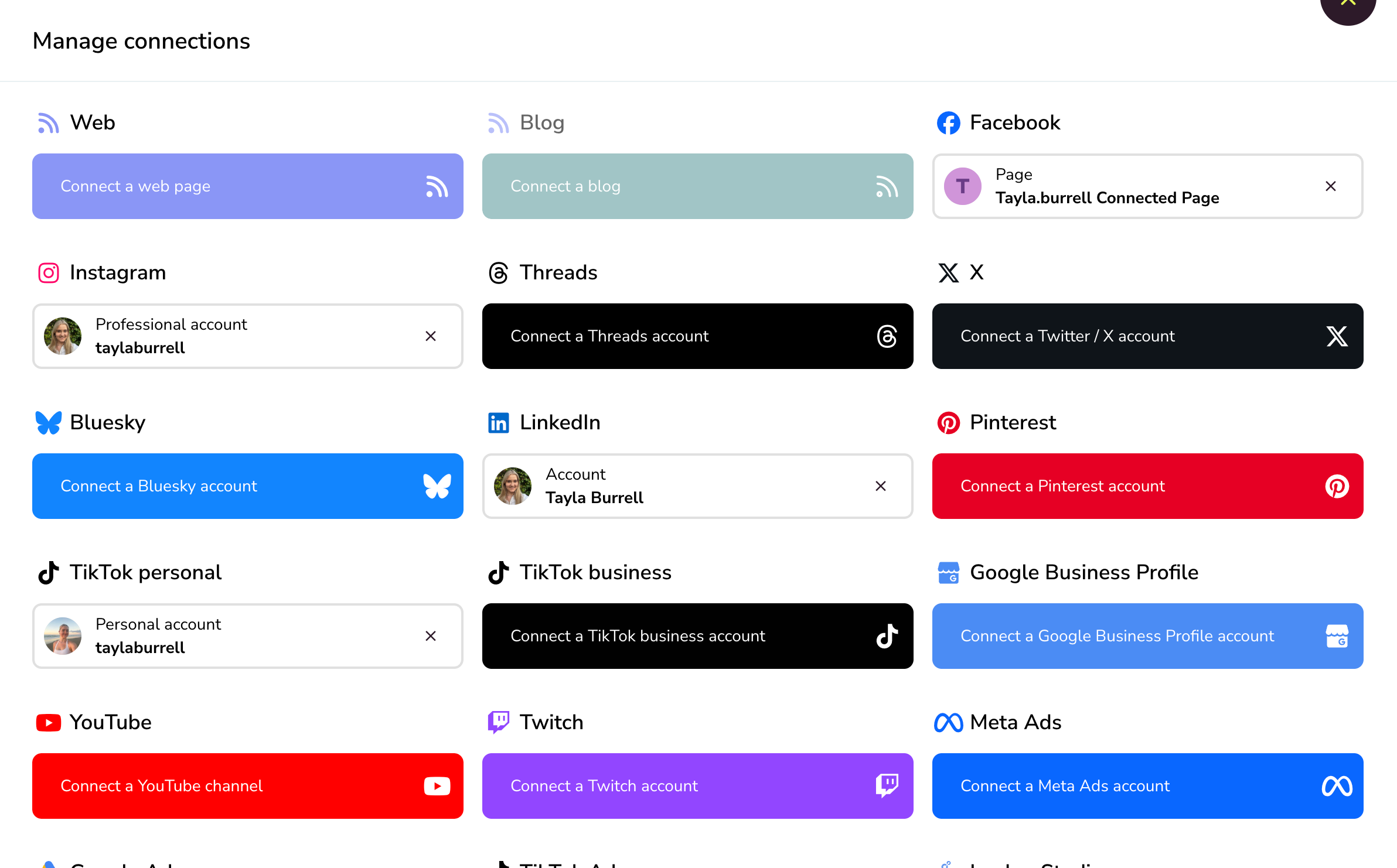
3. Add at least 5 competitors from your niche, plus 5 creators you admire from outside it. This is what feeds the Scout.
4. Connect Claude to Metricool. This lives inside Claude itself, so you can run the whole thing from a normal chat or Cowork. Go to Customize > Connectors > Add a custom connector, and paste in the Metricool address: https://ai.metricool.com/mcp. Log in, approve access, and it will connect automatically. (Metricool’s full walkthrough with screenshots is here: https://metricool.com/metricool-mcp-claude/.)
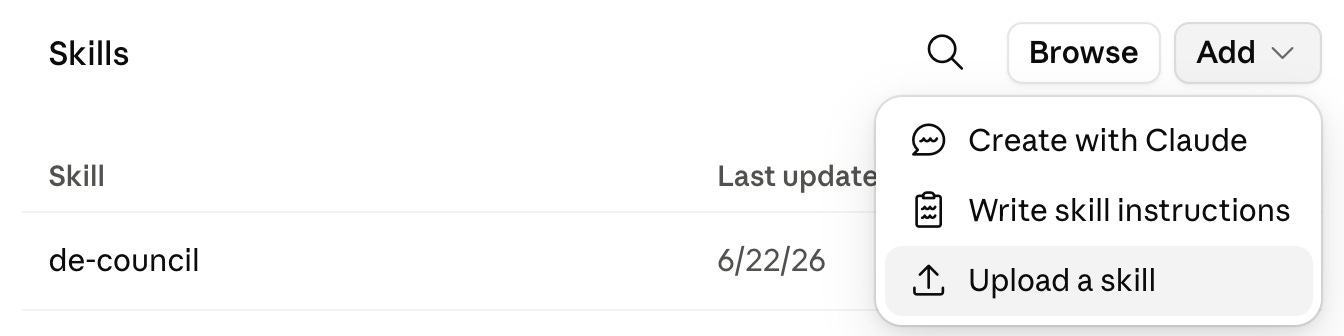
5. Download the skill below and upload it to Claude. This packages all four advisors I built over about 2 weeks into one skill you can run by typing /content-advisors, PLUS builds you a dashboard so you’re not reading through 4 text-heavy files.
Grab the free Board of Advisors skill
To upload the skill, go to Customize > Skills > Add > Upload a skill and drop the zip file straight in.
Finally, take 3 intentional actions off the back of your findings - whether that’s planning out content more intentionally for next week, updating your strategy or building out a Claude skill that repeats this process for you on a weekly or fortnightly basis.
That’s your first afternoon, and you can start here with 30 days free of Metricool Premium using the code TAYLA.
You can find Metricool on Instagram at @metricoolapp if you want to see what they’re about first.
This is free because I honestly wish someone had handed it to me four years ago before all the wasted posts. If it’d help someone you know, the friend who’s trying to grow on social media, or the one who’s content isn’t getting the attention it deserves, send it their way.
Next up: The Great AI Comparison Crisis: You’re not actually behind (the numbers say so) + what matters in AI this week
No posts
Comments
Nothing yet. Say the first thing.
Sign in to join the conversation.