
By Christine Wolking
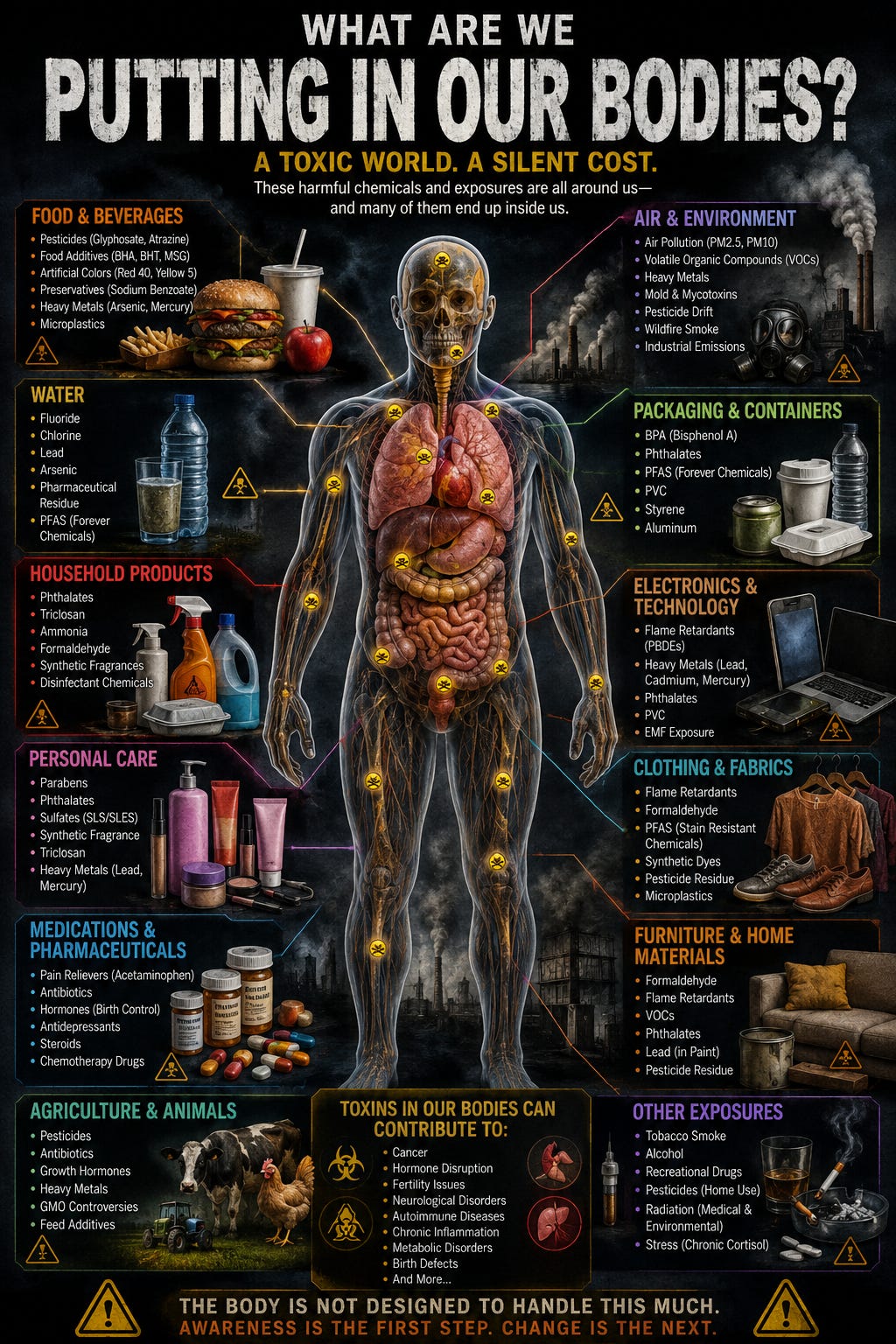
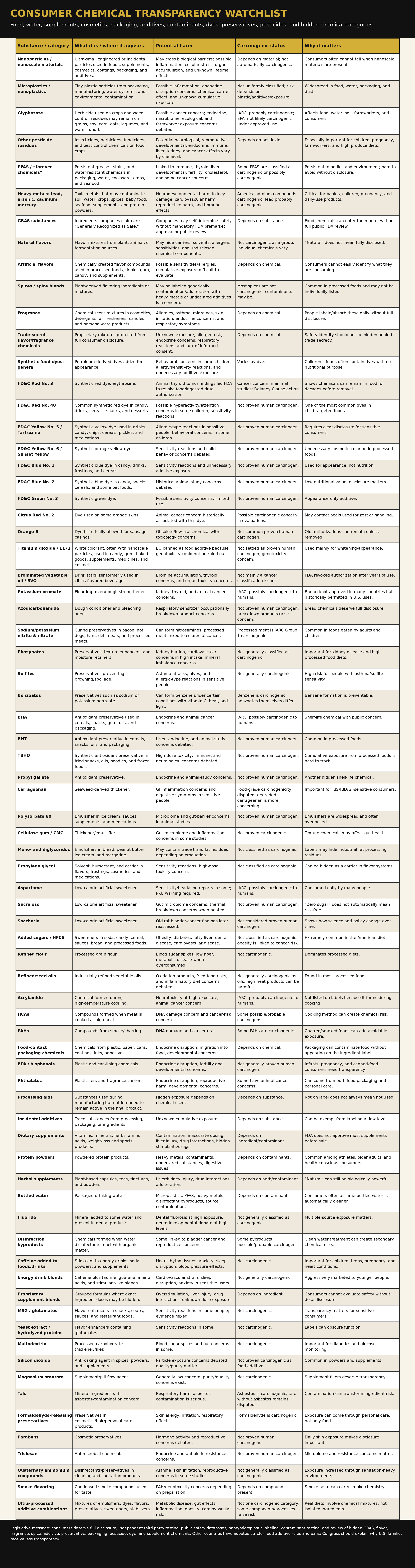
If this investigation informs you or makes you look differently at the products you use every day, please subscribe and consider becoming a paid member. I do not accept corporate advertising or paid influence. Reader support funds my independent research, investigative journalism, document analysis, educational resources, and advocacy through the Targeted Community and Guardians Global Code Foundation.
Most Americans probably assume that when they turn over a package, bottle, cosmetic, medication, supplement, or other consumer product, the label tells them what is in it. Sometimes it does. Sometimes the answer is more complicated.
That is why this investigation has grown far beyond food.
I want to know what we are eating, what we are drinking, what we are putting on our skin, what we are inhaling, what we are giving our children and pets, what is contained in the medications we swallow, and what is being injected or infused into our bodies. I also want to know which substances can legally be grouped under broader terms, omitted because of regulatory exemptions, treated as processing aids, protected as trade secrets, or otherwise difficult for an ordinary consumer to identify.
This is not an argument that every unfamiliar substance is dangerous. Chemistry does not work that way, and neither does toxicology. The presence of a chemical name is not proof of harm. Dose, route of exposure, chemical form, frequency, susceptibility, and the quality of the scientific evidence all matter.
The issue is transparency.
If a product is going into us or onto us, consumers should not have to become regulatory attorneys, chemists, pharmacists, or professional investigators just to understand what they are being exposed to.
Food Is Only the Beginning
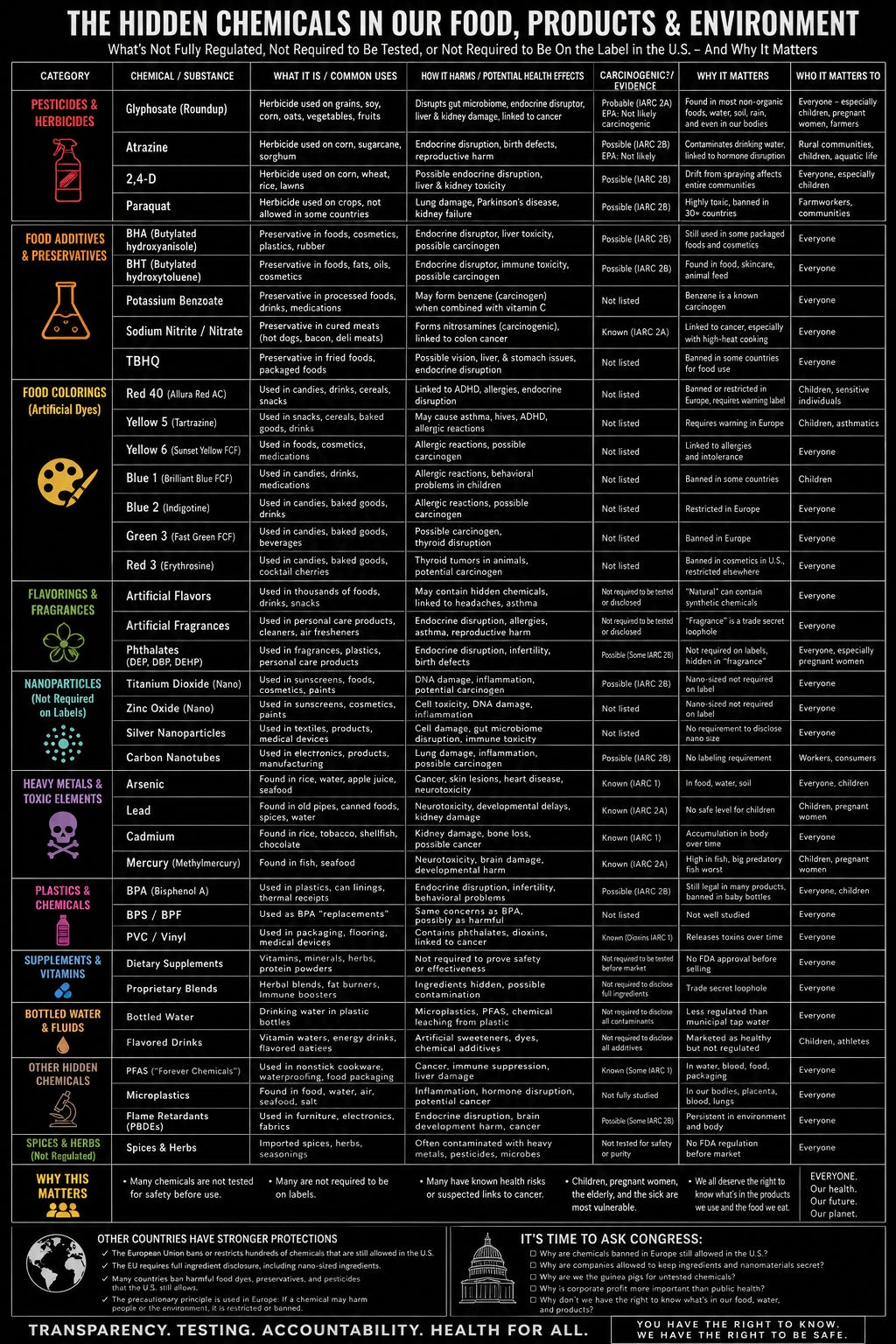
Federal food-labeling rules require ingredient declarations in many circumstances, but they also contain exemptions. One of the most important is the federal regulation covering incidental additives. Under 21 CFR § 101.100, certain substances present at insignificant levels and having no technical or functional effect in the finished food may be exempt from ordinary ingredient-label declaration requirements. The regulation includes certain processing aids and substances that may enter food through another ingredient. (U.S. Food and Drug Administration)
That distinction may make sense from a regulatory and manufacturing perspective, but it raises a different consumer question: why should exemption from printing something on the physical ingredient panel mean the public cannot easily obtain the information elsewhere?
Modern technology gives us a better option. A package does not need a twenty-page ingredient history printed on its side. A standardized QR code could provide a complete manufacturing disclosure showing ordinary ingredients, processing aids, compound-ingredient components, flavor systems, relevant residues, contaminants monitored during production, and explanations of what each substance does.
“Natural Flavor” and “Artificial Flavor” Are Categories, Not Complete Formulas
Food labels routinely use broad descriptions such as “natural flavor” and “artificial flavor.” Similar issues arise in cosmetics, where FDA explains that fragrance and flavor formulations may contain numerous individual components while appearing on the label simply as “Fragrance” or “Flavor.” FDA specifically notes that these formulations can contain complex mixtures of natural and synthetic ingredients. (U.S. Food and Drug Administration)
That does not automatically make those products unsafe. It does mean the words visible to a consumer may tell considerably less than the complete formulation would.
For people managing allergies, sensitivities, religious restrictions, medical conditions, pregnancy, interactions, environmental concerns, or simply personal preferences, that distinction matters.
A consumer should be able to ask, “What exactly makes up this flavor or fragrance?” and receive an answer without having to beg a manufacturer for information.
Cosmetics and Personal-Care Products Need the Same Scrutiny
The same right-to-know principle should apply to products we put on our bodies.
That includes makeup, lotions, creams, shampoos, conditioners, hair dyes, sunscreens, deodorants, antiperspirants, perfumes, colognes, soaps, body washes, nail products, shaving products, baby products, feminine-care products, and everything else intended for routine bodily contact.
FDA generally requires retail cosmetics to carry ingredient declarations, but there are important limitations. Fragrance components may be listed collectively, certain trade-secret ingredients may receive protection, and cosmetics distributed solely for professional or institutional use may fall outside some retail ingredient-list requirements. FDA also states that, with the exception of certain color additives, cosmetic ingredients generally do not require FDA premarket approval, although companies remain legally responsible for product safety and proper labeling. (U.S. Food and Drug Administration)
FDA additionally acknowledges that some consumers may experience fragrance allergies or sensitivities and that the agency does not possess the same statutory authority to require cosmetic allergen labeling that applies to food. (U.S. Food and Drug Administration)
That is exactly the kind of regulatory difference consumers deserve to understand.
What About Medications?
Prescription and over-the-counter medications introduce another layer of complexity because products contain active and inactive ingredients.
FDA defines an inactive ingredient as a component of a drug product other than the active ingredient, and the agency maintains an Inactive Ingredient Database covering inactive ingredients found in approved drug products. FDA updates that database quarterly. (U.S. Food and Drug Administration)
For over-the-counter medications, the Drug Facts label includes an inactive-ingredients section. FDA explains that inactive ingredients can include substances such as binders, colors, and flavorings. Prescription labeling generally contains ingredient information in the product’s formal labeling, but consumers may need to consult the detailed prescribing information rather than simply looking at the pharmacy bottle. (U.S. Food and Drug Administration)
That may technically make the information available, but “available somewhere” and “easily understandable at the moment of consent” are not necessarily the same thing.
If a patient is about to swallow, inhale, absorb, or receive a drug by injection, the complete composition should be readily accessible in ordinary language.
Vaccines and Other Injected Products Deserve Clear Ingredient Information Too
Vaccines are biologic products that undergo FDA review before they can be marketed in the United States. FDA states that its review considers vaccine ingredients and that approved vaccines continue to be monitored for safety after approval. The agency also publishes information about common vaccine ingredients, such as adjuvants used in some formulations. (U.S. Food and Drug Administration)
The public conversation becomes unnecessarily polarized when transparency itself is treated as controversial.
Someone should not have to be “for vaccines” or “against vaccines” to believe that every patient has a right to clear information about what is being administered.
The same principle should extend to injectable medications, IV infusions, contrast agents, biologics, implants, medical devices that release substances into the body, and emerging biotechnology.
Informed consent is strongest when the information is clear enough for an ordinary patient to understand.
Dietary Supplements and Vitamins Belong in This Investigation
Supplements are another enormous category because consumers frequently assume that products sold alongside medications have undergone the same type of premarket review.
They have not.
This project therefore needs to examine vitamins, minerals, probiotics, herbal products, amino acids, powders, gummies, weight-management products, sports supplements, and other ingestible products not merely for what the label claims to contain, but also for independent testing, contamination, adulteration, dosage accuracy, lot traceability, and whether consumers can obtain batch-specific certificates of analysis.
Our existing Consumer Right-to-Know research framework already identified mandatory independent testing, public lot-level certificates of analysis, contaminant testing, and stronger disclosure rules as major reform areas for supplements and other ingestible products.
Drinking Water Cannot Be Left Out
The investigation also has to cover what we drink every single day.
Municipal water and bottled water operate under different regulatory frameworks, yet both become part of the human body.
Consumers should be able to obtain straightforward information about tested contaminants, treatment chemicals, PFAS, heavy metals, microbial contaminants, source water, and emerging issues such as microplastics when reliable testing methods and standards are available.
Our existing project specifically identified bottled-water transparency, lot-level contaminant reporting, independent testing, and comparisons between bottled-water and municipal-water disclosure systems as areas requiring further investigation.
Household Exposure Matters Too
Not everything that enters the body is deliberately eaten or swallowed.
People inhale products. Products touch our skin. Residues migrate from surfaces. Children put objects into their mouths. Household products can create repeated exposures in enclosed spaces.
That means the research must also examine laundry detergents, fabric softeners, dryer sheets, cleaning products, room fragrances, carpet products, air fresheners, disinfectants, pesticides, pet products, food-contact packaging, cookware coatings, plastics, and other products capable of creating meaningful human exposure.
FDA itself notes that many fragranced products that are not cosmetics, including laundry detergents, fabric softeners, dryer sheets, room fresheners, and carpet fresheners, fall under different regulatory systems. (U.S. Food and Drug Administration)
That fragmentation is part of the problem. Consumers experience exposure across their entire lives, while regulation is divided among different statutes, agencies, product categories, and definitions.
The Database Has to Be Built Substance by Substance
This project cannot stop at listing categories.
The master database we started was designed with fields for the substance, what it is, why it is used, where it is found, whether it can be hidden or grouped on a label, regulatory oversight, premarket review, independent testing, health concerns, cancer evidence, endocrine effects, neurological effects, reproductive and developmental concerns, environmental effects, international status, legislative recommendations, and supporting sources.
Some of those worksheets are still only frameworks rather than completed research databases. The Flavorings and Fragrances sheets, for example, contain the full column structure but currently lack substance-level entries, while the reconstruction workbook explicitly contains instructions to populate categories such as Food Additives, Food Colorings, Processing Aids, and Municipal Water with substance-level research, regulatory status, health concerns, international comparisons, references, and legislative recommendations.
That is the work that still has to be completed.
Not ten examples.
Not a few headline chemicals.
Everything we can reasonably document, category by category and substance by substance.
What the Full Research Project Should Cover
The final Consumer Right-to-Know database should examine food additives, preservatives, colors, natural and artificial flavors, processing aids, incidental additives, GRAS substances, agricultural chemicals and pesticide residues, packaging migrants, PFAS, microplastics, nanomaterials, municipal water, bottled water, dietary supplements, vitamins, medications, inactive pharmaceutical ingredients, vaccines, injectable products, cosmetics, fragrances, personal-care products, household chemicals, cleaning products, products marketed for babies and children, pet products, and other significant routes of human exposure.
Every entry should identify what is known, what is uncertain, what regulators require, what manufacturers disclose, what independent researchers have found, and where scientific evidence remains incomplete or disputed.
That distinction is important.
A serious right-to-know investigation should never turn uncertainty into certainty simply because a frightening conclusion is more dramatic. If evidence is strong, say it is strong. If evidence is limited, say it is limited. If agencies disagree with independent researchers, document both. If another country regulates a substance differently, explain exactly how and why.
The Infographics Must Show the Whole Picture
The first infographic should be simple enough that someone understands the problem in seconds.
Its central question should be:
What Are We Really Eating, Drinking, Putting on Our Bodies, and Injecting Into Our Bodies?
Around that question should be the major routes of exposure and the categories consumers may not fully recognize from an ordinary label: processing aids, incidental additives, flavor mixtures, fragrance mixtures, inactive pharmaceutical ingredients, contaminants, manufacturing residues, packaging-related substances, agricultural residues, nanomaterials, microplastics, and other categories identified through the research.
The second infographic should be much larger. It should function almost like a visual map of the entire database, showing each product category, what disclosure rules apply, what may be grouped or exempted, what regulatory agency has jurisdiction, whether premarket review is required, whether independent testing is mandatory, and what reforms would create a true right-to-know system.
Those graphics should come after the research is populated, not before it, because every statement on them needs to trace back to an actual source.
A Better Standard: Full Consumer Product Transparency
I believe the United States should establish a comprehensive Consumer Right-to-Know standard covering significant products that people eat, drink, inhale, apply to their bodies, absorb, or receive through medical administration.
The physical package can remain readable. The complete disclosure can exist digitally.
A standardized QR code could provide consumers with detailed information about ingredients, components of mixtures, processing aids, inactive ingredients, known allergens, manufacturing functions, applicable contaminant testing, regulatory status, safety assessments, batch or lot information where appropriate, recalls, and links to primary government documentation.
The system should distinguish clearly between an intentionally added ingredient, a processing aid, a trace contaminant, an unavoidable environmental residue, and a substance detected at a level that has regulatory significance. Those things are not equivalent, and responsible transparency requires context.
Transparency Should Inform People, Not Frighten Them
This may be the most important principle of the entire project.
Consumers deserve more information, but more information should come with better explanation.
Chemical names alone can be misleading. “Detected” does not automatically mean “dangerous.” A hazard is not the same as a real-world risk at a particular exposure level. Route, dose, duration, metabolism, susceptibility, and quality of evidence matter.
A responsible disclosure system should therefore answer five basic questions whenever possible:
What is it?
Why is it there?
How much is present or expected?
What does reliable evidence say about exposure at that level?
Where can the consumer examine the underlying evidence?
If You Have Found This Investigation Valuable So Far, Please Support My Independent Journalism
Please subscribe or become a paid member. Your support allows me to continue the deep research, database development, regulatory analysis, source verification, and public-interest investigations necessary to complete projects like this without relying on corporate advertising or paid influence.
The Right to Know Should Follow the Person, Not the Product Category
Our bodies do not care which federal agency has jurisdiction.
A substance does not become irrelevant because it entered through skin instead of food, because it came from a medication rather than a beverage, or because it was part of a manufacturing process rather than something intentionally marketed as an ingredient.
Consumers experience the cumulative reality of their environment.
Our transparency laws should begin to reflect that reality.
This does not require assuming that everything is harmful. It requires recognizing that informed choice begins with access to accurate information.
If we eat it, we should be able to know what it contains.
If we drink it, we should be able to know what it contains.
If we put it on our bodies, we should be able to know what it contains.
If we inhale it through ordinary product use, we should be able to find meaningful exposure information.
If it is injected or infused into our bodies, we should have clear access to its complete formulation and appropriate medical information.
And if a substance is exempt from appearing on an ordinary label, the exemption should not automatically become a barrier to consumer knowledge.
It Is Time to Finish the Right-to-Know Project
The next stage is not another short list.
It is the database.
Every category needs to be populated. Every substance needs sources. Every regulatory claim needs verification. Every health concern needs evidence grading. Every comparison with another country needs documentation. Every proposed reform needs to distinguish what current law actually requires from what we believe the law should require.
Then the infographics can show people, visually and clearly, what we discovered.
The ultimate goal is not to make people afraid of their groceries, medicine cabinets, bathrooms, drinking water, or household products.
It is to make sure they no longer have to guess.
Wireless Devices, RF Exposure, and the Missing Consumer Warning
The right-to-know discussion should not stop with food, cosmetics, medication, or injections. It should also include the electronic devices and wireless infrastructure that surround people every day.
Cell phones, tablets, laptops, Wi-Fi routers, smartwatches, smart meters, Bluetooth devices, cellular-connected surveillance cameras, 5G equipment, and other wireless transmitters emit radiofrequency energy. EPA describes RF as non-ionizing radiation and states that wireless devices operate in an environment where people are exposed to a nearly constant background of wireless signals. EPA also says that scientists continue to study the effects of long-term exposure to low levels of RF energy.
The current federal system does not give consumers the kind of plain-language exposure disclosure I believe should accompany these products.
FCC rules require wireless devices to comply with RF exposure limits, and the agency uses measures such as Specific Absorption Rate, or SAR, for portable devices. FCC technical guidance also addresses RF exposure when a device contains multiple transmitters, which is particularly relevant as modern electronics increasingly combine cellular, Wi-Fi, Bluetooth, ultra-wideband, and other radios in a single product.
Yet most consumers never see a prominent warning on the front of a cell-phone box explaining what RF frequencies the device can transmit, its maximum tested SAR, how exposure changes with distance from the body, whether several transmitters can operate simultaneously, or what practical steps can reduce exposure.
That should change.
What Wireless Labels Should Tell Consumers
Every RF-emitting consumer device should provide an easily visible disclosure containing:
The radio technologies contained in the device.
The frequency bands the device can transmit on.
Its maximum authorized RF output.
Its tested SAR or other applicable exposure measurement.
The testing distance between the device and the body.
Whether multiple transmitters can operate simultaneously.
Recommended minimum separation distances where applicable.
Instructions for reducing exposure.
Known electromagnetic-interference precautions.
Its FCC identification number and a direct link to the device’s federal equipment-authorization records.
A plain-language explanation distinguishing ionizing radiation from non-ionizing RF energy.
Any important limitations in the available long-term safety evidence.
This is not unprecedented. FDA already recommends keeping certain cell phones and smartwatches at least six inches from implanted medical devices because their magnets can interfere with pacemakers and other implants. FDA also recognizes that cell phones can produce RF interference with hearing aids.
Those examples demonstrate something important: wireless-device interactions with the human body and medical equipment are already recognized sufficiently to justify specific precautions in particular circumstances.
Consumers should not have to search multiple federal websites to discover them.
We Also Need Better Information About Infrastructure
The same principle should apply beyond devices people personally purchase.
Cell towers, rooftop antennas, small-cell installations, wireless utility equipment, radar transmitters, and other high-powered RF sources should have publicly accessible information describing their operating frequencies, authorized power, applicable exposure limits, compliance measurements, ownership, and responsible regulatory authority.
EPA states that very strong RF fields can cause rapid tissue heating and serious burns and that hazardous areas around powerful transmitting equipment require warnings and restricted access.
That does not mean an ordinary cell tower or Wi-Fi router produces those hazardous exposure levels at normal public locations. It does establish why RF power, distance, frequency, and access restrictions matter and why the public should be able to examine compliance information rather than simply being told that equipment has been approved.
Cellular-Connected Surveillance Equipment Belongs in the Database Too
Automated surveillance infrastructure increasingly contains wireless transmitters of its own.
For example, Flock Safety states that its license-plate-reader cameras are solar-powered and LTE-connected, meaning they use cellular communications to transmit data.
That fact alone does not establish that Flock cameras cause harmful RF exposure. I have not found reliable evidence establishing that ordinary public exposure from those cameras causes the injuries some people attribute to them.
But it does mean they belong in a comprehensive wireless-exposure database.
For every such installation, the public should be able to determine:
What cellular modem is installed?
What bands does it use?
What is its authorized transmitter power?
How frequently does it transmit?
Is transmission continuous or intermittent?
What FCC equipment authorization covers the radio module?
What are RF levels at typical pedestrian distances?
Have cumulative exposures from multiple nearby transmitters been measured?
If equipment is installed directly beside homes, sidewalks, schools, hospitals, or workplaces, the answers should be readily available.
Cumulative Exposure Needs More Transparency
Modern exposure is rarely produced by one wireless source.
A single person may simultaneously be near a cell phone, smartwatch, Wi-Fi router, laptop, Bluetooth accessories, cellular tower, smart meter, vehicle electronics, and other transmitters.
FCC technical guidance explicitly contemplates devices containing multiple transmitters and provides procedures for evaluating RF compliance in those situations.
The broader public-health question is how the regulatory system evaluates cumulative exposure from numerous independent devices and infrastructure sources over long periods.
EPA states that long-term effects from low-level RF exposure continue to be studied. FDA, by contrast, currently says the weight of scientific evidence has not linked cell-phone RF exposure with health problems. Those positions are not identical, and both should appear in the research rather than presenting either conclusion alone.
High-Power RF and Directed-Energy Systems Must Be Treated Separately
The project should also contain a separate category for intentionally high-powered RF, microwave, laser, acoustic, and other directed-energy technologies.
Those systems should not be grouped together with ordinary Wi-Fi routers or consumer cell phones simply because they may occupy parts of the electromagnetic spectrum.
Power density, waveform, duty cycle, beam concentration, pulse characteristics, frequency, distance, and exposure time can be radically different.
Where military, law-enforcement, industrial, research, or security equipment is capable of producing exposure levels that can injure people, there should be appropriate exclusion zones, access controls, warning signs, occupational standards, incident reporting, and medical-response protocols.
Any claim that a particular device near a residence is actually being used as a weapon, however, requires evidence identifying that source and measuring the exposure. The right-to-know framework is strongest when it demands those measurements instead of assuming the answer.
Wireless, Electromagnetic, and Radiation-Emitting Products
It should include at minimum:
Cell phones
Tablets
Laptop computers
Desktop wireless adapters
Wi-Fi routers
Wi-Fi access points
Bluetooth products
Smartwatches and wearables
Wireless headphones
Smart-home equipment
Baby monitors
Cordless phones
Smart meters
Vehicle wireless systems
5G small cells
Cellular base stations
Traditional cell towers
Broadcast towers
Radar systems
Satellite communications equipment
Wireless surveillance cameras
Automated license-plate readers
Flock Safety cameras and comparable systems
RFID systems
Ultra-wideband devices
Wireless charging equipment
Medical RF devices
Industrial RF equipment
Microwave transmitters
High-power RF systems
Laser systems
Directed-energy research systems
Ionizing-radiation-producing equipment as a separate subcategory
The Reform Should Be Simple
If a product transmits electromagnetic energy around people, consumers and nearby residents should be able to learn what it transmits, at what frequencies, at what authorized power, under what exposure standard, and what testing demonstrated compliance.
If several transmitters operate together, that should be disclosed.
If there are circumstances in which distance matters, that should be disclosed prominently.
If certain people with implanted medical devices require precautions, those precautions should be easy to find.
If scientific uncertainty remains about specific long-term exposure questions, the public should be told that plainly rather than having uncertainty converted into either reassurance or alarm.
The purpose of a right-to-know law should not be to tell people what conclusion they must reach.
It should give them enough verified information to reach their own conclusion.
Support My Independent Journalism and Research
If you value investigations like this, please subscribe and consider becoming a paid member. I do not accept corporate advertising or paid influence. Reader support funds independent research, investigative journalism, regulatory and scientific document review, educational resources, public-interest advocacy, and the continuing work of the Targeted Community and Guardians Global Code Foundation.
One-time contributions are also an important way to support this research without committing to a recurring subscription.
Continue Your Research
The Guardians’ Global AI Code & Human Rights Constitution is my broader framework addressing human rights, emerging technology, government accountability, environmental protection, informed consent, and responsible governance.
The Annex of Violations and Proposed Reparations expands upon violations and accountability mechanisms examined through the broader Guardians framework.
https://docs.google.com/document/d/1bCb6vJ_7l0KKy3iXBzR0GKRRyiz9GhzA45BhTueqJl4/edit?usp=drivesdk
My Letter to Congress presents requests for congressional attention, oversight, transparency, and legislative action.
The Guardians Global AI Code & Human Rights Constitution Comparative Tables, Charts and Glossary provide supporting comparisons, terminology, and reference material for understanding the larger constitutional framework.
Global Survivor is my preparedness store. Purchases help support my independent research and related projects.
Comments
Nothing yet. Say the first thing.
Sign in to join the conversation.