
By Christine Wolking
Before reading, please consider subscribing and becoming a paid member. This publication is independently researched and does not accept advertising or commercial sponsorships. Reader support helps fund the time, research, documentation, and investigative work required to examine difficult subjects that are often ignored or oversimplified.
A Psychology Experiment From the 1960s Raises an Uncomfortable Question Today
What happens when an apparently ordinary person is told by someone in authority to hurt another human being?
Will conscience prevail?
Will the person refuse?
Or can authority, social pressure, division of responsibility, and gradual escalation persuade someone to participate in conduct that they would ordinarily consider cruel?
More than six decades ago, Yale University psychologist Stanley Milgram designed one of the most famous experiments in the history of psychology to investigate precisely that question. The results became disturbing not because Milgram discovered a population of unusually sadistic people, but because he discovered something potentially much more consequential.
Under particular circumstances, seemingly ordinary people could be persuaded to continue participating in what they believed was the increasingly severe physical punishment of another human being simply because an authority figure instructed them to continue. Milgram’s original published research described an experiment designed specifically to study “destructive obedience.”
That discovery deserves renewed attention whenever society discusses institutional abuse, workplace mobbing, organized harassment, bullying, abusive policing, military misconduct, unethical experimentation, coordinated online harassment, or what some people describe as gang stalking.
An important distinction, however, must be established at the beginning. There are documented forms of stalking, organized harassment, workplace mobbing, cyberharassment, coercion, intimidation, discriminatory targeting, and institutional abuse. Separately, people also use the term “gang stalking” to describe experiences in which they believe numerous unrelated or loosely connected individuals are coordinating surveillance or harassment against them.
Peer-reviewed literature has documented these reported experiences, but that literature does not establish that every reported incident represents an objectively verified coordinated network. Researchers themselves emphasize how little systematic scientific investigation exists.
That distinction matters. This article is not arguing that the Milgram experiment proves the existence of any particular alleged gang-stalking operation. It asks a different and much more defensible question:
If coordinated mistreatment does occur, what does psychology tell us about how ordinary people can become participants?
Milgram provides an extraordinary place to begin.
The Experiment
Milgram recruited adults who believed they were participating in research concerning learning and memory. The participant was assigned the role of “teacher,” while another individual was presented as the “learner.” What the participant did not know was that the learner was part of the experiment.
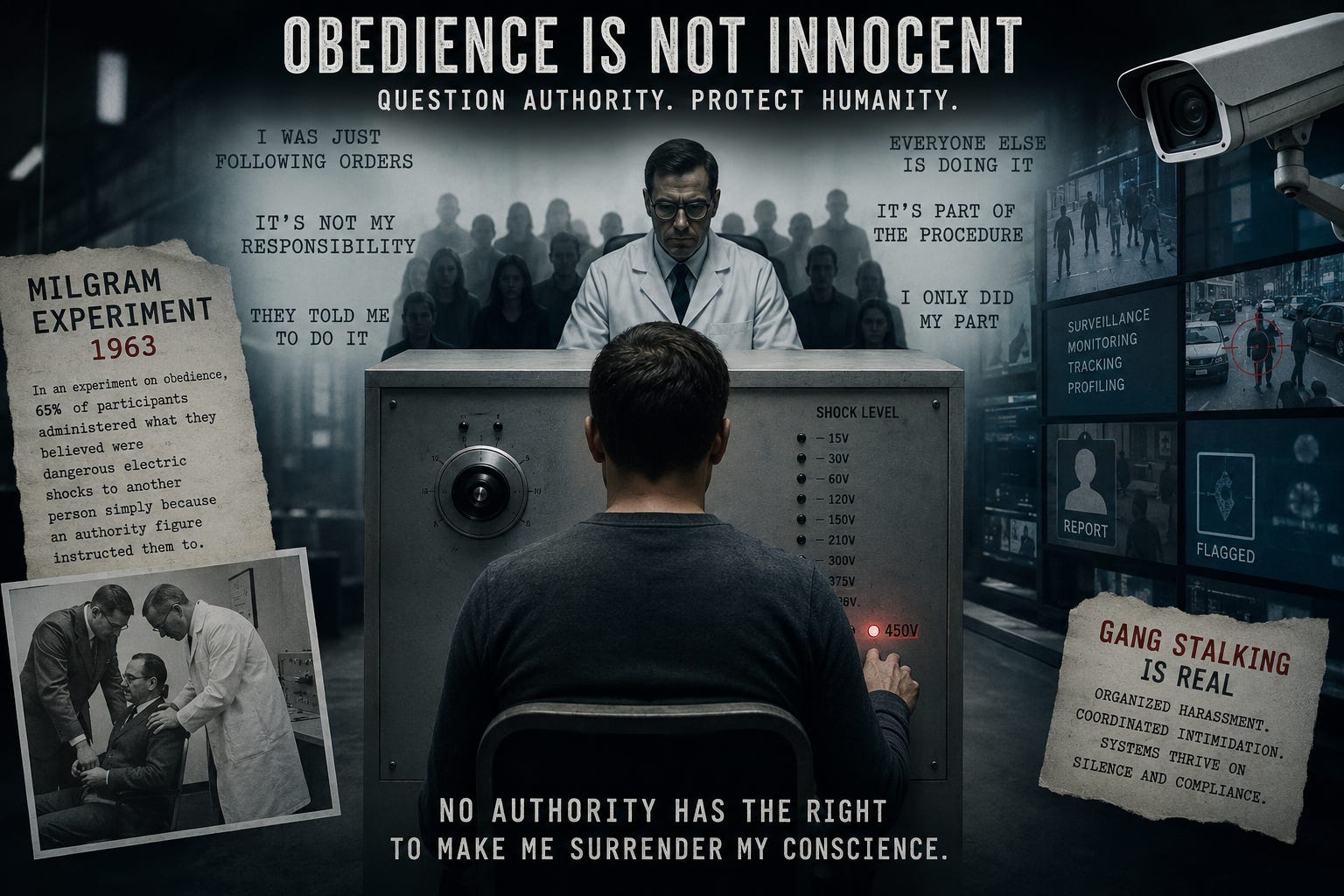
The teacher was instructed to test the learner and administer an electric shock whenever the learner answered incorrectly. A large shock generator sat before the participant, with switches progressing upward from 15 volts to 450 volts. Labels suggested increasingly serious levels of danger.
The participant believed the shocks were real. They were not.
As the supposed shocks increased, the learner began protesting. Eventually there were cries of pain, demands to be released, references to physical problems, and finally complete silence at the highest levels.
The critical question was whether the teacher would stop. When participants objected or hesitated, the experimenter encouraged them to continue.
The authority figure did not generally threaten them with violence. There was no gun, no prison sentence, and no physical restraint. There was authority, legitimacy, procedure, an experiment, and somebody apparently responsible for the situation telling the participant what to do.
For many participants, that was enough.
In Milgram’s best-known experimental condition, 26 of 40 participants continued through the maximum 450-volt level. That was 65 percent. Every participant reached at least 300 volts.
Think about what those participants believed. They believed another human being was suffering because of something they themselves were doing, yet many continued.
They Were Not Necessarily Cruel People
This is arguably the most important part of the experiment. Many participants were visibly uncomfortable. They sweated, trembled, protested, became agitated, displayed nervous laughter, questioned the experiment, and in some cases clearly wanted it to end.
Yet they continued.
That difference is essential because Milgram was not demonstrating simply that people enjoy hurting other people. He was investigating something considerably more complicated:
How does a person continue performing an action that conflicts with his or her own conscience?
The answer involves several interacting psychological mechanisms.
1. Authority Changes Behavior
Humans are social creatures, and from childhood onward people are taught to obey legitimate authority. Parents, teachers, doctors, police officers, judges, military commanders, supervisors, government officials, scientists, and institutional experts all occupy positions in which society expects some degree of compliance.
Usually this obedience is functional. Society could not operate if every instruction from every legitimate institution were constantly disregarded. The same psychological tendency, however, can become dangerous when authority is wrong.
Milgram demonstrated that the presence of a perceived legitimate authority could substantially alter what participants were willing to do. The lesson extends far beyond laboratories.
A person may resist something when approached by an ordinary stranger but comply when told, “This is authorized,” “Everyone has been briefed,” “This came from management,” “The police know about it,” “It’s part of procedure,” “Don’t worry about why,” “You’re only responsible for your part,” or “We know what we’re doing.”
None of those statements makes harmful conduct legitimate. Psychologically, however, they can make participation easier.
2. Responsibility Becomes Diffused
One of Milgram’s most influential concepts involved what he called an agentic state. A person may begin viewing himself not as the person making the moral decision but as an agent carrying out another person’s decision.
The psychological distinction becomes the difference between thinking, “I decided to hurt someone,” and thinking, “I was told to do this.”
That difference can be enormous.
Responsibility becomes psychologically transferred upward. The participant may tell himself that the scientist is responsible, the supervisor decided, the organization approved it, the government authorized it, the doctor knows what he is doing, the superior issued the order, or that he personally performed only one small part.
This phenomenon appears repeatedly in studies of institutional behavior. It also offers a framework for examining any alleged system of coordinated harassment without assuming beforehand that such a system exists.
If numerous people ever participate in mistreating one person, it does not necessarily follow that every participant knows the entire plan. One person could believe they are reporting something. Another could believe they are watching someone. Another could be following workplace instructions. Another could repeat rumors. Another could participate in online harassment. Another might simply be imitating what others are doing.
That is one reason investigating actual evidence is more useful than assuming that every observed person belongs to one centrally controlled operation.
3. Harm Can Escalate Gradually
Milgram’s participants did not begin at 450 volts. They began at 15, then 30, then 45, then 60, with the intensity increasing incrementally.
That gradual progression is psychologically significant.
Imagine instead that a participant entered the room and was immediately instructed to administer what appeared to be a potentially lethal 450-volt shock. Many people who progressed gradually through the experiment might have refused if confronted immediately with its most extreme action.
Once someone agrees to a small action, however, the next action can feel only slightly more serious. Then another step occurs, followed by another. Eventually, the individual may find himself doing something he might have rejected completely if confronted with it at the beginning.
This principle applies broadly to abusive systems. A participant might first be asked merely to observe someone, then document them, then report their movements, then exclude them, then frighten them, then ridicule them, and eventually interfere with them more directly.
At each stage, the previous behavior can become the new normal.
That hypothetical progression should not be interpreted as evidence that such a system is occurring in a particular case. It illustrates why gradual escalation is such an important mechanism whenever organized wrongdoing actually occurs.
4. The Victim Can Become an Abstraction
Physical and psychological distance matter. Milgram conducted variations in which the learner’s proximity changed, and broadly, obedience became more difficult when participants were brought psychologically or physically closer to the person experiencing the consequences.
Distance makes harm easier.
Modern society has created forms of distance Milgram could never have imagined. A person can flag an account, spread a rumor, submit a report, send someone’s information, join an online pile-on, forward a photograph, participate in surveillance, or publicly ridicule someone without ever seeing that person’s reaction.
The target becomes a username, photograph, case number, file, label, profile, complaint, or “problem person.”
Once someone becomes an abstraction, empathy can decrease.
5. Labels Can Alter Moral Judgment
This point is particularly important when discussing people who believe they are being targeted. Once a person acquires a stigmatizing label, other people may interpret everything that person does through that label.
Words such as “troublemaker,” “crazy,” “paranoid,” “dangerous,” “disruptive,” “conspiracy theorist,” “problem employee,” or “security risk” can dramatically influence how other people interpret a person’s behavior.
Whether such labels are accurate or inaccurate, they can alter social judgment. A person may begin believing mistreatment is justified because the victim has already been categorized as somebody who deserves suspicion.
This does not mean allegations should automatically be accepted as true. It means they should not automatically be dismissed through labeling either. Evidence should be investigated.
6. The Group Can Become More Powerful Than the Individual
Milgram’s later variations provided another important result: social resistance mattered. When other people defied the experimenter, participants became much more likely to resist as well.
That finding tells us something profound. Authority may be socially reinforced, but resistance can be socially reinforced too.
One person saying, “No. This isn’t right,” can radically change what everyone else believes is socially permissible.
This principle is directly relevant to whistleblowers. Many historic abuses persisted because participants assumed that everyone else was cooperating and therefore the behavior must somehow be acceptable.
Then somebody refuses.
Suddenly other people realize that refusal is possible.
7. Institutions Can Normalize Behavior Individuals Would Reject
Uniforms matter. Titles matter. Buildings matter. Credentials matter. Official paperwork matters. Procedures matter. Hierarchy matters.
Milgram’s experiments were conducted in association with Yale University, an institution carrying enormous prestige. Participants therefore entered an environment signaling legitimacy.
Institutional prestige does not automatically produce wrongdoing. But when wrongdoing occurs inside powerful systems, legitimacy can camouflage it.
People may assume that surely the organization would not permit anything unethical, that someone higher up would stop it, that lawyers must have approved it, or that adequate oversight must already exist.
History demonstrates why those assumptions cannot substitute for accountability.
Institutions are composed of people. People can make errors, follow orders, rationalize behavior, remain silent, protect organizations, and eventually expose them.
Gang Stalking and the Milgram Question
This brings us to the modern term “gang stalking.”
Scientific literature uses the term primarily in describing the experiences and beliefs reported by people who say they are being systematically followed, watched, harassed, or interfered with by multiple individuals.
A 2020 peer-reviewed qualitative study examined accounts from people describing themselves as victims of group stalking and noted that the subject had received comparatively little scientific investigation. Other peer-reviewed research analyzing online gang-stalking communities similarly describes beliefs involving distributed networks of people participating in surveillance or harassment.
The scientific status must be represented carefully. Researchers documenting these accounts are documenting people’s experiences and descriptions. That is different from independently verifying every alleged perpetrator, technology, organization, or coordinated operation.
That distinction should not be used as an excuse to ridicule people. It should be a reason to investigate concrete evidence carefully.
If someone reports being stalked or harassed, investigators can ask:
Are there recurring identifiable individuals?
Are vehicles or license plates repeatedly present?
Are there messages, emails, calls, photographs, or videos?
Are there documented threats?
Are accounts being accessed?
Are workplace records involved?
Are multiple witnesses independently reporting the same occurrence?
Do security logs support the allegation?
Are events happening at reproducible times?
Can devices be examined independently?
Can medical symptoms be independently measured?
Can environmental exposures be objectively tested?
Can alternative explanations be eliminated?
That approach protects everyone. It protects a victim if something real is happening, and it protects an innocent person from being incorrectly identified as a perpetrator.
What Milgram Does Tell Us
Milgram cannot tell us whether a particular gang-stalking allegation is true. It can, however, address an objection frequently raised whenever coordinated misconduct is alleged:
“Too many people would have to participate. Nobody would agree to do that.”
History and psychology tell us that this argument by itself is insufficient.
Large systems do not necessarily require every participant to understand the entire system. People can obey authority, compartmentalize, follow narrow instructions, conform, repeat rumors, rationalize, defer responsibility, remain silent, and gradually accept behavior they would once have rejected.
Milgram experimentally demonstrated just how powerful some of those forces can become.
This Is Bigger Than Gang Stalking
The implications extend far beyond this controversial subject.
The same psychological mechanisms can become relevant when examining military atrocities, institutional abuse, workplace mobbing, police misconduct, prison abuse, medical misconduct, corporate fraud, intelligence operations, government surveillance, school bullying, online harassment, discriminatory systems, unethical experimentation, and bureaucratic wrongdoing.
Different systems have different structures and different evidence requirements. But many share the same human vulnerability:
Someone else appears to be responsible.
“I Was Just Following Orders”
The twentieth century permanently changed how the world views that defense.
Milgram’s work developed against the backdrop of the Holocaust and the prosecution of Nazi officials, including Adolf Eichmann. Milgram wanted to know whether destructive obedience required uniquely monstrous people.
His research suggested a more disturbing possibility: under certain conditions, ordinary people could perform extraordinarily harmful actions.
The implication is not that ordinary people are inherently evil. The implication is that systems matter enormously. Authority matters. Social pressure matters. Distance matters. Incremental escalation matters. Responsibility matters. Language matters. The presence or absence of dissent matters.
The Ethical Controversy Around Milgram
Milgram’s own experiment eventually became an ethical case study.
Participants were deceived. Many believed another person was actually being injured, and some experienced considerable emotional distress. The experiment therefore contributed to continuing debates surrounding informed consent, deception, psychological risk, debriefing, and researchers’ responsibility toward human subjects.
Ethical critiques of Milgram remain part of the psychology literature today. Modern American Psychological Association ethics standards contain specific provisions governing informed consent and deception in research.
There is an important irony here. An experiment designed to demonstrate the dangers of obedience itself became an enduring example of why researchers need ethical boundaries.
Imagine the Same Principle in the Digital Age
Milgram’s laboratory had a shock generator. Our world has networks, smartphones, cameras, databases, social media, location information, facial recognition, automated decision systems, artificial intelligence, mass communications, behavioral advertising, remote workplaces, online communities, and digital reputation systems.
Modern technology dramatically increases the number of ways one person’s actions can affect another person without direct physical contact.
A worker clicking a button might have no idea what happens downstream. A moderator may see only one piece of information. An algorithm designer may never meet the people affected by the system. A contractor may receive a narrow assignment. A supervisor may see only a report. A person participating in an online campaign may know almost nothing about the individual being attacked.
That is why modern ethical safeguards cannot focus exclusively on intentional cruelty. They must also address distributed responsibility.
Compartmentalization
One of the most important concepts for understanding large organizations is compartmentalization. People may know only what they need to know.
Compartmentalization has legitimate purposes. Governments, companies, scientific organizations, cybersecurity teams, military organizations, hospitals, and financial institutions all use forms of it, often for security or efficiency.
But compartmentalization also creates a moral danger.
If each person sees only one tiny part of a process, nobody may feel responsible for the complete outcome. Person A collects information. Person B analyzes it. Person C approves something. Person D performs an action. Person E reviews a report.
Every person can tell himself, “I only did my job.”
That is precisely why accountability must look at systems, not merely isolated individuals.
Dehumanization Makes Participation Easier
Another recurrent feature of abusive systems is dehumanization.
People become categories rather than human beings: the enemy, the criminal, the undesirable, the difficult patient, the problem employee, the extremist, the threat, the target, the crazy person, or the conspiracy theorist.
Once someone has been reduced to a label, behavior that would ordinarily trigger empathy can become easier to justify.
This is why allegations against individuals must be evaluated through evidence and due process rather than rumor or stigmatizing labels.
It works in both directions. A person reporting harassment should not automatically be dismissed as irrational. Nor should someone accused by a person reporting harassment automatically be declared guilty.
Evidence remains the dividing line.
Bystanders Matter
There is another participant in nearly every abusive system: the person who sees something happening and does nothing.
Sometimes the bystander is frightened. Sometimes they are uncertain. Sometimes they assume someone else will intervene. Sometimes they fear losing employment. Sometimes they simply do not want involvement.
Silence, however, can become structurally important.
If twenty people privately believe something is wrong while each assumes everyone else accepts it, a harmful system can appear far more socially legitimate than it actually is.
The moment one person objects, others may discover that they were never alone. Milgram’s variations involving peer dissent illustrate the enormous importance of social resistance.
The Question Society Should Be Asking
When somebody reports coordinated mistreatment, there are two intellectually lazy responses.
The first is:
“Everything that person says must be true.”
The second is:
“That could never happen.”
Neither is an investigation.
The proper response is to ask what can be independently verified, what evidence exists, what alternative explanations exist, what records and witnesses exist, and what data could establish or disprove the allegation.
Investigators can ask whether technical claims can be reproduced, whether independent experts can examine the evidence, whether law enforcement can distinguish ordinary activity from stalking behavior, whether physicians can document physical findings, whether digital forensic specialists can examine devices, and whether environmental investigators can objectively measure claimed exposures.
That is how serious allegations should be handled.
The Most Important Lesson of Milgram
The Milgram experiment leaves society with one question that has never disappeared:
At what point does obedience end and personal responsibility begin?
Every participant in every institution ultimately confronts some version of that question.
A uniform does not eliminate conscience. A paycheck does not eliminate conscience. An instruction does not eliminate conscience. A security clearance does not eliminate conscience. A supervisor does not eliminate conscience. An algorithm does not eliminate conscience. A bureaucratic procedure does not eliminate conscience. Neither does being only one person among many.
If a person believes an instruction is harming another human being, responsibility cannot simply disappear because someone higher in the hierarchy issued the order.
That may be Milgram’s most enduring warning.
The frightening discovery was never simply that 65 percent of one group reached a switch marked 450 volts. The frightening discovery was how ordinary the people holding the switch appeared to be.
Perhaps the most hopeful discovery came from the same body of research. People also refused. People challenged authority. People stopped. People recognized that responsibility remained theirs. When others demonstrated resistance, resistance became easier.
That may ultimately be the lesson worth carrying into the twenty-first century.
Whether the subject is institutional misconduct, organized harassment, workplace mobbing, online persecution, government abuse, corporate wrongdoing, unethical research, or allegations described as gang stalking, a functioning society needs something stronger than obedience.
It needs evidence, independent oversight, due process, whistleblower protection, informed consent, accountability, and human beings willing to say:
No authority has the right to make me surrender my conscience.
If you value independent journalism that digs deeper, questions conventional narratives, examines the evidence, and explores the issues that too often go overlooked, please subscribe to Targeted Community and consider becoming a paid member. Your support helps fund independent research, investigative reporting, document review, public-record research, and the continued examination of technology, government accountability, health, human rights, civil liberties, and emerging threats.
I do not accept advertising or commercial sponsorships, which means this work depends on readers who believe independent journalism still matters. If this article made you think, taught you something new, or raised questions worth investigating further, please subscribe, share it with others, and help this community continue growing.
Resources/References
American Psychological Association. (2004, May 25). Obeying and resisting malevolent orders. https://www.apa.org/topics/forensics-law-public-safety/order
Haslam, N., Loughnan, S., & Perry, G. (2014). Meta-Milgram: An empirical synthesis of the obedience experiments. PLOS ONE, 9(4), e93927. https://doi.org/10.1371/journal.pone.0093927
Milgram, S. (1963). Behavioral study of obedience. Journal of Abnormal and Social Psychology, 67(4), 371–378. https://doi.org/10.1037/h0040525
Milgram, S. (1974). Obedience to authority: An experimental view. Harper & Row.
Russell, N. J. C. (2024). Stanley Milgram’s obedience studies: An ethical and methodological critique. Philosophia Scientiæ.
Additional Scholarly Sources Used for the Article
Caspar, E. A., Ioumpa, K., Keysers, C., & Gazzola, V. (2021). A novel experimental approach to study disobedience to authority. Scientific Reports, 11, 22927.
Harvard University Department of Psychology. (n.d.). Stanley Milgram. https://psychology.fas.harvard.edu/people/stanley-milgram
These references cover the original Milgram experiment, the 65% maximum-obedience result, the 15-to-450-volt procedure, participant distress, variations involving proximity and peer resistance, obedience to authority, later analysis of Milgram’s 23 experimental conditions, ethical controversies, and subsequent research on obedience and disobedience.
Further Resources
Guardians Global AI Code & Human Rights Constitution, Citizens Edition
https://docs.google.com/document/d/1zqVMQf_3_1LPXpe1f32zvADDV-eJyLuIfTBXjvUen8c/edit?usp=drivesdk
Guardians’ Global AI Code & Human Rights Constitution, Full Edition / 1000 Most Dangerous and Deadly Technologies
https://docs.google.com/document/d/1aKAFK3wEvdn8gkQm_wTIRD0xpOGWzKj4/edit?usp=drivesdk
TO ALL LEADERS, INSTITUTIONS AND CITIZENS OF THE WORLD / Annexes
https://docs.google.com/document/d/1bCb6vJ_7l0KKy3iXBzR0GKRRyiz9GhzA45BhTueqJl4/edit?usp=drivesdk
Letter to Congress
https://docs.google.com/document/d/1-AdZuXzSqdLbLQGA7BoDlck4lT1D2_Nr/edit?usp=drivesdk&ouid=112154308998711532676&rtpof=true&sd=true
Comparative Tables, Charts and Glossary
https://docs.google.com/document/d/1SyPVRYO2VkSWdDLQohxpEzbKH5MbXVmo/edit?usp=drivesdk&ouid=112154308998711532676&rtpof=true&sd=true
Targeted Community on Substack
https://targetedcommunity.substack.com
LinkedIn, Christine Wolking
https://linkedin.com/christine-wolking
Global Survivor, Emergency Preparedness, EMF/5G/6G Protections and Much More
https://globalsurvivor.co/
Sign the Petition
The Fight for Survival: Humanity vs. AI, Chemtrails, Geoengineering, Directed Energy Weapons, 5G Abuses, Gangstalking & More
Support Independent Journalism and Research
If this article sparked your curiosity, challenged your perspective, taught you something new, or inspired you to learn more, please consider subscribing and becoming a paid subscriber to Targeted Community.
Paid subscriptions are $5 per month or $50 per year and help support independent journalism, investigative research, education, advocacy, the Guardians Global Code Foundation, and continued research into emerging technologies, artificial intelligence, civil liberties, and human rights.
Targeted Community does not depend on commercial advertising or corporate sponsorships. Reader support helps make independent research and publication possible.
https://targetedcommunity.substack.com
Referral Rewards
5 referrals = $20 gift card
10 referrals = One-hour Zoom with Christine Wolking
25 referrals = Founding Membership in the Guardians Global Code Foundation plus a $50 gift card
Thank you for reading, sharing, and being part of a growing community dedicated to truth, accountability, ethical artificial intelligence, civil liberties, and human rights.
Christine Wolking
Founder, Guardians Global Code Foundation
Creator/Author, Guardians’ Global AI Code & Human Rights Constitution
Owner, Global Survivor
Comments
Nothing yet. Say the first thing.
Sign in to join the conversation.