
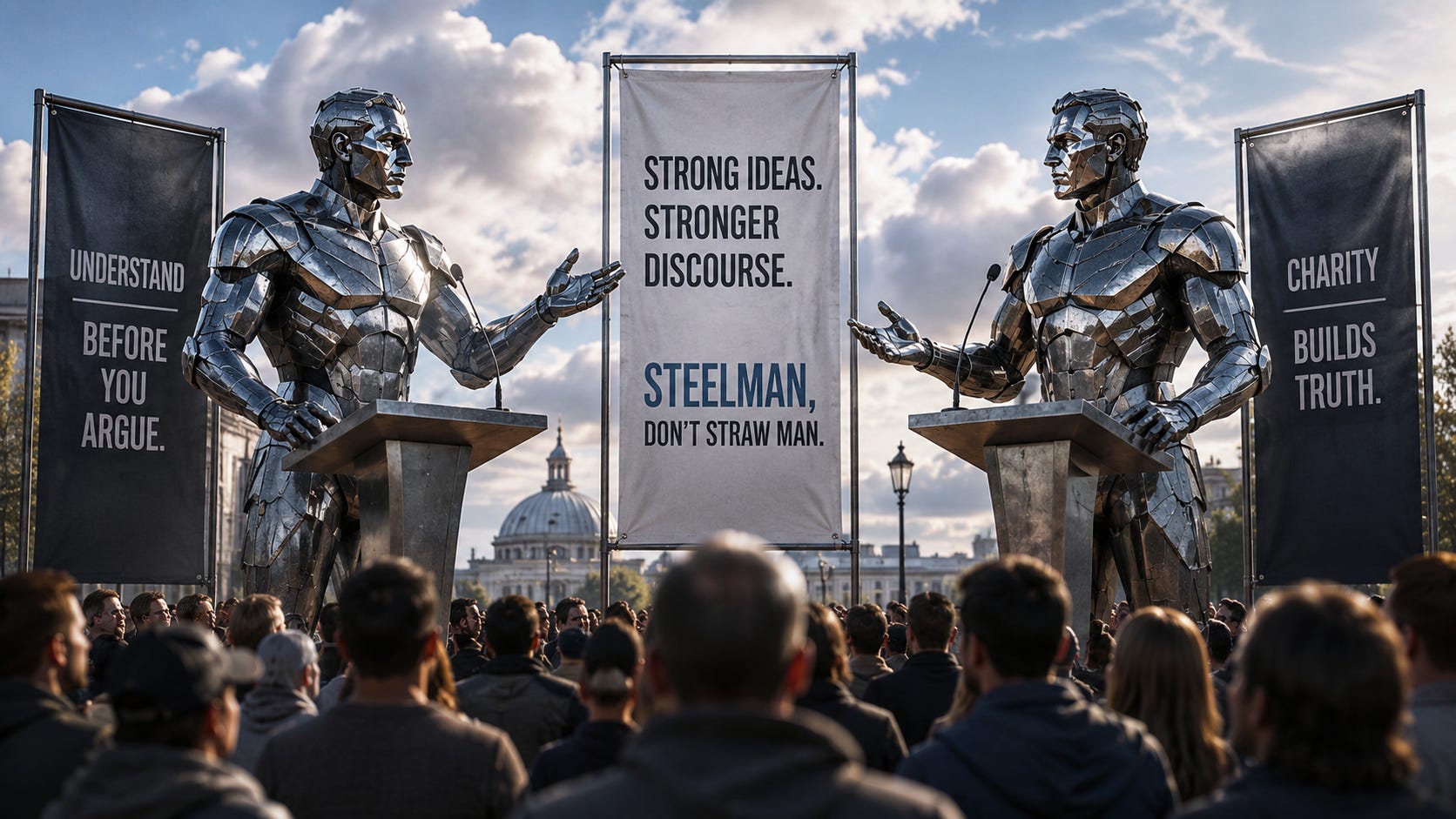
TL;DR:
Most bad arguments begin by attacking weak versions of opposing ideas. Steelmanning is the opposite approach: intentionally presenting the strongest, most reasonable version of another person’s position before responding to it. It improves debate, reduces misunderstanding, and creates more productive discourse because people feel heard rather than caricatured.
You’ve probably watched this happen a hundred times. Two people disagree about something important. Politics. Parenting. Technology. Education. Whatever the topic is, the conversation starts with potential. Then, within minutes, one person summarizes the other side in a way that makes everyone listening think:
“That’s… not actually what they meant.” The conversation derails from there.
Instead of discussing the real disagreement, both people end up arguing over distortions of each other’s position. One side feels misrepresented. The other side feels justified attacking a simplified version of the argument.
Nothing gets clarified. Everyone leaves more frustrated than when they started. That dynamic has a name. It’s called strawmanning. And there’s a much healthier alternative that almost nobody practices consistently: Steelmanning.
A straw man argument weakens an opponent’s position so it becomes easier to attack. A steelman argument does the opposite. It deliberately reconstructs the strongest, most reasonable version of the opposing viewpoint before responding to it.
The term “steelman” is relatively modern and informal compared to classical logic terminology, but the underlying principle has deep roots in philosophy, law, and intellectual debate traditions. Philosopher Daniel Dennett described a similar principle in Intuition Pumps and Other Tools for Thinking, arguing that before criticizing a position, you should first restate it so clearly and fairly that the other person says, “Yes, that’s exactly what I mean.”¹
That’s harder than it sounds. Because steelmanning requires something most arguments avoid: genuine effort to understand.
Strawmanning is tempting because it makes disagreement easier. If your opponent’s position sounds ridiculous, your own position automatically feels stronger by comparison.
This happens constantly online. Someone expresses concern about immigration policy and gets reframed as hating immigrants. Someone questions a new technology and gets portrayed as anti-progress. Someone advocates for reform and gets treated as wanting total destruction of the system. The original argument disappears beneath the exaggeration.
Psychologists studying motivated reasoning have found that people naturally interpret opposing viewpoints in ways that reinforce their own existing beliefs.² We don’t just argue against other people’s ideas. We unconsciously edit those ideas into forms that feel easier to defeat.
That tendency intensifies in emotionally charged environments like social media, where speed and certainty outperform nuance.
Steelmanning interrupts that pattern. Instead of looking for the weakest version of an opposing argument, you look for the strongest possible interpretation that still remains faithful to what the other person actually believes. That changes the emotional structure of the conversation immediately.
People become less defensive because they feel accurately understood.
The debate becomes more intellectually honest. And importantly, it forces you to think more carefully too. If your position still holds up against the strongest version of the opposing case, your argument becomes more credible.
Philosopher John Stuart Mill argued something very similar in On Liberty. He warned that people who only understand their own side of an argument rarely understand it deeply. According to Mill, meaningful intellectual development requires engaging seriously with opposing viewpoints, not dismissing caricatures of them.³
Steelmanning operationalizes that idea in real conversation.
Imagine someone says:
“I worry social media is damaging attention spans and increasing social isolation.”
A strawman response might be:
“So you think technology is evil and everyone should throw away their phones?”
That’s easier to attack because it sounds extreme.
A steelman response sounds different:
“So if I understand you correctly, you’re not against technology itself. You’re concerned that certain platform designs may be shaping behavior in unhealthy ways, especially for younger users.”
Now the real conversation can begin. Notice what happened there. The second response clarifies, and clarification is one of the most underrated skills in modern discourse.
One reason people resist steelmanning is because they fear it weakens their own side. It doesn’t. Accurately representing someone else’s position is discipline.
Good lawyers do this constantly. Serious academics do too. The strongest debaters often spend more time understanding opposing arguments than their own supporters do.
Why? Because weak caricatures create weak rebuttals. If you only practice against distorted versions of opposing ideas, your reasoning becomes fragile. Steelmanning strengthens intellectual rigor because it removes easy victories.
Steelmanning improves arguments and it improves relationships. Many interpersonal conflicts escalate because one side feels misunderstood.
When someone hears their position reflected back accurately, tension drops. The nervous system relaxes. Defensiveness decreases. Productive disagreement becomes possible again.
Research in conflict resolution consistently shows that perceived understanding is one of the strongest predictors of successful dialogue outcomes.⁴ People don’t require agreement to continue a conversation. They require evidence that they’ve been heard fairly. That’s what steelmanning provides.
A simple rule helps:
Before responding to someone’s argument, try to explain it in a way they would endorse themselves. You can even ask directly: “Is this a fair summary of your position?”
That question alone changes the tone of many conversations.
Other useful habits include:
Removing emotionally loaded exaggerations
Distinguishing between extreme examples and core claims
Asking clarifying questions before criticizing
Looking for the strongest evidence supporting the opposing side
The goal isn’t to become passive or indecisive, but rather it’s to argue against reality rather than caricature.
Modern communication systems reward strawmanning. Outrage spreads faster than nuance.
Simplified enemies generate engagement. Complexity gets flattened into tribal shorthand.
Steelmanning moves in the opposite direction. It slows conversation down just enough for actual understanding to occur. That’s one reason it matters so much for healthy digital discourse.
A platform built around constructive disagreement only works if participants engage honestly with each other’s real ideas rather than distorted versions designed for easy dismissal.
Without steelmanning, debate becomes performance. With it, disagreement becomes useful.
Steelmanning is difficult because it requires intellectual confidence. You have to believe your position can survive contact with the strongest opposing arguments. Many people unconsciously avoid steelmanning because they fear what might happen if the other side sounds too reasonable. But that discomfort is exactly where better thinking begins.
The point of discourse isn’t to win imaginary arguments against fake opponents. It’s to understand reality more clearly together. Steelmanning helps make that possible.
Daniel Dennett, Intuition Pumps and Other Tools for Thinking
Ziva Kunda, “The Case for Motivated Reasoning,” Psychological Bulletin (1990)
John Stuart Mill, On Liberty
Fisher & Ury, Getting to Yes
Jonathan Haidt, The Righteous Mind
Comments
Nothing yet. Say the first thing.
Sign in to join the conversation.