
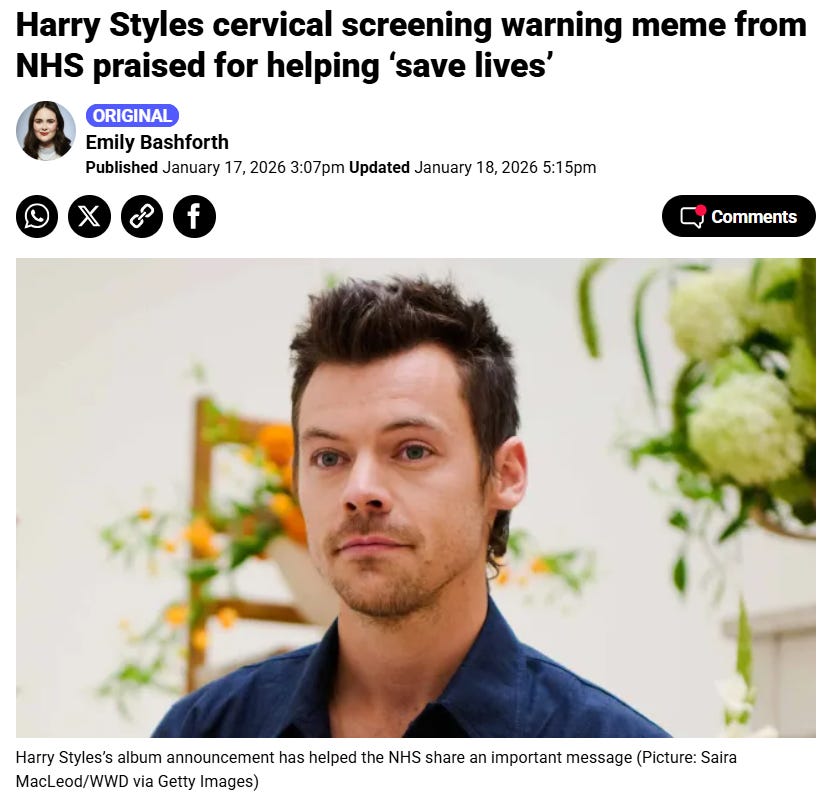
Memes and healthcare social media communications might seem about as compatible as oil and water. Yet last week, the UK’s National Health Service or NHS proved otherwise, using a Harry Styles meme to prompt women to book cervical cancer screenings and blowing past typical health engagement metrics. This Instagram post generated four million impressions and 400,000 engagements (and counting).
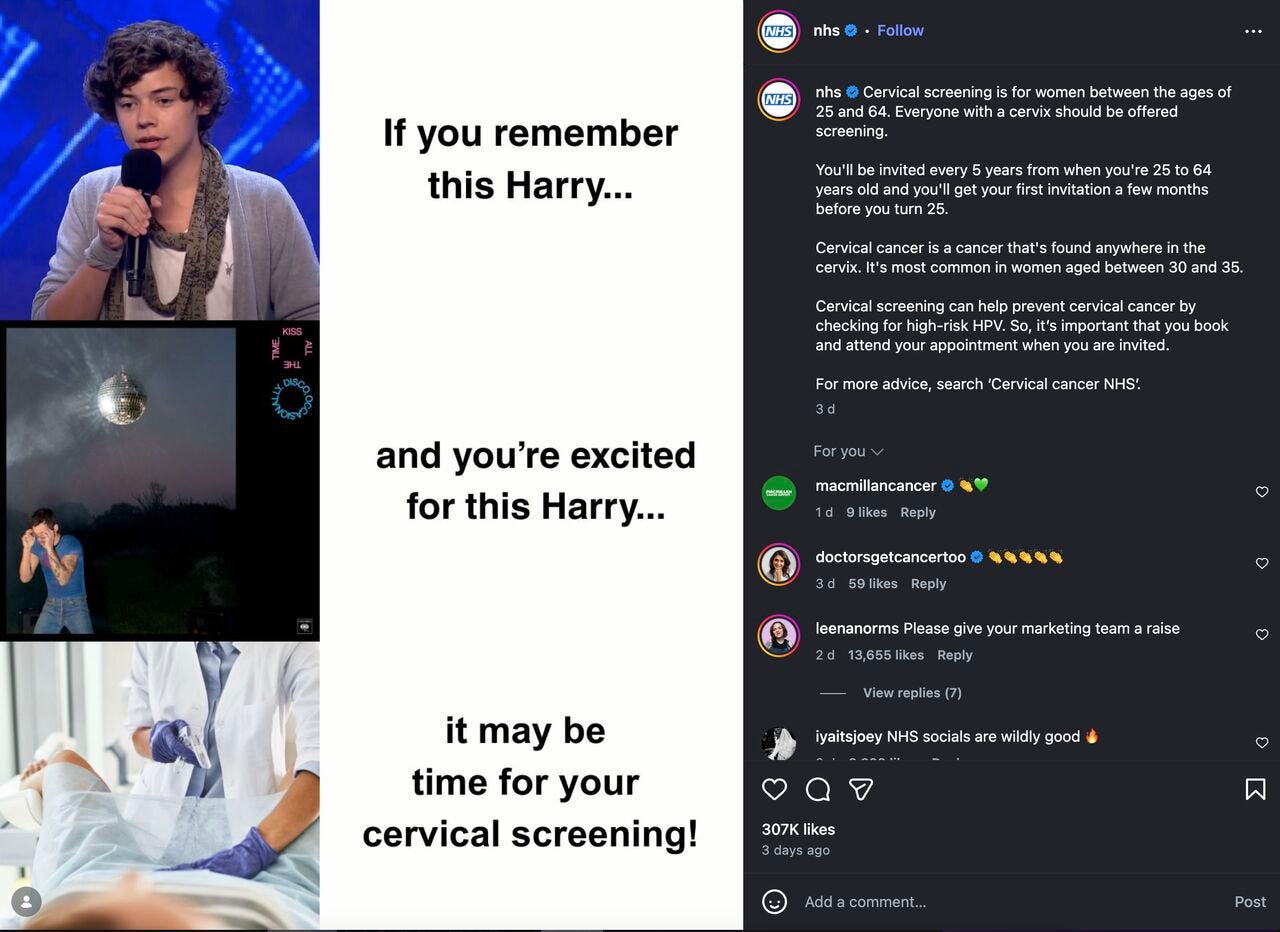
This meme was simple: the NHS Instagram post paired a nostalgic photo of Harry Styles from his X Factor days in 2010 with the artwork from his newly announced album this year, captioned “If you remember this Harry… and you’re excited for this Harry…” before pivoting to a direct health call-to-action — “it may be time for your cervical screening.” Fans who could remember his debut in 2010 are likely to be between the ages of 25 and 64, the target segment for cervical cancer screening.
Using a three-part meme formula—nostalgia, a trending cultural hook, and a clear call-to-action—the NHS slipped an essential health message into a moment when Harry Styles fans were already emotionally invested. Instagram users responded positively, with many commenting that the meme actually prompted them to book a screening, and praise flowed for the NHS social media team’s ability to “speak the language of the internet” while staying on message.
This tactic worked because it struck a balance: it was culturally current, audience-centric, and directly related to the health behaviour it aimed to influence. The humour was soft and relatable to the target audience, not dismissive of the seriousness of the underlying medical issue. This balance even won a Metro media report.
Where Memes Fall Short — Lessons from Missteps
But not all meme usage translates gracefully in healthcare contexts.
Last year, the UK Stroke Association’s Threads post tried to latch onto a viral kisscam of two people who were embarrassed to be seen hugging at a Coldplay concert, mentioning “nothing destroys lives and families quicker than a stroke”, which some other users felt was in poor taste and downplayed the severity of the condition. It also responded to a comment that the original post lacked compassion with another post, saying, “We didn’t make anyone have an affair.”
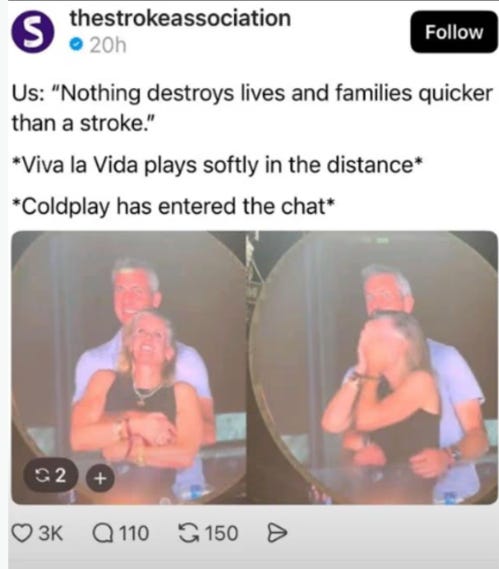
The result was widespread disapproval from beneficiaries and disability advocates, prompting the charity to delete the posts and issue a formal apology. The charity’s chief executive, Juliet Bouverie, noted, “This isn’t how we usually speak about stroke – a condition that changes lives in an instant and leaves a deep impact on survivors, families and carers”, inadvertently trivialising the seriousness of stroke and offending survivors who felt their lived experiences were undermined.
This misstep highlights a crucial truth: context matters. Humour in messaging must be carefully calibrated to enhance understanding and engagement without diminishing the perceived importance of the health issue or belittling the lived experiences of affected communities.
Meme Guidelines for Social Media
For PR and strategic communications professionals ready to experiment with memes while avoiding unnecessary risks, the NHS social media team has posted about their experience with memes. The team stated their objectives for meme experimentation: “Not everyone wants advice from the NHS; but we want them to hear it. Not everyone cares; but we want them to. Not everyone follows our Instagram account; but we want to break out beyond our 570,000 followers.”
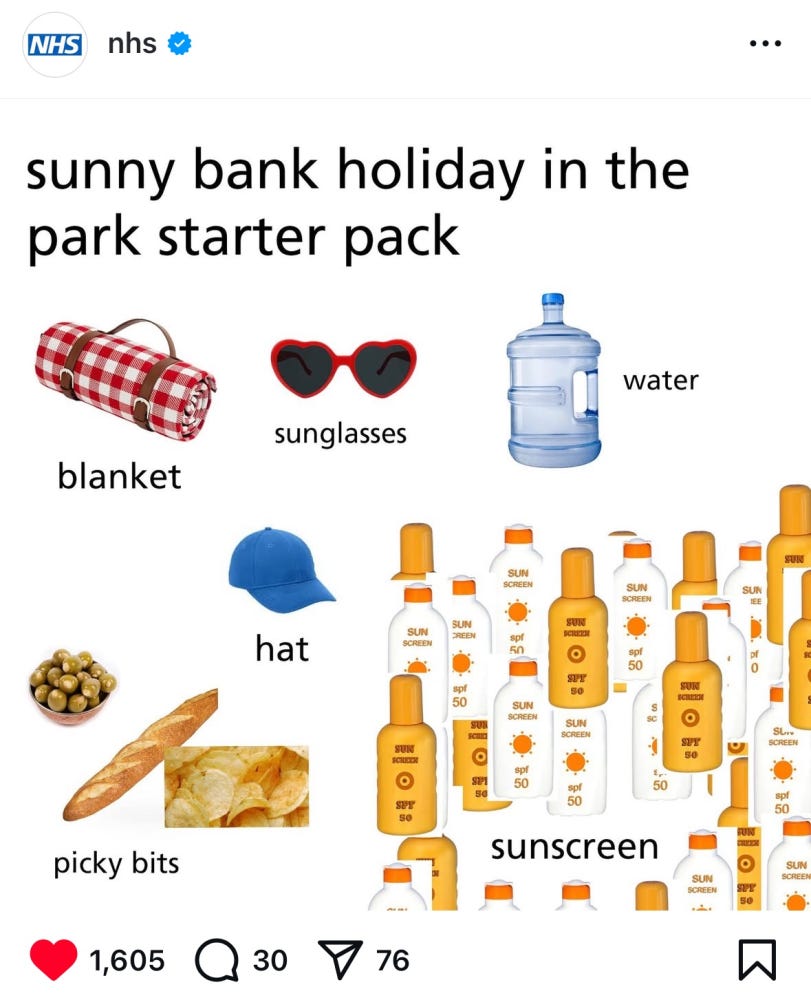
It’s a fascinating read, with an upfront acknowledgement that memes don’t have to be ‘hilarious.’ Notably, the NHS social media team did not start its’ meme streak with a complicated meme tagging onto a celebrity’s coattails, but rather a plain vanilla meme on what to bring for the upcoming summer holiday season.
After digesting the NHS social media team’s posts, I came up with a potential meme creation framework that balances creativity with care:
Align a Meme with Your Target Audience
Memes work best when they resonate with the specific subculture of your audience, not just broader internet trends. Harry Styles and all the NHS memes are very British.
Tie Clearly to an Action or Insight
A meme should be more than a funny image; it should anchor a meaningful health message — a prompt to act, a myth to dispel, or an awareness point to reinforce.
Evaluate Emotional and Ethical Dimensions
Before posting, ask: Could this be interpreted as dismissive, insensitive, or offensive? If the answer is even lightly yes, revisit or shelve the idea.
Use Sparingly and Strategically
Over-memeing dilutes impact. Think of memes as spice, not the main course. Since the NHS social media team introduced memes, it has become a 10% meme account.
Monitor and Respond with Empathy
Be prepared to engage in dialogue if a meme provokes questions, confusion, or criticism and respond with sincerity.
Conclusion: Be Brave, Be Smart, Be Human
The brave communicator doesn’t avoid risk but always has a plan to manage it. By combining cultural savvy with clinical sensitivity, PR professionals can unlock the power of memes while protecting the dignity and well-being of the communities they serve. In the end, social media communications isn’t just about being seen or shared — it’s about being meaningful and responsible in every conversation you enable.
About the author
JX (Jaxon) Tan founded Momentum AI Communications, a boutique PR consultancy based in Singapore, with a mission to simplify science and spark engagement. He was previously based in China, where he led international communications for BGI Genomics and was head of content (APAC) for PR Newswire. Reach him on LinkedIn.
Comments
Nothing yet. Say the first thing.
Sign in to join the conversation.