
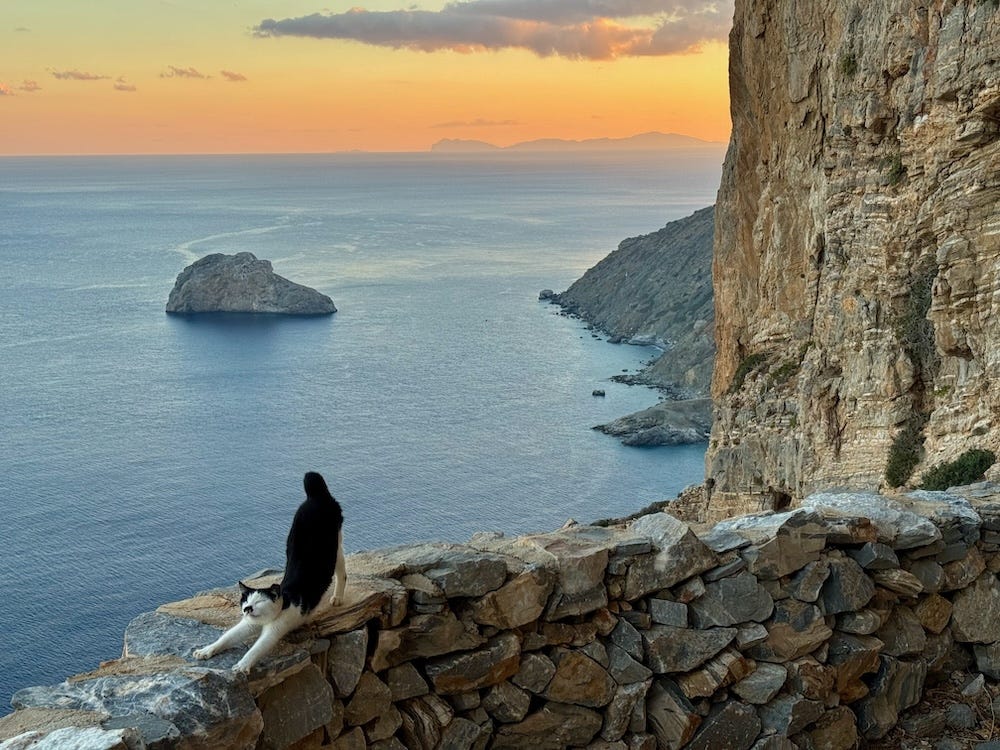
Those who wish to know about the world must learn
about it in its particular details.
-Heraclitus (Greek philosopher, c. 500 BCE)
When people ask me why I want to visit a particular place, I never know how to answer. I might say, “There’s so much history there!” or, “It looks so beautiful,” or, “I’m a fan of such-and-such writer from that region.” While not false, these aren’t the whole story.
In truth, I don’t know why particular places call me. I just know I feel drawn. That’s why I spent the better part of a year in West Africa almost thirty years ago, and it’s why I traveled to Greece last month.
I’d been hearing the Grecian siren song for years. In 2018, I’d started researching avenues for leading a retreat there. So when I finally developed a plan for a women’s writing retreat on the island of Amorgos, I made sure to allow myself extra time to explore.
I arrived in the morning to pouring rain.
After a ten-hour flight, an hour-long subway ride and a bit of urban trudging, I hauled my suitcase up the narrow stairs of the Hotel Tempi, where I’d booked a room. The man at the desk looked up in surprise.
“Not ready yet,” he said brusquely, though not unkindly. “Come back one hour.”
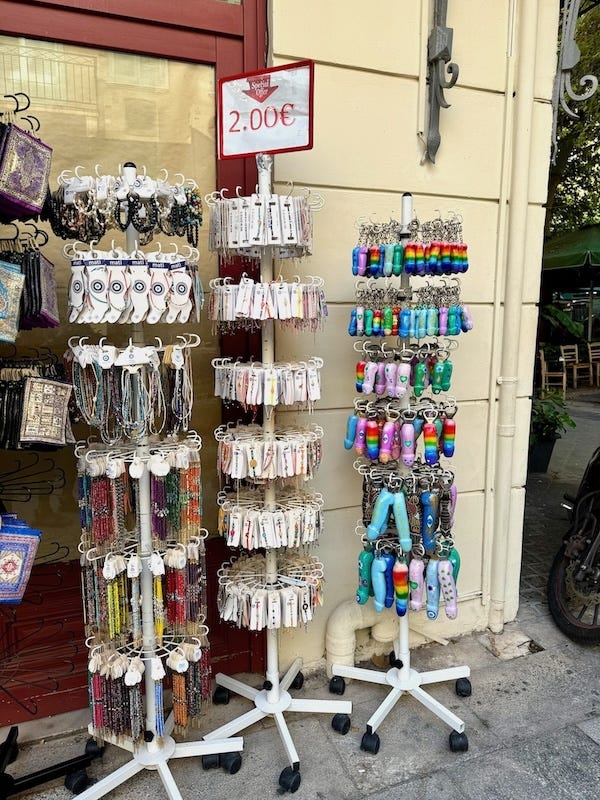
I stowed my suitcase and wandered the narrow, cobbled alleys of the heavily-touristed Monastiraki district in the rain, gazing blearily at store after store of colorful tchotchkes, puzzling over the ubiquitous penis-shaped bottle openers (who buys these?!), and gasping in wonder every time I rounded a corner and came face to face with crumbling columns, thousands of years old. Sometimes the ancient structures were fenced off. At other times you looked down and they were beneath your feet, covered in plexiglass, so you were literally walking on top of them.

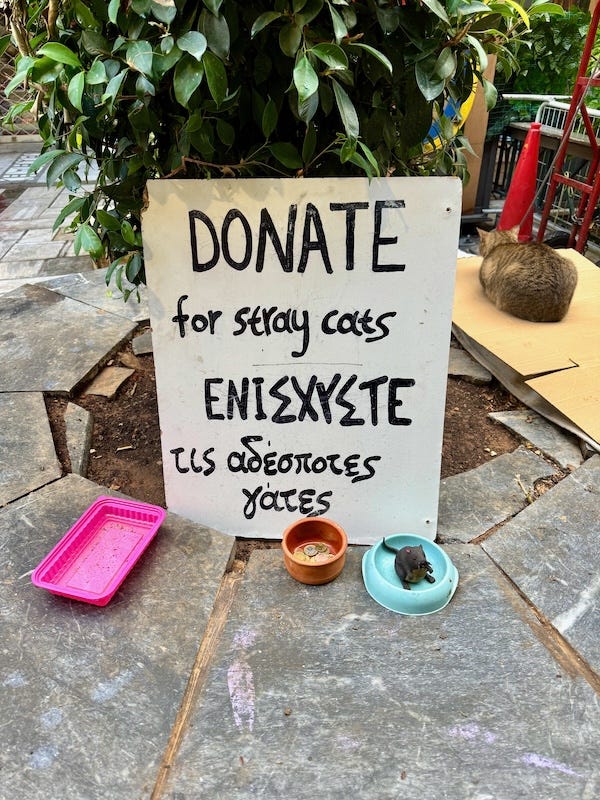
I noticed, as well, a ubiquity of cats. They were everywhere! Surprisingly, they didn’t look scraggly and starved, but rather well-loved. I soon discovered sites where people collected donations and put food out for them. I later learned that the locals count on these cats to keep the mouse and rat populations at bay.

I eventually hauled my soggy self back to the hotel and asked my laconic front-desk pal, “Has it been an hour yet?”
He gave a half-shrug, half-nod. “Okay.”
I paid €100 cash for my three-night stay. He told me the shared bathroom was down the hall from my fourth-floor room.
“No private bathroom?” I asked.
He shook his head. “You buy cheap room.”
I asked if I could upgrade.
“No. Full.”
I hiked up the four steep flights of stairs. The room was tiny but clean. A single bed, a desk, a sink and an armoire. Just enough space to squeeze by my suitcase and lie down on the bed.
I smiled that, on the eve of my fifty-ninth birthday, I was traveling in much the same manner I had in my wild, untethered youth. But what did I need, really, besides a roof, a shower, and a place to sleep? How lucky I was to encounter this city for the first time, with its fascinating juxtapositions of old and new. How lucky that my legs could still carry me up these stairs without undue strain. That my heart still thrilled to adventure.
I immediately fell asleep. For two hours, I slept like an unexcavated tomb, until the alarm I’d set to avoid sabotaging my nighttime rest went off. I slapped blindly at it until it went quiet. I fell back to sleep.
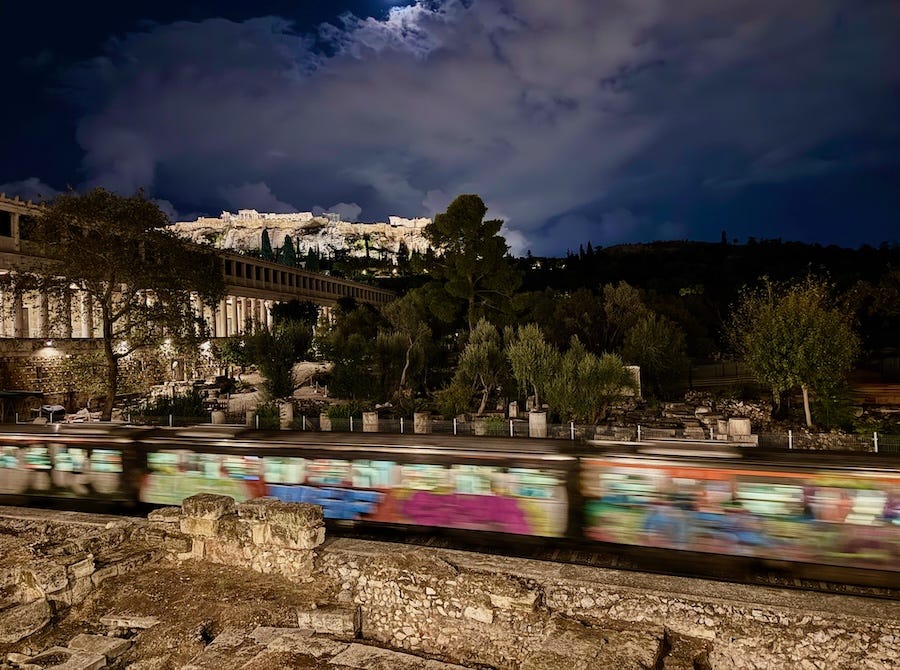
At 2 a.m. I awoke with a raging headache. I immediately understood the cause and the remedy. Coffee. The last time I’d had it was nearly forty-eight hours earlier, before leaving the U.S.
I figured if there was a place outside New York City where I could walk out the door at two in the morning and find coffee, this was it.
After some initial disappointments—“Coffee?” “No, Coffee finished. Drinks.”—I located an all-night café. I sat at a rickety metal table outside, sipping cappuccino in the mild October night. I took out my notebook and wrote for a while.
A man approached, speaking Greek. I shook my head apologetically, and he switched to English.
He asked if I was a writer. I said I was and that I’d just arrived in Greece to lead a writing retreat. We began chatting. Soon his friends from a nearby table got involved, and Voila! I had three new pals.
I remembered then what I love about solo wandering. It’s fun to travel with others, but more often than not, you and your companions form a closed unit. But no matter your age, a solo traveler with a willing spirit is open to the world.
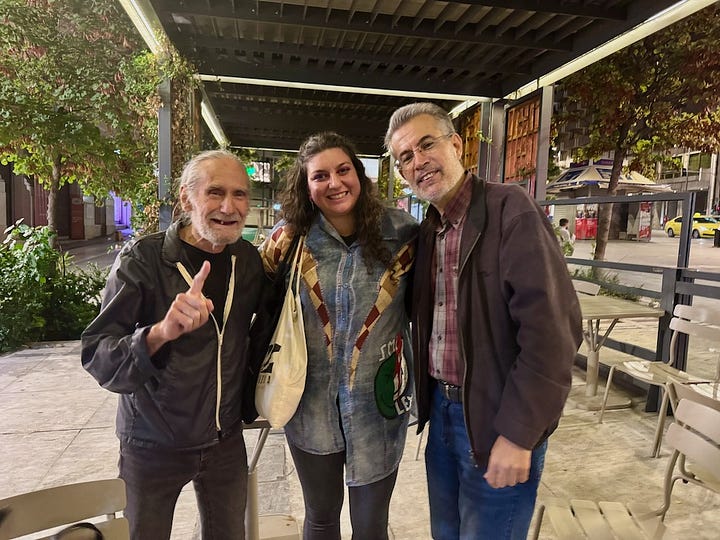

My co-leader for the Amorgos retreat was novelist Kelly Dwyer—an Oberlin classmate of mine and a fun, brilliant, creative badass. Jonas Saul of Imagine Greece Retreats, our in-country retreat partner, had generously offered a two-day walking tour of Athens to anyone who wanted to arrive a few days before the retreat’s official start. Consequently, I spent the next couple of days kicking around Athens with Jonas, Kelly and most of our retreat participants.

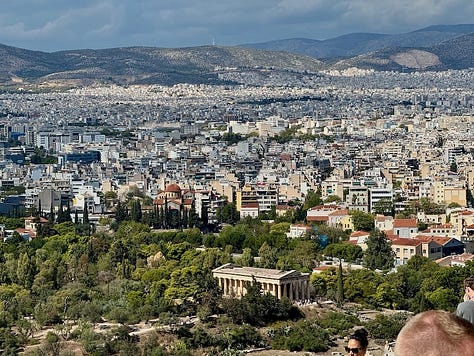

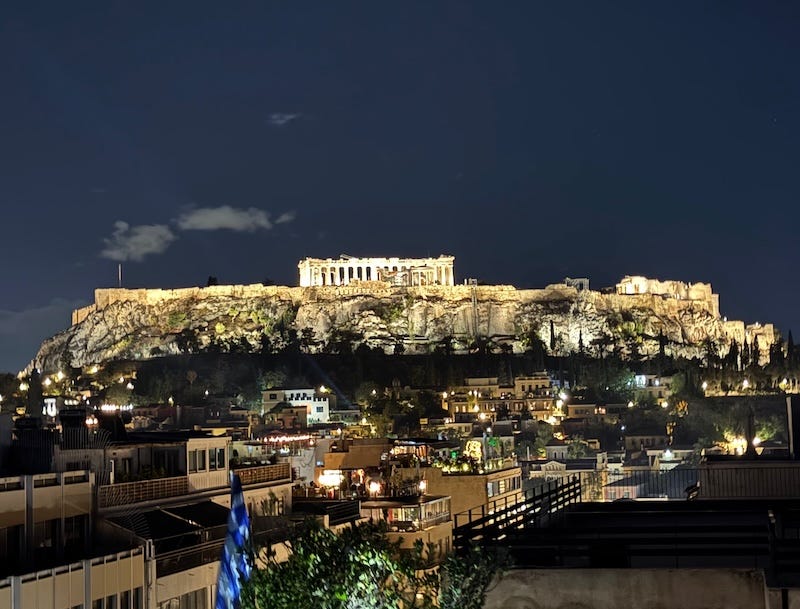
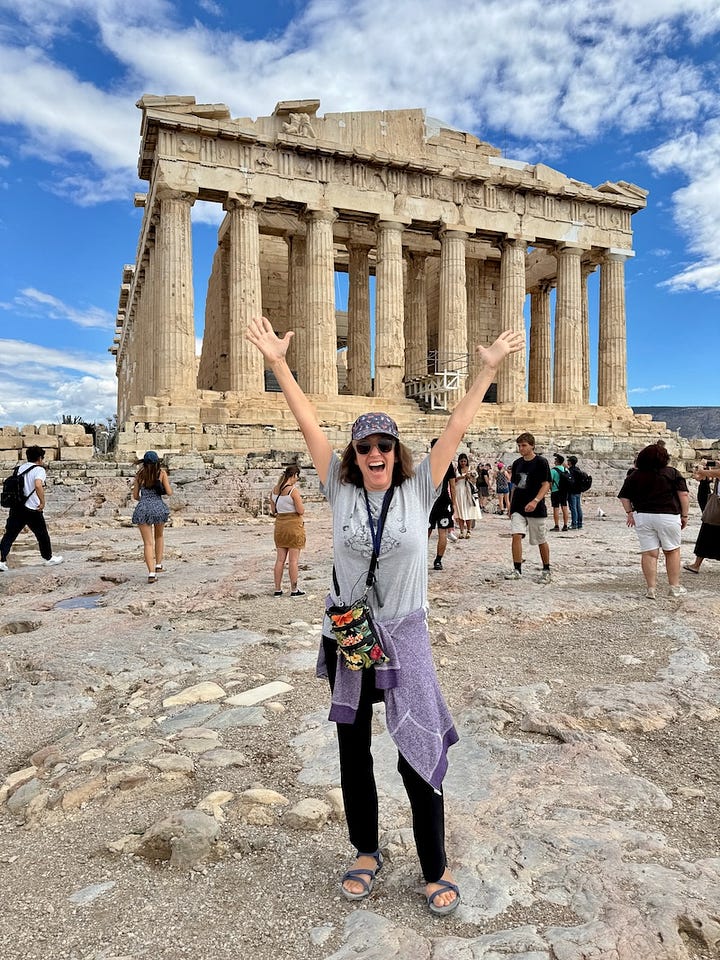
Perched high on a rocky outcrop overlooking Athens, the Acropolis contains several majestic buildings. Its crowning jewel, however, is the Temple of the Athena, known as the Parthenon. Visible from all over the city, it boasts spectacular views stretching all the way to the sea.
Athens is one of the oldest named cities in the world, with over 5000 years of continuous habitation. According to legend, it was originally called Aktiki, meaning “beach” or “coast,” after its King, Aktaio. A later king named Kekrops—a cross between a human and a snake—changed the city’s name to Kekropia.
When the gods began taking Greek cities under their patronage and naming them after themselves, a fierce conflict developed between Poseidon, god of the sea, and Athena, goddess of wisdom, over who would be Kekropia’s patron.
To avoid further violence, Zeus decreed they should each present the city with a gift and allow the inhabitants to vote on which gift they preferred. Poseidon struck the earth with his might trident, and a spring poured forth, symbolizing his dominion over the seas. When the citizens tasted the water, however, it was salty as an ocean, not fit for drinking.
Athena then knelt and planted an olive seed, which immediately grew into a beautiful tree. As well as providing food, oil and wood, the tree represented wisdom, peace and prosperity.
To this day, the olive branch remains a symbol of the city of Athens.
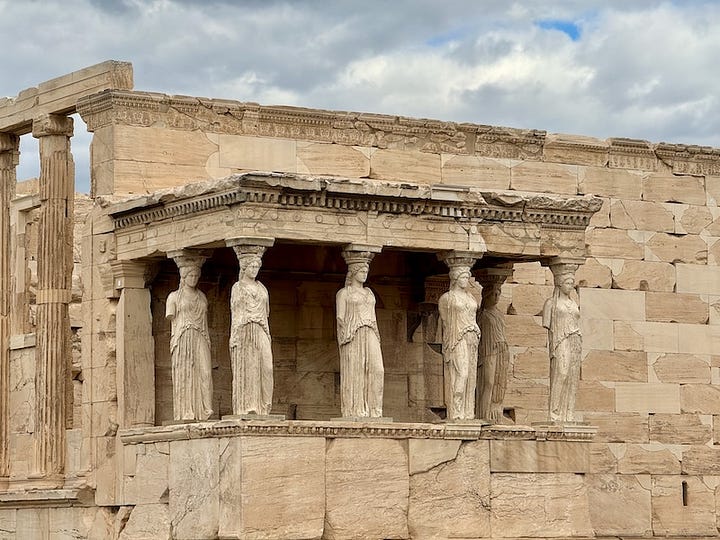

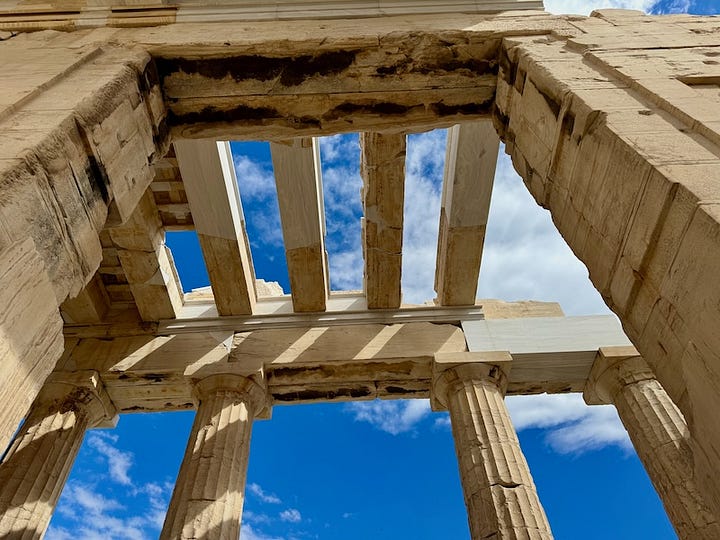

Our day at the Acropolis was sunny and warm. Walking its ancient steps, approaching those iconic columns, familiar from countless photographs, is an awe-inspiring experience, even when shared with hordes of other travelers. Next to the Parthenon, on the south slope, is the Theatre of Dionysus, built around the 6th century BCE. Although theatre as ritual has existed from time immemorial across all known cultures, the Theatre of Dionysus is the world’s oldest known permanent dedicated performance space. Although it fell into decay during the Byzantine era, it was restored in the 19th century and is in use again today for concerts and other performances.
As a lifelong theatre person—first an actor and later playwright and producer—it gave me a deep personal thrill to stand on that spot and imagine the works of Aeschylus, Sophocles and Euripides being performed there for the first time. I imagined thousands of ancient Greeks in their tunics and cloaks, laughing at the comedies, weeping and howling at the tragedies, then going home to their olive oil-rich meals. Could they possibly have imagined we’d be reading those plays thousands of years later? Certainly they could not have imagined me sitting at this computer writing about them.

The next night at dinner with our group, in honor of my birthday, my co-host Kelly gave me an olive branch necklace as a memento of our time in Athens. All in all, not a bad way to kick off another year on earth.

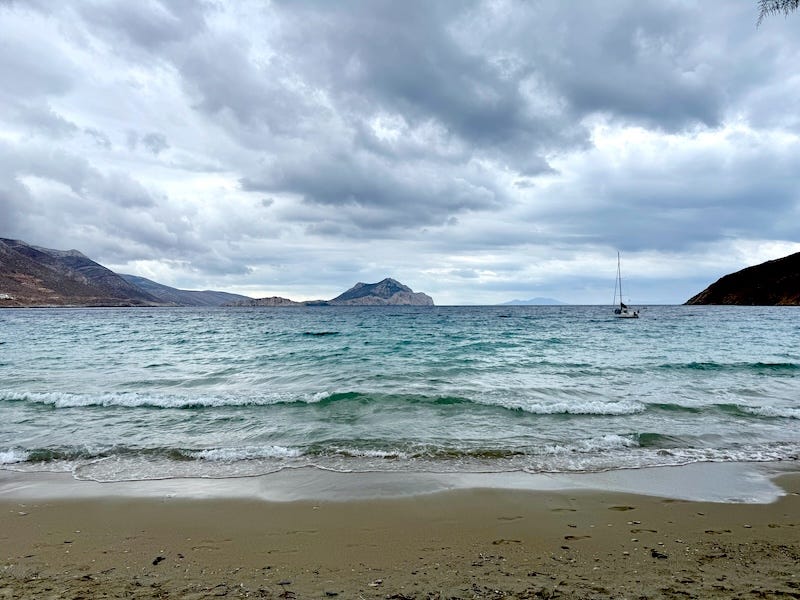
My twenty-something traveler self never would have predicted she’d one day lead writing retreats. Although I’ve written since childhood, it wasn’t until my fifties that I felt ready to teach. When I finally did, I discovered I loved it. I began dreaming of combining my newfound love of teaching with my eternal passion for travel.
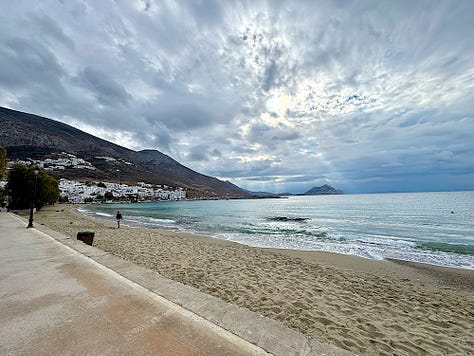
Kelly and I had chosen our in-country partners at Imagine Greece Retreats because of their warmth, professionalism and copious experience hosting writing retreats. What we did not realize was how remote their home island of Amorgos was.
It turned out to be a seven-and-a-half-hour ferry ride from Athens. As someone who once spent four wretched hours puking my guts out in a small boat cruising Kauai’s Nā Pali Coast, all I can say is, Thank the gods and goddesses for Dramamine. Once that little white pill kicked in, I dozed in my gently rocking seat throughout the entire ride.


Before leading retreats, my only comparable experience had been producing theatre. Though I loved it in many ways, every time I produced a show, I encountered at least a few moments so stressful I wanted to commit hari-kari.
Leading my first retreat—in Hawaii in 2024—I braced myself for similar stress. To my relief and delight, it never came. Sure, there were hiccups—humans are, after all, human. But the emphasis on process rather than product changes things. Theatre artists strive to create an exceptional experience for the audience; retreat participants are focused primarily on their own growth, connection and transformation. And while both groups are doing deep creative work, retreatants are also vacationing in a stunningly beautiful place.


Our most spectacular excursion on Amorgos was to the Hozoviotissa Monastery. Built in 1018, it hangs on a cliff almost 1000 feet above the sea. The views were staggering in their breadth and beauty. On the way up the stairs we encountered a friendly monk who looked to be in his seventies. He’d lived there since he was a young man, praying, gardening, and maintaining the grounds. We had no common language, but his warmth and gentleness were palpable. Aside from the bulky watch on his wrist, he could have stepped straight out of another century.
We toured the inside, where they fed us delectable Turkish Delight. I’d read about this confection in The Lion, the Witch, and the Wardrobe, but never tried it before. The delicate rosewater morsel melted away on my tongue, and I understood why the character of young Edmund had gotten hooked.

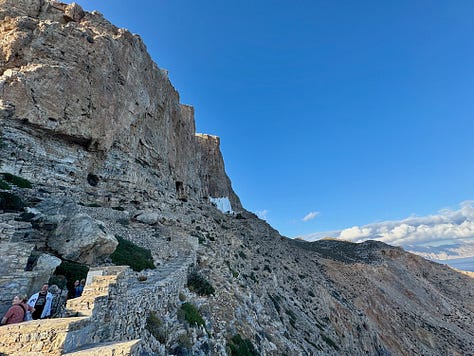
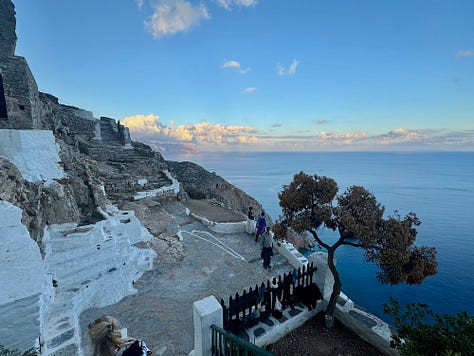


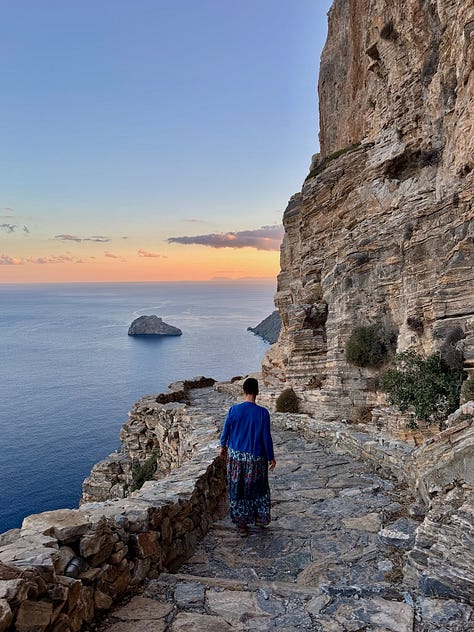
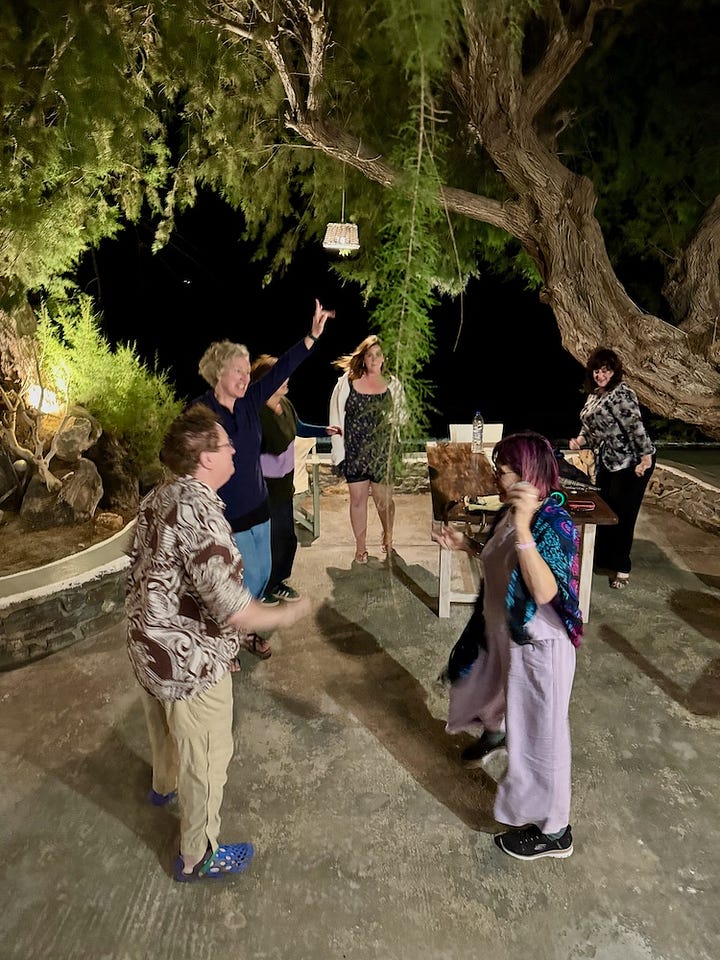
With the help of Kelly, Jonas and Rania (Jonas’ wife and partner in Imagine Greece Retreats), the grace of the Muses, and a fabulously open-hearted group of women, the week on Amorgos was everything I’d hoped it would be. Each day was packed with creativity and discovery, yet somehow the week flew by. And suddenly there we were, hugging each other tightly and promising to keep in touch as we headed off in separate directions. Some headed home. Others, like me, continued their journeys. And just like that, what had been a dream and a scheme became a cherished memory, and I was a solo traveler once again.

I hope you enjoyed the first installment of My Greek Island Dream. Stay tuned for Part 2, Santorini and Crete, coming soon to the Off-Leash Chronicles!
Stay tuned as well for January writing workshops—announcement coming soon!
If you enjoyed this piece, you might also enjoy Japan Journals 1: Tokyo, Japan Journals 2: A Night in Asakusa, and Japan Journals 3: Of Cats and Capybaras.

Comments
Nothing yet. Say the first thing.
Sign in to join the conversation.