
If you haven’t read my previous post about Cumulative Hexflowers, this won’t make a ton of sense. Have a link here.
So, as always when you do maths by hand, you miss things. I tried to check my working, by summing all the probabilities for each hex and making sure they added to 216 (6^3) but it turns out I made two mistakes that completely cancelled out.
The first is that it turns out that the nearest hexes diagonally away from the centre (as in, 2 steps away, but not along one of the six ordinals) can be reached by three means, not two! They can be overshot and returned to, or branched into from initial steps one rotation away. That’s really neat, and it adds a new complexity to the hexgrid that I didn’t expect. This handy computer generated heatmap (rather than hastily drawn in krita) demonstrates it beautifully.
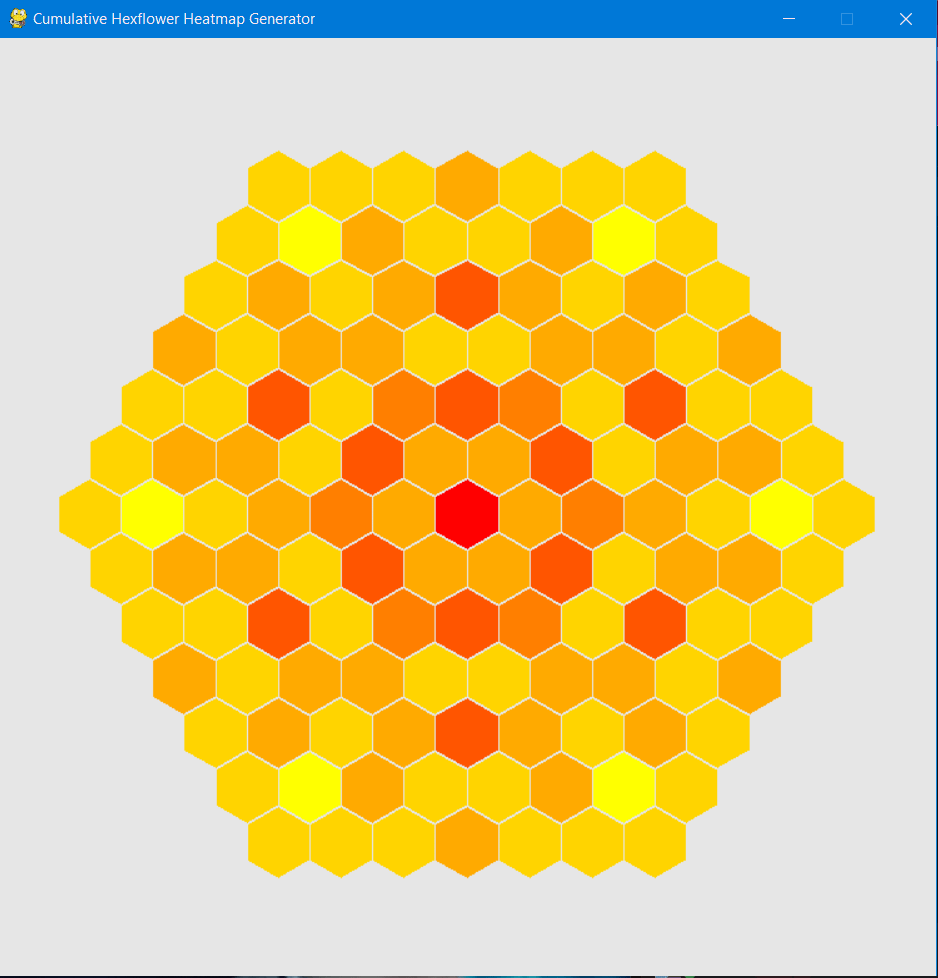
You might spot another new colour here, distinct from the 6, 4, 3, 2 and 1 /216 probabilities you’re used to. Bright yellow, along the penultimate ordinal hexes, indicates a 0% chance of landing there.
Yup. I missed something big.
“This lets three dice fill a six hex radius flower” - she said, lyingly
So it turns out that all the hexes I was very careful about checking, along the edges, the difficult to reach dead spaces in tension between two starting pathways, weren’t actually the problem. The problem was reaching so far in a single direction, and still having specificity. 3d6 isn’t the only hex to suffer this issue.
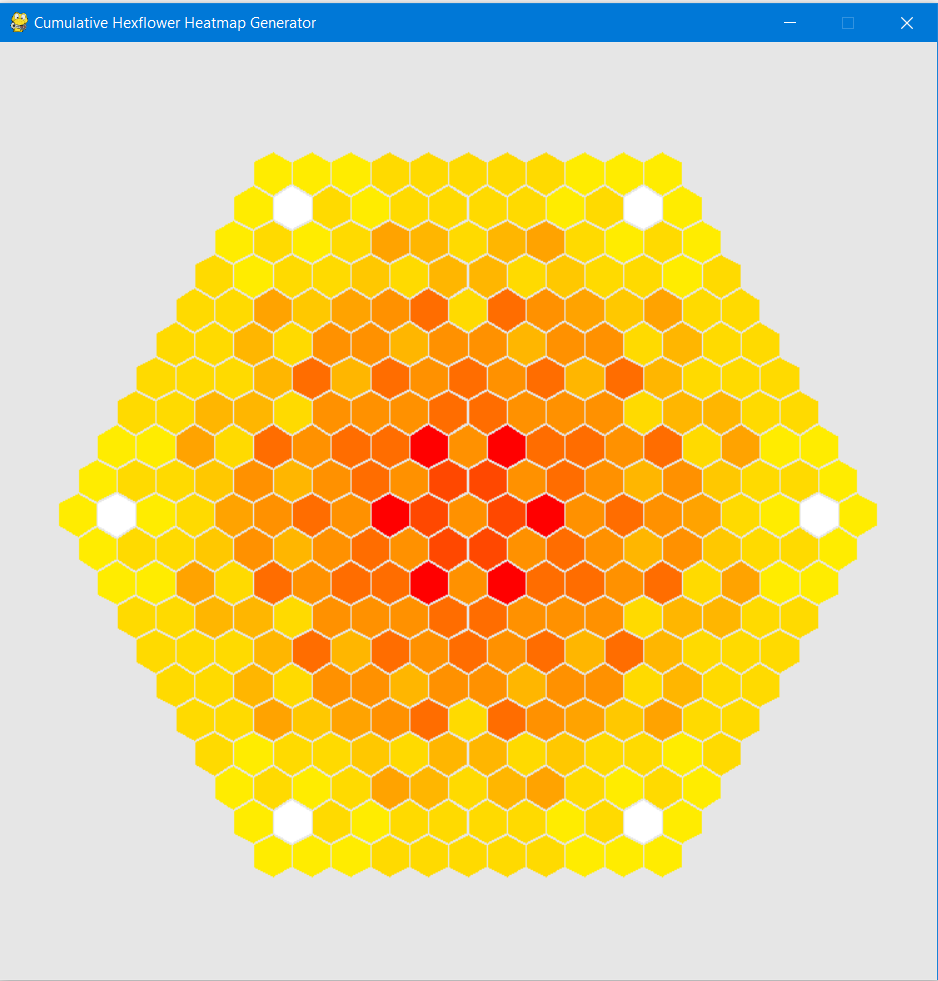
So my friend Kazia wrote up the code for this, and contacted me curious about my working by hand, wanting to check notes. But, no longer doing the maths at 2am in the dark of my room, the error was plainly obvious to me. She quickly edited it to display those 0 probability hexes in white, and tested it at greater resolutions, but the issue persisted.
It turns out actually that with a bit of vector algebra, you can prove no combination of [1, 2,… N] magnitude vectors along these six rotations can sum to a vector of (N/2)(N+1)-1 total length. Which is a fancy way of saying, just before each corner, you find a dead space.
If anyone wanted to draw a map for the hexflowers, and run some traversal exploring outwards from the central hex, keep in mind that actually there are some beautiful impossibilities baked into this method, no matter your scale.
Toucantsam on bsky has been considering some amazing possibilities with numbered cards; that a player can select one by one either before or after rolling the d6 to determine direction. The cards here let a player have a lot of agency in the process, but constrain the possibilities to the same set of final hexes, with the same final probability distribution if the player is doing output randomness rather than input.
Of course, the most agency that you could give a player rolling on this flower might be to allow them to roll all of the dice, and then order their steps as they choose. But, I digress deeply.
Kazia has just gotten in touch with me to share some interesting developments about bigger sizes of flowers though!
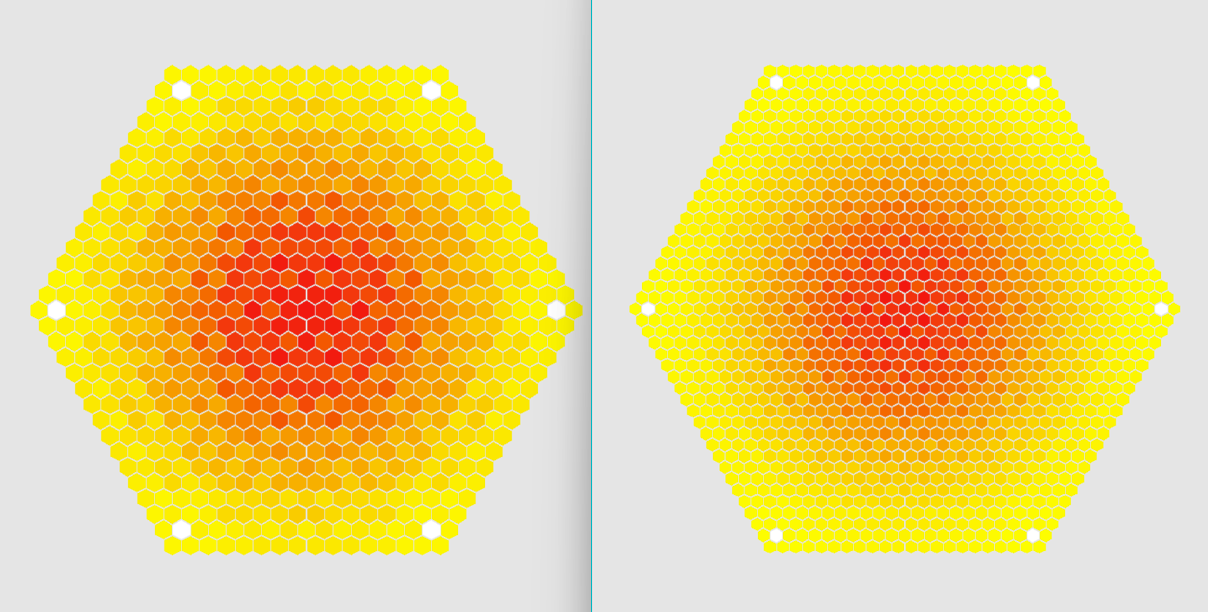
So it turns out that past 6d6, the central hex ceases to be the most common! At an astonishingly unlikely 132/46656, it is beaten out by a number of nearby hexes all the way up at 140/46656 apiece, with more paths converging back near the centre than actually reaching it again. When computers drink enough milk and grow large enough, maybe one day we’ll know how this pattern develops into the tens of d6s, but for the purposes of generating anything practical or interesting, 6d6 might be where I choose to stop.
Regardless, this has been a really lovely adventure with you all, and I’m glad that I got to revisit this so soon, thanks to some wonderful friends willing to simulate my terrible ideas, and tell me when I’m wrong. Massive thanks to Kazia again for getting in touch with me about this, and giving me permission to share her beautiful heatmaps. I’ll be using these going forwards if I ever need to explain this system again.
Have a good one everyone!
No posts
Comments
Nothing yet. Say the first thing.
Sign in to join the conversation.