
So a friend of mine is designing an OSR and she’s putting some godawful systems in there, one of which decides “where you come from”. She asked me “what’s a bad table I could do” so I suggested a cumulative hexflower, which I think might be a new thing, or at least is something I can’t figure out how to attribute to anywhere else. So here’s what that is.
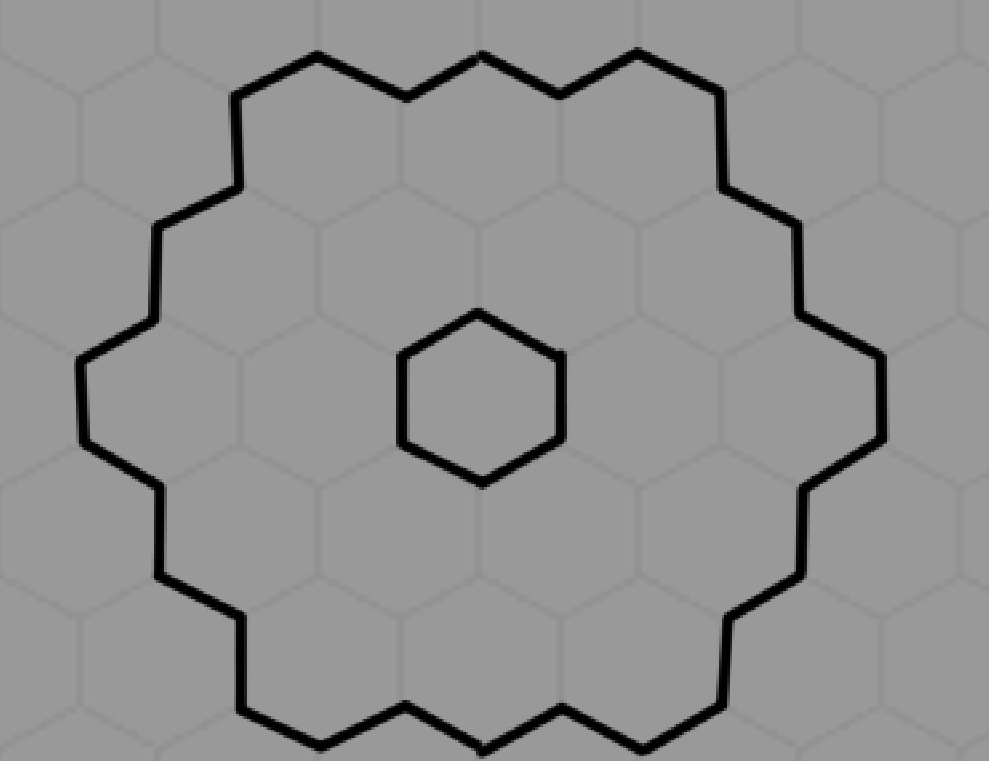
With a normal hexflower, you start at a central point, and explore outwards step by step to find yourself at some other hex in the flower. Sometimes these loop around from one side to another, creating a continuum of results that can be really useful for weather tables or gradual changes, tracked over time with a die placed on a little grid.
Hexflowers for lifepath systems feel a lot like the old lifepath grids, where each step through the space adds a little to your sheet, a homeworld, a childhood, an education, shifting bit by bit through adjacent or diagonal connections. But Juniper’s goal when she asked me for this was instead something that would generate a single final result, that would be part of a grand and weird tableau of character traits, to define who you are and where you came from before you came to the Swamp.
So instead, what if you rolled some dice, did some wandering, and the only thing that mattered was where you stopped. A little like the inverse of the narrative she’s telling, a group of adventurers come together from around the world, gathered now in this insidious, awful bog. It had a bit of symmetry to it, so I explored a bit further.
If you just roll 3d6, and use each one to pick a direction in which to wander, you end up never going very far, and quite often coming back to the bog as your point of origin. It isn’t dreadful, but it lacks the sort of grand Elden Rings inspired scope she normally hunts for in these oppressively grand tables. We toyed with using one die to randomise the distance, to get a vector with both direction and magnitude, but with just two dice this amounted to a fancy layout for a d66 table, and with many more, the possibility space exploded into a spidery mess, with very little order or harmony to it.
So instead, I suggested that each die contribute a number of steps that decreases over time. On 3d6, your first die takes you three steps in a direction, your second only two, and your third a single space, a little wandering before you settle down. This lets three dice fill a six hex radius flower, and gives rise to over a hundred possibilities.
You might catch that descending the distance is identical to doing it the other way around, where your first die is a small step, increasing bit by bit, but taking the larger jumps at first builds a sense of anticipation in the same way that roulette wheels losing speed and clacking to a stop, or quiz spinners teetering on a boundary, often do. Vector addition is commutative though, so any order gives rise to the same pattern of results.
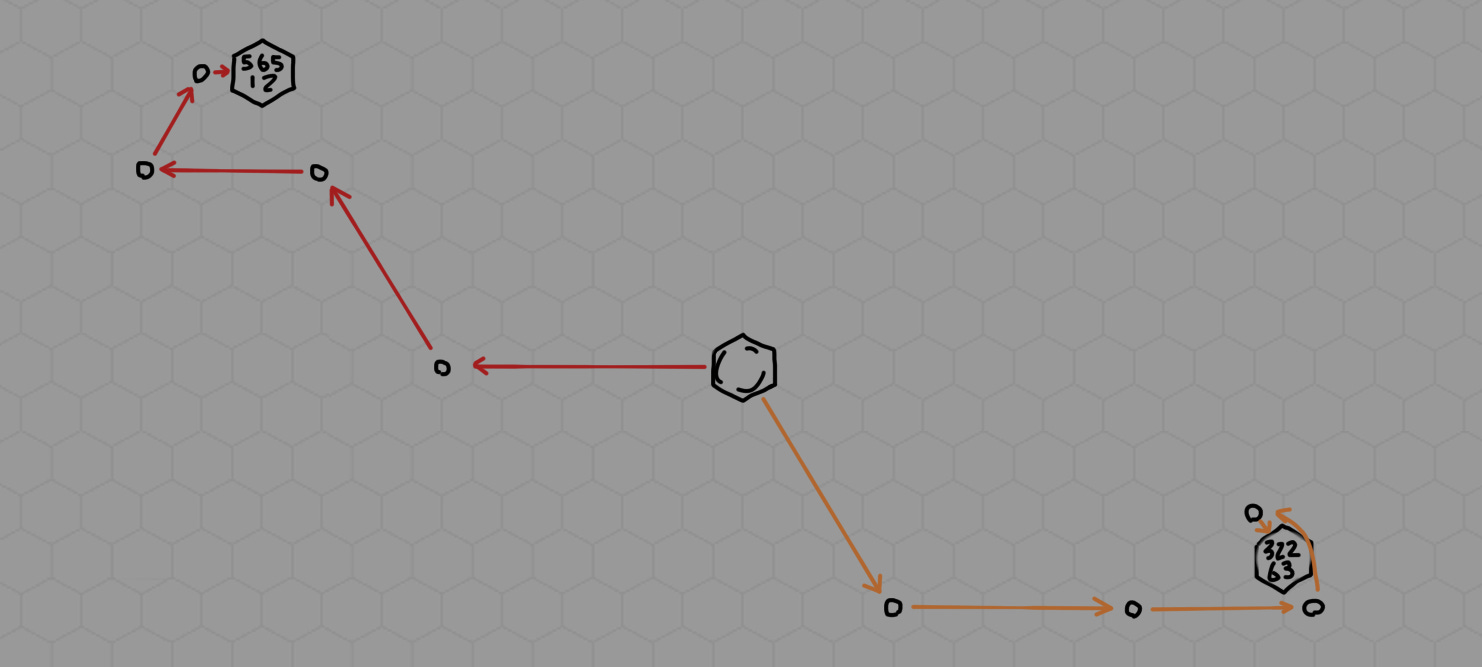
Looking at the 5d6 example, you can see the way that rolls randomly arc back upon themselves, curling in like twisting tendrils on a final result. For any number of d6s past 3 it’s possible to return to the starting point [which can be proved by induction if you want to get technical with it, though I suggest splitting it into odd and even cases].
The actual project started off with a 3d6 flower, with a six hex radius from the center to account for triples giving you 3+2+1 steps in the same direction. That already has a frankly ridiculous number of possibilities, 127 hexes to fill in. Going up to 5d6 gave me (as best I can tell) 630 hexes to fill with results, which is maybe a little beyond me to fill in one by one with interesting results.
The 3d6 cumulative hexflower gives a really beautiful, and quite useful, probability distribution over its area. The central hex shows up 1/36 times, as likely as double ones or double sixes on 2d6, because it depends on taking 3 steps away in any direction, and then 2 and 1 steps back in the exact opposite. But interestingly there are a great number of other hexes that can be reached by four or two means, in fact enough that a plurality of the results you will get will be reached by one of two means.
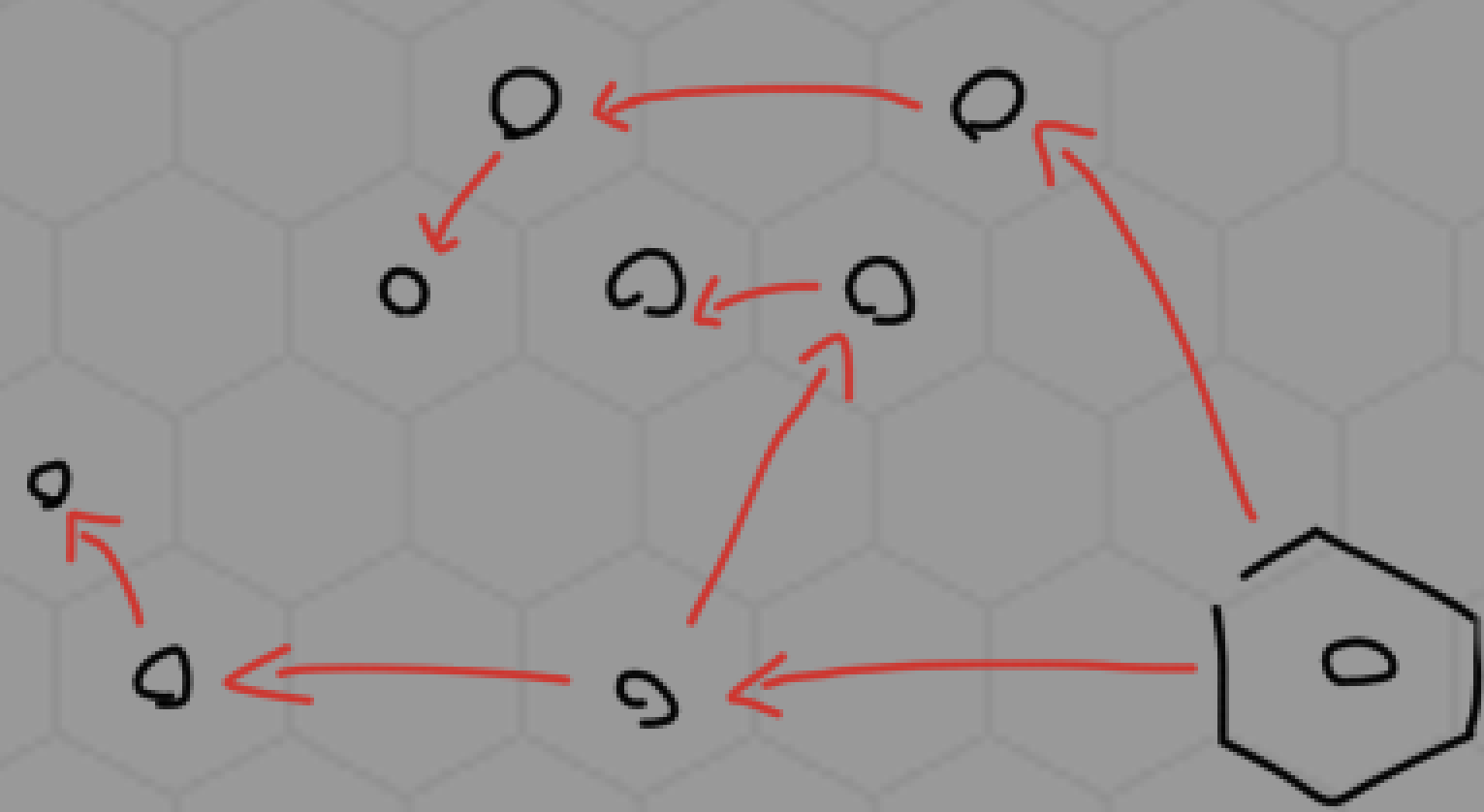
It’s really neat to have a system with a number of hexes reachable only by a specific path, and many reachable by more and more, the heatmaps for this give you a lot of tools to work with to cultivate the likelihood of different experiences, especially when dealing with really large lists or tables.
Trinket tables or demeanour charts often use a d100 to generate one of fewer than 100 results, and allow you to weight them very transparently if you want some of them to be more common than others.
This technique means that it’s very obvious which results are likely and not likely, and the one dimensionality. These are concessions made for ease of writing, and very useful ones as well, but sometimes its nice to have another tool to play around with, so here one is.
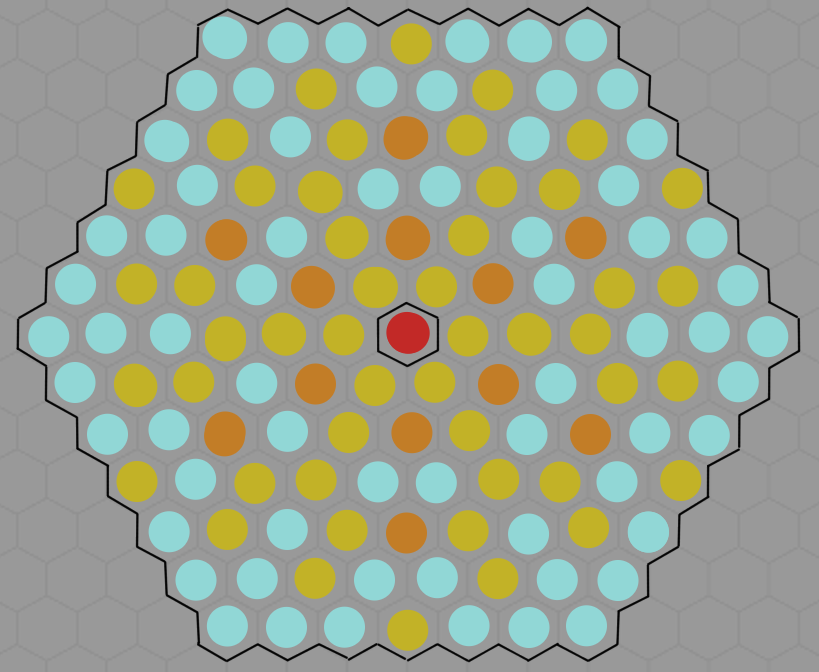
In this diagram, the central hex has a 6/216 chance of being rolled, the orange cells have a 4/216 each, the yellow cells 2/216, and then the blue cells have a unique 1/216 chance apiece. You can see the kind of highways, and continuous zones of likelihood that crop up from this, as well as the twelve dense points radiating out from the central hex.
The original suggestion, to use this as a map to determine where a character had come from, has a lot of draw to me. Red points could be major cities or towns nearby, and with a little sleight of hand hiding the heatmap from the players and sculpting your terrain diegetically, you can have some seeded locations that players are actually deceptively likely to hail from, tied to themes or plots you’re cooking up. An innocuous looking valley to the north east with a few cells of interest turns out to be much more likely than expected, because calculating the overlaps between differing rolls is fairly tough to do on the fly.
Juniper also really latched onto the idea of using this to determine location, but *not* have it map the world in any meaningful way. That two hexes both representing origins in the City Of Lakes might be on opposite sides of the flower, needing very different rolls to find them. The better I understand the maths behind this, the more that rolling on these tables feels like an exploration of a space, a proper pilgrimage through a sculpted environment. Unfortunately, because of the scope, these hexmaps balloon rapidly if the intent is to have each hex be a unique entry in a lookup table somewhere.
Regarding the actual heatmaps, I’ve calculated them by hand for 2 and 3, and could probably do 4d6 by hand if I had a bit of time, but 5d6 gives me more cells than there are days in the year, and as far as I can tell, it’s completely accessible [as in, for any hex, there is at least one pathway that ends up there from the centre].
Other questions maybe worth asking about Cumulative Hexflowers include:
What if the steps aren’t regularly increasing or decreasing, but changing in some other manner?
What if the map is a little smaller, or an irregular shape, and going off one end loops you back on from the other?
What if you *did* have to track your journey, but could choose when to make the long and short steps, to explore more of the space?
This feels like the most ttrpg blog post blog post that I’m likely to write for a while, but there’s a finite amount of time that I can be streaming my screen in a discord server before someone yells at me to just write it up as a post.
No posts
Comments
Nothing yet. Say the first thing.
Sign in to join the conversation.