
The SAVE Act passed the House but hasn’t passed the Senate. It would change the voter registration standard from a sworn attestation of citizenship to documentary proof — meaning passport, birth certificate, or other official records would be required to register for federal elections. That’s a significant shift in how the gate to the ballot box operates, because an electoral system based on paperwork verification has a very different impact in practice than one based on a legal attestation.
At the same time, the Trump administration — via the Department of Justice — is pushing a nationwide demand for unredacted state voter registration data. This is not a law Congress passed; it’s a legal and administrative campaign by DOJ to compel states to turn over full voter files — including dates of birth, driver’s license numbers, and partial Social Security numbers. It has sued at least 24 states plus Washington, D.C. for refusing to hand over that sensitive data, and state election officials and civil rights groups have pushed back in court. Federal judges have already dismissed these lawsuits in states like Michigan, California, and Oregon on legal grounds, even while some states (like Nebraska) have been ordered to comply after state court rulings.
The reason this matters is structural, not just anecdotal. Federal election administration authority under the Constitution is deliberately decentralized — states control how elections are run, how registration is maintained, and how voter lists are kept. When the Department of Justice uses litigation to obtain full voter rolls across dozens of states, it effectively creates a centralized federal repository of detailed voter data, even if no single law establishing a “national database” was passed by Congress.
Critics warn that centralizing voter data in this way raises constitutional questions under the Elections Clause and undermines the states’ traditional authority over elections. They argue that aggregating highly sensitive personal information at the federal level — without clear legislative authorization and with insufficient privacy safeguards — could be used to pressure voter roll maintenance, conduct aggressive purge campaigns, or otherwise influence who remains registered and who does not.
This data push is happening alongside other changes, like shifts in USPS mail-ballot postmark rules that mean ballots may be judged “late” even if dropped in the mail on time, because the postmark now reflects when a regional processing center stamps the ballot rather than when the voter handed it to the post office. Mail timing changes, gerrymandering, roll purges, and tightened registration documentation all add friction to participation — and the cumulative effect is what shapes access to the ballot in modern elections.
Taken together, these efforts reflect a broader re-engineering of electoral infrastructure: tightening the gates to registration, centralizing control of voter data, hardening deadlines, and structuring representation. That’s why the fight over these policies isn’t just about individual IDs or individual data requests — it’s about who decides the rules, whose names get kept on the list, and how easy it is for ordinary voters — especially women, lower-income Americans, and other marginalized groups — to participate in democracy.
The House-passed version of the SAVE Act (in February 2026, as a House amendment to S.1383) would make **documentary proof of U.S. citizenship (DPOC) a prerequisite to being registered to vote in federal elections** and would also impose a **photo-identification requirement for casting ballots in federal elections**.
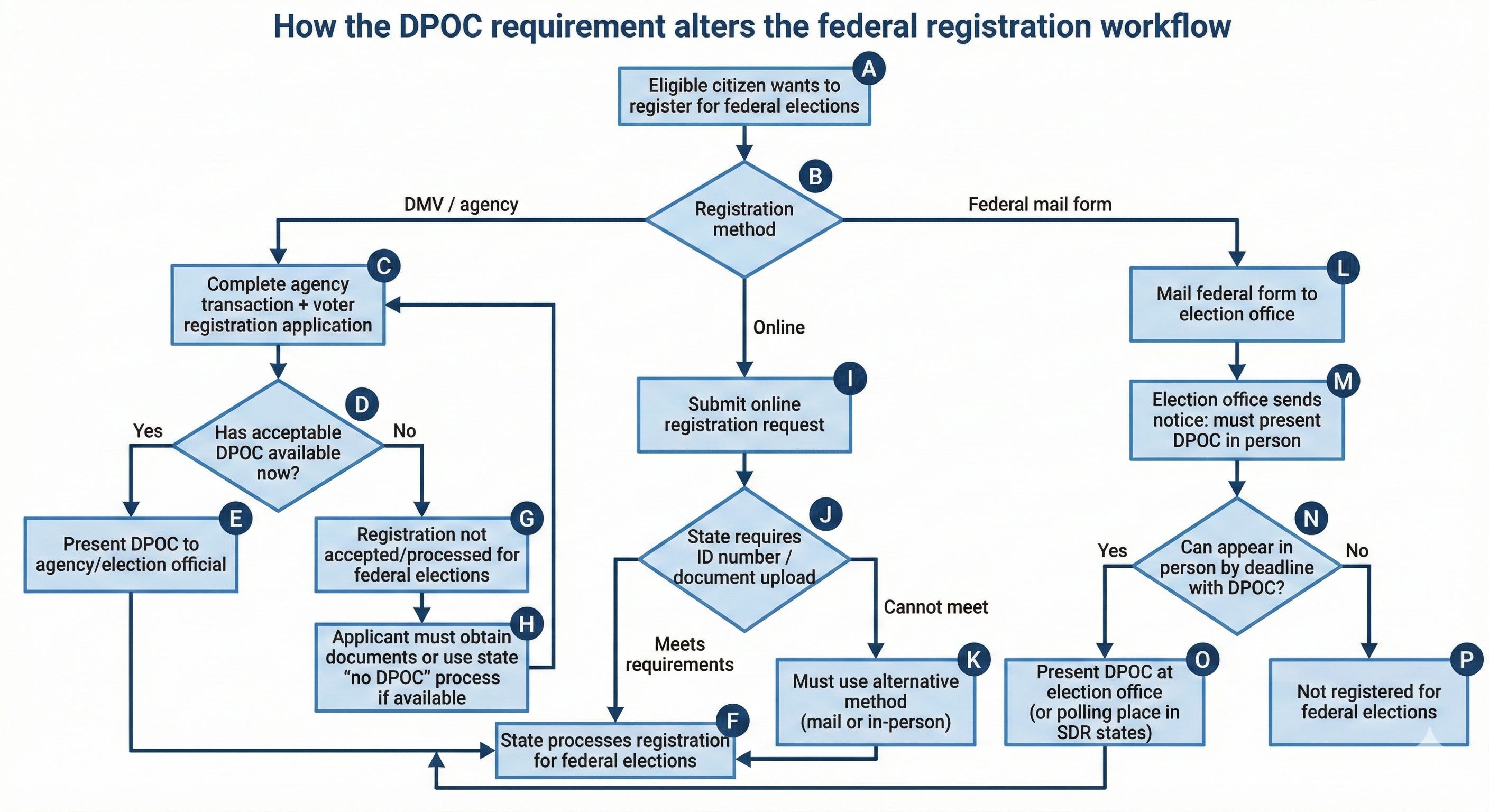
The most consequential operational change is that **mail-based registration would become a two-step process**: (1) submit the federal mail voter-registration form, then (2) **present DPOC in person** to election officials by the registration deadline (or at the polling place for Election Day / early-voting registration states).
This would interact directly with how Americans actually register: federal election-administration data show that states rely heavily on **DMV-linked registration, online registration (often tied to a driver’s license/state ID number), and mail registration frameworks.
Women and lower-income Americans would not lose a formal “right to vote,” but the bill would plausibly **increase “effective disenfranchisement”**—eligible citizens who are unable to register or have a ballot counted because they cannot meet documentation and procedural requirements in time. The likely disproportionate impact flows from (a) **document access and mismatch** (especially name changes), (b) **cost and time burdens**, and (c) **administrative discretion and error** in both document review and database-based list maintenance (including mandated state use of the federal SAVE immigration-status verification system for voter-roll maintenance).
Empirical evidence most directly analogous to DPOC requirements comes from state experience. A prominent example is litigation over Kansas’s DPOC law: courts and reporting describe large numbers of eligible voters whose registrations were blocked or suspended because they could not promptly produce citizenship documents, while the underlying incidence of noncitizen registration was found to be small.
The research literature on strict voter-ID laws (not identical to DPOC, but relevant because the House-passed bill couples DPOC with photo ID for voting is mixed on magnitude but consistently emphasizes that **documentation requirements shift burdens onto voters**, with larger practical impacts where access to ID/documents is uneven.
Core registration rule: DPOC is required for federal registration
The House-passed text would amend the National Voter Registration Act framework to require states to **“not accept and process”** any application to register to vote in federal elections unless the applicant **presents documentary proof of U.S. citizenship.
It also defines “documentary proof of U.S. citizenship” with a specified list, including (among other items):
- a form of identification issued consistent with the REAL ID Act **that indicates the applicant is a citizen;
- a valid U.S. passport;
- certain military ID plus service record showing U.S. place of birth;
- certain government-issued photo IDs showing U.S. place of birth;
- and combinations of photo ID plus a certified birth certificate or other listed records (e.g., Consular Report of Birth Abroad, naturalization/citizenship certificates).
For applicants using the national mail voter registration form (the federal form), the bill adds an additional requirement: the applicant **“shall not be registered”** unless they **present DPOC in person** to the appropriate election office by the state deadline (or at the polling place for states that allow Election Day/early-voting registration).
This is a structural departure from the current federal form’s design, which relies on an applicant checking a citizenship box and signing an attestation under penalty of perjury.
The House-passed text would also amend the Help America Vote Act framework to require that, for federal elections:
- in-person voters must present a **valid physical photo identification**, or cast a provisional ballot and present ID within a short window; and
- voters casting a ballot “other than in person” must submit a **copy of valid photo ID** with the ballot (or use an alternative involving SSN digits plus an affidavit).
The bill pairs voter-facing requirements with administrator-facing incentives and liabilities, including:
- a broadened private right of action referencing election officials who register applicants who fail to present DPOC; and
- amended criminal penalties that include **registering** a federal-election applicant who fails to present DPOC.
The bill would require states to take “affirmative steps” to ensure only citizens are registered, including submitting the voter list to the Department of Homeland Security for comparison via the SAVE system, followed by notice-and-opportunity procedures before removal. This effectively bypasses the recent court rulings saying that the executive branch can not create a national voter database.
The NVRA was designed to make registration a routine part of interacting with government—especially the DMV (“Motor Voter”) and designated agencies—plus mail registration. Election-administration data show that registration is often a **byproduct of people updating an address, changing a name, or renewing credentials**, not only first-time registrants.
Because the House-passed bill requires DPOC “under any method of voter registration,” it would convert many currently low-friction workflows into **document-intensive workflows**.
DMVs are one of the most common sources of registration transactions in federal-election administration data. The bill’s operational effect would be to require DMVs (and other agencies handling registration) to:
1) collect DPOC (or process a citizen-indicating REAL ID/passport/etc.), and
2) implement verification procedures such that the state can lawfully “accept and process” the registration.
For lower-income voters, the DMV channel is a double-edged sword: it is often the most accessible point of contact for government ID, but it is also where documentation problems (missing birth certificate, name mismatch) surface and can trigger repeat trips and delays.
Most states with online voter registration require an applicant to have a driver’s license or other state-issued ID number to use the online system. This interacts with the House bill in a predictable way: if the DPOC a state accepts is tied to **citizen-marked** IDs (or requires uploading/bringing citizenship documents), then online registration becomes less effective for voters who:
- do not have a qualifying state ID number (more common among lower-income adults), or
- have a qualifying ID number but lack the underlying citizenship documentation required by the new federal standard, or
- have a name mismatch between their current legal name and their citizenship proof document.
Mail registration’s role under current law is to provide a universal, non-DMV registration option, including through community registration drives. The House-passed version would keep the mail form but would require a **second in-person step** to complete registration for federal elections, with election officials obligated to notify applicants of this requirement after receiving the form.
This effectively converts mail registration from “mail once” to “mail + travel + in-person appearance,” shifting the binding constraint from “did you fill out the form?” to “can you get to an election office (or a polling place in SDR states) with the right documents on time?”
The bill retains language stating it should not be construed to restrict provisional ballots in federal elections if citizenship is verified under the new framework. But it simultaneously adds a photo-ID regime in which failure to present valid photo ID triggers provisional voting coupled with short deadlines to present ID (or qualify for a narrow affidavit exception).
In practice, provisional ballots often function as a “backstop” that still requires administrative follow-up—an area where time, transportation, and bureaucracy can disproportionately burden low-income voters.
The most relevant real-world analogs are state DPOC regimes. In litigation over a Kansas DPOC requirement, courts found large numbers of eligible voters were blocked or suspended from registration because they did not provide citizenship documentation in time, while evidence of non-citizen registration was comparatively small—supporting a disproportionate-burden narrative.
The analytic relevance is structural: when the binding requirement is not a sworn attestation but a specific document, the population impact is driven by the share of eligible citizens who (a) do not possess the document, (b) cannot locate it quickly, or (c) face frictions (fees, time off, travel) to obtain replacements.
Recent survey-based work summarized by the Brennan Center estimates that **over 9% of voting-age citizens** lack ready access to proof-of-citizenship documents, and millions lack access entirely—suggesting sizable exposure if DPOC becomes a universal registration condition.
Because the House-passed bill also imposes a photo-ID requirement for voting in federal elections, research on strict voter-ID is relevant even though it is not identical to DPOC.
A U.S. Government Accountability Office synthesis of studies and its own analyses has concluded that most registered voters in studied states possessed required ID, but ownership rates vary across demographic groups; it also reviewed evidence suggesting measurable turnout changes associated with implementation in certain states (methodological caveats apply).
The peer-reviewed literature on voter ID includes both findings of depressive effects in certain contexts and critiques emphasizing identification challenges and measurement limitations (e.g., administrative-record vs. survey-based turnout measurement).
A key empirical and conceptual point is that “most people can comply” does not imply “burdens are evenly distributed.” Evidence suggests document and ID access varies by income, age, and race; and administrative steps (repeat trips, copying requirements) can amplify inequality.
A central gender-specific mechanism is surname change. A Pew Research Center survey found that 79% of women in opposite-sex marriages report taking their husband’s last name. That creates an obvious friction point when a primary citizenship document (especially a birth certificate) reflects a prior name.
The House-passed text appears to respond directly to this risk by requiring states to accept and process a registration application when the applicant presents DPOC with an earlier name, so long as the applicant provides additional documentation or an affidavit attesting that the name is a previous name.
However, even with this accommodation, the practical burden can remain meaningfully higher for many women because it can require (a) knowing what documents are acceptable, (b) locating or obtaining an additional document (e.g., marriage certificate, court order), and (c) navigating state-specific processes that election officials design under federal guidance.
The bill’s mail-registration requirement to present DPOC in person is a direct burden amplifier for lower-income voters because it increases the probability of needing:
- transportation to an election office (often during business hours),
- time off work (with higher relative cost for hourly workers), and
- document replacement fees for the underlying citizenship evidence.
The passport pathway illustrates the cost/time channel clearly. Under current federal schedules, a first-time adult passport book commonly requires both an application fee and an acceptance fee, and routine processing takes weeks (plus mailing time). As a distributional matter, survey work suggests passport possession is substantially lower among lower-income adults, meaning a large share of lower-income citizens would need alternative documents (often a birth certificate) or would need to obtain a passport specifically to satisfy a voting-related requirement.
The bill contemplates state-designed processes for applicants who cannot provide DPOC, with election officials making determinations and signing affidavits that the applicant has sufficiently established citizenship. While intended as a safety valve, any discretionary front-line process can generate unequal outcomes if:
- standards are unclear,
- training is uneven, or
- offices are understaffed or inconsistent across counties.
This matters for lower-income voters because they are more likely to rely on overburdened public services and to have less flexibility to return multiple times to correct paperwork or appeal a denial.
Even if a voter has the right document, the bill’s mail-registration rule requires appearing at the election office (or the polling place in SDR states) by the deadline. Rural voters, voters without cars, and voters in areas with limited public transit can face higher time costs for an in-person requirement—especially if the requirement is triggered by registering late, moving, or changing names.
The Supreme Court’s 2013 decision in *Arizona v. Inter Tribal Council of Arizona* held that, under the NVRA’s “accept and use” requirement, states could not add documentary-proof-of-citizenship requirements to the federal registration form for federal elections.
The House-passed SAVE Act attempts to change the underlying statutory baseline by **amending the NVRA itself** to impose a federal DPOC requirement, which would likely moot the specific preemption theory from *Inter Tribal* (because Congress would be the one changing the rule).
Litigation over voting restrictions frequently turns on balancing tests that weigh burdens on voting against the government interests asserted (*Anderson–Burdick*).
A separate but related constitutional concern is that conditioning effective access to the franchise on costs can resemble an unconstitutional poll tax or fee burden in principle, as the Court held that conditioning the right to vote on payment violates equal protection. Whether DPOC document-replacement costs would be treated as a prohibited “fee to vote” is contested; but as a practical matter, the bill’s structure predictably increases the number of voters who must pay to obtain documents in order to satisfy a legal prerequisite to registration.
The bill’s requirement to run voter rolls through DHS’s SAVE system raises a distinct set of legal and operational risks. DHS describes SAVE as a verification service used by agencies to support eligibility determinations, including voter registration/list maintenance contexts, but oversight bodies have identified challenges in guidance, training, and process compliance for SAVE users.
If list maintenance produces false positives (eligible citizens flagged as noncitizens), legal vulnerabilities can arise under due process and equal protection, especially if notice and cure procedures are inadequate or inconsistently applied.
Supporters’ main claims
Supporters argue the bill is necessary to ensure only citizens participate in federal elections, to strengthen confidence in elections, and to create uniform standards (especially by requiring DPOC and photo ID). The Congressional Research Service notes that states and the federal government already impose criminal penalties for registration/voting fraud and for noncitizen voting in federal elections, but debates persist over whether additional front-end verification is warranted.
Supporters also point to some mitigations in the text: the name-discrepancy provision and the “other evidence” process for applicants without DPOC, plus use of provisional ballots under the photo-ID rule.
Critics argue that noncitizen voting in federal elections is already illegal and rare, and that DPOC regimes risk blocking eligible citizens at scale, citing state experience like Kansas.
A further critique targets implementation realism: election administration is decentralized, and converting registration into a DPOC verification system creates new failure points (lost documents, mismatch, office backlogs, inconsistent training), even if the formal rule appears straightforward.
If policymakers’ objective is to reduce the risk of non-citizen registration without imposing broad voter-facing burdens, the evidence base suggests several mitigations/alternatives that more directly target administrative error:
A first mitigation is **free, rapid access to underlying documents** (birth records and name-change records) coupled with streamlined replacement—reducing the de facto “cost barrier” for compliance. The bill itself only partially addresses cost (e.g., copying photo ID) rather than document procurement.
A second alternative is **automatic verification using reliable government records**, with strong due process protections and robust error-correction mechanisms. The bill gestures toward database use (including SAVE and potentially Social Security-related sources) but oversight evidence suggests verification systems require careful governance to avoid wrongful exclusions.
A third approach is to focus on **post-registration, pre-ballot eligibility checks** that target anomalous records (high-risk matches), rather than universal DPOC production at the point of registration—aligning burden with risk. This is consistent with the broader election-administration framing that multiple stages exist to assess eligibility, not only registration intake.
If enacted, the House-passed SAVE Act would likely:
- reduce the usability of mail registration as a broad access channel by requiring an additional in-person DPOC step;
- increase the number of registration and ballot-casting transactions that depend on possession of specific documents (and on local administrative capacity to verify them);
- increase “registration friction” associated with moving and name changes (a particularly gendered pathway given surname-change prevalence);
- shift some disputes from “eligibility” to “paperwork sufficiency,” increasing provisional voting and administrative workload;
- and create new avenues for wrongful removal or delayed registration if database matching (including SAVE) generates errors that voters cannot cure quickly.
If the bill remains unpassed, the federal baseline remains that citizenship is required but generally proven at registration via sworn attestation under penalty of perjury, with significant variation in state voter-ID rules and state-only proof-of-citizenship regimes. Practical debates would likely continue shifting to state legislation and litigation, especially around dual-registration systems and database-driven list maintenance.
Renewing a REAL ID quickly is a real experience for many people, but it does not measure population-level access because voting rules don’t ask whether *someone* can navigate an ID process—they hinge on whether *nearly everyone*, including people with missing records, name mismatches, limited transportation, inflexible work schedules, or fees they cannot absorb, can comply reliably and on time; importantly, the House-passed bill requires specific **citizenship documents** (or tightly defined substitutes) for registration and **photo ID** for voting, so the binding barrier is often not “can you get an ID eventually,” but “do you have the right underlying citizenship proof and the ability to present it in the required way (including in person for mail registration) by the deadline,” which survey evidence suggests millions of eligible citizens cannot readily do.
Protecting the right to vote requires active engagement with the people who write the rules. If you believe the “gates” to democracy should be open and low-friction, here is how you can make your voice heard most effectively:
Don’t just send an email—place a phone call. Legislative offices track the volume of calls on specific topics daily.
The government maintains official directories where you can look up your specific representatives by entering your zip code or home address.
For the House of Representatives: Visit House.gov. You’ll enter your zip code, and if your district is split, it might ask for your full street address to pinpoint your specific member.
For the Senate: Visit Senate.gov. Since each state has two senators who represent the whole state, you just select your state from the dropdown menu to see both.
If you don’t want to dig through websites, you can use the U.S. Capitol Switchboard. This is a single number that can connect you to any office in the House or Senate.
Phone Number: (202) 224-3121
How it works: An operator will answer. You just tell them the name of your representative or senator (or just tell them your state/zip code), and they will patch you through directly to that member’s office.
Every member of Congress has at least two types of offices:
The D.C. Office: Best for calling about specific national legislation or upcoming votes (like the SAVE Act).
District/State Offices: Better for personal assistance (e.g., issues with Social Security, Veterans Affairs, or passports) or for requesting local meetings.
Call instead of email: Staffers tally phone calls daily. A high volume of calls on a specific topic is much harder to ignore than an overflowing inbox.
Be a “Constituent”: Always start by stating your name and that you are a constituent in their district. They generally only prioritize feedback from the people who can actually vote for them.
Keep it brief: Legislative aides are usually young, overworked, and very busy. State your position, the bill number (if you have it), and why it matters to you in 2 minutes or less.
The Ask: Be specific. Mention the SAVE Act (S.1383) and express concern about the in-person DPOC requirement and its impact on women and low-income voters.
The Why: Explain how these requirements create “administrative friction” rather than just “security.” Use the data: mention that 9% of citizens lack ready access to these documents.
When speaking with staffers, advocate for mitigations that maintain security without blocking eligible voters. This includes:
Free and rapid access to birth and marriage records for voting purposes.
Automatic verification through existing state databases to reduce the “paperwork burden” on the individual.
Robust notice-and-cure periods for any voter flagged for removal during list maintenance.
Legislative staffers tally calls daily. A phone call is significantly more impactful than an email because it requires a person to record your specific concern. Use the script below to keep your message clear and professional:
Constituent Phone Script
You: “Hello, my name is [Your Name] and I am a constituent from [Your City/Zip Code]. I am calling to urge [Senator/Representative Name] to oppose the SAVE Act (S. 1383).”
Staffer: “Thank you. Can I ask why you are concerned about this bill?”
You: “Yes. While I support secure elections, this bill creates a two-step, in-person registration process that disproportionately burdens women with name changes and lower-income citizens who lack ready access to birth certificates. We should be using automatic verification instead of creating new paperwork barriers. I would like the [Senator/Representative] to prioritize low-friction access for all eligible voters.”
Staffer: “I will pass that along. Would you like a response?”
You: “Yes, please. Thank you for your time.”
Democracy, like public health, relies on a system that works for everyone—not just those with the most resources. By advocating for a low-friction, high-accuracy registration system, we ensure that the “TACT” of our democracy remains strong.
Comments
Nothing yet. Say the first thing.
Sign in to join the conversation.