

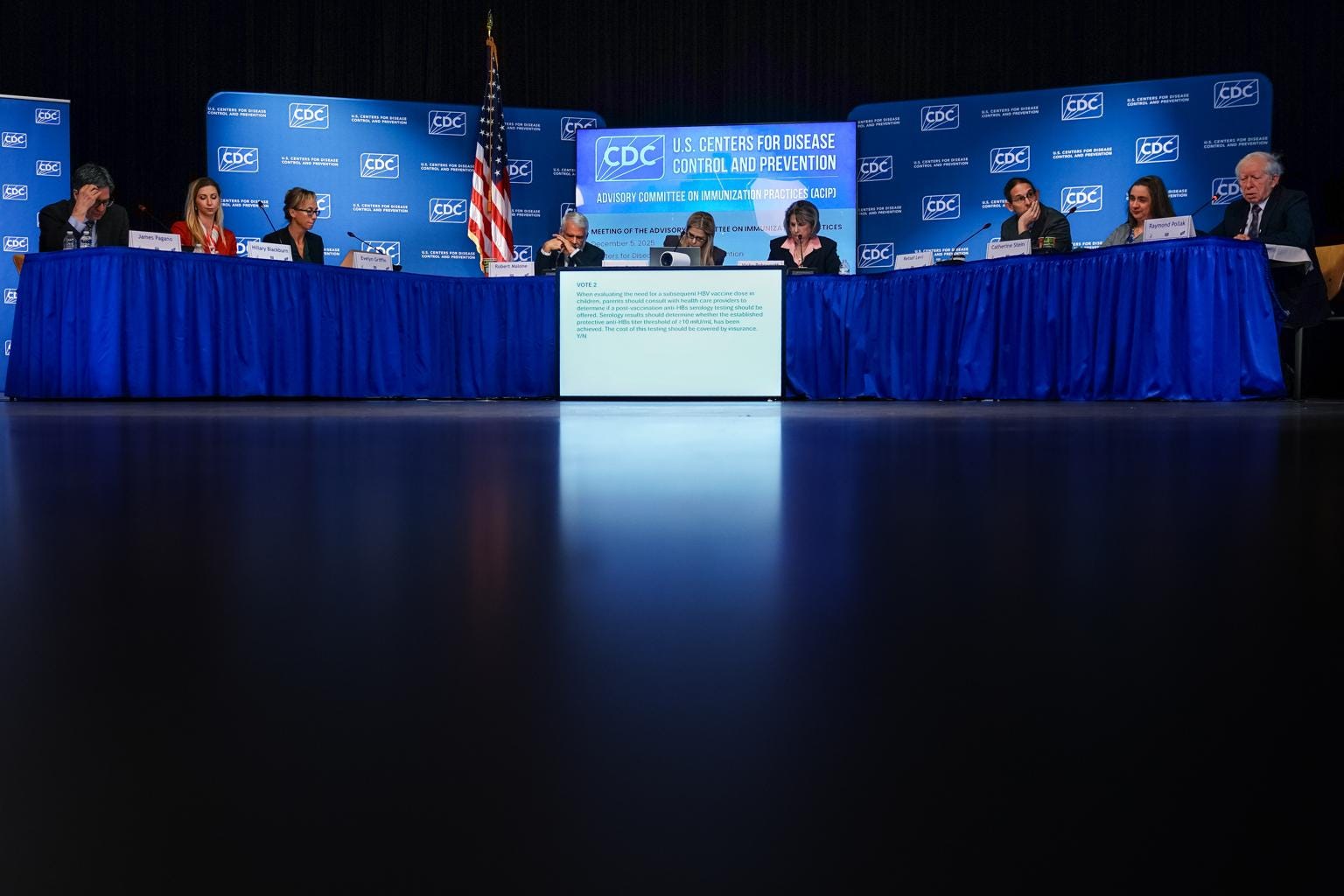
In a major legal setback for the federal government’s attempt to rapidly reshape U.S. vaccine policy, a federal judge has halted key elements of Health and Human Services Secretary Robert F. Kennedy Jr.’s overhaul of the national immunization system. In a detailed 45-page opinion, Brian E. Murphy ruled that the administration likely violated federal law when it changed the CDC immunization schedule and restructured the government’s vaccine advisory committee. The decision immediately freezes those changes and restores the previous vaccine policy framework while the case proceeds.
The revised CDC immunization schedule is frozen. The court stayed the January 2026 changes, meaning the previous schedule remains the operative national standard.
The newly appointed ACIP members are blocked from serving. Thirteen appointments to the Advisory Committee on Immunization Practices were stayed by the court.
All votes taken by the reconstituted advisory committee are suspended. Actions taken by the new panel cannot be implemented while the case proceeds.
The judge found the plaintiffs are likely to win. The ruling concluded the administration likely violated the Administrative Procedure Act and may have violated the Federal Advisory Committee Act.
The prior vaccine policy framework is restored. For now, CDC recommendations developed through the traditional scientific review process remain in force.
An appeal is expected. The administration will likely challenge the ruling at the United States Court of Appeals for the First Circuit, with a possible path to the Supreme Court of the United States.
Judge Murphy’s decision did not attempt to settle debates over vaccine science. Instead, the opinion focuses squarely on how federal agencies must make policy decisions.
For decades, vaccine recommendations in the United States have followed a consistent structure: federal scientists evaluate evidence, the ACIP reviews that evidence in public meetings, and the CDC adopts recommendations based on that analysis. The plaintiffs in this case argued that the administration abandoned that structure when it issued the revised immunization schedule without the normal advisory process.
The court agreed that this procedural shift raises serious legal concerns. Under the Administrative Procedure Act, federal agencies must follow established decision-making procedures or provide a clear and reasoned explanation when departing from them. Murphy concluded that the plaintiffs presented strong evidence that the government failed to do so.
In other words, In the same way that scientists rely on the scientific method to reach reliable conclusions, the legal system relies on procedure to reach fair decisions. Courts follow structured rules—what evidence can be considered, how arguments are presented, and how decisions are reviewed—because those rules help separate facts from claims and prevent decisions from being made based on bias or incomplete information.
As the Supreme Court explained in a landmark case, these procedures may sometimes feel slow or technical, but they serve an essential purpose. They are the legal system’s best tool for sorting through complicated and conflicting information to determine what is actually true. Without those rules, courts would have a much harder time evaluating evidence and ensuring that decisions are based on facts rather than opinion or power.
The opinion also scrutinized the composition of the reconstituted ACIP. Federal law requires advisory committees to be fairly balanced and composed of appropriate expertise for the tasks they perform. The court found credible concerns that the new panel may not meet those requirements, particularly given the limited vaccine-specific experience of some appointees.
The immediate effect of the ruling is stability. The existing CDC immunization schedule remains in place, meaning pediatricians, hospitals, pharmacies, and public-health agencies will continue operating under the same vaccine recommendations used prior to the January policy changes.
Insurance coverage is also likely to remain unchanged for now. Federal law requires many health plans to cover vaccines recommended by ACIP without cost-sharing. Because the court restored the previous schedule, insurers are expected to continue reimbursing providers according to the longstanding recommendation structure. Had the new schedule remained in place, coverage decisions for some vaccines could have become far more complicated.
The ruling also protects the structure of the federal Vaccines for Children program, which provides immunizations at no cost to millions of children in lower-income families. That program relies directly on ACIP recommendations to determine which vaccines are distributed through state health departments. By freezing the changes to the advisory committee and the schedule, the court ensures the program continues operating under the established framework.
School vaccination requirements are also indirectly affected. While states ultimately determine their own school entry rules, those rules typically rely on CDC recommendations as the scientific baseline. By restoring the previous federal guidance, the injunction avoids immediate disruption to state vaccination policies.
It is important to understand that this ruling is a preliminary injunction, not the final resolution of the case. The court determined that the plaintiffs are likely to succeed and that allowing the policy changes to proceed could cause significant harm before the legal questions are resolved.
The Department of Health and Human Services is widely expected to appeal the ruling. Because the case originated in Massachusetts, the next step would be review by the U.S. Court of Appeals for the First Circuit. From there, the case could eventually reach the Supreme Court.
That appellate fight will likely focus on a broader constitutional question: how much authority the Secretary of Health and Human Services has to reshape federal vaccine policy without relying on the traditional scientific advisory system.
The court did not decide whether vaccine policy should change. Instead, it delivered a clear message about how those changes must occur.
Major public-health decisions, particularly those affecting millions of children and families, cannot simply bypass the scientific and procedural structures built over decades. Whether the administration ultimately succeeds in altering vaccine policy will now depend not only on politics and science, but also on the outcome of what could become one of the most consequential public-health legal battles in recent years.
Comments
Nothing yet. Say the first thing.
Sign in to join the conversation.