
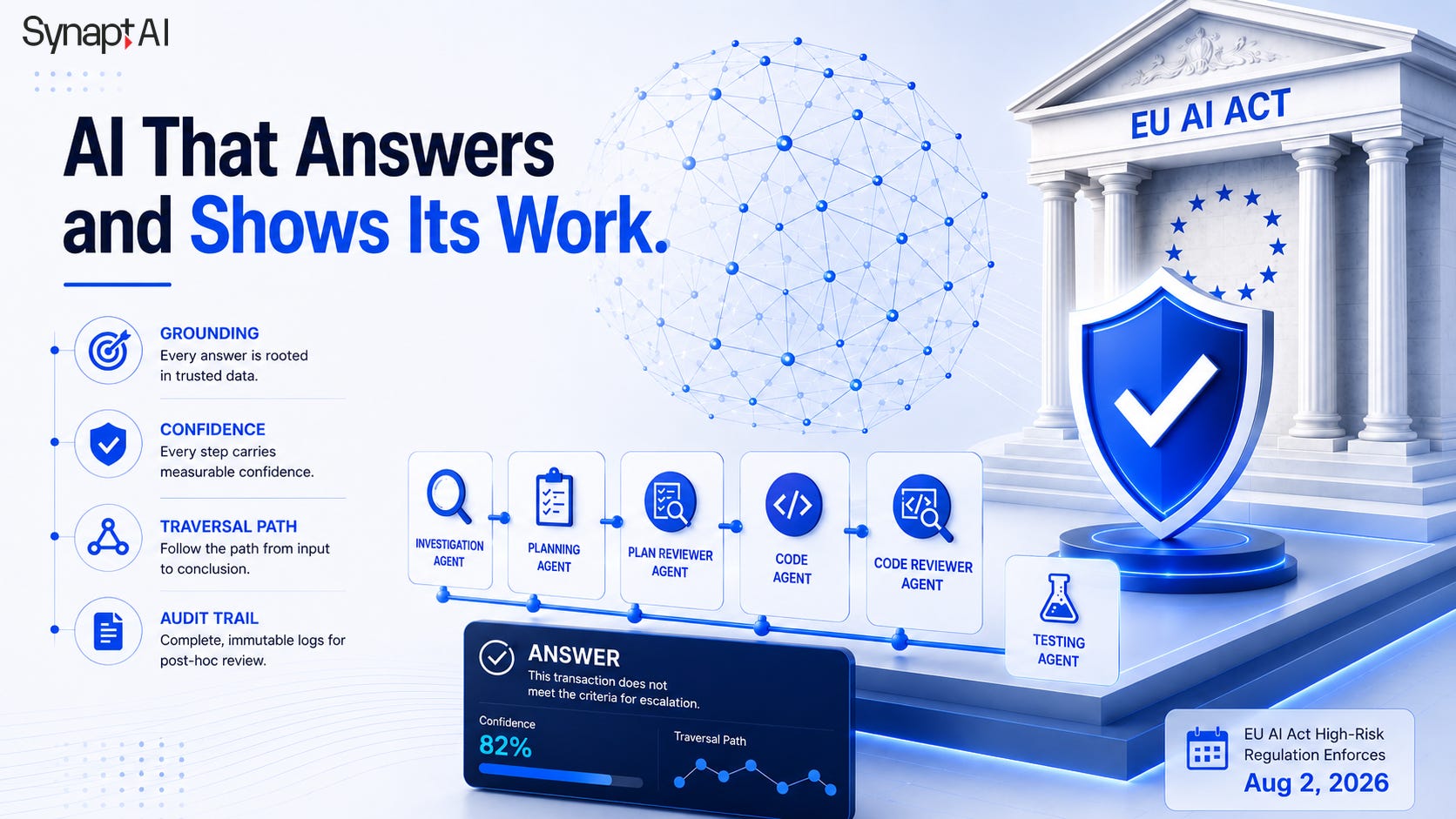
August 2, 2025, was a milestone most enterprise AI teams noted and moved on from. That was the date GPAI model obligations under the EU AI Act came into force — transparency requirements, documentation standards, and governance structures for general-purpose AI models.
The next deadline is August 2, 2026. That is when the majority of high-risk AI system rules come into full force and enforcement begins at both national and EU level — covering AI deployed in banking, insurance, telecoms, healthcare, employment, and credit decisioning.
The direction is clear. The clock is running. And the gap between where most enterprise agents are today and where the regulation requires them to be is wider than most teams are comfortable admitting.
Here is the uncomfortable reality sitting underneath all of it.
Most enterprise AI agents today cannot show their work.
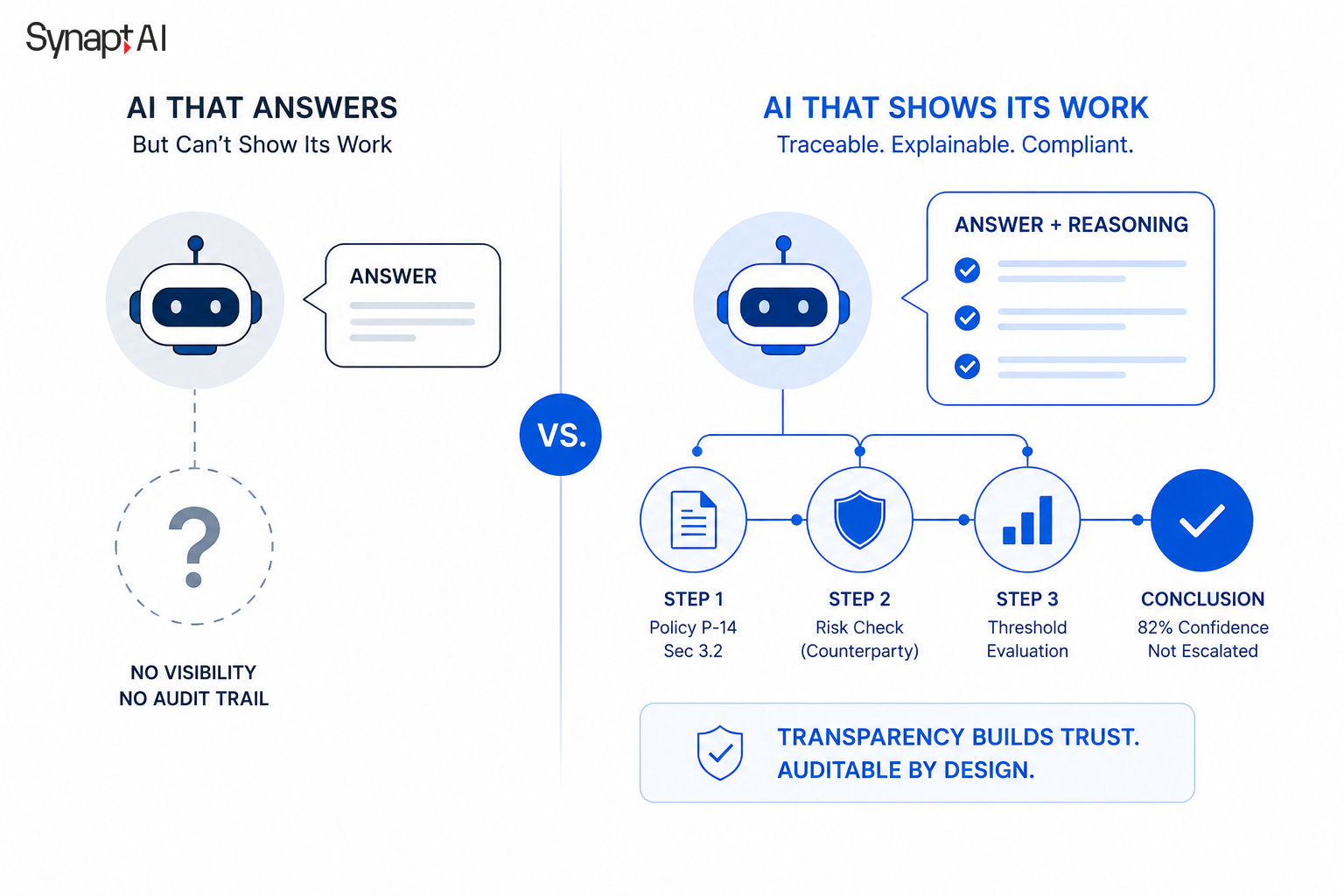
They return an answer. They do not return the path to it. Ask the agent why it reached a particular conclusion, and the honest answer from most systems is: it cannot tell you. The model processed context generated a response and produced an output. The reasoning if you can call it that lived and died inside a forward pass that left no audit trail.
That gap, not model quality, is the real deployment blocker in regulated environments right now.
Enterprises are not failing to deploy AI because their models are not capable enough. They are failing to deploy AI or deploying it in ways that create significant liability because the systems they are running cannot produce the one thing a regulator will ask for on day one: show me how you got there.
The regulation is more specific than most teams realize until they read it carefully.
For high-risk AI systems, the Act requires technical documentation covering the system’s design and development methodology. It requires automatic logging sufficient to enable post-hoc review of system behaviors. It requires human oversight mechanisms that are genuine not a checkbox where a human nominally approved the output, but a structure where a human can actually understand, challenge, and override what the system did.
And critically, it requires outputs that are interpretable. Not just accurate. Interpretable.
An output is accurate if it gets the right answer most of the time. An output is interpretable if a compliance officer, auditor, or regulator can follow the chain of reasoning from input to conclusion and understand why the system arrived where it did.
Most current enterprise agent architectures meet the first bar. Very few meet the second.
Picture two agents answering the same compliance query inside a regulated bank.
The first returns: “This transaction does not meet the criteria for escalation.”
The second returns: “I am 82% confident this transaction does not meet escalation criteria. The transaction was evaluated against policy document P-14, section 3.2. Three conditions were checked transaction volume, counterparty risk rating, and jurisdiction flag. All three fell below threshold. Here are the three hops through the knowledge graph that produced this assessment, with confidence scores at each step.”
Both agents gave the same answer. Only one of them is auditable. Only one survives a regulator asking follow-up questions. Only one has a defensible paper trail if the answer turns out to be wrong.
The difference is not the underlying model. It is the architecture specifically, whether it was built to reason transparently or simply to answer quickly.
This is the part that catches most teams off guard.
Explainability, grounding, confidence scores, and traversal paths are not features you can add to an existing agent deployment the way you update a prompt template. They are architectural properties that require the system to have been built from the ground up around a knowledge structure that makes reasoning traceable.
If your agent retrieves chunks of text and feeds them to a language model, there is no path to trace because no path was taken. If your agent traverses a structured knowledge graph querying relationships, following typed edges, accumulating confidence at each hop the path exists by design. Every step is logged. Every inference is grounded in a specific, retrievable node.
Grounding, confidence scores, and traversal paths are not things you bolt on after the fact. They are the difference between a demo and something you can put in front of a compliance team.
August 2, 2026, is the enforcement deadline for high-risk AI in the industries AI is most eager to transform. That is less than a year away. The organizations that will navigate it most cleanly are the ones that treated explainability as an architectural requirement from the start not a compliance feature to be added when regulators came knocking.
An agent that cannot show its route is not a compliant agent. It is a demo running in production.
If your AI agent had to defend one of its answers to a regulator tomorrow not the answer itself, but the reasoning behind it could it?
📖 Read more on how Synapt is building explainable AI for regulated enterprise
Authored by Rayani Aravind, Founding PMM, Synapt AI.
Over to you: Is your organization treating explainability as an architectural requirement or a compliance checkbox? Do you think EU AI Act enforcement will change how enterprise AI is actually built or just how it is documented?
Drop your thoughts in the comments and subscribe so you don’t miss what comes next.
No posts
Comments
Nothing yet. Say the first thing.
Sign in to join the conversation.