
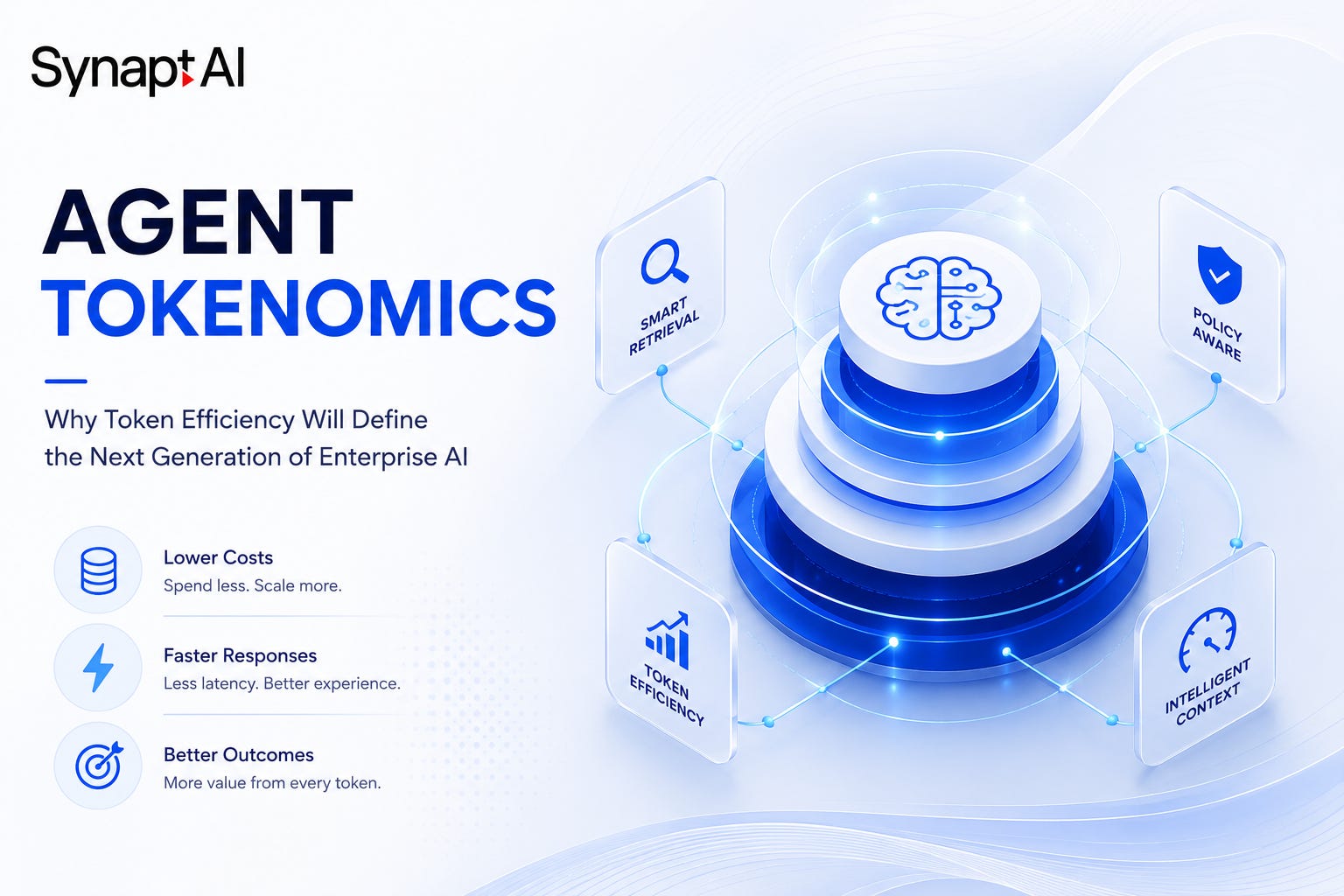
The first generation of enterprise AI focused on model intelligence. The next generation will focus on something far less glamorous — and far more important: token intelligence.
Most enterprise teams discover this the hard way. A pilot runs smoothly. Costs look manageable. Then the system scales, and the infrastructure bill arrives. The model didn’t change. The usage patterns didn’t change dramatically. But the token consumption exploded — and nobody saw it coming because nobody was measuring the right thing.
This is the agent tokenomics problem. And it is quietly becoming the defining challenge of enterprise AI in 2026.
Traditional chatbots follow a simple, predictable pattern: a prompt goes in, a response comes out. The economics are easy to understand and easy to forecast.
AI agents are fundamentally different. A single agent task may involve planning the approach, retrieving documents from multiple sources, invoking external tools, generating intermediate reasoning steps, validating the output against policy, coordinating with other agents, and then finally producing an answer. Every one of those steps consumes tokens. The user sees one clean response. Behind the scenes, the agent may have generated thousands of tokens to produce it.
As organizations move from single prompts to autonomous agent workflows, token consumption — not model size — becomes the dominant driver of cost, latency, and scalability.
Every agent decision has a token cost. Enterprise AI is becoming an economics problem as much as an AI problem.
Unlike chatbots, AI agents rarely solve problems in a single interaction. Consider a straightforward enterprise support agent. To answer one customer query, it may need to interpret user intent, break the task into subtasks, search multiple knowledge sources, retrieve relevant APIs, generate intermediate reasoning, verify the answer against policy, and format the final response correctly.
The user sees one answer. The agent generated thousands of tokens to produce it.
The challenge compounds significantly in multi-agent systems. One planner agent delegate work to specialist agents, which call tools, exchange messages, and summaries findings before returning results. The conversation the user never sees often costs more — in tokens — than the final answer itself.
This hidden token consumption is rapidly becoming one of the largest operational costs in enterprise AI deployments. Most teams don’t see it coming during pilot. They feel it at scale.
A common assumption is that larger context windows solve the token problem. Feed the agent more information and it will reason better.
They don’t solve it. They often make it worse.
More context means more tokens processed, higher latency, increased inference costs, and a greater volume of irrelevant information that the model has to sift through. Many enterprise workflows repeatedly resend the same documents, conversation history, and tool outputs to the model on every turn. The agent spends tokens rereading information it already processed two steps ago.
This is the equivalent of reopening an entire project folder every time you need to answer a single question. More context does not automatically produce better reasoning. It frequently produces more expensive reasoning.
The goal should not be maximizing context. It should be maximizing useful context per token.
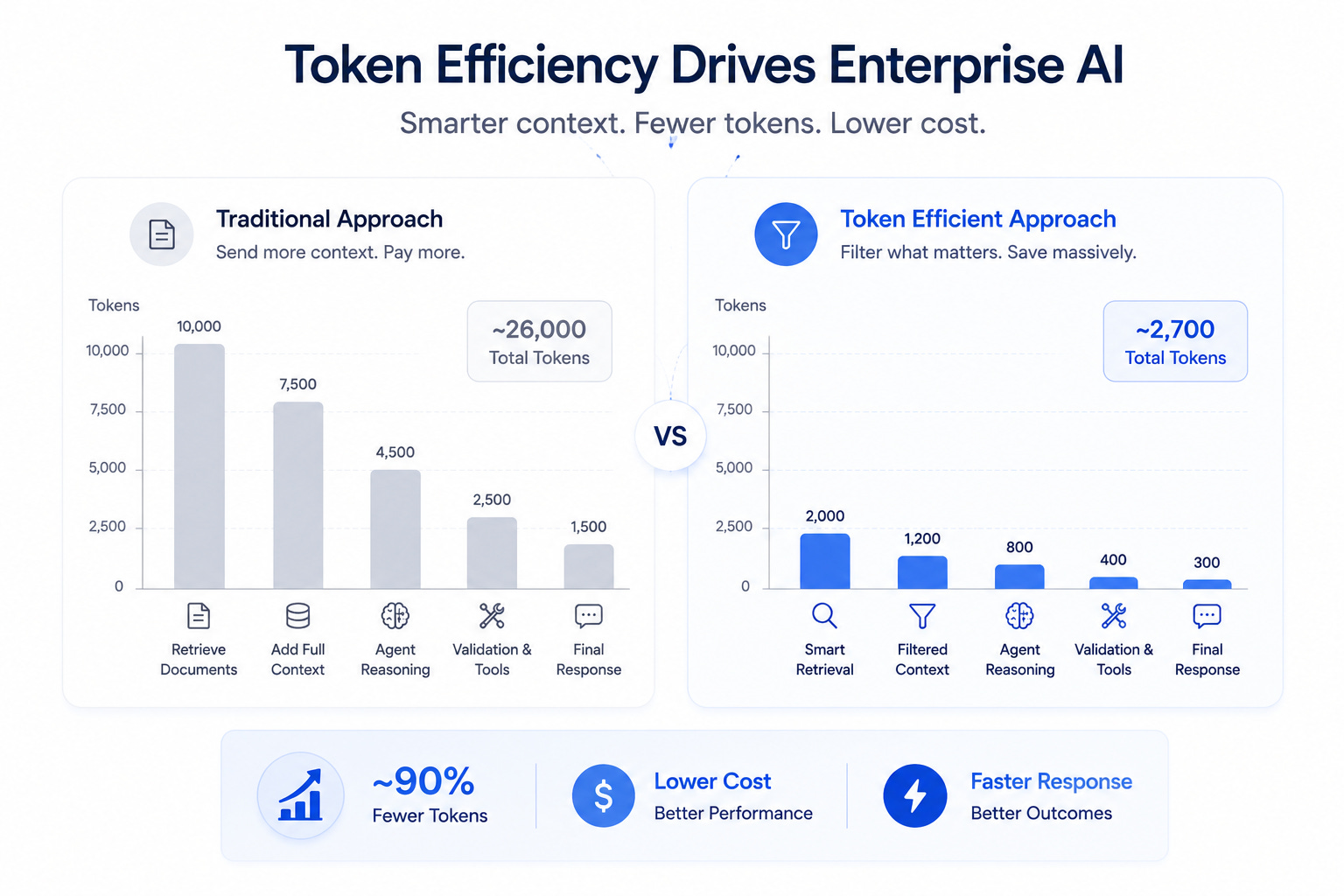
Token optimization is becoming a new engineering discipline, and the highest-performing enterprise AI systems will not necessarily be the ones using the largest models. They will be the ones using tokens more intelligently.
Context compression. Instead of repeatedly sending full documents, agents summaries, retrieve only the relevant sections, and maintain structured memory rather than raw conversation history.
Smarter retrieval. Rather than retrieving ten documents as a precaution, advanced retrieval systems identify the minimum context required for accurate reasoning and surface only that. Less noise. More signal.
Hierarchical agents. Not every task requires frontier-model reasoning. Smaller, cheaper models can classify, route, or summaries requests before escalating only genuinely complex problems to larger models. The right model for the right task at the right cost.
Memory-aware agents. Instead of replaying the entire conversation history on every turn, persistent memory allows agents to retain important facts while discarding unnecessary context. The agent remembers what matters without paying to re-read what doesn’t.
Outcome-based optimization. The most important metric is not tokens consumed. It is tokens per successful task completion. Organizations that optimize this metric reduce infrastructure costs without sacrificing output quality.
The future KPI for enterprise AI isn’t cost per million tokens. It’s cost per business outcome.
As enterprises scale from hundreds to millions of agent interactions, token economics becomes infrastructure economics.
A workflow that wastes 2,000 tokens per request may appear insignificant during a pilot. At enterprise scale, those unnecessary tokens translate into millions of additional inference calls, higher GPU utilization, increased response latency, and significantly larger operational costs.
This is why the next wave of AI optimization will not focus solely on larger foundation models. It will focus on designing efficient reasoning systems — architectures that achieve more by consuming less.
Just as cloud computing evolved from buying bigger servers to optimizing workloads for efficiency, enterprise AI is evolving from building bigger models to optimizing token flow throughout the entire agent pipeline. The organizations that win this next phase will not simply deploy the smartest agents. They will deploy the most token-efficient ones.
In the age of AI agents, intelligence isn’t measured by how much a model can generate. It is measured by how little it needs to generate to solve the problem.
The principles of agent tokenomics are not theoretical at Synapt. They are the architecture.
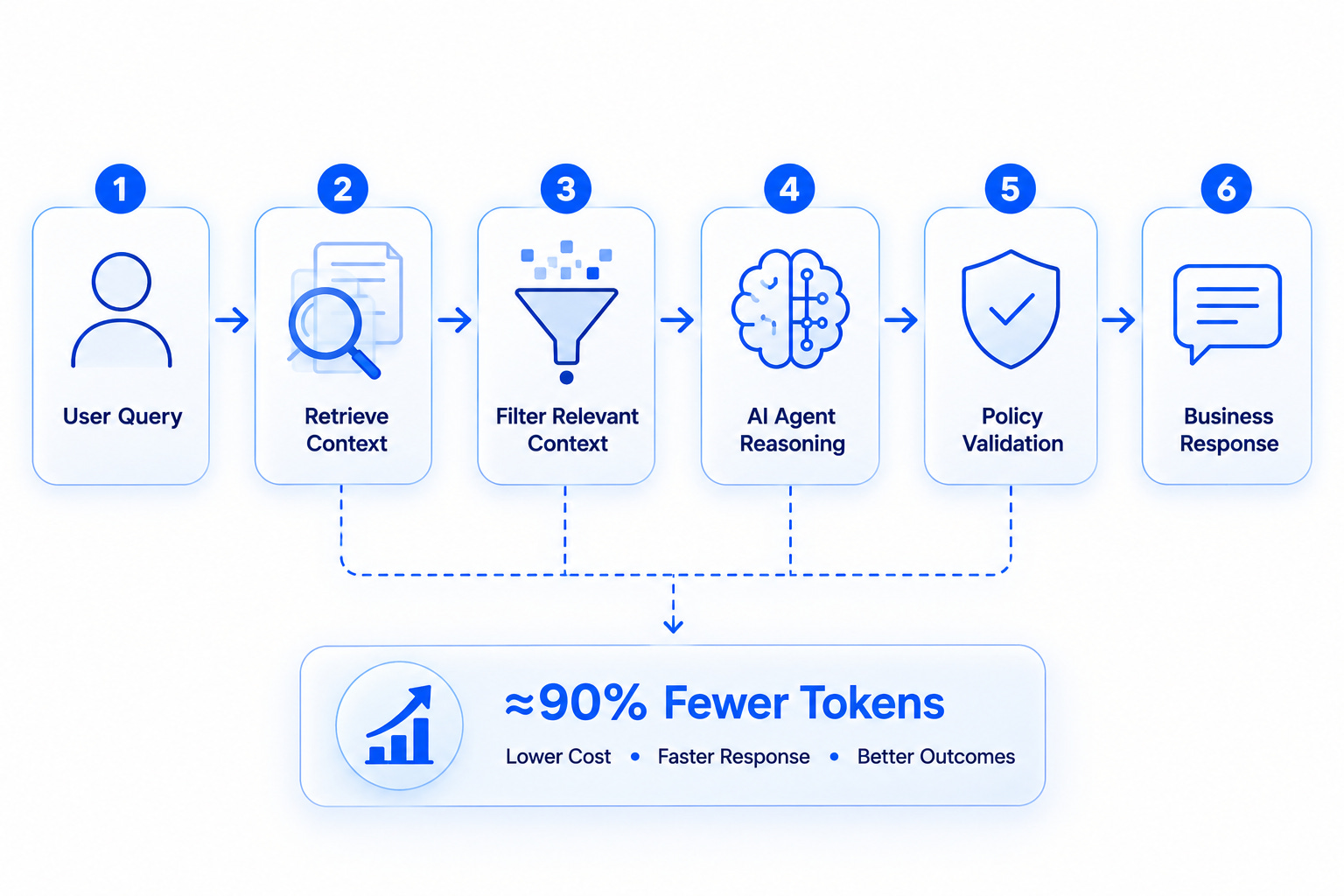
Most enterprise AI deployments send everything to the model and hope for the best — full documents, entire conversation histories, raw data dumps. The model is smart enough to find what it needs. The problem is that the model charges for every token it reads, whether it uses it or not.
Synapt’s Knowledge Graph works differently. Instead of injecting thousands of raw tokens into the model context, Synapt’s semantic retrieval layer identifies and surfaces only the tokens that are licensing-relevant, policy-relevant, or domain-relevant to the specific query. The model never sees the noise. It only sees the signal.
The result: approximately 90% token reduction per compliance check — not by using a smaller model, but by using a smarter context layer.
This is agent tokenomics in production. And as enterprise AI moves from pilot to production, the organizations that win will not be the ones with the largest models. They will be the ones with the most intelligent token economics.
Read the complete article on synapt
Authored by Priyankaa A, Rayani Aravind, Founding PMM, Synapt AI.
No posts
Comments
Nothing yet. Say the first thing.
Sign in to join the conversation.