
In Ensouling Language: On the Art of Nonfiction and the Writer’s Life, Stephen Buhner explores the world of García Lorca’s duende: “to be entangled in a direct experience of meaning without having to go through the medium of language.” To experience duende is to be “baptized with dark water.” Buhner writes, “Some sacred thing, perhaps the living reality of the imaginal world itself, has reached down and touched your brow with the dark waters of meaning.” Within these dark waters, Lorca finds black sounds. “The baptismal water is dark, not because of its color but because of its depth. And just as water may become dark when you travel deep within it, so, too, does sound.”
Languaging is one of my love languages: putting words to meaning that permeates. Writing, for me, is a way of being in relationship with whomever my words speak into existence, whether that be myself or something much bigger, or something much smaller. My words hold onto moments that dangle before my eyes, stitching my inner world to my outer world until they become indistinguishably familiar.
The words that have the ability to stir worlds come from writing that inhabits. Writing is a means of inhabiting and immersing, not the product of those moments thereafter.
As a writer, particularly in my more formal writing, I sometimes fail to let go of the conventional notion of moving the reader from one idea to another with transitional phrases and instructions on how to navigate the text. But sometimes, the story takes us where we need to go without pointing any fingers. Some stories ask us to move with them rather than follow them. Those stories are my favorite. Reading them is like surrendering to a current that couldn’t be withheld even if I tried.
I like words that feel like something when strung together on the page. They have a taste; they create a reality that I can live within that is soluble in my consciousness. There is an incredible amount of data and information floating through our planet that is not soluble in the human experience. I like words that melt; that have a felt sense; that transport me to somewhere in my body that likes the way the words feel; that implore my senses to participate in something, even if they don’t know what.
Sometimes the knot can’t be untangled, only noticed. So you stop trying to untangle the knot and just try to understand it as it is: a knot. Sometimes, writing is simply tugging on knots and threads to see what shifts. Sometimes, writing tangles the knot even more.
My current project, which is now real enough to name here, is on the ecology of multi-species households through the seasons. Even though I’m inside, winter is nipping at my fingertips. I can feel her resting on the end of my nose. When I walk outside, she stays by my side until I return home. But the way the sun is spilling through my bedroom window like a still, ceaseless flame distracts me from who is fogging up my windows.
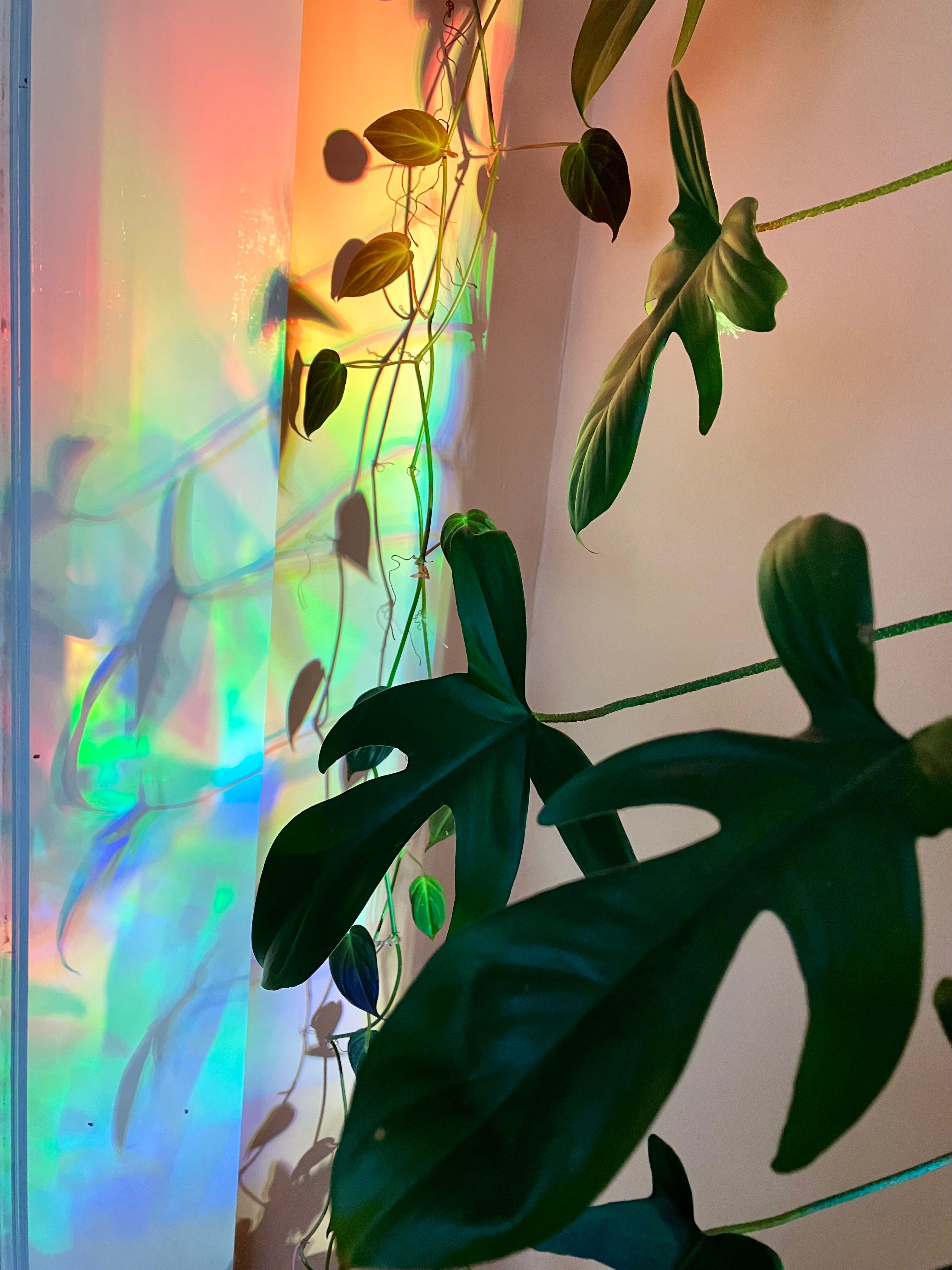
Since beginning this project, I have been forced to live with Ladybugs, Stinkbugs, Crickets, Thrips, Grain Mites, Spider Mites, Green Lacewing Larvae, a Yellow-Bellied Sap Sucker that frequents the Elm that belongs to my office window, the Elm that belongs to my office window, Violets wilting on my porch railing, and a Rosemary bush that waits for me in a garden bed. On the right side of my bed lives a Dieffenbachia who I’ve thought I would lose several times, an African Milk Tree who I rescued from Spider Mites and has remained steadfast seven years on, a Monstera that came back to life on a porch that is no longer mine, an Epiphyllum guatemalense monstrosa who likes being called by their Latin name, a Philodendron Giganteum whose second and third vines now rest in pieces in a jar of water on my stairwell window, an Angelwing Begonia who looks like they’re about to take flight, and a Variegated Rubber Tree who is recovering from a blight of Thrips and too much sunlight. To the left is a Marble Queen Pothos whose lack of sunlight is evident in deep green hues. She drapes nearly a wall’s span, painting a mural whose edges keep moving outward.
My home is a garden, something I’ve only recently realized. It’s been a little over two months since I finished and published I, Garden, but I don’t think it’s time for me to shut up about gardens yet. I remember watching Sebastian Chabot’s The Gardener about Frank Cabot’s gardens in Quebec and thinking what a perfect thing to dedicate my life to. I’ve also recently learned that you don’t have to be Frank Cabot to make gardens that nourish the soul.
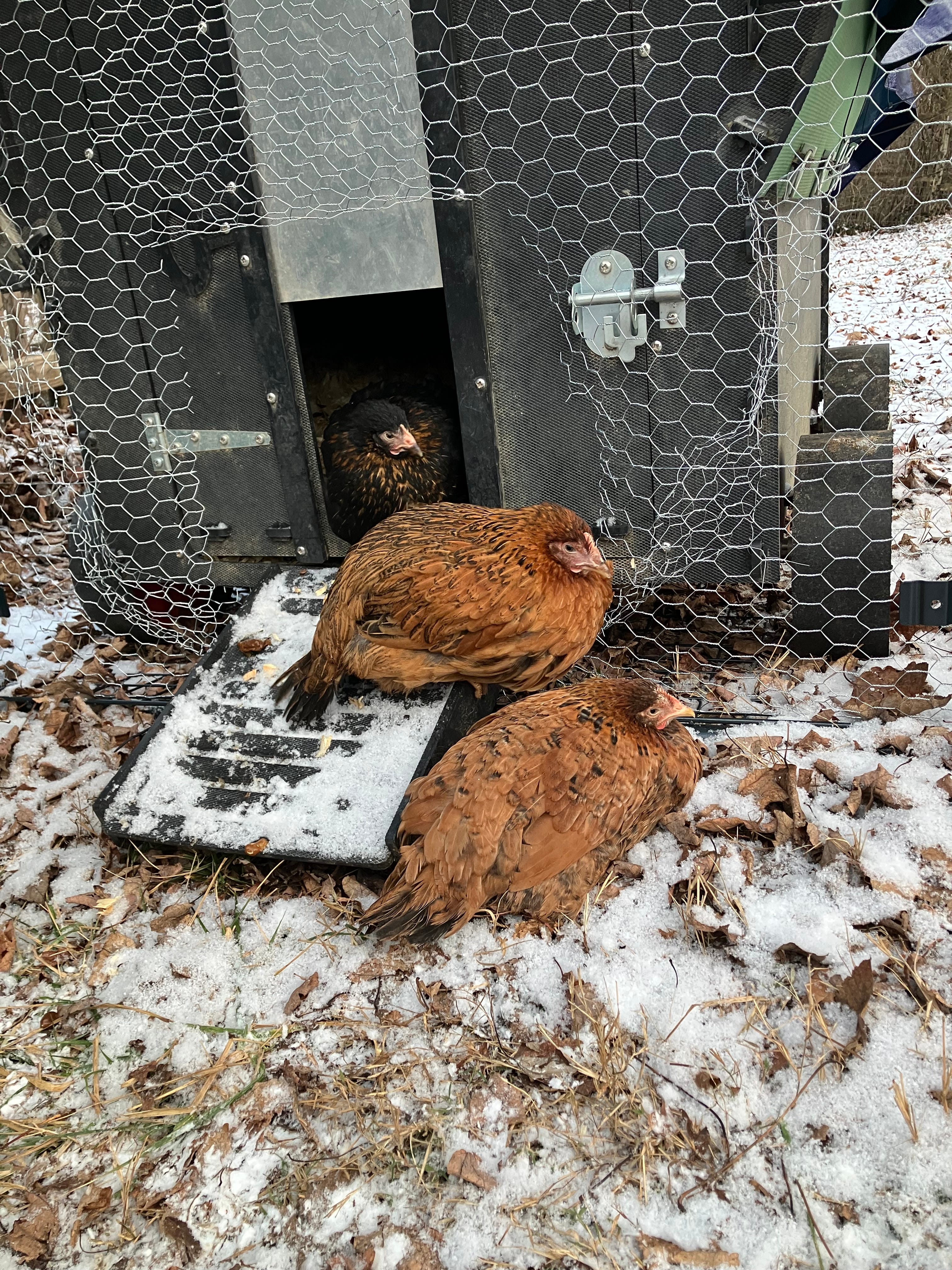
Gardens are places that draw us toward them, to be a part of them. I recently welcomed three hens into my garden: Charlotte, Lily, and Ruby. They remind me that my garden isn’t only built for me. When I participate in Garden, I am participating alongside and for many others. I have a vision of who my Garden will become. I don’t know all of the details yet, and I don’t have to, because all I need to know is that plants will be there. They will tell me where they want to go, or where they don’t. They’ll reach upward, they’ll spread and migrate, they’ll die, some will demonstrate steadfastness while others cling to ephemerality and refuse to let go. Some plants only visit. Others make Garden their home.
Eyes basking in sunlight warm a body even on the coldest days. I turn around and look out my bedroom window just as my hens are stepping out of their coop. I like the way they move together, following each other in and out of the coop as the wind allows. They can’t help but be themselves. Charlotte enjoys being touched. She pecks at my shoes for reasons I don’t know. Lily will tolerate being touched, sometimes. She’s curious and cautious. Ruby has no interest in being touched. Sometimes, I want her to need more of me than she does. But who I am to her is not entirely up to me.
My writing is covered in knots that I can’t untangle, and perhaps aren’t asking me to. The knots are what hold the weave together. They create touchpoints of certainty that conceal some of who they are while giving us a place to put our words, to feel them under our fingertips and in our imaginations, to watch them fold into themselves and wonder how, in self-communion, they will come out the other side.
I’ve always wondered what it would be like to read braille, to feel the shapes of words like we see them emerge before our eyes. The world of our words is tactile. It feels like something to language.
No posts
Comments
Nothing yet. Say the first thing.
Sign in to join the conversation.