
Summary: At its August meeting, the Riksbank left the policy rate unchanged at 1.75%, as expected, and retained its tightening bias. Inflation has been somewhat stronger than expected, but the labour market has been weak. With no urgent need to act, the Riksbank is waiting for the data to become clearer.
The summer holidays are drawing to a close, and Gerlach Macro Notes will return to broader international topics in the coming weeks. But last Thursday’s Riksbank meeting is worth a comment before moving on.
As expected, the Riksbank left its policy rate unchanged at 1.75% in August and retained the tightening bias that became explicit in June. The Executive Board continues to judge that a rate increase later this year may be necessary if inflation proves stronger and more persistent than expected.
The reasoning was straightforward. Inflation and growth have come in a little stronger than the Riksbank expected in June, but the labour market has been weak and unemployment remains high. Companies’ pricing plans are also subdued. With policy pulled in two directions and no urgent need to act, the Board chose to wait for more data.
Source: SCB
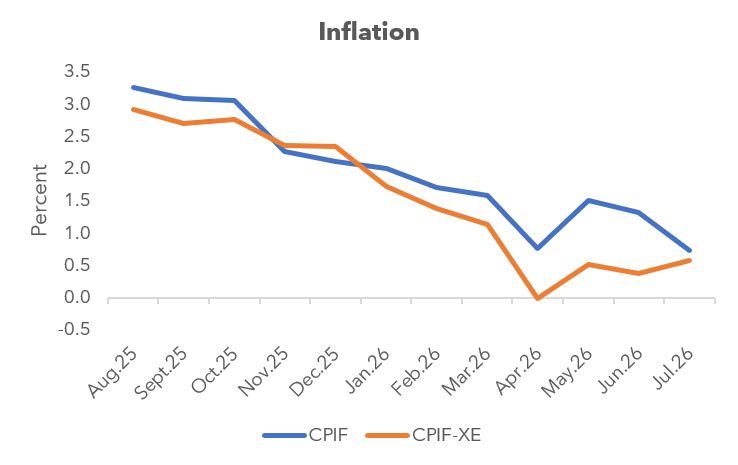
Measured inflation remains low, partly because of temporary fiscal measures introduced in April. These measures also depress CPIF-XE, making the published figures a poor guide to underlying inflation. According to the Riksbank, inflation excluding both energy and the direct effects of the fiscal measures is relatively close to 2%. Recent inflation outcomes have nevertheless been a little stronger than the bank predicted in June. The key policy question is whether this is temporary or the start of something more persistent.
Source: Ekonomifakta.se
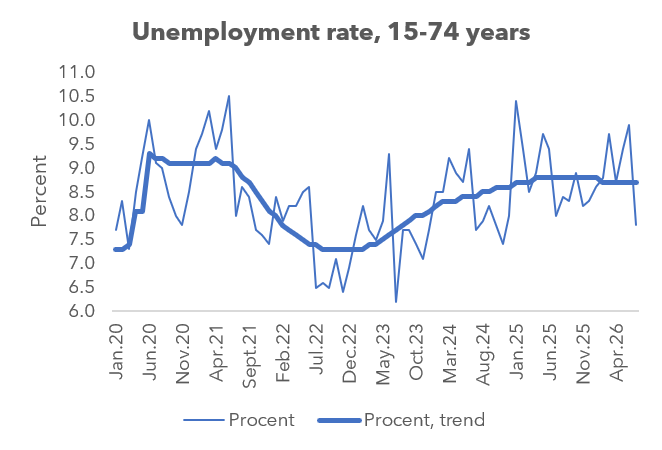
The labour market argues for patience. Unemployment remains high and developments have been weaker than the Riksbank expected, making it difficult to argue that stronger activity is generating significant domestic inflationary pressure.
The evolution of the Riksbank’s message over the past three meetings is instructive. In May, inflation had surprised on the downside and activity was weak. By June, Middle East-related supply disruptions had increased inflation risks, prompting the Riksbank to raise its policy-rate forecast and flag a greater chance of a hike later in the year.
August leaves that assessment essentially unchanged. Despite the stronger inflation and growth data, the Riksbank did not say that the probability of a hike had risen further, only that it “remains”.
That looks like a deliberate decision to play the ball into the long grass: keeping the option of a rate increase alive while seeing whether the recent inflation surprises persist. Unless they do, the policy rate is likely to remain at 1.75%.
The views expressed are my own. The work presented is preliminary and may contain errors. It should not be construed as investment advice. Readers are encouraged to seek professional investment guidance.
No posts
Comments
Nothing yet. Say the first thing.
Sign in to join the conversation.