
Summary: I earlier argued that markets were overestimating the likelihood of further ECB rate increases. But the euro-area economy is proving more resilient than expected, making another increase more plausible.
As readers know, I have argued that markets were putting too high a probability on further ECB rate increases. I am much less confident about that view following the release of the S&P Global Flash Eurozone PMI on August 21.
My scepticism was based on the view that the Governing Council would be reluctant to tighten policy simply to bring inflation quickly back to 2% if doing so risked pushing the euro-area economy into recession.
That seemed reasonable. Much of the recent rise in inflation has reflected higher energy prices following the conflict in the Middle East. Indeed, while headline HICP inflation has risen from 1.9% in February to 2.9% in July, reaching 3.2% in May, HICP inflation excluding energy fell from 2.4% to 2.2% over the same period. More generally, there is little evidence of the broader second-round effects that would normally worry a central bank.
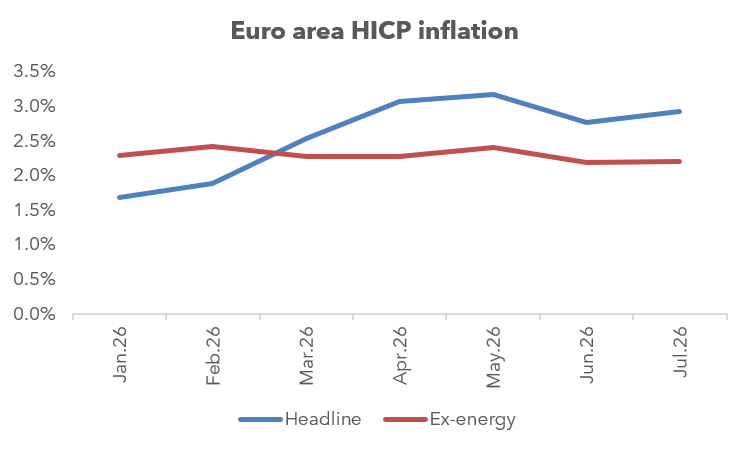
Source: ECB
In this situation, it seemed sensible for the ECB to practise “opportunistic disinflation”: wait for energy prices to fall and inflation to decline. The Governing Council had little reason to risk a recession simply to return inflation to 2% more quickly.
That argument has not disappeared. But the euro-area economy is proving considerably more resilient than I had expected. GDP grew by 0.4% in the second quarter, despite the energy shock and the uncertainty surrounding the Middle East conflict.
The PMI shows why that calculation now looks different. Activity weakened markedly after the outbreak of the Middle East conflict, and by the spring the composite PMI was signalling contraction. But that weakness has been reversed. The August flash reading is above its pre-war February level and at its highest since November. S&P Global estimates that the survey is consistent with GDP growth of around 0.3% in the third quarter.
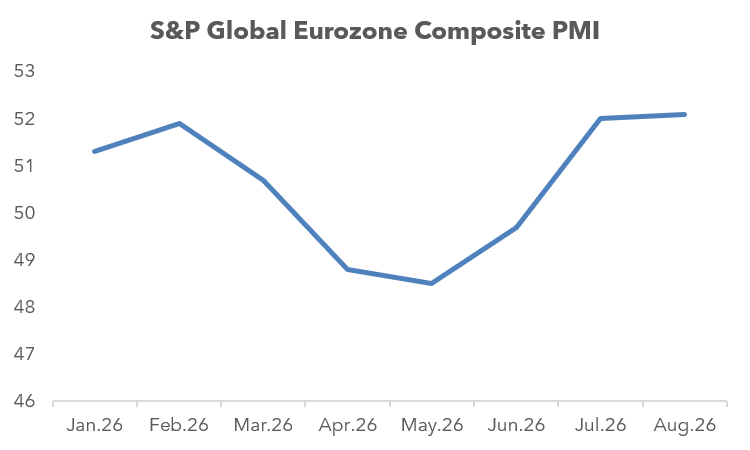
Source: S&P Global
That changes the calculation facing the ECB. My earlier view depended importantly on the risk that further tightening could push the economy into recession. That risk now looks considerably smaller. If inflation remains close to 3% while the economy continues to expand, another 25 basis-point increase becomes much easier for the Governing Council to contemplate.
Recent comments from ECB officials point in the same direction. Chief Economist Philip Lane expects inflation to remain around 3% for the rest of the year, while Mārtiņš Kazāks, Governor of Latvijas Banka, has described current inflation as “somewhat uncomfortable” and emphasised that the economy has been more resilient than expected.
None of this makes a September hike certain. The ECB has deliberately avoided forward guidance and continues to stress that decisions will be taken meeting by meeting. The account of the July meeting, released tomorrow, should provide further clues about the balance of views on the Governing Council, while the August inflation data will also be critical.
But the balance has plainly shifted. I still doubt that the Governing Council has become significantly more hawkish. What has changed is the economy: the apparent cost of another rate increase has fallen. That makes the market’s expectation of further tightening considerably more plausible than I thought only a few weeks ago.
The views expressed are my own. The work presented is preliminary and may contain errors. It should not be construed as investment advice. Readers are encouraged to seek professional investment guidance.
No posts
Comments
Nothing yet. Say the first thing.
Sign in to join the conversation.