
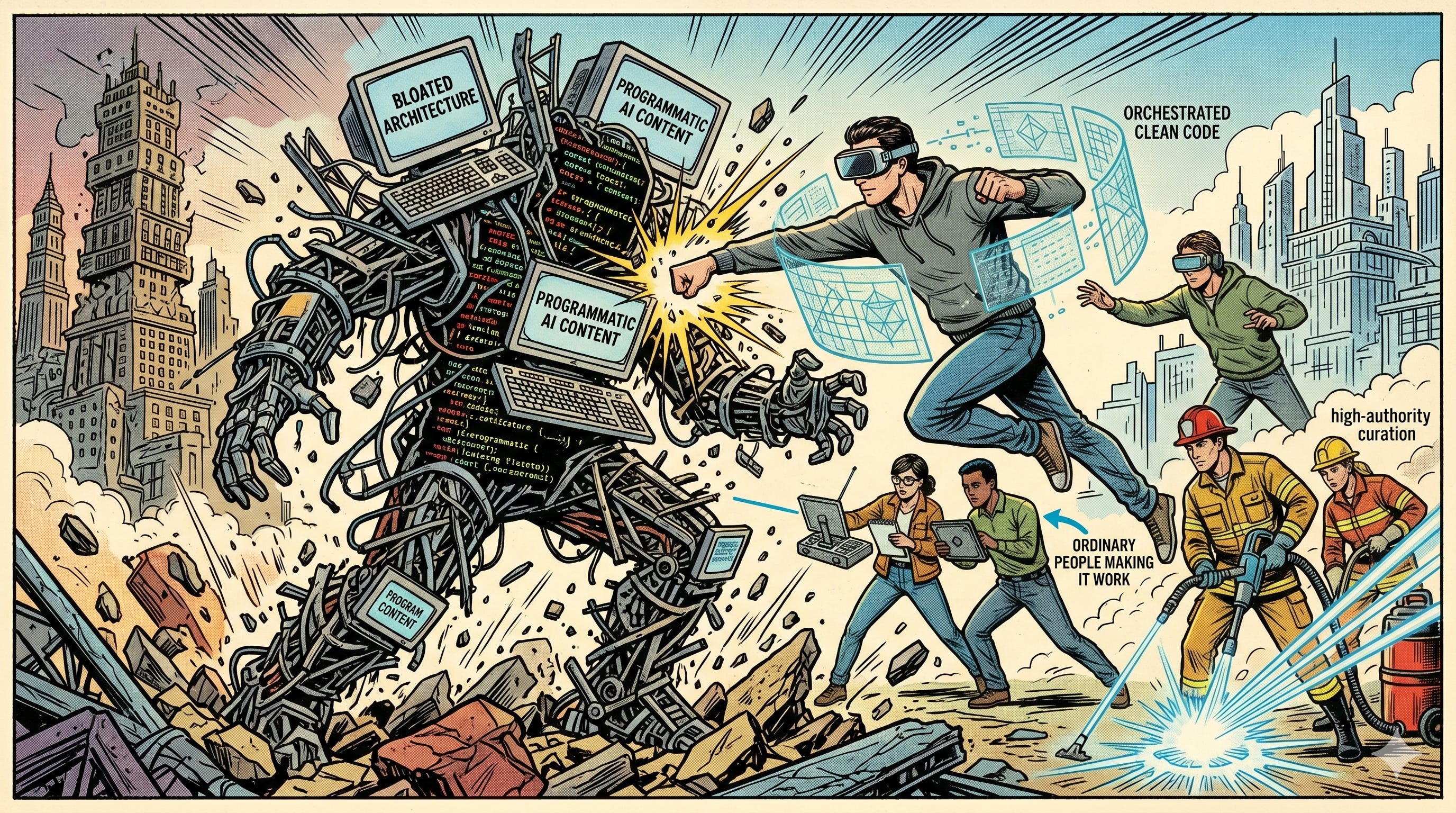
I’m not sure yet what to make of what has happened over the last two weeks, but… it looks like a hyper-focused race toward lean, multi-agent orchestration and high-authority "evidence layers" that prioritize deep, systemic value over cheap volume.
Devs are shifting toward optimizing velocity and systemic security by balancing the use of AI tools with strict controls against vulnerabilities. This trend also includes a practical pushback against architectural bloat, favoring lightweight stacks and unified engines to build fast, secure software without unnecessary complexity.
Marketers are facing a major shift toward Answer Engine Optimization (AEO). The consensus is that winning requires building an “evidence layer” of authoritative, human-first content that conversational engines trust. Success depends on treating content as a high-value product rather than just a high-volume megaphone.
From passive chat to active multi-agent orchestration like Claude Code and Figma assistants… that’s how you can describe movement in an AI scene. Yet, pushing frontier models into production—for migrations or vulnerability testing—reveals persistent constraints like token limits and displacement risks. The current value of AI lies in using local, quantized models and managing architectural drift rather than simple code generation.
Happy reading.
PLEASE🙏 Should you find emails from SWIPE unwanted or annoying, unsubscribe. If you’re interested in learning how and when you might end up in SWIPE and what you can expect in the future, check it out here.
Security in React Applications - An article explaining how to secure React applications. It details built-in defenses against XSS, safe token storage (using HttpOnly cookies), CSRF protections, input validation in Server Functions via tools like Zod, and configuring robust Content Security Policies (CSP).
Collection of npm package manager Security Best Practices - A comprehensive community guide on GitHub documenting essential strategies to defend Node.js applications against npm supply chain attacks, outlining immediate response plans, dependency pinning, configuration hardening, and auditing using security tools like npq.
TypeScript, C#, and Turbo Pascal with Anders Hejlsberg - Publication: The Pragmatic Engineer (by Gergely Orosz). An interview feature exploring the language design philosophy, career history, and evolving technical insights of legendary software engineer Anders Hejlsberg, the creator of Turbo Pascal, Delphi, C#, and TypeScript.
React is Overkill: Why Python + HTMX is Dominating in 2026 - A community blog post arguing that full Single Page Application (SPA) setups like React introduce unnecessary organizational and performance taxes for standard CRUD and content applications, favoring the productivity and simplicity of returning server-rendered HTML fragments using Python paired with HTMX.
The Pulse: Did capacity shortages at AWS happen, or not? - Publication: The Pragmatic Engineer (by Gergely Orosz). A standard “Pulse” industry report covering recent market changes, infrastructure stability, and investigative analysis into reported server capacity strains or shortages inside Amazon Web Services data centers.
The Integration Tax Is Killing Your Growth. Here’s How to Eliminate It with Headless Commerce - An article examining the architectural downsides of patchwork commerce setups that combine separate, mismatched PIMs, CMS systems, and shopping engines. It details how unified, API-first headless models eliminate this “integration tax” and natively optimize catalogs for AI-agent discovery.
How I Moved My Digital Stack to Europe - A first-person case study looking at digital sovereignty and cloud provider migration. The author recounts the technical logistics of shifting their daily software infrastructure—including mail, analytics, storage, and password management—away from US giants to European-hosted platforms like Proton Mail and Scaleway.
Ship code within minutes with the Gemini CLI DevOps Extension - A developer article detailing Google’s new AI-agent extensions for the Gemini CLI. It breaks down the three-tier system used by the tool to conduct automated pre-deployment security scans, handle multi-language framework containerization, and provision target infrastructure safely on Google Cloud.
The One Weird Git Trick That Makes Coding Agents More Effect-ive - A guide illustrating how developers can dramatically improve the accuracy and context efficiency of AI programming assistants by vendoring full framework codebases directly into their repository using git subtree, bypassing the fragmented context limitations of random web searches.
Automated release on GitHub Actions - A step-by-step technical guide on configuring fully automated package publishing workflows via GitHub Actions using release-it, emphasizing secure OIDC tokenless authentication through npm’s “Trusted Publisher” feature.
Browsers Treat Big Sites Differently - An architectural deep dive exploring how major browsers like Safari and Firefox maintain site-specific “quirks,” system overrides, and web compatibility layers to automatically inject custom code and fix broken client-side behavior for major platforms like TikTok, Facebook, and Netflix.
7 best session replay tools for mobile apps - A comparative industry roundup reviewing the top product platforms capable of capturing mobile application session replays (across iOS, Android, Flutter, and React Native) for deep developer tracking, network monitoring, and bug debugging.
Build fast, no matter what: how Expo is optimizing for speed (and how you can, too) - An engineering post outlining architectural upgrades made to EAS (Expo Application Services) builds—including compiler caching, M4 infrastructure adjustments, and build fingerprints—to minimize local rebuilding overhead and maintain developer momentum.
Learnings from 100K Lines of Rust with AI - A case study exploring the limits of AI coding agents (like Claude Code and Codex) to construct a production-grade multi-Paxos consensus engine in Rust. It highlights spec-driven workflows, generating property-based tests from formal code contracts, and automated performance optimization.
AI Agents Build Paxos in Rust - This video provides an engaging audio summary of several tech stories, including the engineering takeaways from the multi-Paxos Rust system built with AI agents featured in your list.
Why Social Media Marketers Should Take a Break From Trend Content - An article making the case that over-reliance on viral social media trends and memes dilutes a brand’s identity, consumes excessive workflow time, and attracts low-intent audiences. It encourages marketers to prioritize original, thumb-stopping content series instead.
Browsers Treat Big Sites Differently - An engineering deep dive uncovering how minor browsers like Safari and Firefox maintain secret, domain-specific compatibility scripts (Quirks.cpp and about:compat) to inject custom patches and fix broken client-side behavior for dominant platforms like TikTok, Netflix, and Facebook.
Optimizing your website for generative AI features on Google Search - Google’s official documentation outlining how to optimize web properties for features like AI Overviews and AI Mode. It clarifies that AI optimization is fundamentally an extension of strong, human-first technical and editorial SEO rather than a new discipline.
SEO Is a Product, AEO Is Brand - Publication: Product-Led SEO (by Eli Schwartz). This article breaks down the strategic dichotomy between traditional Search Engine Optimization (managed like a scalable technical product) and Answer Engine Optimization, which acts as a brand play targeting visibility across conversational AI interfaces.
Be more expressive to close more sales - A research-driven breakdown analyzing over 800 sales pitches to show how energetic vocal tones, open body language, and high expressiveness increase audience purchase intent by up to 35.8%, particularly for emotionally-driven or experiential products.
The Marketing Game of 2026: Full Guide - Publication: RedDot (by Pierre Herubel). A comprehensive handbook illustrating the state of marketing strategy, detailing tactical methodologies around modern demand generation, B2B positioning architectures, and content systems required to win market share.
The Software Abundance Trap - An essay examining the philosophical and practical challenges of operating in an era of hyper-abundant, low-cost software development, reflecting on how engineers and businesses must redefine value when code creation becomes cheap and continuous.
Hreflang Canonical Setup Guide: Rules, Errors, Fixes - A technical tutorial detailing the precise sequential logic Google follows when evaluating self-referencing canonical tags alongside regional hreflang clusters, offering actionable solutions to prevent indexing conflicts on enterprise multilingual sites.
commerce AI Search Optimization: Citation Patterns Across 5 Subverticals - An analytical study mapping out how conversational AI systems cite ecommerce resources. It shows that AI systems look past standard product pages to pull answers from a broader “evidence layer” containing sizing charts, return policies, and expert guides.
Inside Canva’s social media campaigns: their social lead explains - An exclusive interview breakdown exploring how Canva builds high-impact social campaigns by generating local cultural conversations and using social channels as an agile testing ground for broader marketing initiatives.
21K Google Ads Accounts Show Why Budgets Must Change - A Q1 data benchmark report auditing performance data from over 21,000 active Google Ads accounts, highlighting an 11% dip in overall impressions, softening global conversion rates, and showing why mid-market accounts are netting the highest ROAS.
The Creator Economy’s Next Chapter: 7 Lessons From Scalable Summit - An industry report distilling key takeaways from the Scalable Summit, focusing on the professionalization of the creator economy, multi-platform media diversification, and how brands can scale influencer marketing sustainably.
TikTok Marketing Strategy: The 2026 Playbook - A strategic agency guide detailing the creative frameworks, algorithmic shifting patterns, and paid advertising architectures required for corporate brands to execute successful commercial campaigns on TikTok.
What Companies Should Know Before Publishing Technical Content Online - A practical guide for B2B engineering and dev-tool companies outlining how to produce technical blog content that respects developer intelligence, balances educational depth with product positioning, and avoids the trap of generic AI-generated copy.
Google AI Optimization: The Complete Strategy Guide - A business-focused strategy guide dissecting the mechanics of Google’s AI search layout, advising content teams on how to position their brand as an authoritative informational entity so that AI engines prioritize citing them.
Old PC vs New AI: Can a 2015 Desktop Actually Run Gemma 4? (2B vs 4B Benchmark) – A performance case study testing whether a decade-old consumer CPU setup can practically execute local SLMs (Small Language Models). The author benchmarks token-per-second generation, structural JSON validity, and hardware thermal throttling thresholds using quantized flavors of Google’s Gemma 4.
It works, until it doesn’t: The risks of scaling AI content – Publication: Lily Ray’s Substack (by Lily Ray). An analytical research report tracking over 220 domains that relied on high-volume programmatic AI writing tools. The data maps out a distinct “SEO hype cycle” where explosive traffic jumps are followed by catastrophic, domain-destroying Google algorithm updates.
HTML is the new Markdown: How Anthropic engineers are building with Claude Code – Publication: Lenny’s Newsletter (by Lenny Rachitsky & Claire Vo). A podcast feature and deep-dive interview with Anthropic engineer Thariq Shihipar exploring how terminal-resident developer agents are replacing standard markdown with raw HTML to output inline micro-apps, live ui previews, and reactive design primitives.
How to build an AI marketing strategy – A strategic guide outlining corporate frameworks for embedding artificial intelligence tools into existing workflows. It details structural governance, data privacy parameters, and balancing machine efficiency with authentic brand tone across social operations.
Anthropic just launched Claude for Small Business – A feature breakdown detailing the launch of Anthropic’s new enterprise-lite tiers, specifically highlighting “Claude Design” on the Opus 4.7 architecture, which uses custom sliders, codebase syncing, and local design systems to bridge the gap between prompting and visual UI prototyping.
Project Glasswing: what Mythos showed us – Cloudflare’s technical analysis after deploying Anthropic’s highly restricted security model, Claude Mythos Preview, across 50 internal code repositories. It covers the model’s ability to chain multi-step exploits together, alongside the formatting nuances and safety refusals encountered during legitimate vulnerability research.
AI’s impact on software engineers in 2026: key trends, Part 2 – Publication: The Pragmatic Engineer (by Gergely Orosz). A conclusive data breakdown assessing feedback from over 900 developers on the systemic costs, token limitations, and structural changes of AI tooling. It details how junior engineer apprenticeships are being systematically erased by task-level copilot automation.
Google Search at I/O 2026: What’s new for users and creators – Google’s official announcement detailing platform upgrades revealed at Google I/O 2026, summarizing updates to search layouts, deeper multimodal reasoning workflows, expanded rollout parameters for AI Overviews, and new creator attribution models.
Google I/O: Agents, agents, agents – Publication: Context Window on Every (by Dan Shipper). A technical commentary breaking down the developer landscape coming out of Google I/O 2026, analyzing the industry’s pivot away from basic chat boxes toward multi-agent orchestration frameworks designed to execute long-running asynchronous workflows.
The Figma Agent is here – A product reveal presenting Figma’s native AI design agent, showcasing how deep file context allows the canvas assistant to intelligently generate UI components, automate systematic design tokens, and handle bulk layer restyling tasks within complex enterprise design files.
Software is not solved – An essay asserting that despite massive advancements in automated code generation, software engineering remains fundamentally unsolved. The author separates the cheap mechanical act of “typing code” from the complex human challenges of clarifying product ambiguity, debugging systemic architectural drift, and aligning shifting requirements.
Migrating Express to Next.js using AI agents – A technical tutorial demonstrating an automated code migration workflow. It showcases how developers are deploying agentic code assistants inside modern setups (like the Antigravity IDE) to systematically re-architect backend Express API endpoints into Next.js App Router server solutions.
¯\_(ツ)_/¯
🛠TOOL you should check out: Meet Okara, the AI CMO - The only AI CMO you need for growth and marketing.
🎸LISTEN TO: Steely Dan – Do It Again (1972)
Happy reading /bookmarking!
If you enjoyed these, please SUBSCRIBE, recommend 👏 and share to help others find us! Let us know what you think in the comments section below. 🐦Follow SWIPE on TWITTER
No posts
Comments
Nothing yet. Say the first thing.
Sign in to join the conversation.