
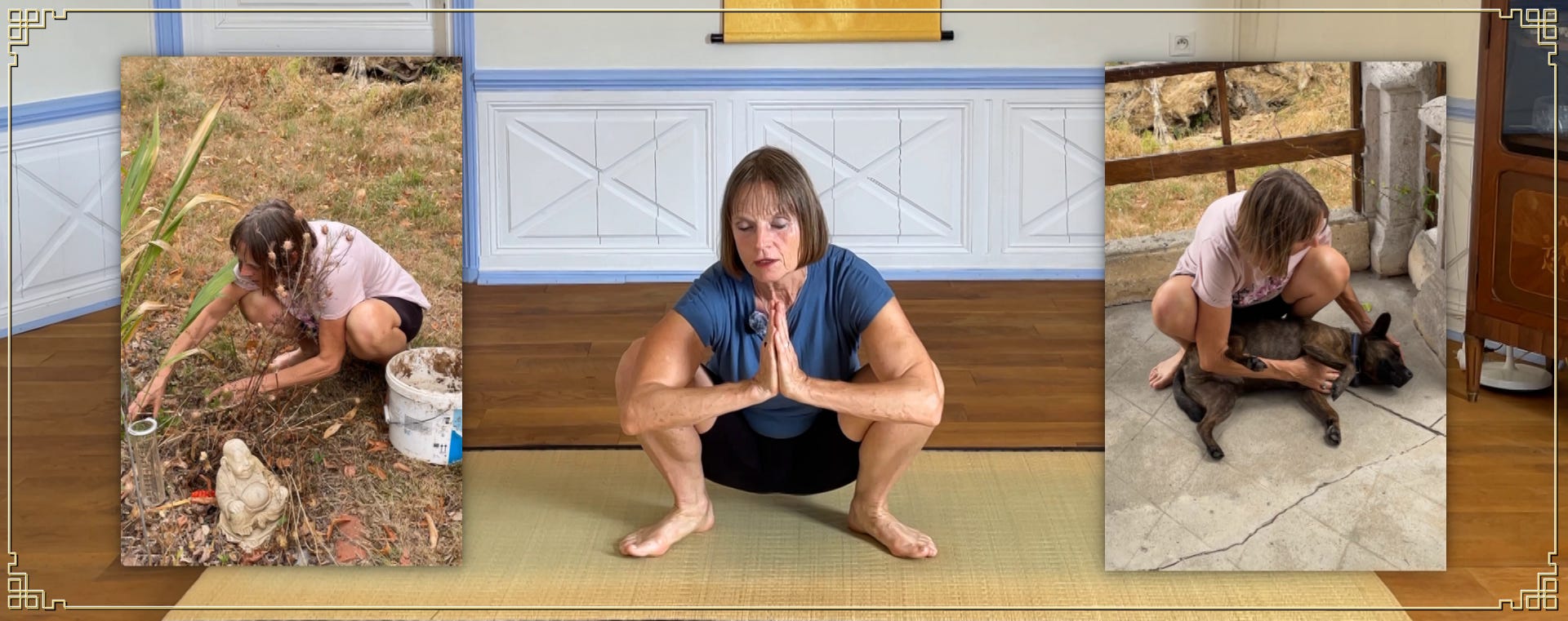
I’ve recently posted videos on YT and Instagram on movements for birth preparation. These include standing, squatting, all fours and resting. I want to reflect on how these positions are not only for birth, but for life: especially as we get older.
I am post-menopause, and my birthing years are well behind me. As many of you know, last year I became a grandmother and supported my daughter during her journey into motherhood. Even when supporting a woman during labour it can help if you are able to do the birth movements yourself.
However if even if you are not supporting women during birth, and even if you are not planning to have children, birth movements are important for us all at all stages of life: especially these days, when we are less likely to include them as part of our everyday activities.
In the past, our ancestors would work outside, bending and moving in many of these ‘birth’ positions. Science has shown that prehistoric women had stronger arm bones than today’s elite rowing athletes ( Macintosh AA, 2017). Their bones and muscles were strong because of their daily tasks, like grinding grain and working outside. They would often be in some version of squatting as they worked or rested. When I used to come to France as a child, there were still squatting style toilets here. Before vacuum cleaners and mops, women would be on all fours to scrub floors. I still try to do some cleaning on all fours.
I am fortunate that I work on the floor for my shiatsu, and most of my massage sessions. During my shiatsu training, which I began in 1983, we were encouraged to do the martial arts ‘ walking squat’ to prepare us for all the kneeling and semi-squatting movements we use during a shiatsu session. After more than 40 years of practicing shiatsu people often ask me how my knees are. They are absolutely fine. The only time I have experienced knee problems is when I have fallen while skiing. I am sure that cycling and doing shiatsu helped me in my recovery. When I gave birth to my daughter Rosa in 1990, inspired by my pre and post-natal exercise teacher, Elizabeth Noble, I birthed Rosa squatting. My shiatsu practice had prepared me to birth.
Modern life makes our pelvises stagnant: sitting, not moving enough, not walking. We need to find ways to move our bodies more in our daily life.
Watch my video and I hope you become inspired to use these more as part of your daily activities. This video is not just about squatting.
I personally don’t overly like going to gyms. I find them a bit noisy and busy, and they are inside! I like to be outside as much as I can for my movements. Most days, during all seasons, I run for around 20 to 30 minutes with my dog, Loki. You would think it might be during winter that I run less, but it is actually during the summer. When it gets into the 30’s and even 40’s here, I need to do my gardening and outside tasks early in the day. If I run, even if I get up at 6 am, it is usually too hot and tiring for me to have energy for much else during the limited cool hours. By contrast, during the winter, even if it is cold and rainy, I find that running warms me and helps me get started with my day.
All these movements help to keep your body fit and well. They also keep your powerful Extraordinary Vessels flowing.
They involve movements of all your Extraordinary Vessels, but especially your Girdle Vessel (Dai Mai) which regulates your pelvis. In pregnancy, it opens for birth. In menopause, as our essence shifts, it’s still important to keep this vessel flowing, to support our pelvis, to keep us strong in our centre and to keep us grounded.
Running and walking help your Stepping Vessels (Qiao) regulate your daily energies and the flow in your 12 meridian system. They help you to be present and take your place in the world, to stand your ground.
Movements which work your arm and shoulders work the powerful Linking Vessels: your wings.
Alongside moments of activity, it is also important to take time to rest: like during birth. In rest, you activate your Yin Vessels more, especially your Penetrating Vessel: your Sea of Blood.
The needs of all bodies, whatever age, whether you are birthing or not, are not so dissimilar. We all need to know how to open, how to be strong and how to surrender.
We were born to move.
These aren’t just birth positions. They are your blueprint for a vibrant, mobile life at any age.
Which of these movements do you use in your daily life? Tell me below. 👇
Try bringing one of these into your routine this week:
Squatting: Bending down to garden, tend to pets, or pick things up off the floor.
All-fours: Scrubbing a low surface or stretching on the rug while watching TV.
Arm work: Carrying groceries or lifting objects using the strength of your back and shoulders.
Thanks for reading Rewriting your Life! This post is public so feel free to share it.
Reference:
Macintosh AA, Pinhasi R, Stock JT. Prehistoric women’s manual labor exceeded that of athletes through the first 5500 years of farming in Central Europe. Sci Adv. 2017 Nov 29;3(11):eaao3893. doi: 10.1126/sciadv.aao3893. PMID: 29209662; PMCID: PMC5710185.
No posts
Comments
Nothing yet. Say the first thing.
Sign in to join the conversation.