
Greetings friends! As we head into Thanksgiving weekend, a reflection on gratitude, giving back, and what to do when the aliens attack.
I’m deep in another nightmare, and once again, the aliens are invading.
Their massive ships, gathered at the edge of our Earthly atmosphere, are so like the Star Destroyers of my childhood they’re probably some kind of dream-state copyright violation.
I’m in the midst of a terrified crowd—rising fear like a band around our chests, leaving us directionless in our dread. What to do? Some run home to cower. Others grab up children and pets. But what is the point? I can’t help but think. We are out-gunned, over-powered.
“They’re going to suck out our brains!” Someone shrieks, arms waiving overhead in a rather impressive Kermit the Frog impression. And we all believe him. After all, isn’t that what aliens do?
Panic rising, I join a crush of women and children, and we huddle inside an abandoned church, abject in our despair. We’re not praying, just waiting for the end. I gather a random toddler into my arms, finding a semblance of comfort in being a source of reassurance.
But it appears that time has run out.
“They’re here…”
“They’ve landed…”
“It’s over…”
The words, a susurration of fearful resignation, echo through the hall. We turn as one toward the heavy oak doors. Horror claws at my throat, and I fight to breathe.
Like a scene from a film, the double doors swing open, angry hinges breaking the terrible silence.
Then I blink, confused. Because this nightmare of mine is about to take a strange turn.
We expect a horde of ravenous aliens, brain-suckers all. But there is just one figure framed in the doorway, and she pauses only a moment before striding down the church aisle, her pace that of someone with work to do, and not enough time to get it done.
This is a fifty-something woman. Average height. Sensible shoes. Basic brown cardigan. Long, grey-streaked hair. She spins on her heel, taking us all in, this room filled with sweaty, perplexed women and children.
“I’ve come,” she says, her voice clear and carrying, “to smash the patriarchy.”
Well! That was not what I was expecting.
We follow her outside, blinking in the bright light of day. A young man grips my arms, glee in his eyes. “She’s fixing everything!” he gabbles. “We have free healthcare now! A fully funded social safety net! Childcare! Education! She’s funding renewable energy, and shutting down fossil fuels!” He literally jumps for joy, before (again, quite literally) skipping away.
Huh? I feel a hysterical giggle rising through my chest, and I turn toward the Woman, still struggling to accept that my nightmare has somehow shifted to a utopian fantasy.
“How are you doing this!?”
“I commandeered the Mother Ship,” she replies, a steely glint in her capable eye. “It’s holding the invading alien armies at bay.”
This woman-in-sensible-shoes, with the power of a Star Destroyer behind her, had beamed down to Earth and gone straight to the billionaires, stripped them of their wealth, and was already redistributing those billions to the poor and the vulnerable, pouring ill-gotten gains into earth-healing, soil-regenerating work.
Across the way, I can already see some of those (formerly) rich dudes starting to grumble—they rather enjoyed being billionaires, after all. And the patriarchy had been pretty fun (for them anyway).
“I told them they could choose between universal healthcare and the brain-sucking aliens,” she informs me, matter of factly. Then she raises a brow. “It took them longer to decide then it should’ve.”
This very no-nonsense Woman has a lot of work to do, but I wrap her in a hug before she can go. “You’re our hero!” I beam, tears in my eyes. She gives me a reassuring pat on the back.
“Gotta go,” she says, “the patriarchy isn’t going to smash itself.”
This isn’t the first time I’ve shared a nightmare with you all. If you’ve been reading my substacks (or if you’ve ever taken a class with me) you already know I’m a bit of an over-sharer. Welcome to my subconscious, friends and relatives! My dreams are usually ridiculously on-point, almost comically obvious in their meaning.
But this one felt a little different—because I woke up feeling gleeful.
I’m no stranger to nightmares—the kind that have me sitting up with a pounding heart and a feeling of impending doom. But dreams filled with utopian optimism? Not so much.
So I got up, got dressed—sensible shoes and cardigan, of course—and headed to school feeling lighter and more hopeful than I have in a while.
I wasn’t sure where exactly this dream came from, until I started mentally preparing for class.
Ah yes, of course.
I was heading in to teach my Introduction to Native American and Indigenous Studies course, and today we were wrapping up our discussion of Robin Wall Kimmerer’s book Braiding Sweetgrass, concluding with her two essays on Windigo.
Windigo are cautionary figures within Anishinaabe mythology. Cannibals, these once-human beings are driven by endless voracious hunger, so overwhelmed by greed and self-interest that other human beings are reduced to mere objects, things to be consumed. The more they eat, the hungrier they become, until their bodies feed on themselves, their lips bloodied as they chew their own flesh. These are morality tales—lessons on the importance of moderating one’s appetites, of prioritizing the needs of others, even during times of terrible scarcity.
For Kimmerer, Windigo is also a metaphor: for the clearcut, for the voraciousness of a consumerism predicated on the illusion of infinite economic growth, for an economic system that chews its way through human beings, ecosystems, and species with a terrible, insatiable recklessness. It’s a monster that thrives on scarcity—the belief that there is not enough, that there will never be enough, and that I must fight for every inch of ground, horde every bit of wealth. It’s the Windigo spirit that (as she puts it) “tricks us into believing that belongings will fill our hunger, when belonging is what we crave.”1
It’s how we arrived at profit-driven healthcare, at politicians who sit idly by while children go hungry, at economic systems that create a climate crisis. It’s the quintessential self-destructive mindset. But, Kimmerer also reminds us, we cannot afford to let Windigo destroy itself.
“Some folks argue that we need do nothing at all—that the unholy coupling of greed and growth and carbon will make the world hot enough to melt the Windigo heart once and for all. Climate change will unequivocally defeat economies that are based on constant taking without giving in return. But before the Windigo dies, it will take so much that we love along with it. We can wait for climate change to turn the world and the Windigo into a puddle of red-tinged meltwater or we can strap on our snowshoes and track him down.”
Kimmerer tells us a story of doing just that. In her modern day myth-making, she lures the beast to her home, where she has laid a trap. This is scary work—a Windigo will definitely suck out your brain, after all. But, “gratitude for all the earth has given us lends us courage to turn and face the Windigo that stalks us, to refuse to participate in an economy that destroys the beloved earth to line the pockets of the greedy, to demand an economy that is aligned with life, not stacked against it. It’s easy to write that. It’s harder to do.”
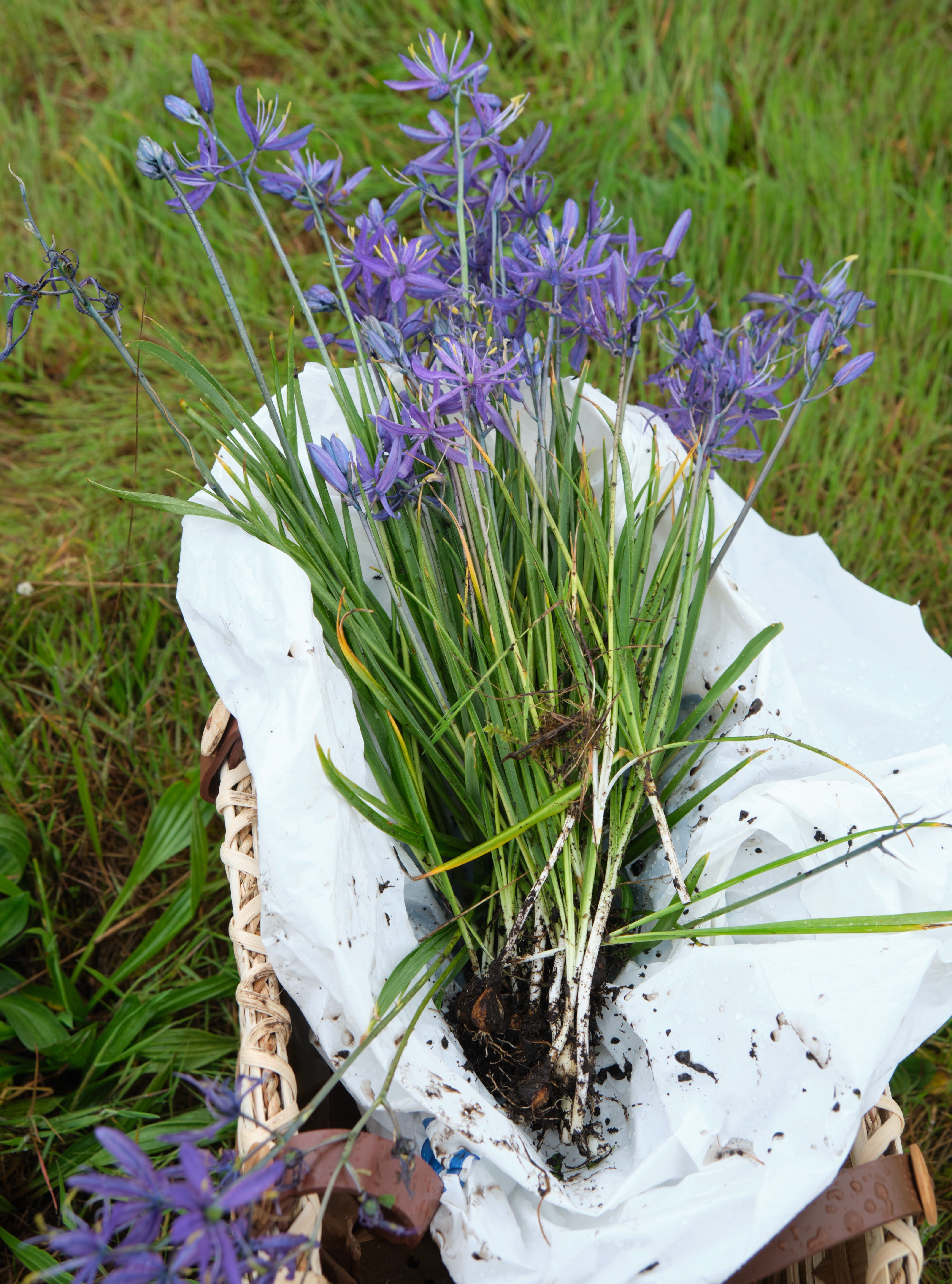
But this is no trapline snare that she’s laid. A botanist grounded in Indigenous ecological knowledge, Kimmerer gathers the lessons from her plant teachers, combining them into a potent tea. She begins with Buckthorn, a powerful emetic. And when the Windigo slurps it down, demanding more, more, more, the Buckthorn does its job. That poor creature vomits up coal slurry, oil slicks, tar sand. Then, as he lies gasping and weakened, she doesn’t put him out of his misery. Instead, she lifts a different concoction to his lips: willow that satiates, wild-strawberry that heals, the lessons of collaboration from the Three Sisters (corn, beans, and squash). She infuses the medicine with the unity of white pine, the mutual flourishing of pecans, the nurturing of cedar, the humility of birch, the gratitude of maples. It’s this last one—gratitude—that seems to do the trick. Transforming this monster from a being defined by voracious greed to one of compassion and care.
The Windigo-mind flips morality on its head, telling us that greed, self-interest, and cruelty are heroic qualities to be admired, emulated. So restoring Windigo to sanity requires a moral and ethical move.
Having just finished re-reading these chapters before bed, perhaps it’s no wonder I dreamt about an alien-invasion turned patriarchy-smashing utopian dreamscape?
Now, I realize not everyone equates “smashing the patriarchy” with universal healthcare or solving the climate crisis, but apparently my subconscious does. For me, “the patriarchy” isn’t just male domination, but an idea inextricably linked to systems of inequality and economies of extraction, the hording of wealth, the worshipping of power, the stripping of personhood and worth from other sentient beings—human and otherwise.
But the thing to remember is that Windigo is no alien species. Before his terrible transformation, Windigo was homo sapiens—not some extra terrestrial invader. Windigo is the terrible, irrational, destructive part of us, the part that eats up the very ground under our feet, the very air we breathe, and the water we drink in a feeding frenzy of self-destroying self-interest.
And gratitude, Kimmerer suggests, may just be the antidote to that Windigo-mindset.
But—and oh, this is important—Kimmerer doesn’t stop there. Gratitude, she writes, is just the beginning. We’re not called to simply feel, but to act. Because real gratitude inspires reciprocity—the drive to return the gift, to give back. To put our hands to work building a world that is more just and more sustainable.
In the epilogue to Braiding Sweetgrass, Kimmerer inspires us to do just that. Here she tells the story of a giveaway—a tradition practiced among Indigenous communities across North America, and indeed, around the world. In these cultures, a celebration of a major life event isn’t a time to receive gifts, but to return the gift, to honor those who helped get you there.
So Kimmerer describes a giveaway blanket, spread out on a grassy field, covered in gifts, and surrounded by celebrating kin.
University programs are required to have learning outcomes—the things we commit to teaching our students, the skills we hope to impart. And in PLU’s Native American and Indigenous Studies Program, we’ve committed to helping our students:
“Draw connections between their academic work and personal vocation by reflecting on the importance of community, relational responsibility, and reciprocity, what it means to live beautifully, harmoniously and ethically, to engage in work that is useful, and to conduct inquiry that holistically draws on the spiritual, intellectual, physical, and social realms.”
That’s quite a mouthful. But it’s the kind of mouthful that nourishes and inspires.
And it also inspired the question I posed to my students: what will be on your giveaway blanket? What people, places, ancestors, or ecosystems have sustained you? How are you going to give back? What gifts do you have to give them? What are you able to offer to this moment in time, that no one else can?
I often hear Indigenous elders and teachers say that each of us is here for a reason. That every person alive today is meant to be here, that each of us have a particular gift, a particular contribution to make to this pivotal moment in human history. And so the question becomes—what gifts do we have to bring? How will we give back, for all we’ve been given?
Because, my friends, the patriarchy isn’t going to smash itself.
Thanks for reading Climate Anxiety and Spiritual Resilience! This post is public so feel free to share it.
Quotes from Robin Wall Kimmerer, Braiding Sweetgrass (Milkweed Press, 2013).
Comments
Nothing yet. Say the first thing.
Sign in to join the conversation.