
Twenty-four states and Washington, DC, have legalized recreational cannabis. And the newest data show a sharp rise in pediatric Emergency Department (ED) visits and poison-center calls from cannabis ingestion, especially edibles.
The most recent U.S. trend: in children under 6, reported edible cannabis ingestions rose 1,375% from 2017 to 2021 in National Poison Data System data. Many kids required ED evaluation, and hospital and/or PICU admission increased.
Approximately 18.7% of U.S. persons aged ≥12 years used cannabis in 2021. Further expansion of legalization of medical and nonmedical cannabis has contributed to increased availability and use of cannabis by adults. More worrisome, however, is that Monitoring the Future data show that American youth’s perception of the risk of cannabis has declined. Go figure!
Published in 2023, CDC surveillance of emergency departments found cannabis-involved ED visits rose markedly during the pandemic, including among children ≤10 and those ages 11 to 14. For children ≤10-years-old, visits peaked in summer 2022 at about 71.5 weekly visits in the CDC surveillance sample.
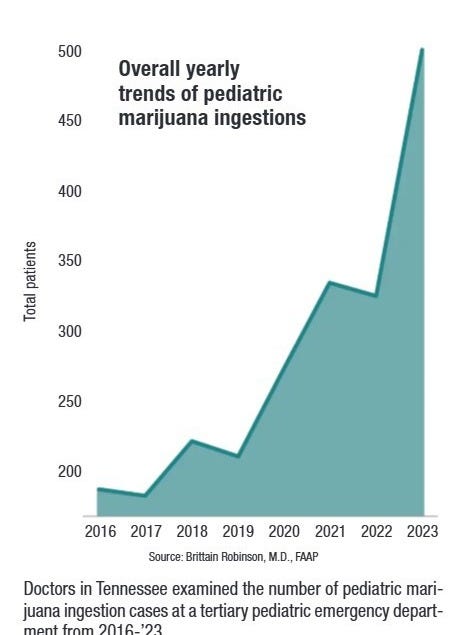
Newer (unpublished) data presented at the AAP national conference in 2025 by pediatric researchers from Tennessee, found that marijuana ingestions presenting to the ED between 2016 and 2023 increased by about 40 cases per year.
ED presentations of cannabis ingestion by children 0 to 5 years old increased 1,467%. The share of all ED visits due to marijuana ingestion nearly tripled, from about 0.20 to 0.26% before the pandemic to 0.70% in 2023.
“Children are typically finding cannabis gummies that belong to a family member or at home and eating them, unaware of the impact. Even young children in states where marijuana is not legal (like Tennessee) are being hospitalized after unintentionally ingesting cannabis products - often edibles that look like candy,” said Brittain Robinson, MD, FAAP.
A nation-wide 47 hospital study of the Pediatric Health Information System included ED encounters between 2016 and 2023 for children <6 years of age with a diagnosis indicating cannabis ingestion. Only 29% of those occurred in states where recreational marijuana was legal. Many children received head CT scans and/or lumbar punctures, and 62% of children were hospitalized. In states where cannabis was legal, children were more quickly diagnosed with urine toxicology screening.
In states where recreational cannabis use remains illegal, parents are reluctant to admit to using cannabis in their homes.
altered mental status
lethargy/somnolence (extremely sleepy, “out of it”)
ataxia (severely off balance)
hypotonia (low muscle tone)
irritability
vomiting
tachycardia (fast heart rate)
hypotension (low blood pressure)
apnea (cessation of breathing)
seizures
respiratory depression (slow, ineffective breathing)
Severe CNS depression, apnea, PICU admission, mechanical ventilation, cardiac dysrhythmia, and rare deaths have been reported.
Most children recover with supportive care, but pediatric cannabis ingestion is not benign.
Historically, most studies of cannabis’ impact on youth were performed when lower-concentration “pot” was the norm. The THC concentration of dried cannabis harvested in the 1990s was about 5%. Some of the high-concentration products such as wax, rosin, shatter and oil can have THC levels that reach as high as 90%!
This means that young children are particularly vulnerable because they are unable to recognize what is in these products or regulate dosing, and this can result in ingestion of large amounts of THC relative to their smaller body weight.
Increasing awareness about the potential for severe toxicity, particularly from high-potency edibles, is essential. In addition, public health measures such as child-resistant packaging, clearer labeling, and limiting products that closely resemble children’s candies or snacks may help reduce unintentional pediatric exposures.
Under the 2018 Farm Bill, hemp-derived CBD products containing very low THC became widely available nationwide. In practical terms, adults can purchase some form of CBD product in most or all states, although restrictions differ regarding THC content, labeling, food additives, and sales channels.
A 2025 review published in BCMJ found 88% of reported pediatric cases involved edible products such as gummies, candies, chocolates, or baked goods. These authors recommended that cannabis toxicity be considered in any child who presents with neurologic symptoms.
In addition, in 2022, the FDA reported that national poison control centers received 10,448 single substance exposure cases involving only edible products containing THC between January 2021 and May 2022. Of these cases, 77% involved patients <19 years old. Sixty-five percent involved unintentional exposure to edible products containing THC and 91% of these unintentional exposures affected pediatric patients. Furthermore, 80% of these cases required health care facility evaluation, of which 7% resulted in admission to a critical care unit. Most of the patients requiring hospital evaluation were pediatric patients.
Pure CBD generally does not produce profound lethargy, a coma-like state, respiratory depression, or PICU admission that pediatricians see after THC ingestion.
However, there are numerous reasons for caution:
CBD itself can cause drowsiness.
Prescription CBD (Epidiolex) commonly causes sleepiness, fatigue, and sedation in children treated for epilepsy.
Large doses can make a child sleepy.
Furthermore, many retail “CBD” products contain THC.
Numerous studies have found inaccurate labeling.
Some products marketed as CBD contain measurable amounts of THC.
Others contain delta-8 THC, delta-9 THC, or other psychoactive cannabinoids.
Full-spectrum CBD products may contain enough THC to intoxicate a small child.
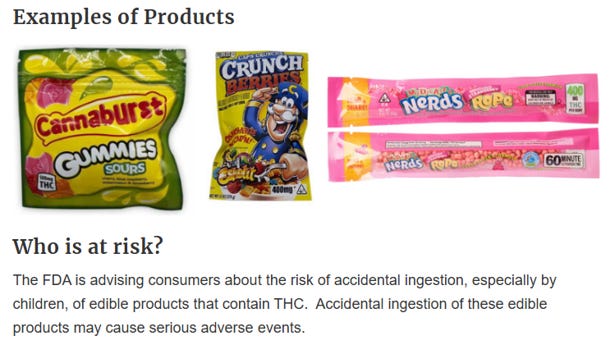
Most severe pediatric poisonings today involve products that were purchased legally and were perceived by adults as “hemp” or “CBD” products.
The majority of serious pediatric cannabis intoxications now involve:
THC gummies
Cannabis chocolates
Cannabis cookies or brownies
Delta-8 THC gummies
Hemp-derived THC edibles marketed similarly to CBD products
These products are often mistaken for candy by toddlers. Many children who require ICU admission have consumed edibles containing THC rather than pure CBD. The rise in poison-center calls has closely tracked the expansion of edible cannabis products.
Parents and caregivers must understand safe storage practices, emphasizing that cannabis products, especially edibles, should be treated like medications and securely locked away out of children’s reach.
Expect that safe cannabis storage will be discussed with your pediatrician in their normal poison prevention conversations. You will be advised to put things up and out of reach and locked up. Cannabis is now on the list with alcohol, cigarettes, and prescription drugs.
Call 9-1-1 or get emergency medical help right away if a child in your care has serious side effects from these products. Always keep these products in a safe place out of reach of children.
Call your local poison control center (1-800-222-1222) if a child has consumed these products. Do not wait for symptoms to call.
Contact your healthcare provider if you or someone in your care recently ingested these products and you have health concerns.
CBD ingestion alone is unlikely to cause the severe intoxication seen with marijuana edibles, but many products sold as CBD contain THC or other psychoactive cannabinoids.
For toddlers, even a single package of gummies can cause profound sleepiness, difficulty walking, respiratory depression, PICU admission, and in extremely rare cases death.
Parents should store all cannabis and hemp-derived products exactly as they would prescription medications - locked, out of sight, and out of reach.
Most children recover with supportive care, but pediatric CBD and cannabis ingestions are not benign. Please do not allow it to happen to a child in your care.


Available for iOS and Android
If you enjoy my writing and these updates, please hit the❤️ button below and restack by hitting the 🔄️ button. Then other people can find my work. Thanks for reading!
Comments
Nothing yet. Say the first thing.
Sign in to join the conversation.