
2026 Introduction:
First of all, we need to recognize that we’re always dealing with stories. No news comes to us by way of bald facts. They are always encased in narratives. Sometimes those narratives are deliberately constructed to persuade, entertain, inflame. Other times, some narrative is “in the air,” surreptitiously setting the terms of what’s worth talking about and how it should be talked about. Still other times, overwhelmed by the urgencies of their jobs in a 24-hour news cycle, journalists get sloppy with their words, overlook crucial context, “rush to judgment.” And then, too, there are the unexamined, often unconscious biases that subtly or brazenly shape their narratives..
Liberal media mavens like to blame Fox for supplanting fact-based reporting with “alternative realities.” But although Fox has clearly been the abuser-in-chief, MSNBC, CNN, The New York Times, The Washington Post, and other “responsible” news outlets, while not as fast and loose with the facts, embed and garnish those facts—with words, images, headlines—that perpetuate some realities and “disappear” others. The words they use suggest how to see events. The images they choose to proliferate tell a story all on their own. Events that are headlined, dramatized, and repeated slyly segue into the category of believability, while those that are deemed less gripping slip into the purgatory of inattention.
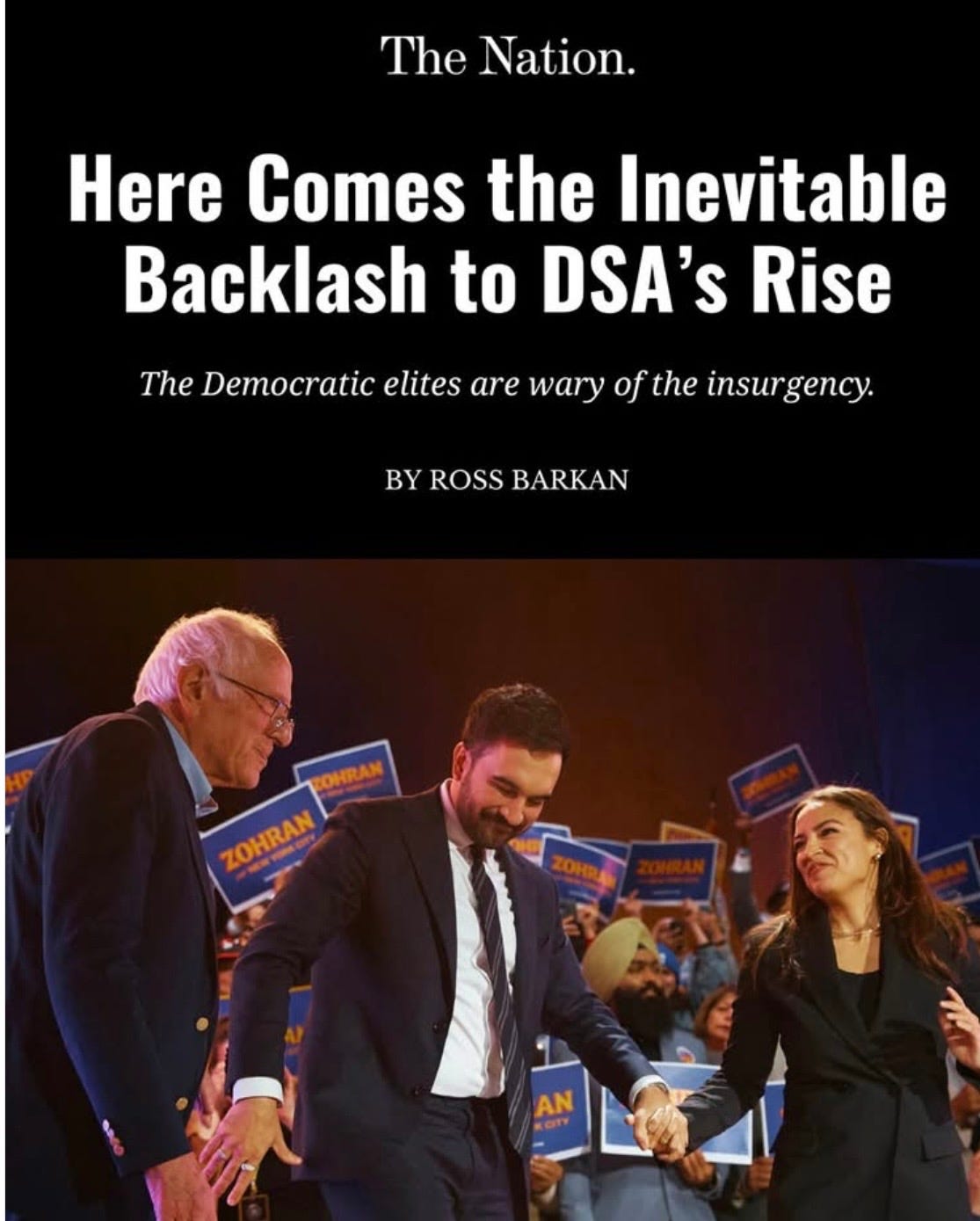
For a while now, the mainstream media has hyped the “rise” of the DSA. That’s no surprise. It’s a story that can get headlines and clicks from. They don’t realize, or worse don’t care, that they are aiding and enabling what they pretend they are just “reporting.” That includes not just the “rise” of an “insurgency” (suggesting a revolutionary “wave” of brave “resistance” to an oppressive power) but the perpetuation of Bernie Sanders’ self-serving (and unfortunately long-lasting) “progressive”/“establishment” construction (what young person wants to be a supporter of some stale “established’ order? Isn’t “progress” better?) and terms like “elite,” which make hard-working members of an outnumbered Democratic congress sound like they are at a cocktail party in the Hamptons.
And now—just this morning—we’re told that ‘the progressive wave” that is “washing” over Democratic primaries has generated a ‘Civil War’ within the Democrats.(This is from Newsweek, by the way; didn’t realize that they had adopted the GOP’s preferred language to refer to the ‘Democrat’ Party.)
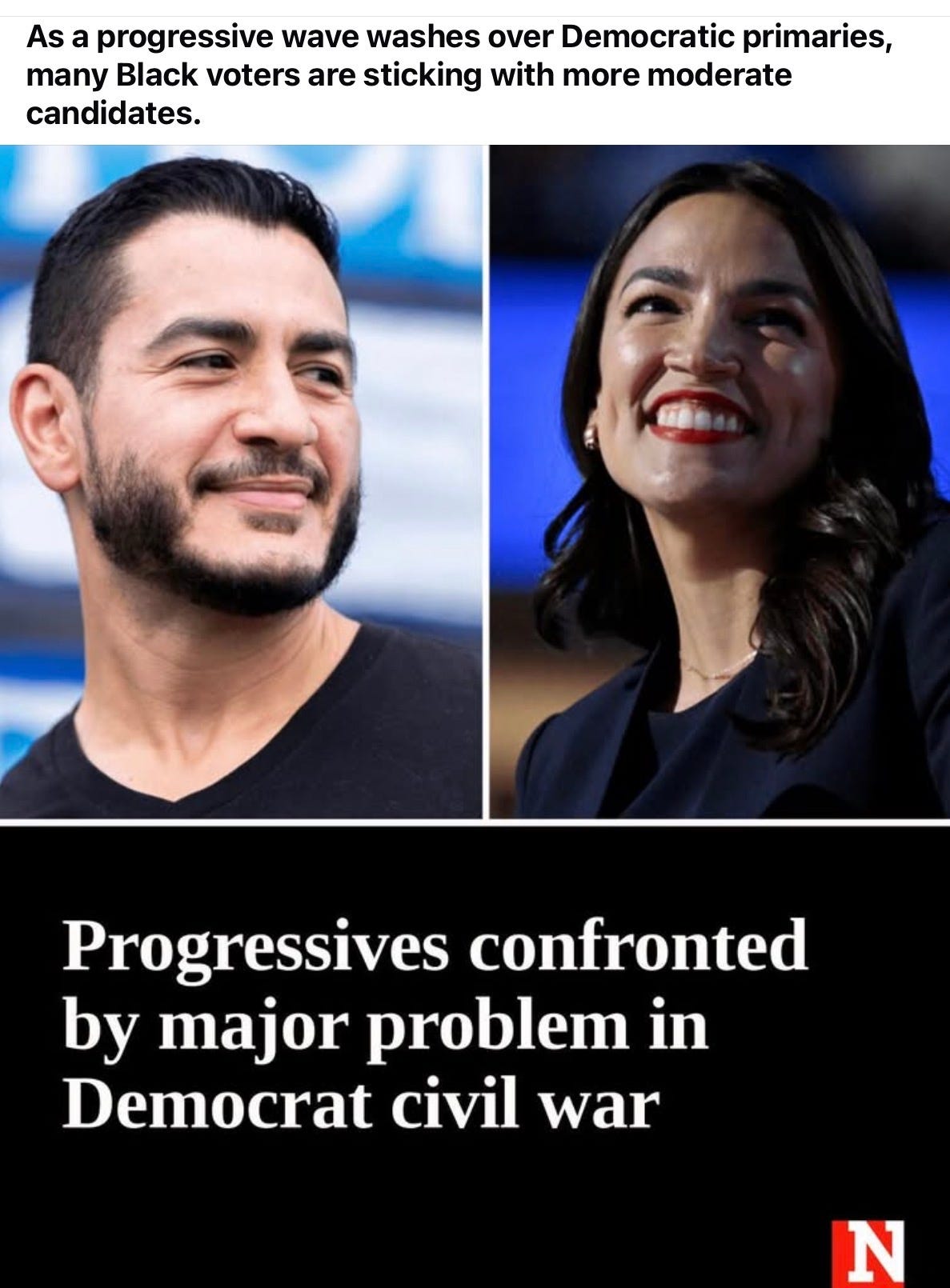
Tidal waves!!! Insurgency!!! Civil War!!! These headlines are hand-feeding both the DSA and—more significantly—the GOP a narrative about the impending “collapse” of the party as we’ve known it. And that narrative, in turn, can easily become a self-fulfilling prophecy.
We saw in 2016 and 2024 how powerful mainstream media and social media narratives that “catch on” can be, especially among under-educated voters. And There seems to be a magnetic pull toward blaming the Democrats for everything. After the 2016 and 2024 elections there was an orgy of “here’s what they/we did wrong”—which was especially perverse when you consider the unscrupulous, unconstitutional, sometimes criminal behavior that became the norm in getting and putting Trump in office and then squeezing him back in—you know, like unrestrained lying, voter suppression, foreign interference, and “hush money” schemes. Corruption. Crashing into guardrails. Mass delusions about immigrants eating pets, Trump as reincarnated Christ.
As those of you who subscribe to BordoLines know, I followed 2024 week-by-week, with full receipts—and I’m going to remind you again of some of the “highlights” of media malpractice. There will be a lot of scare quotes, representing the repetitiveness of the talking-points that the media seizes on and defines reality with. They are different from today’s headlines—the cast of characters and Big Defining Issues are different—but remembering how it happened then may—hopefully—make you more vigilant about what’s happening now.
As in the past, I’ll be watching and reporting. Please consider supporting my work!!
CONSTANTLY ASKING KAMALA ABOUT HOW HER STANCE ON ISRAEL/GAZA DIFFERED FROM BIDEN’S
There was no good answer to this question, not just because of Kamala’s personal fidelity to Joe and the fact that she was still his VP while running, but because of the complexity of the issues involved. Whenever Hillary got complex and “wordy,” she was mocked—as though admitting to historical or moral complications was “evading,” “deflecting,” etc. But a simple answer to a complex issue only stimulates the media’s desire to poke more, and again and again—and then to complain how “inadequate” the candidate’s answers are.
As the media hammered away at it and channeled attention to it, they provided fuel for the protests.
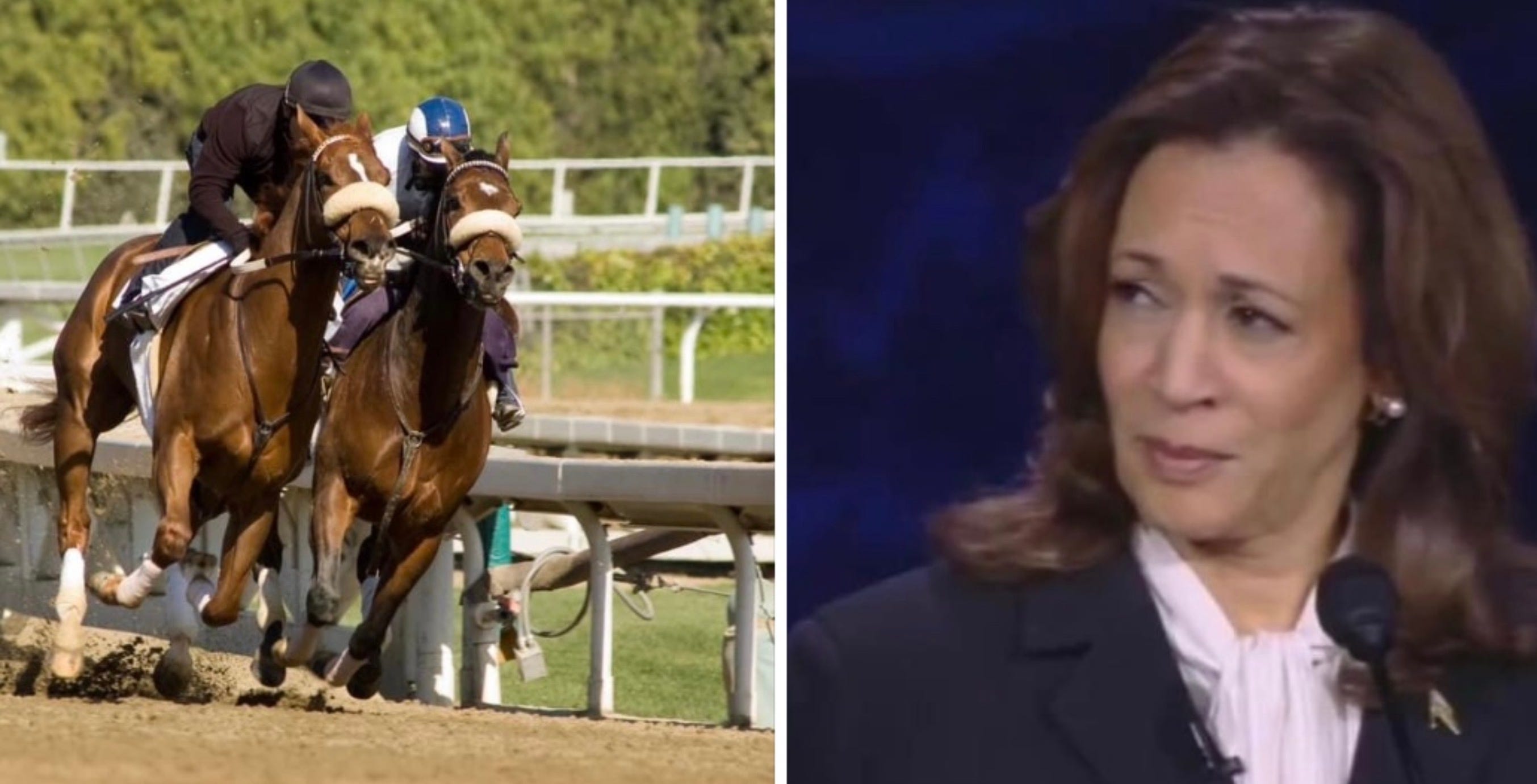
At first, Kamala was able to respond to the interruptions with a withering “classic Black mom look” and reminding audiences that whatever your stance on the war, threatening to not vote Democratic meant, in effect, voting for Donald Trump.
First the extended stare, then the pissed-off look-away, with a final direct stare to say “we’re done now.” They were schooled. It brought back the memory of Nancy Pelosi standing behind Trump in a SOTU, extending her arms in the exaggerated clap that her daughter recognized instantly, having been on the receiving end as a child. Women have an impressive array of nonverbals that are unambiguous speech.
But that, of course, wasn’t going to satisfy the protestors—or the media, who accused her of not taking the protestors seriously enough and goaded her to “address their issue.” So during the next rally she jettisoned the look and “spoke to the topic”:
“We’re here to fight for democracy which includes respecting the voices that I think we are hearing over there. Let me just speak to that for a moment and then I’m going to get back to the business in hand. So let me say I have been clear: Now is the time to get a ceasefire deal and get the hostage deal done. Now is the time and the president and I are working around the clock every day to get that ceasefire done and bring the hostages home. So I respect your voices but we are here now to talk about this race in 2024.”
Uh-oh. “The president and I are working around the clock.” “Ceasefire deal.” “I respect your voices.” Not good enough for the protestors; they wanted her to disown Biden and condemn Israel unequivocally, they wanted “her issues to align with us.” As the Democratic convention approached, disruption was being planned. Hatem Abudayyeh, executive director of the Arab American Action Network in Chicago and a leader of the Coalition to March on the Democratic National Convention—an amalgamation of more than 200 advocacy groups and community organizations—had declared his dedication to making sure the convention didn’t go off smoothly. Co-organizer Hamza AbdulQuader added, “Unless [Harris] clearly takes a stance and says this is not okay … that door is shut….[W] hen it comes to the genocide in Gaza there is no difference between Biden, Harris, or any of the likely candidates for the nomination.”
“We’re not changing a thing. Everything is still full steam ahead,” said Abudayyeh. “It’s still about ending the genocide,” he said. “Our target is the Democratic Party and the leadership of the party and ‘Killer Kamala’ is one of them.”
Many carried signs and made speeches indicating their intention to vote for Cornell West.
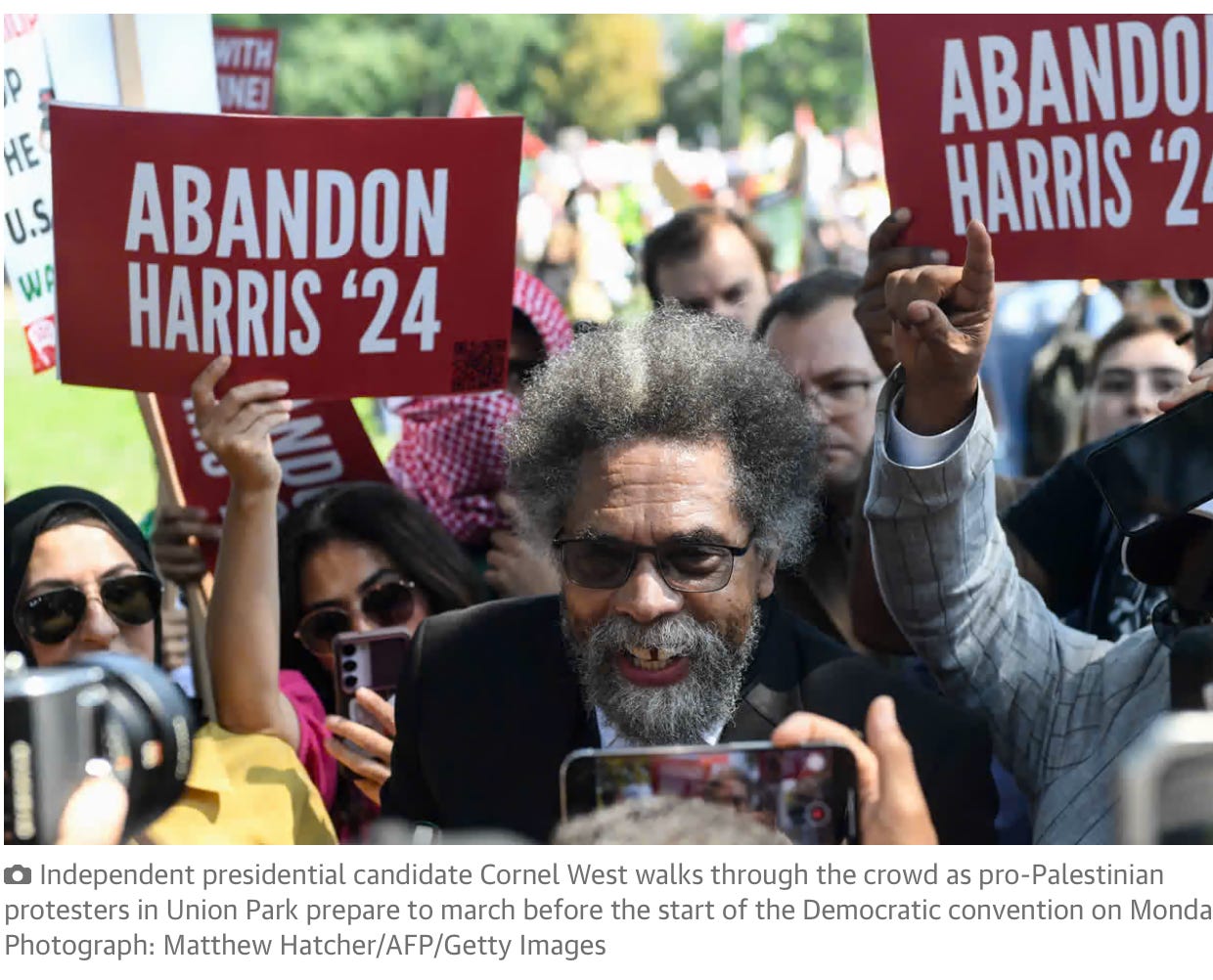
Other protestors were threatening to vote for Jill Stein or no-one unless Harris demonstrated her “difference” from Biden. An “uncommitted” member: “We are open to supporting Harris — but only if she lays out policies toward Israel that differ significantly from Biden’s.”
THE “WHY IS SHE AVOIDING THE PRESS” TROPE
During the sixth week of the.campaign Kamala Harris and Tim Walz made a two-day bus tour of southeastern Georgia, a region of the state usually ignored by Democratic campaigns. The press, however, preferred to pay more attention to a tepid and irritating pseudo-event: the media-pushed and media-pumped-up “sit-down” interview with Dana Bash.
The tour was vibrant and left a neglected region feeling noticed—and needed. Kamala’s ability to make connection—with her words, her eyes, her smile, her laugh, her gestures—is a super-power that the mainstream press doesn’t seem to have cared much about as they pressured her, without waiting a moment once they’d exhausted their DNC stories, to provide “unscripted” answers in a “sit-down” interview with a member of the press.
The Big Story they collectively generated was reminiscent of similar stories about Hillary Clinton’s “avoidance” of the press. They just can’t stand being ignored, can they? But they have the mechanism to get even. Marx called it “owning the means of production,” and in this case, it’s a version of reality itself that’s being produced:
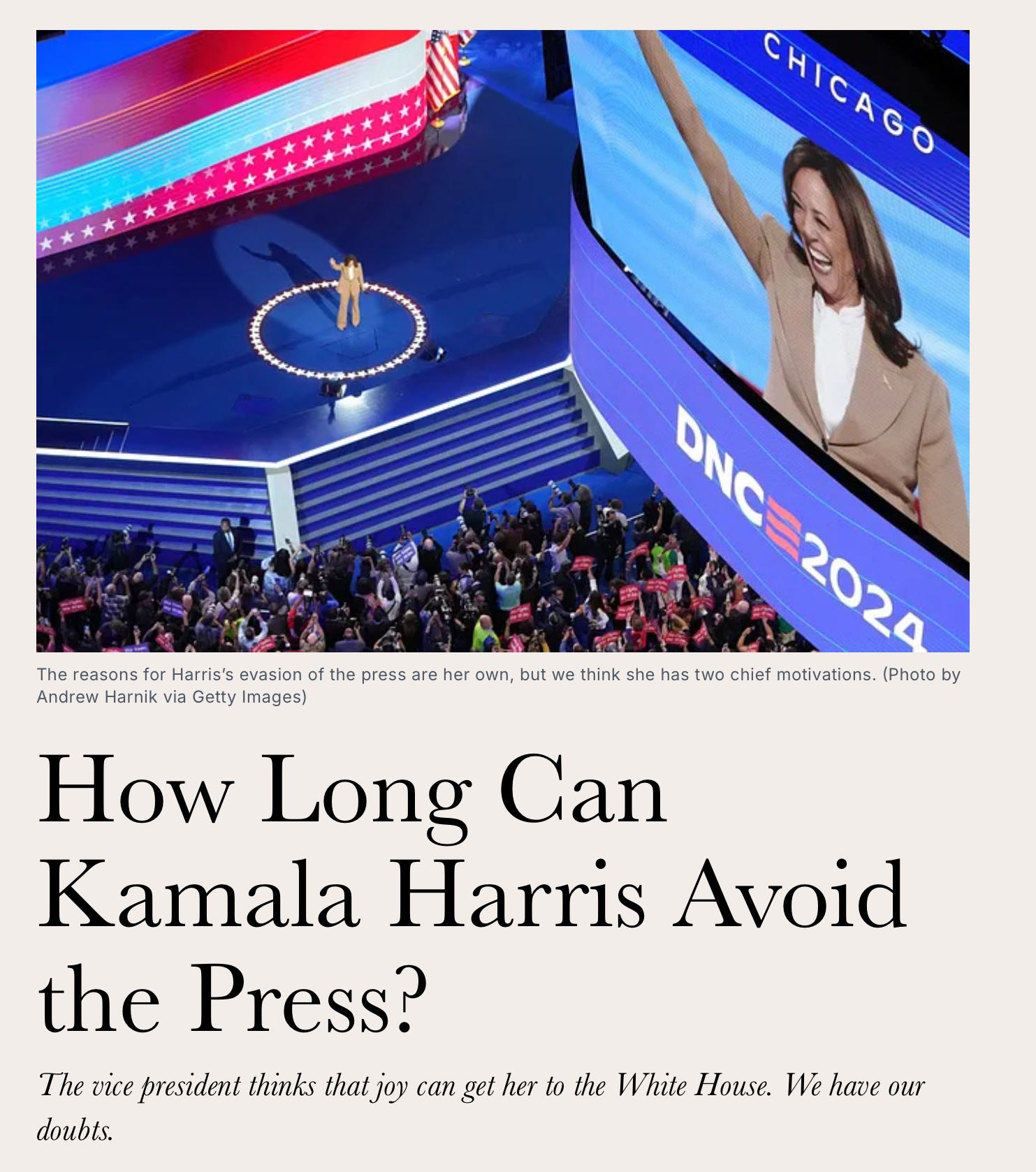
The subtext—and at times explicit text—of Hillary’s “avoidance” was that she was hiding something that she didn’t want subjected to the probing of “hardball” questions (usually about her emails.) But take a look at any of her press conferences; harassment is more accurate a description than “hardball.”
With Kamala, who didn’t come to her campaign like Hillary, carrying the weight of past scandals in which the press often merged her with her husband Bill, the issue was competence rather than secrets. Did she have what it takes to be POTUS? Would she fall apart without a teleprompter? Are “vibes” and “joy” all she has to offer? Is there any “substance” to her?
And then, when she did do something unprecedented and truly “of substance,” appearing together with Republican Liz Cheney, they didn’t seem all that interested. In the after-rally commentary, Joy Reid and Juanita Tolliver almost immediately shifted to a discussion of how the Democrats had lost a huge number of Arab-American voters because they’d not allowed a speaker sponsored by “Uncommitted” to give a speech at the DNC. And the morning after, I woke up to the Morning Joe group talking about the appeal of J.D. Vance to young men and how Kamala had better start “reaching out” to working-class men. It’s just her failing, you see, not a systemic obstacle—despite the fact that the same thing happened when other powerful women like Stacey Abrams have run for office. Later in the day it was Chris Jansing going on and on, virtually harassing Michael Steele and Basil Smikle—two men whose wisdom and experience exceeds Jansing’s by 15 miles—about the fact that Kamala hadn’t done enough interviews, press conferences, yada yada yada. Yes, that one again, and I’ve rarely seen Chris dig in the way she did.
I had MSNBC on all day and hardly heard a word about that unprecedented, potentially transformative moment when two women stood on a stage together in Wisconsin and showed their parties and constituent groups—many of them who have still not understood what the stakes of this election are—what “unifying” around a common goal means.
THE FIRST “SIT-DOWN” INTERVIEW
The petulant press got something extra to headline when it was announced that the interview would finally happen—but with a Lancelot sitting by Queen Kamala’s side for her to turn to when she couldn’t handle Dana Bash’s “tough questions.”
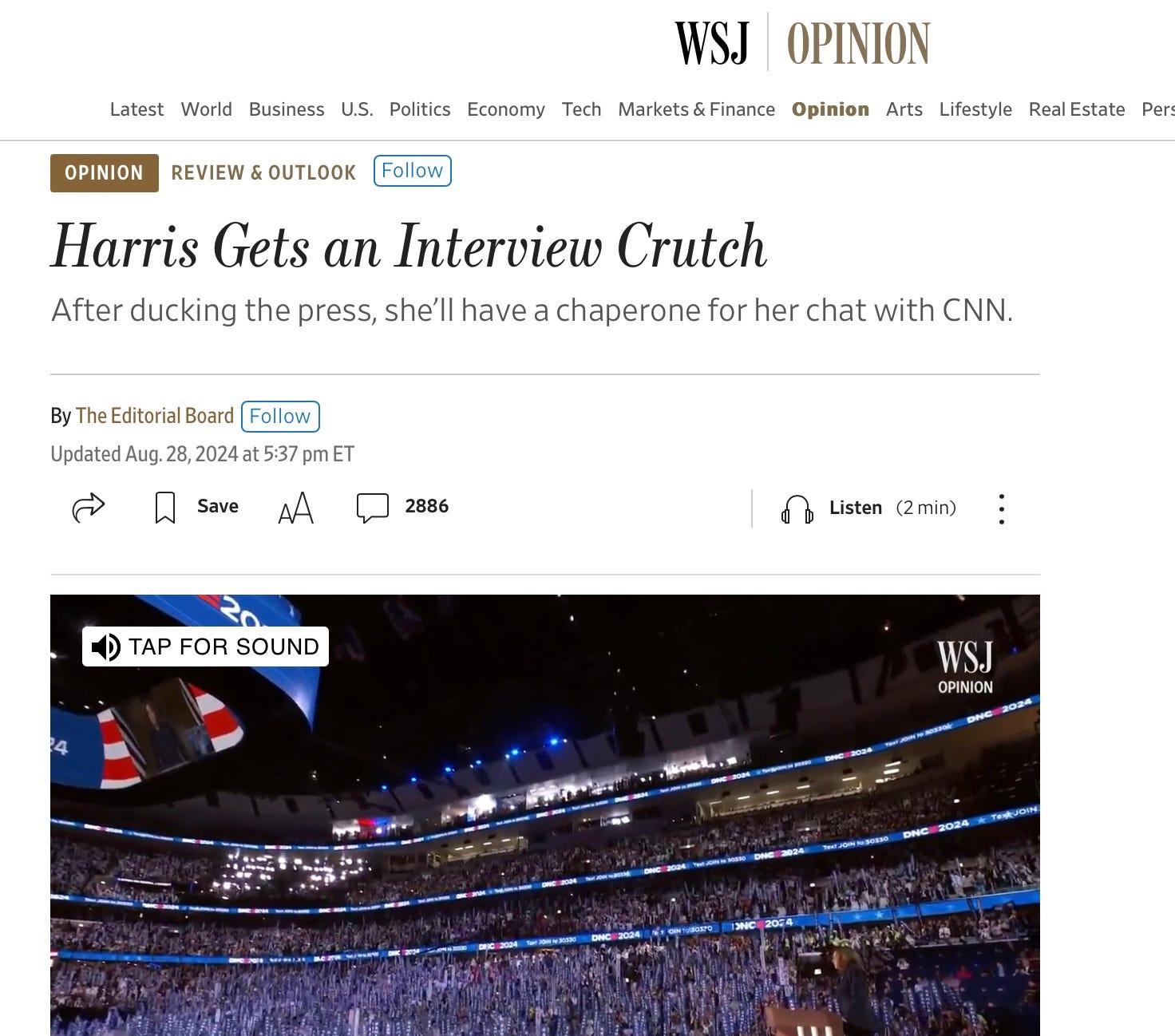
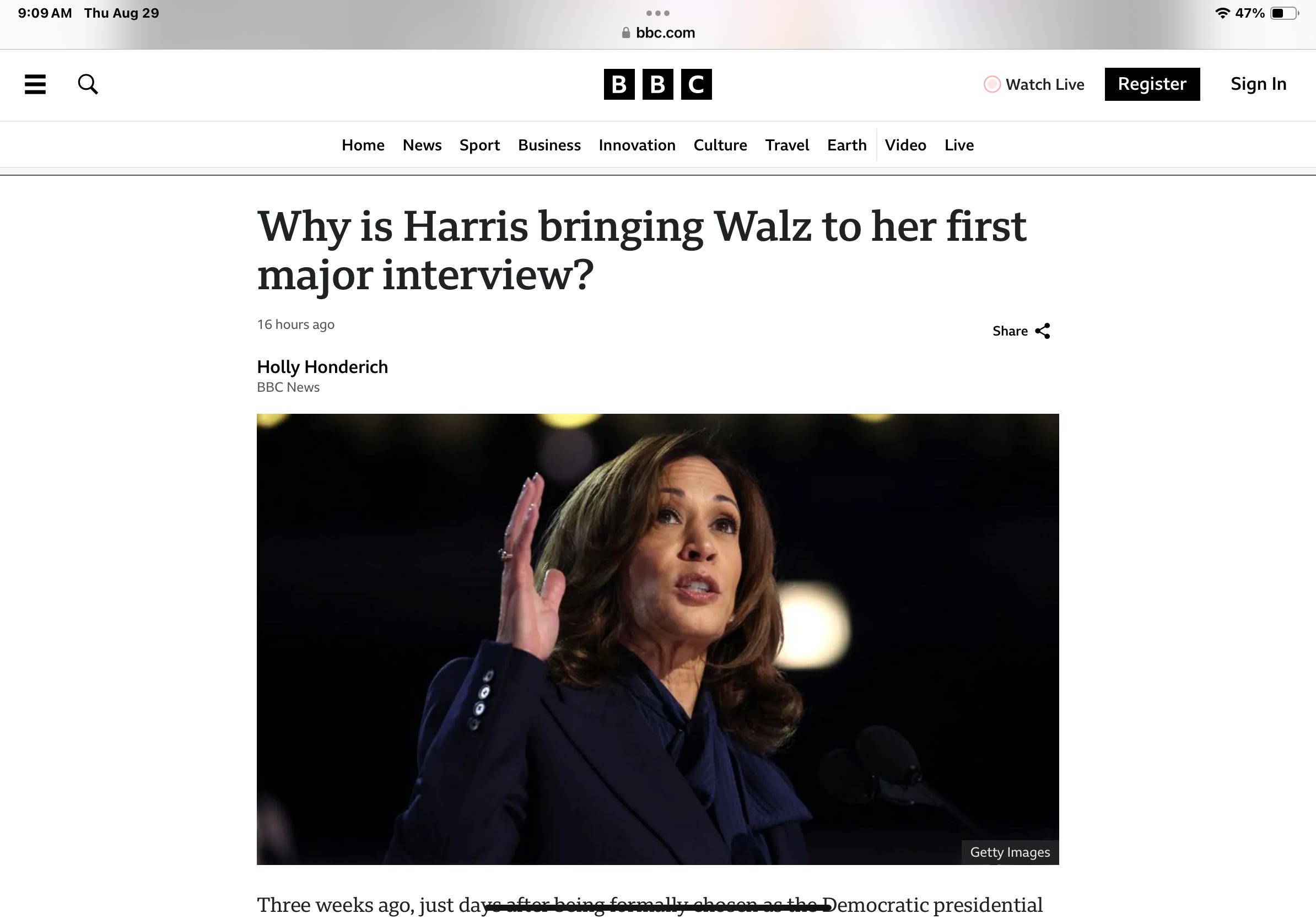
“….The Bash interview is an attempt to rebut the criticism that she hasn’t done any interviews as a candidate. But that isn’t nearly enough, especially with Mr. Walz along as chaperone.”
(The fact is that it’s typical for a POTUS candidate to do an interview with their VP choice. It’s just the timeframe that was different this time, because the whole pre-election period has been so compressed.)
With a chaperone or not, the interview—as we were constantly told—was going to be a crucial test for Kamala:

As it turned out, though….
There were no questions that Kamala needed Tim to “rescue” her from. There was one question about foreign policy: predictably, about the Israel/Gaza war. The opening question was that silly “What would you do on day one?”—and when Kamala didn’t answer it literally (“Well, first I’d unpack my briefcase, take a satisfying dump in the Oval Office john, and then I’d issue a couple of executive orders,” etc.) Dana asked it again. And then she asked the same of Tim.
Next up, in response to Kamala’s specifying parts of her proposed “opportunity economy,” Dana challenged her with: “You’ve been Vice-President for three-and-a-half years; the steps you’re talking about now; why haven’t you done them already?” (Jeez, maybe reforming the whole economy wasn’t part of the VEEP job description.)
Then there was a whole lot of time spent on fracking. It was one of several questions that had the basic format of: “You said this then; Why are you saying something different now?” In other words, challenging Harris on what the press calls a “flip-flop” (something that Donald Trump does as often as he arranges his hair and never gets called out for.) Leaving Trump’s penchant out of it, I have to say that in my opinion, “flip-flop” needs to be thrown in the garbage along with other journalistic “gotcha” equipment. I don’t know about you but much of my life has been a series of flip-flops—such as changing my mind/behavior due to: learning something I didn’t know before, accommodating to a new situation, noticing something I hadn’t seen before, regretting hurting someone, realizing something isn’t working, getting older and less dogmatic, getting older and smarter, finally hearing what another person is saying, having a personal experience that’s transformative.
Cynically “flipping” ones position from something deeply held to something one doesn’t really believe but hopes is going to get votes is one thing. That’s Trump’s specialty, except nothing is “deeply held” by him except staying out of jail. Changing, learning, growing, or accommodating different circumstances is another. Yet Bash—and she’s hardly alone—asks Harris if voters should believe what she says now because it’s different from something she said in the past:
Bash: Generally speaking, how should voters look at some of the changes that you’ve made — that you explained some of here — in your policy? Is it because you have more experience now and you’ve learned more about the information? Is it because you’re running for president in a Democratic primary? And should they feel comfortable and confident that what you’re saying now is gonna be your policy moving forward?
Harris replied that voters could trust that her values would remain the same, as they had been in the past despite the demands of different circumstances. And really, what more could a person truthfully say? When Obama was elected, he was opposed to same-sex marriage. He changed his mind on that. Most of us applauded. Would we have wanted him to not change his policy on same-sex marriage just because when he was first elected he felt differently?
And what about the craven motivation implied in “Is it because you’re running for president in a Democratic primary?” And if that was the case, would anyone so accused reply “yes”??
The next question was whether Harris would appoint a Republican to her cabinet. Harris said yes, and I thought it was a great opening for Bash to delve more deeply into Kamala’s views on how she’d govern. Instead, she made an absurd segue to Trump’s ridiculous questioning of Kamala’s racial identity.
BASH: Speaking of Republicans, I want to ask you about your opponent, Donald Trump. I was a little bit surprised, people might be surprised to hear that you have never interacted with him, met him face to face. That’s gonna change soon, but what I want to ask you about is what he said last month. He suggested that you happened to turn Black recently for political purposes, questioning a core part of your identity.
This was yet another question that left me wondering, as so many of Bash’s questions did, just why she was asking it. Why quote Donald Trump? It was among his stupidest remarks (which is saying a lot) and had already gotten way more air-time than it deserved. In a 45 minute interview, in what world was it worth devoting a question to?
I suspect that Bash wanted to get a juicy counter-attack out of Kamala, who still refused to fall into that trap:
HARRIS: Same old, tired playbook. Next question, please. (LAUGH)
BASH: That’s it?
HARRIS: That’s it.
Stymied, Bash tried to get Tim Walz to confess that he and Gwen hadn’t used IVF but a different kind of fertility treatment (and so…?) and a few other trivial “falsehoods.” She ended with her favorite “tough” question: “What do you say to voters who aren’t sure whether they can take you at your word?”
Kind of astonishing, isn’t it, that Walz’s honesty should be presented as a central uncertainty in a campaign in which he and Harris are running against a chronic and unscrupulous liar who lies about events and policies that have enormous consequences for the future of our country.
“What fertility treatment did you really use? Come on, confess!”
CNN had some chutzpah to advertise this as an “in depth” interview.
As I browsed through journalist’s and commentator’s evaluations of Kamala and Walz’s “performances” (mostly: “did what they had to” and “did no harm”) I was struck by the fact that no-one was grading Dana Bash’s “performance.” I will: formulaic, unimaginative, and at times passive-aggressive. And amazingly, especially when you consider their opponent, the overarching theme of the interview might be summed up as: Can the American people trust you two?
Are you hearing echoes from the past?
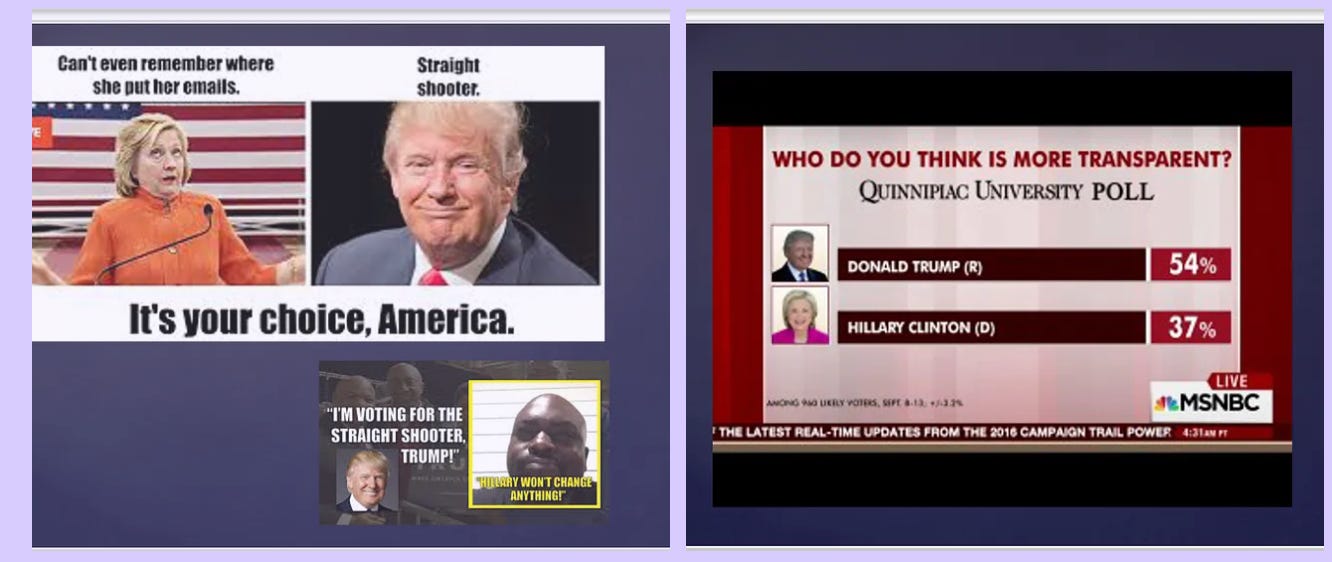
“SHE’S DODGING” OUR “HARDBALL” QUESTIONS
Don’t you just love (by that I mean hate) those journalists who kept kvetching about how important it is for Kamala to “put herself out there more” and “introduce herself” to the American people—and in the next breath complain if she does “friendly” interviews? The “mainstream”/corporate/legacy media notion of “introducing” oneself seems to be: let some grim-faced, headline-seeking inquisitor “expose” every vulnerability, every trivial mistake, every “pivot,” every “dodge,” every “flip-flop” (also known, by regular people, as changing ones mind.)
In fact, you got to know a lot more about Kamala from Howard Stern’s “friendly” (for the msm that means “non-rigorous”) interview with her, in which Kamala starts out kinda formal and ends up, due to the relaxed atmosphere provided by Stern, to get more personal than she has in any other interview. These relaxed interviews with people who are not looking to catch her up or expose her (or get some “breaking news” out of her) show the value of conversation. Those stilted and inquisition-like interviews that invariably made the headlines in the mainstream press may serve the media’s interests, but not those of the voter.
Anderson Cooper’s “Town Hall” with Kamala Harris was another of those “hardball” interviews. The next day, a panel of “experts” mocked her for “word salad” when she didn’t produce two-sentence answers to questions. They seem to think that “hardball” questions are those that attempt to “pin down” a person and “hold them to account” for any contradictions, evasions, and changes in their positions. Anderson had been doing that constantly throughout the town hall. Why did your position on fracking change? You once savaged Trump’s idea of building a wall, but the bill you came up with in congress includes a wall; how do you explain that? Etc.
She struggled with such questions, and the reason why—the reason why she struggled with all those “gotcha” questions—is contained in her answer to a “what’s your greatest weakness” question that had come from the audience.
“I think that I -- perhaps a weakness, some would say, but I actually think it’s a strength—is I really do value having a team of very smart people around me who bring to my decision-making process different perspectives. I -- my team will tell you I am constantly saying, let’s kick the tire on that. Let’s kick the tires on it.
…When I was attorney general of California, I was attorney general of what is the fifth-largest economy in the world, and acutely aware that my words could move markets. So I take my role and responsibility as an elected leader very seriously. And I know the impact it has on so many people I may never meet.
And that is why I engage and bring folks around. So I may not be quick to have the answer as soon as you ask it about a specific policy issue sometimes because I’m going to want to research it. I’m going to want to study it. I’m kind of a nerd sometimes, I confess. And some might call that a weakness, especially if you’re, you know, in an interview or just kind of, you know, being asked a certain question and you’re just expected to have the right answer right away. But that’s how I -- that’s how I work.”
Could her answer have been better organized? Sure. She’s just told you, she likes to prepare. But is it “word salad”? If you cared to actually listen, you saw she was answering the question. Anderson, however, just saw her as evasive, and was determined to get her to reveal something more headline-y. “I don’t think I’ve ever heard the former president admit a mistake. A lot of politicians don’t,” he began, implicitly accusing her of not answering the question. Then he pressed on: “Is there something you can point to in your life, political life or in your life, in the last four years that you think is a mistake that you have learned from?”
At this point, Kamala was getting angry. Didn’t he hear what she’d just said? After admitting she’d “made many mistakes” she brushed him off: “It’s a mistake not to be well-versed on an issue and feel compelled to answer a question.”
Anderson didn’t even get the hostility in “compelled to answer a question.”
LETTING TRUMP GET AWAY WITH…EVERYTHING.
From September 9th, 2024 stack:
It was the Big Debate. The “Make or Break” moment. The “Showdown.” The “highly anticipated” evening when Donald Trump and Kamala Harris will finally come “Face to Face.”
What, according the msm, does she “have to do”? Introduce herself to “the American people.” “Define” herself. Show she is the “change candidate.” Distinguish her policies from Biden’s. Explain why her views on fracking and “the border” have changed. Get under his skin. But not too mean.
What does He “have to do”? Apparently, just show up.
The msm had pretty much ignored Donald’s unhinged rants during the week before—like, say, the 49 minute “press conference” outside a New York courtroom in which he charged, over and over, that every prosecutor, judge, and jury who were “against him” had been hand-picked by “Biden’s DOJ.” And then took no questions from the press. (And for some reason, the press wasn’t as furious with him as they were with Kamala Harris when she “avoided” meeting with them in the two weeks after the DNC, as she travelled across the Midwest, actually campaigning.)
I watched the entire 49-minute thing myself.It was a complete breakdown of any discipline he’d ever had over himself, an extended, repetitive, paranoid verbal tantrum in which he took advantage of the presence of the media to “take the stand” in his own defense—something he’d been cautioned not to do at the trial itself, and could not restrain himself from finally having the opportunity to do.
He’s done versions of this ever since he began to sense that perhaps he wouldn’t be a “winner” this time around. Lie, repeat, accuse others, lie, repeat, accuse others. Keep talking, flood listeners with the Trump versions of things.
He’s so rarely been called on it that he thinks he can still turn things around with it. And God help us, he may. (He did.)
Just this past week or so, we’ve seen such a shocking level of—I don’t even know what to call it: Ignorance? Confusion? Breakdown of cognitive ability?
From a Tuesday interview: “I was told if I got 63 million, which is what I got the first time [2016] ‘You would win. You can’t not win.’ And I got millions more votes than that [in 2020] and lost by a whisker.”
TV commentators, chyrons, and print headlines seized on Trump’s apparent admission—at long last—that he indeed lost the election, and merely chuckled over the fact that a candidate for President of the United States apparently has no idea how elections actually work.
Trump’s typical escape-route, which he employed over and over in his debate with Biden: When you don’t actually know anything about the topic you’re being asked about, shift to a favored talking point (tariffs, the border) ramble on about it, and end with a grand slam at how Biden has trashed all Trump’s good work, turning us into a “failed” nation.
This “debate,” as you’ll recall, sent the press into full-throttle warrior-mode about Biden’s lack of fitness for office, and set off a crisis within the Democratic Party that ended with Biden’s leaving the race, while Donald Trump’s reprehensible (although more “robust”) debate performance was allowed to slide into the purgatory of media inattention. His evasive and lying babbling should have been torn apart sentence by sentence. But the story of his appalling performance never got a chance to “get legs,” because we’re used to all that. The media, over the years, has helped normalize it largely by ignoring it. The more shocking, headline-worthy story was Biden.
It’s easy to forget how much craziness Trump has always gotten away with, because the mainstream media has had fresher, more-attention-grabbing stories pointing out the “flaws” in his opponents.

“Finally”??
Just because you media mavens ignored it doesn’t mean that line wasn’t crossed years ago.
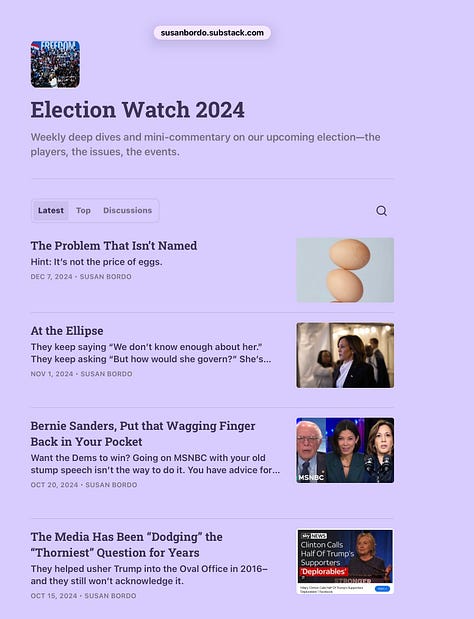
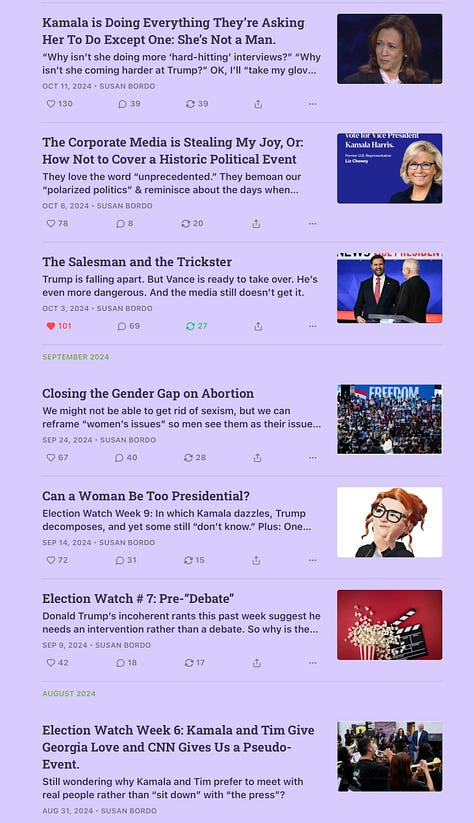
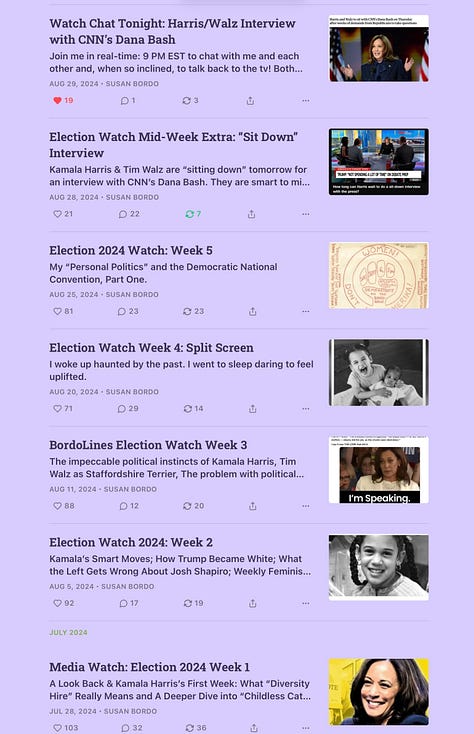
For full coverage of the 2024 election, from which these excerpts were taken, pull down the “Election Watch 2024” tab or click on the “Election Watch 2024“ newsletter thumbnail on the BordoLines homepage. In the archives, you’ll also find lots on 2016. For example, see
See also:
Comments
Nothing yet. Say the first thing.
Sign in to join the conversation.