
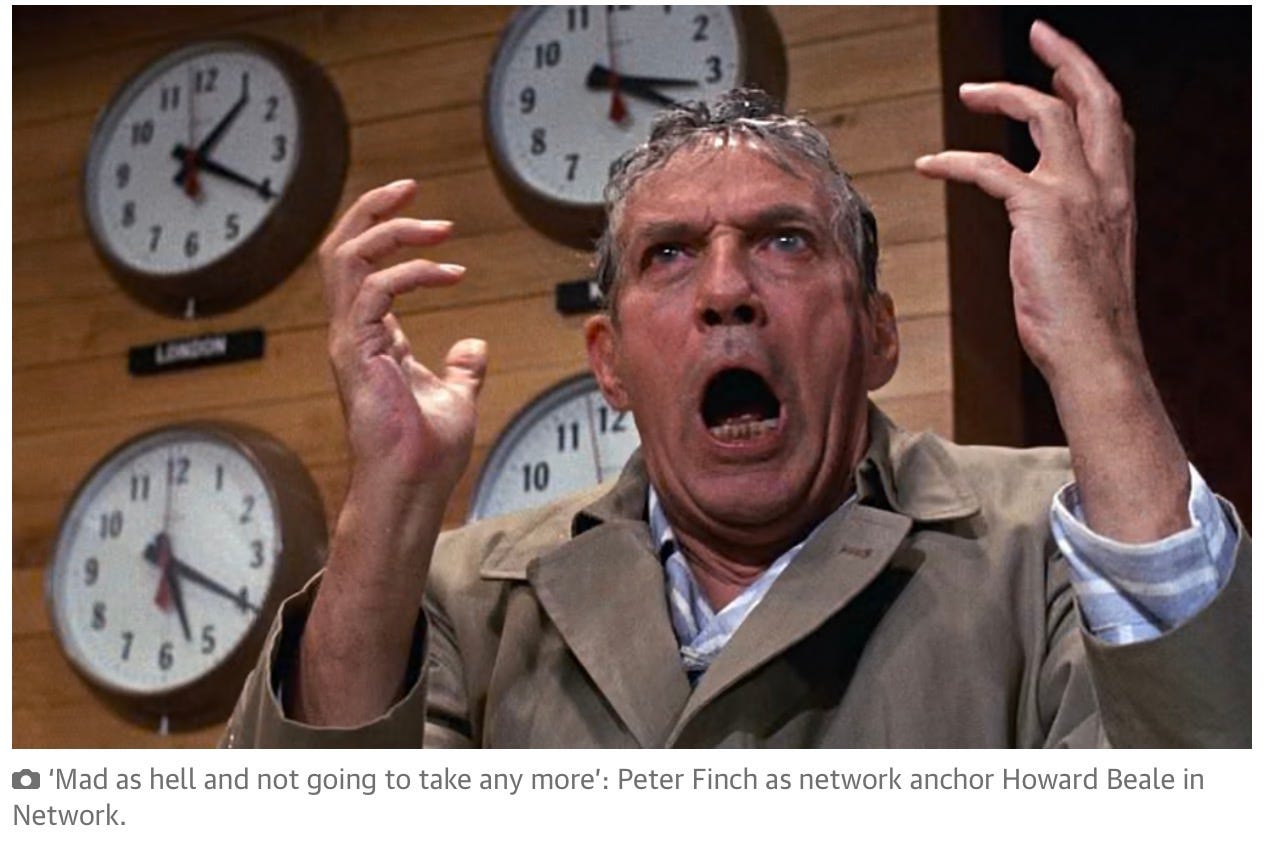
It’s standard cultural history to mark Betty Friedan’s “The Feminine Mystique” (1962) as firing the first shots in what’s thought of as an exclusively feminist war against traditional gender roles. But actually, it was men who fired those first shots. Just a couple of years after movies like “Father’s Little Dividend” (1951) had pushed the ideal of the domesticated good provider to its pinnacle, an ethos of male rebellion was being stirred up. Books like Robert Lindner’s “Must You Conform?” and William Whyte’s “The Organization Man” warned of the dangers of male socialization and conformity to middle-class life. A new breed of “rebel male” actors-exemplified by Marlon Brando and James Dean—began to replace Spencer Tracy and Henry Fonda, who often played happily married men who might bumble around in the kitchen (when wife out of town) but didn’t resent it. And “Playboy” was publishing articles lamenting the idealization of the accommodating “hubby” and the “womanization” of America:
After more than 70 years of feministic propagandizing for the American woman’s God-given rights to liberty, equality, security and luxury, it is somehow “inconsiderate” to even discuss the wedded male as a human entity, or to factually describe the increasing erosion of rights and the growing magnitude of the sacrifice which American marriage imposes upon the male provider…
“He is rather more servant than wife ... Man, once known as ‘the head of the family,’ is now partner in the family firm, part-time man, part-time mother and part-time maid. He is the chief cook and bottle washer; the chauffeur, the gardener, and the houseboy; the maid, the laundress and the charwoman.”
Clearly, no prince, pasha or robber baron of the past was ever obliged to supply -- singlehandedly -- so much in the way of convenience and comfort.
(From “Love, Death and the Hubby Image”, William Iversen, September 1963)
Hugh Hefner announced the magazine’s agenda in his first editorial (1953):
“We want to make clear from the very start, we aren’t a ‘family magazine.’ If you’re somebody’s sister, wife or mother-in-law and picked us up by mistake, please pass us along to the man in your life and get back to your Ladies’ Home Companion.”
Hefner conceived of himself as declaring a war of independence. He called on men to own their “membership in a fraternity of male rebels” and prided himself on having “tapped into the male Zeitgeist. Post-war males were free agents, restless, not willing to be tied down to the model of family togetherness espoused by magazines like McCall’s.” Along with more noble causes (civil rights, freedom of speech, reproductive rights, gay rights, all of which Hefner championed), the campaign to free men from the constraints and demands of mothers and wives was a guiding principle of “The Playboy Philosophy.” The same year as “Rebel Without a Cause,” Playboy published “Open Season on Bachelors,” which recommended that readers take a good look “at the sorry state of regimented husbands trudging down every woman-dominated street in this woman-dominated land” and warned men to beware of the marriage month of June when women “become more heated, more desperate, and more dangerous.”
Hefner’s remedy for this “sorry state” was a new magazine. 1
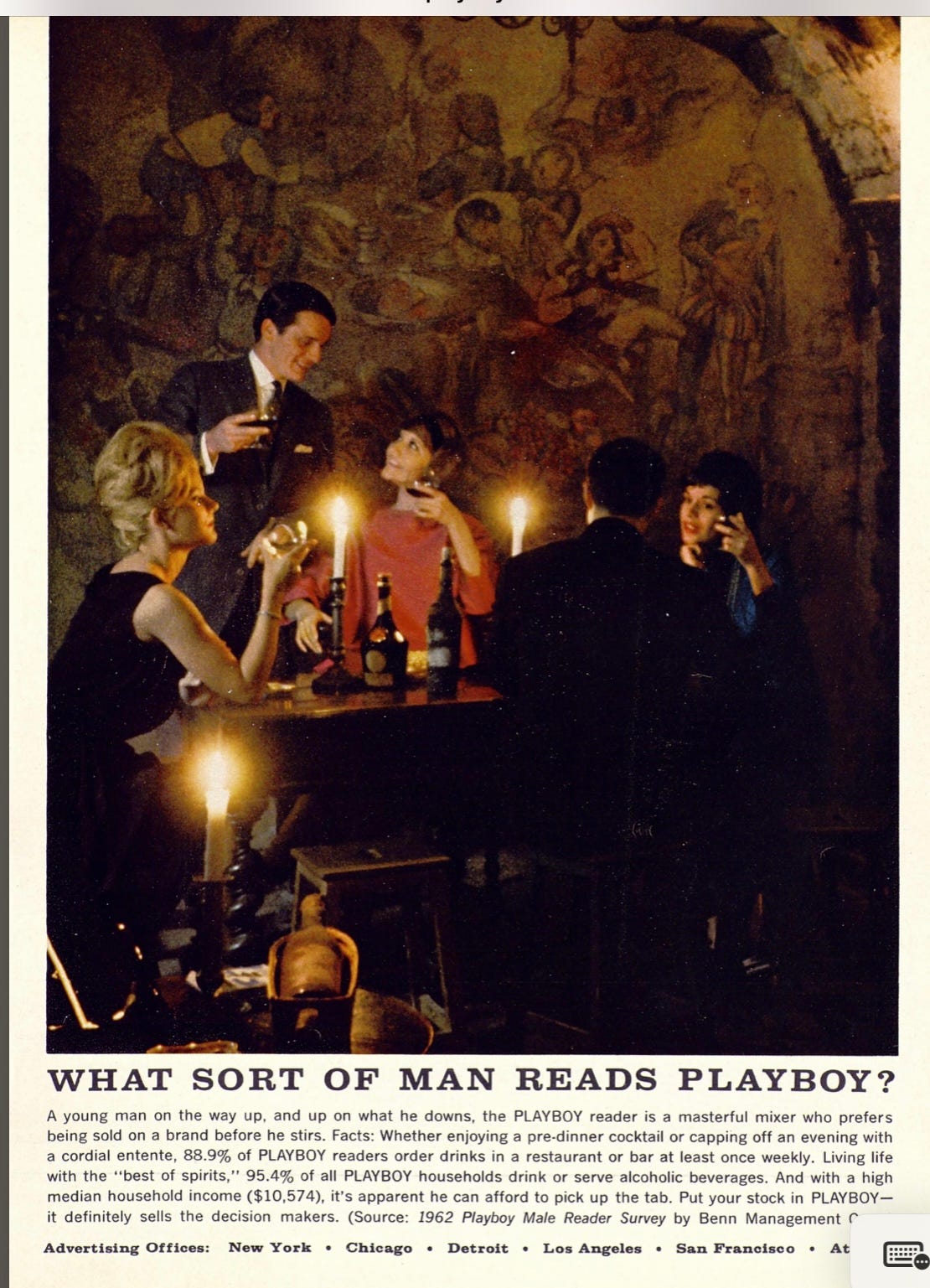
From “Inside the Playboy Mansion”, December 1998 issue:
Oh, to be at Hef’s! This is all any grown boy, sound of mind and libido, ever really wanted, ever really wants. Somehow, if you are very clever or very lucky, you get yourself there. Here, laid before our wide eyes, were the domestic fixtures, naked and architectural, hot and (most) cool, of his two Playboy Mansions---pads deliriously palatial, repositories of ultimate male fantasy, hulking shrines to all sybaritism. Every published picture and videotaped revel would tell a new secret. But the most important secret of all wasn’t really much of a secret: Life was more delectable in those houses than it had ever been anywhere else in the world. For a guy, especially.
To be inside: Parties. Gadgets. Grottoes. Games. Beautiful women. Hidden passages. More parties. Bunnies. Bounty. Famous people. Playmates. Pillow fights. Peacocks. Movies. Monkeys. Cool jazz. Warm Jacuzzis. Waterfalls. Nude sunbathing. Nude moonbathing. Much, much nudity. Orgiastic sex. Still more parties. Dionysus would have blushed.
Names from Frank Sinatra to Johnny Carson, the Rolling Stones to Barbra Streisand, Muhammad Ali to Joe DiMaggio. I mean, everyone. You don’t have the time.There, amid the paintings of Picasso and De Kooning, amid the carved oaken filigrees and mammoth corniced pillars, jazzmen wailed, martinis rattled, Bunnies grooved.
Brings to mind Epstein’s “Birthday Book,” doesn’t it? And perhaps especially Donald Trump’s “letter,” with its reference to “wonderful secrets” and the pleasures of a life “having everything.” If you were “a guy,” that is.
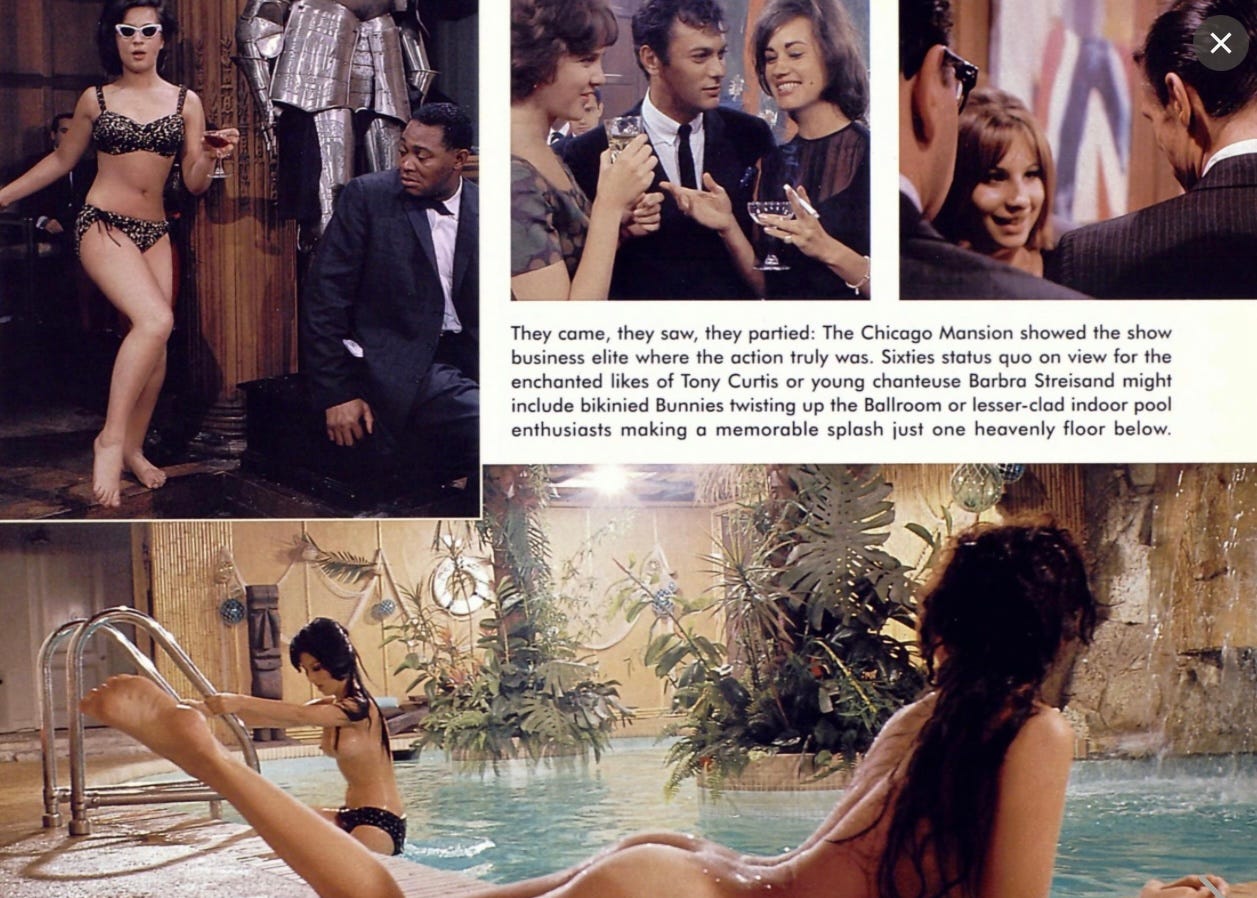
In the late 60’s and into the 70’s, Women’s Liberation was still a side-show, derided by those outside the movement as puritanical and humorless. The avatars of “sexual liberation” were writers like Mailer, Miller, and Roth, and “Playboy” magazine could feature interviews with literary greats side-by-side with nude centerfolds and articles that encouraged men to free their libidos from the repressive demands of wives and mothers. It was a time when my English teacher Mr. Tumin, who described me in my yearbook as having “a happy marriage of mind and body”, talked dirty to my 16-year-old self, his crotch zipper half undone, while introducing me to the male writers I had to read if I wanted to be a writer, and I thought I was being a prude for finding it creepy.
“Mad Men” got it perfectly: The men casually discussing how they’d like to get under the dress of “new girl” Peggy Olsen (Elizabeth Moss); the women cheerfully accepting what would come to be known as “being objectified.” Voluptuous, worldly-wise Joan Holloway (Christina Henricks) gives Peggy a tour of the department, where she gets the same advice from men and women alike: make the most of your physical assets, sweetie, and don’t be afraid to show that body off. She also recommends a gynecologist (“scootch” down the table, sweetheart”) who prescribes Enovid but instructs her not to become a “strumpet.” Later that night, Peggy has sex with a very drunk Pete (Vincent Kartheiser,) who at his bachelor party has been celebrating his last night as a “free man.” Marriage—for men—as the ball-and-chain. Getting over your sexual “hang-ups”—for women—as liberation. And always, that double-standard: a male “conquest” could so easily become a “ruined reputation” for the women.
When Hefner opened the doors to his mansion, the abusive side of male “liberation” from bourgeois conventions was still—culturally—a well-kept secret, and “Playboy” was instrumental in cultivating a narrative that would keep that secret behind the walls of the mansion: A luxurious, enchanted castle. Sophisticated men allowed to indulge their every whim. And obliging playmates, “grooving” in the grotto—or in Hefner’s circular bed.
Pamela Anderson, on her first visit to the mansion: “Everyone was nude in the Grotto. I took it all in. Later, I followed Hef and seven girls to his bedroom. I stood at the foot of the bed watching them until I realized they were watching me. I thought it was time for me to leave. A lot of Bunnies and a lot of Johnson’s Baby Oil, Hef’s favorite lubricant.”
There are articles from the “Playboy” of the sixties that read ominously now.
On “Virginity” (1964):
All sophisticated playboys are interested in virginity. We trust that the matter of your own virginity has already been satisfactorily taken care of. You must now face up to the problem of virginity in your female friends and acquaintances.
Most men recognize that virginity is an unpleasant little matter to be disposed of early in life. They appreciate that it’s troublesome, a bother, and all things considered, just isn’t worth having around. Unfortunately, this important information has been withheld from a large part of our female population.
Some men, shirking their responsibilities, might shrug this off as none of their concern. If you’ve a social conscience, however, you realize, of course, that it is up to enlightened members of the community to get the facts to the uninformed.
The most pleasant, satisfying, and generally successful method of spreading the good news is through demonstration. You will, of course, meet a certain amount of intellectual resistance from young ladies who have been previously misguided by narrow minded mothers, teachers, maiden aunts, etc. The purpose of this article is to show you how such resistance to learning (a form of social lag) can be most easily overcome.
Your attitude is extremely important and will effect your entire approach to the problem. Remember -- and this is very important -- you are actually doing the girl a service. Some may suggest that you are trying to deprive them of something -- trying to take from them a cherished possession. This is nonsense. Actually, you are giving them a new freedom -- a means of enjoying life more fully -- a greater appreciation of life and its many pleasures.
I don’t need to deconstruct, do I? The line between the “unpleasant little matter to be disposed of early in life” and rape is pretty thin—as it was in the reality of the mansion, where, as we learned after Hefner died, “misguided resistance” was often overcome with knock-out drugs.
Hefner was determined, though, to give the magazine a “respectable” image. “I buy it for the articles and interviews” was a running joke at the time. In fact, it’s kind of staggering how many famous writers published pieces or were featured in “The Playboy Interview”: Ray Bradbury, Ian Fleming, Kenneth Tynaan, William Saroyan, James Baldwin,, Saul Bellow, Erskine Caldwell, John Steinbeck, Philip Wylie, Lawrence Durrell, Studs Terkel, Robert Roark, W. Somerset Maugham, Irwin Shaw, John Updike, Ben Hecht, Nelson Algren, Vance Packard, Tom Wolfe, Terry Southern, John Cheever, John Irving. And even some women: Ursula K. LeGuin, Doris Lessing Joyce Carol Oates Anne Sexton, Helen Gurley Brown.
The “sort of man who reads Playboy” could then tell himself that he wasn’t just an ogler of boobs, he could also imagine he was a member of an intellectual, avant-garde elite. “I want to appeal to male readers devoted to pussy and Picassos.” Hefner told his staff, “On a typical night, I picture him in his chic apartment with a beautiful doll. While hearing mood music in the background, they drink champagne while consuming Iranian caviar. The talk is of jazz, sex, and Nietzsche in that order.”
This is a piece of the Epstein story that helps to explain how he and Maxwell could freely socialize with the most famous artists, writers, and scientists of the day—even those who knew (perhaps vaguely, perhaps personally) what he was up to.
It didn’t require an official “network.” An ethos of male sexual enabling went hand-in-hand with reverence for the taboo-breaking “geniuses” of the time.
Actually, even as I type the word, I’m finding “enabling” too soft a word to describe the abuses that were permitted in the name of “sexual liberation” and—in the case of “Playboy,” “entertainment for men.” Most readers of the magazine didn’t know about those abuses—the drugging, the covered-up rapes, the demands made on Hefner’s harem of “girlfriends” and aspiring Playmates, the “movie nights’” that always ended in obligatory sex—because of the elaborate, carefully enforced imagery of sexy-yet-innocent “bunnies” who were there to serve men with power and position.
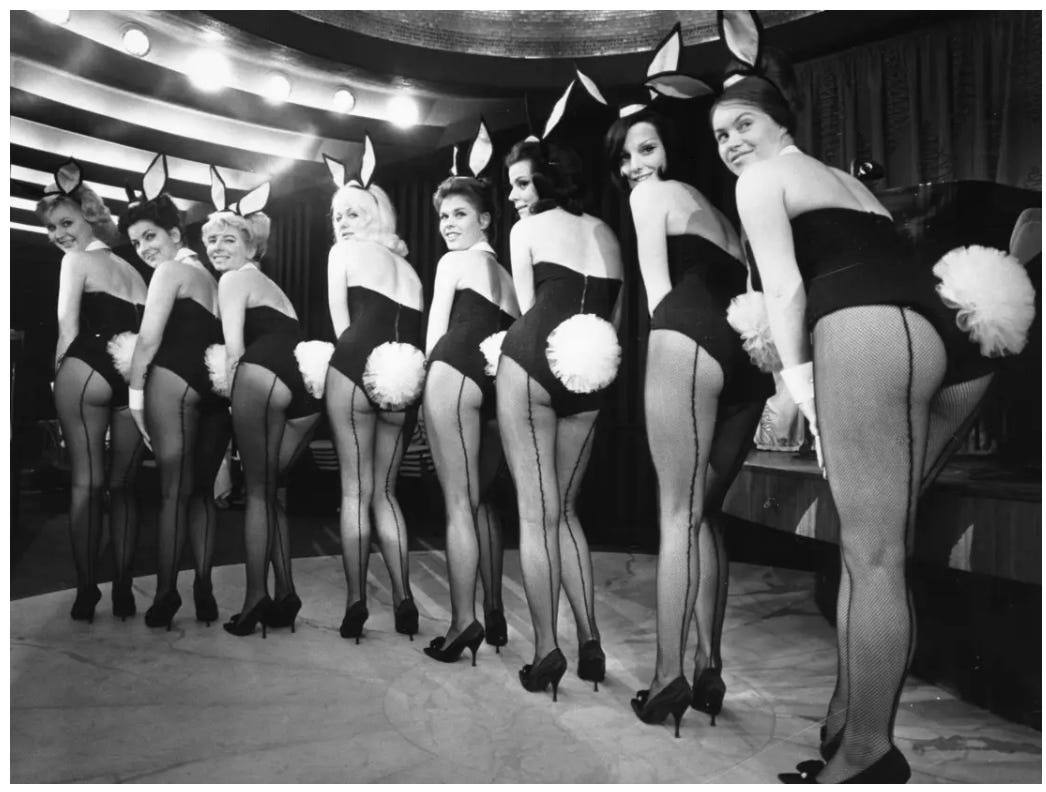
Hugh Hefner:
The rabbit, the bunny, in America has a sexual meaning, and I chose it because it’s a fresh animal, shy, vivacious, jumping-sexy. First it smells you, then it escapes, then it comes back, and you feel like caressing it, playing with it. A girl resembles a bunny. Joyful, joking. Consider the kind of girl that we made popular: the Playmate of the Month. She is never sophisticated, a girl you cannot really have. She is a young, healthy, simple girl-the girl next door. The sex that we fight for is innocent sex. Anybody can join. We are not interested in the mysterious, difficult woman, the femme fatale, who wears elegant underwear, with lace, and she is sad, and somehow mentally filthy. The Playboy girl has no lace, no underwear, she is naked, well washed with soap and water, and she is happy.
(From an interview with Oriana Fallaci, “Look” Magazine, January 10, 1967.)
Young, healthy, shy, simple, “well-washed” (with soap and water, no exotic cleansers)—and so innocent and unspoiled that it’s to be expected she would at first try to “escape” your caresses. But playfully, teasingly, she always “comes back,” like a little animal who is play-fighting. Or a child. Despite her voluptuous curves and her skill at serving drinks leaning backward (called the “bunny dip”), the bunny was not supposed to be a grown-up woman, with desires and a mind of her own. In the Fallaci interview, Hefner confessed that he didn’t feel “comfortable” with “the old ones, or the intelligent ones,” and dismissed Jeanne Moreau, Melina Mercouri, Greta Garbo, Marlene Dietrich, and Elizabeth Taylor with exclamations like “Absolutely no!” “For heavens sake!” “Don’t even speak about her!” The only grown-up actresses of the time that he regarded as acceptable “as women” were Ursula Andress and Brigitte Bardot (but only “when she was young.”)
At the same time as Hefner himself avoided “the intelligent ones,” his publicity department was churning out articles about the great careers bunnies hopped into: “Cover girl Cynthia Maddox bounded from the Chicago Club two years ago and is now our Assistant Cartoon Editor. Similarly, doe-eyed Bunny-Playmate Teddi Smith has switched to a receptionist’s post at Playboy and is now taking night courses in journalism and English lit for the avowed purpose of trying to crack our all-male editorial ranks”
How did posing for the magazine centerfold, which featured a new bunny every month and a much-coveted “Playmate of the Year,” figure in such aspirations? It didn’t—so it needed its own ad-copy, as an artful celebration of the naked body and a “symbol of disobedience” to bourgeois norms. The female body may have been the symbol, but the “disobedience” was only for men. The female ideal Hefner sought to enshrine was far from a rebel, as Gloria Steinem discovered when she went undercover for “Show” magazine to write a two-part expose of life as a bunny.
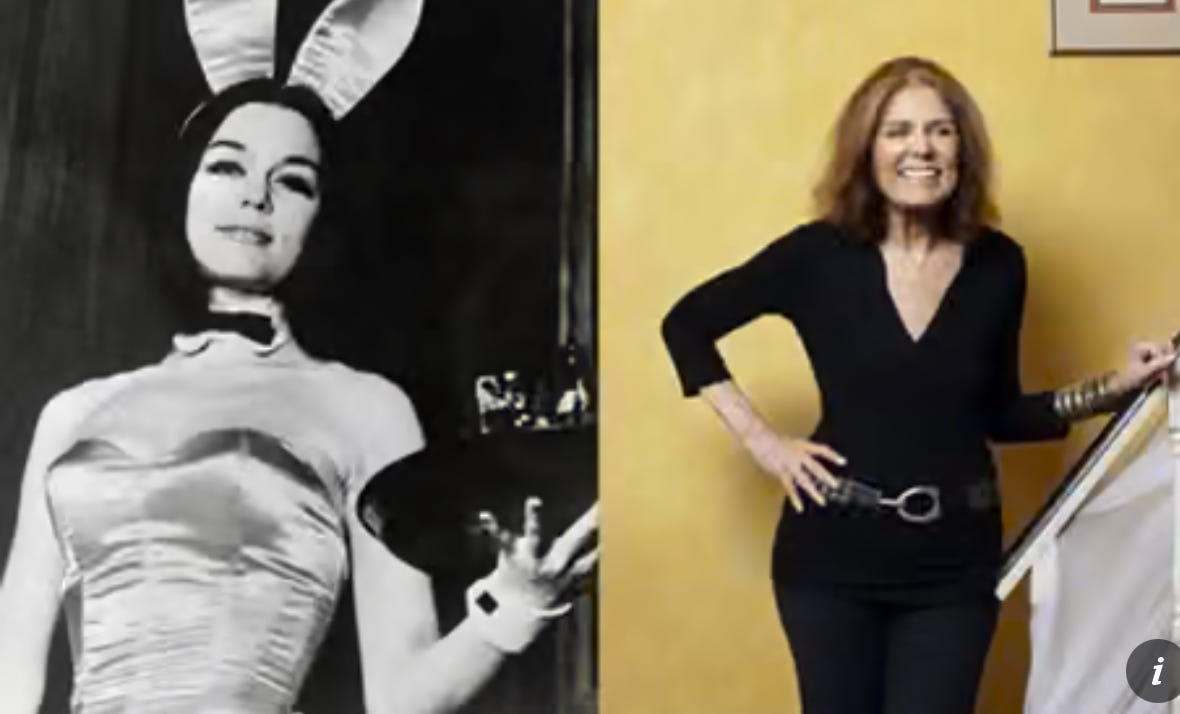
From the first interview, a would-be bunny was subjected to a host of invasive medical procedures to make sure she was “clean,” required to keep her weight within strict parameters, and given a “Bunny Bible” full of rules and regulations designed to maintain the image of young, “wholesome,” “happy” femininity. “Bunnies must always appear gay and cheerful in spite of all worries,” was an overarching command. And they had to be “clean”: Runs in hosiery, underwear that shows, crooked or unmatched ears, dirty costumes, messy hair, bad nails, failing to keep a makeup appointment, eating food in the Bunny Room, chewing gum, would all results in demerits, the “dollar value” of which “shall be or could be determined by the General Manager of each Club.” And then, too, they could be fired for infractions they weren’t even aware they had committed.
A cardinal rule was no dating any customer—except for the VIPS, whose whims the bunnies were expected to indulge. When her make-up artist mentioned to Steinem that a girl had just been fired from the Club because she wouldn’t go out with a VIP, Steinem was puzzled. “But aren’t we forbidden to go out with customers?” “You can go out with them if they’ve got Number One keys,” the beauty shop girl explained. The reality, revealed in the A&E documentary “Secrets of Playboy” was not just that interaction with VIPS was permitted but required:
“Movie night, he had every celebrity from Robin Williams to Chevy Chase. All these celebrities would come and here’s Arnold before he was Arnold. There’s Wilt, and there’s Jimmy, Caan and Cosby. They were like in a candy store up there these men.
Mary O’Connor (Hefner’s Executive Secretary) was a pimp in charge. She would call up my office and say we’re having a party. Send the bunnies up. ‘You’re expected to be at the movies tonight.’
We would turn the living room into a theater. So, we had one couch in the front, another couch behind the front couch and then the rest would be seats. Hefner would sit on the couch in the center, right up in front. His girlfriends are on either side or a couple on either side and then the director friends, the celebrity friends.
So, VIPs were up in front. Girls were encouraged to talk and engage with VIPs. That was the whole point of being up there.
They were constant flow of pretty faces that circulated throughout the mansion for movie night. They liquored them up. They gave them drugs, and they ended up in the Jacuzzi and it was a free for all.
You had to be part of their scene. It was like, well, Hef’s gonna want you to do that or Hef’s gonna be disappointed, You know?
What the “girls” didn’t know was that there were video cameras all over the mansion, recording everything, and that Playboy owned the rights to every image, every photograph taken, including the outtakes from their auditions for Playmate of the Month. Ex-playmates trying to establish post-Playboy careers were not permitted to use any of the images in websites of their own. But at the same time, when Playboy partnered with the online pornography company Manwin, those images became available to any drooling teenager with a computer.
The clip above was taken from Season One, Episode 8 of the A&E documentary, “Secrets of Playboy.” 2The episode is entitled “Predator’s Ball” (originally aired March 7, 2022) Among the secrets disclosed:
It was okay to be with a young girl. Just don’t get caught. The idea of underage sex was not really taken very seriously. And indeed, Hefner’s interest in young girls had been evident throughout his adult life, epitomized by the fact that he seduced one of the girls that had been at his daughter’s 16th birthday party..
Why’s it taken till today for it to be believed that oh my god, these things do happen to girls? Yeah, 50 year old men do rape girls.
What we’re dealing with is a very powerful team of close friends who stick together. What predator is not going to go to the Playboy Mansion? It’s locked. It’s secure. All the cookies are in the jar and it’s okay.
No one judges.
Thanks for reading BordoLines! This post is public so feel free to share it.
Attribution of quotations to be supplied shortly.
Comments
Nothing yet. Say the first thing.
Sign in to join the conversation.