
“I think, frankly,” Bernie said in January 2016, campaigning in New Hampshire, “it’s hard to be a real progressive and to take on the establishment in a way that I think [it] has to be taken on, when you come as dependent as she has through her super PAC and in other ways on Wall Street and drug-company money.”
Progressive. It’s a term with a long, twisty history. In the nineteenth century, it was associated with those who argued for the moral “cleansing” of the nation. A century ago, both racist Southern Democrats and the founders of the NAACP claimed it for their purposes. The Communist Party has described itself as “progressive.” By the time Sanders argued that Clinton was “not a true progressive,” the word was not very useful descriptively—one can be progressive in some ways and not so progressive in others, and no politician that I know of has ever struck every “progressive” chord. For Sanders supporters, however, “progressive” wasn’t an ill-defined, historically malleable label, but rather a badge of honor, a magical talisman for those who considered themselves “anti-establishment.” When Sanders denied that badge of honor to Clinton he wasn’t distinguishing his agenda from hers (their positions on most issues were, in reality, pretty similar), he was excluding her from the company of the good and pure-and in the process, limiting what counted as “progressive” causes, too. His list didn’t include the struggle for reproductive rights or affordable child care. Nor, at the beginning of his campaign, was there much emphasis on racial justice.
As I watched Sanders enchant the crowds in one of his first rallies during the primary, it was something of a déjà vu experience to see a charismatic male politician on stage telling women which issues are and aren’t “progressive.” Cultural histories of the sixties rarely acknowledge what a sexist decade it was. We imagine that breaking through the suburban fifties fantasy meant that old-fashioned gender roles and attitudes had been discarded. Far from it.
In fact, in many ways the decade was more male-centric than the fifties; it just privileged a different sort of male.
Those men loved having us as uninhibited sexual partners and helpers in their political protests, but they never let us forget who was in charge of creating the platforms or who belonged in the political spotlight. Working in the South for voting rights, young activists like Casey Hayden and Mary King’1 had gained sophisticated organizing experience and found strong female role models they could respect in the older black women who were such a central part of the civil rights movement. But by the mid-sixties, as Black Nationalism, the “student movement,” and anti-war protests moved to the center of cultural prominence, white activist women found themselves both unwelcome within black identity politics and demoted within other movements. Charged with making coffee while the male politicos speechified, shouted down and humiliated for daring to bring up the issue of gender inequality during rallies and leftist gatherings, their early calls for sexual equality were seen as trivial, hormonally inspired, and “counter-revolutionary.” Inspired by the Black Panthers to look to their own oppression, women began to speak up about what came to be known as “personal politics.” But unlike the Panthers, women were told over and over that they had to subordinate their demands to “larger” causes in the interests of “the movement.” They found themselves simmering and stewing as boyfriends and husbands defined what was revolutionary, what was worthy, and what was “progressome.”
It was both an exhilarating and a frustrating time to be an activist woman. Some, like me, dropped out of the fight for a time. Others became more violently countercultural and joined the Weather Underground. Others still became leaders of the emerging women’s liberation movement. In 2016, however, Sanders had encouraged activists to see that movement as part of “establishment” politics and no longer requiring their revolutionary fervor. As one Sanders supporter wrote:
“Yes, equal rights for women and minorities are critically important. To consider these ideals progressive, however, seems passé. At this point, it’s more fair to suggest they are traditional. Gender and civil rights and equality may remain under attack from the right, but these ideals are positively engrained in two generations of Americans.
Progressive voters, at this stage in our young country’s political history, want to challenge corrupt systems. The prison-industrial complex, the military-industrial complex, the financial-industrial complex, and the other lobbies that control our politicans and our government, for example.”
[2024 -2026: Substitute “AIPAC” for “the other lobbies.” That’s the only one that apparently matters any more to the “progressive” “movement.” ]
Sanders was the perfect vehicle to revive political passion both among the older left, revitalized by being on the side of “the revolution” again, as well as a younger generation who had yet to experience the sense of “rightness,” community, and belief in the possibility of radical change that nourished us in the sixties. Here was this guy who had lived through it all, who looked like a grandfather but spoke like a union organizer, who was making it seem possible again—but in terms that spoke to the present, to their issues. He was fierce, he was un-compromising, and he wasn’t afraid to call out clear enemies, which revolutions always need to rally around. Wall Street.Greed. Big Money. Super PACS. The “Establishment.”
[2024-2026: Add, in the boldest of letters: “ISRAEL” and all politicians deemed “pro-Israel,” a label that is attached to anyone who isn’t virulently hostile. That includes those who are critical of Benjamin Netanyahu’s government and conduct in the war, but disagree that “Israel”—the nation—is an apartheid state guilty of ethnic cleansing. Also add: “ZIONISTS” (knowing what that means not required by those who brandish the term.]
Before he declared war on Hillary and “women’s issues”, I liked Bernie Sanders a lot. In terms of class, geography, and religion, I actually have much more in common with him than I do with Hillary Clinton, whose background was solidly middle class, Methodist, and Midwestern. Sanders and I share the same immigrant, working-class Jewish roots. The neighborhood he grew up in in Brooklyn looked very much like the one I’d grown up in in Newark, New Jersey. Although Sanders was a few years older than me, we had belonged to the same left-wing groups—Sanders while in college, I while in high school. We even went to the same college (University of Chicago, where I had an on-again/off-again few years as a student.” As his campaign took off, and despite my support for Hillary, it made me smile to hear someone who sounded like he could have been a relative deliver speeches to mass audiences.
Sanders’s branding of Hillary as “establishment,” however, seemed vastly unjust and corrosively divisive to me, especially when delivered to a generation that knew very little about her beyond what Bernie told them. Like “progressive,” establishment is a pretty meaningless term, particularly when lobbed at one Washington politician by another. Neither Sanders nor Clinton had been working “outside the system.” Appearances to the contrary, Sanders was not a union organizer, but rather a longtime member of the Senate. And if Clinton had more support from the Democratic Party, that was due in large part to the relationships she had cultivated over the years, working with others—something Sanders was not particularly good at.
Nonetheless, for weeks during the’ early months of the primary, I listened to nineteen-year-olds and media pundits alike lavish praise on Bernie Sanders for his bold, revolutionary message, and scorn Hillary for being a part of the “establishment.” They described him as “heart” and her as “head”—a bitter irony for those of us familiar with the long history of philosophical, religious, and medical diatribes disqualifying women from leadership positions on the basis of our less-disciplined emotions. He was seen as “authentic” in his progressivism while she was seen as having been pushed to the left by political expediency—as though a lifetime of fighting for racial equality, health care, and children’s rights meant nothing. He was the champion of the “working class” (conveniently ignoring that Black and white women were members, and that their issues were also “working class” issues), while her longstanding commitments to universal health care, child care, paid sick leave, racial justice, and narrowing the wage gap between working men and women apparently meant nothing because she’d accepted well-paid invitations to speak at Goldman Sachs. Bernie bellowed about those speeches, over and over.
Later, the news media even let Sanders get away with describing Planned Parenthood and NARAL as “establishment” when he didn’t get their endorsement. They made little of it when he described abortion as a “social issue” (as though loss of control over one’s reproductive life has no impact on one’s economic survival). They accepted, without question, his descriptions of himself as an activist for feminist causes, when all he had done was vote the right way in the Senate. They posted pictures of him being arrested at a protest against the University of Chicago’s real estate investments, while making no mention of the work Hillary had done, when she was the same age, investigating racist housing practices with Marian Wright Edelman. Clinton’s emails and her “trust problems” were the only stories about her they were interested in re-porting.
I was shocked when in February 2016, at the Iowa caucus, Clinton described herself as “a progressive that likes to get things done” and was loudly booed by a robust Sanders contingent in the audience. The Hillary Clinton that I had been following for decades and who had spent her entire public life promoting progressive—yes, progressive— issues was clearly not registering with these booing Sanders supporters. Upset, I typed up a blog for Huffington Post.
I began by saying, “I am one of those ‘over 65’ women who belong to the faceless, aging ‘demographic’ with a Hillary sign on my front lawn,” and went on to describe my frustration with the way Hillary was being imagined, recalled the sexism prevalent during the political movements of the sixties, and reminded those who had booed Hillary of her lifelong commitments.
I wasn’t expecting the piece to hit such a live nerve, both among Clinton and Sanders supporters. The former showered the piece with thousands of “likes” and the latter with a torrent of vicious hate mail for me, Hillary, and my entire generation of feminists. I didn’t recognize the person they seemed to be addressing as me, any more than I recognized the Hillary Clinton they described:
I am a woman and a feminist and I will not be taken in by the identity politics that Hillary and her supporters are using to install her in the White House. Her decisions are her own and she should be judged by them. It’s not sexism to hold her to the high standards we should require from someone to put into the highest office of our country. She chose to enrich herself from the very corporations and people who have captured the government and she is not immune because of her gender.
Hillary Clinton is the worst enemy to women. She bullies victims of a serial predator, and her policies are toxic to the most vulnerable women.
Sorry that younger folks don’t embrace your “woman-at-all-costs” brand of feminism.
Hillary doesn’t just have ties to the establishment, Hillary is the establishment.
A real feminist doesn’t need to sell her soul and her entire country along with it just to get ahead. Hillary will do whatever it takes to get the power she thinks she deserves. It has all to do with her last name and nothing to do with feminism.
I’m not interested in the woman who won’t take a stand on something until it is politically correct/safe to do so.
I’m not interested in the woman who is a career politician clearly out of a desire for power and wealth and ego. I’m interested in the candidate who has been quietly doing the right thing before Hillary even decided she was going to run someday for president.
From what I know, second wave feminism has mostly been the purview of privileged white ladies like you, like Hilary.
Has it occurred to you that while you accuse us of not knowing history, you’re frozen in it, trying to score that one big victory by getting one of your own in office? Mean-while, us third-wavers are concerned with class gaps, race issues, and LGBT issues, too.
The argument that [Hillary] was ever a leading feminist is just silly, she never was. She was a “one note nancy” who began her own political career while serving as first lady.
She used Health Care to launch her political career, it was safe to do as the wife of a very popular President.
Comments like these (even more than what had made me write the piece in the first place) made me aware of the enormous gap between my understanding of Hillary Clinton and the privileged, inauthentic, and cynically political “establish-ment” creature that Sanders supporters booed in Iowa. Many Sanders supporters, ignoring the evidence of history, spronounced him “more of a feminist” than Clinton. (In fact, Katha Pollitt had it exactly right: “Bernie is a traditional leftist for whom feminism is a distraction.”)
As her primary victory became inevitable, Sanders himself seemed to abandon any scruples he may have had against describing Clinton as the handmaiden of the devil. An interview with George Stephanopoulos on May 23, 2016 contained this exchange:
SANDERS: We need a campaign-an election-coming up which does not have two candidates who are really very, very strongly disliked. I don’t wanna see the American people voting for the lesser of two evils. I want theAmerican people to be voting for a vision of economic justice, of environmental justice, of racial justice. That is the campaign we are running, and that’s why we are getting the support we are.
STEPHANAPOLOUS: Is that how you would describe Hillary Clinton against Donald Trump-as the lesser of two evils?
SANDERS: Well if you look-No, I wouldn’t describe it, but that’s what the American people are saying.
It was very Trump-like of Sanders to get his digs in by referring to “what people are saying.” But, like Trump, he got the message through loud and clear. A month earlier, in April, Hillary had held between 71 and 82 percent of Sanders’s supporters; by the beginning of June that number was between 55 and 72 percent, and “Bernie or Busters” were threatening that “If we don’t get Bernie, we’re not just going to automatically vote for the demon.” Bernie said nothing. Nor did he dispute Susan Sarandon when she described Hillary Clinton as “more dangerous” than Donald Trump.
Instead, as the primary election made way for the general, he made no attempt to challenge the myth that the DNC had “orchestrated the nomination of Hillary Clinton against the will of ‘the people.” First, it was the number of debates, presented as a conspiracy against Sanders. (In fact, the number initially pro-posed-six-was exactly the same number proposed in 2012.) Then it was the primaries that were closed to independents—surely not inappropriate considering they were Democratic primaries, and conveniently ignoring the huge boost Sanders got from caucuses, which favored young, healthy, economically privileged students who could spend hours hanging out at them without having to worry about child care or money lost from time off from work.
Finally, it was the Russian hack of DNC emails that “proved’ the organization had its thumb on the scale for Clinton.” As Kurt Eichenwald pointed out, those emails were almost all from May 2016, at which point Sanders had no hope of winning the nomination, except through a massive “flip” of superdelegates—a rather odd strategy for someone running a campaign in the name of “the people.” Yet he was still hammering away at Clinton, invoking the words “Goldman” and “Sachs” as often as possible, and delivering heavily sarcastic remarks about Clinton’s unreleased transcripts of her speeches. As to the DNC emails, as Sanders himself later admitted, we surely would have found emails just as nasty, if not worse, had Sanders’s campaign been hacked as well.
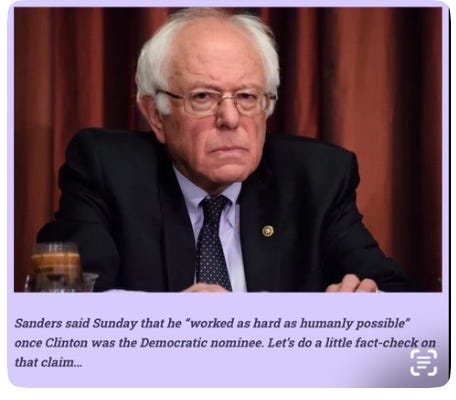
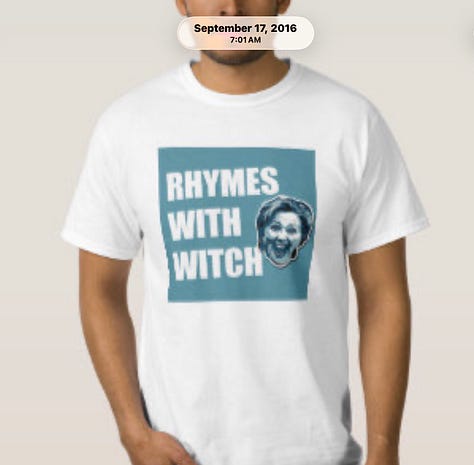
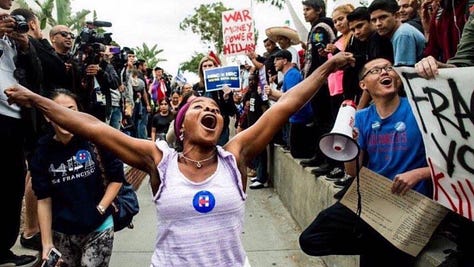
As the Democratic National Convention approached, “Bernie or Busters” began to organize protests. The first night of the convention was disrupted by anti-Hillary hecklers in Bernie shirts handing out posters that said “War Hawk” and “Gold-man Girl” and “Monsanto Mama” on them. “You can’t expose the corruption of the political system and then expect us to get behind the same political system,” said one of the orgaminers, in a CNN piece in early June. “If Bernie Sanders does not walk out of that thing as the nominee, we can guarantee you from that point on we’ll start the de-registration of the Democratic Party.”
It was so striking different from Clinton’s behavior after she lost the nomination to Barack Obama. Like Bernie, she ran until the bitter end. But four days after the voting ended, she got out of the race and endorsed Obama passionately:
The way to continue our fight now, to accomplish the goals for which we stand, is to take our energy, our passion, our strength, and do all we can to help elect Barack Obama, the next president of the United States. Today, as I sus-pend my campaign, I congratulate him on the victory he has won and the extraordinary race he has run. I endorse him and throw my full support behind him. And I ask all of you to join me in working as hard for Barack Obama as you have for me.
Clinton’s unqualified endorsement of Obama was an immeasurable help in uniting the party. In contrast, weeks after Clinton had officially secured the majority of pledged delegates (on June 7), Sanders was still delivering his stump speech, broadcast on national television, saying his “political revolution” was just beginning, while Clinton supporters waited in vain for his endorsement.
There had been rumors that it would be coming on June 17, but they proved wrong. The speech designated for that day was highly anticipated-and bitterly disappointing to Clinton supporters. “The major political task that we face in the next five months,” he said, “is to make certain that Donald Trump is defeated and defeated badly.” But he then went on to repeat his critiques of economic, racial, and environmental inequalities in the country. Strikingly absent was an endorsement of Clinton. Instead, he emphasized “the significant difference between him and Hillary on VERY, VERY important issues” (emphasis Bernie’s) and called on his supporters to continue his “revolution”: “We need new blood in the political process, and you are that new blood.”
Those of us expecting an endorsement were not only angry, but insulted. Many of us considered ourselves political progressives, yet to Sanders we were apparently just stale blood, clogging the veins of the revolution, agents of a corrupt “establishment.” And when he spoke of taking the party back for “working people” and young people and out of the handsof rich donors, I wondered—not for the first time—how the hundreds of thousands of Black Americana who supported Clinton (they were her solidest supporters) fit in. Did he think Black voters all owned Bentleys? Or maybe too many were Black women, who of course were women and so not really a part of his white, male image of the “working class.”
Bernie’s core supporters, of course, were right there with him that night, many “gathered at Bernie-watching parties, like one in the East Village of Manhattan, where twenty supporters in the upstairs dining room of the Bareburger restaurant broke into raucous applause when he said his twelve million votes proved that his was not a radical campaign, but rather ‘mainstream’. Yamiche Alcindor of The New York Times reported that Jessica Stokey, forty-three, a television editor, was one of many who shed tears: “I don’t know if it’s just my imagination, but it looked to me like the bags under his eyes got bigger and his face grew more thin,” she said. “That’s when I started crying. It’s like knowing the zombies are here and you have to save your child; that’s how heartbreaking it is,” she added.
Other supporters who had gathered for his speech, when asked about Clinton, replied that “she doesn’t speak for me or my issues.” In the days that followed, those who had come around to accepting the fact that she was the nominee invariably prefaced their reluctant support with phrases like “I don’t really like Mrs. Clinton, but...” And too many remained who were actually hoping Trump would win: “[He’s] an asshole,” said one, “but I feel like he’s full of hot air. HRC is calculating, she’s conniving... If [she] wins in November, I feel like she will do whatever she can to squash the progressive movement. That movement dies.” Some, like Susan Sarandon, believed that a Trump win would help make “the revolution” happen quicker-the old lefty theory that exposing the contradictions and abuses of capitalism was a prerequisite to the system collapsing under the weight of worker uprising.
For many followers, both Black and white, the “1994 Crime Bill” and “super-predator” said all one needed to know about Clinton. Some spoke as though she was personally responsible for the spike in mass incarceration that was a consequence of her husband’s bill. “She was part of the whole problem that started sending blacks to jail,” a young black man from Ohio observed. He wasn’t alone. Another—a millennial black woman, also from Ohio, likened the choice between Clinton and Trump to the choice “between being stabbed and being shot.” Sports icon Colin Kaepernick, famous for kneeling during the national anthem as a form of protest, described both Trump and Clinton as “evil”. “Both are proven liars and it almost seems like they’re trying to debate who’s less racist.” (In the meantime, in June and early July, both the GOP and the mainstream media were pushing hard on the email “scandal” that Sanders had once gallantly dismissed during the first debate. But Sanders was no longer offering his “enough with the damn emails” position, allowing Republicans and James Comey to dish the dirt without interference.
[2024-2026: Substitute “Crime Bill” (which First Lady Hillary didn’t even vote for, though Sanders did—a fact he conveniently “forgot”) for Israeli “Genocide,” “Apartheid” and “Ethnic Cleansing.”]
When he finally endorsed Hillary on July 12, speaking to a crowd in which many of his supporters jeered her name and held signs saying “Won’t Vote Hillary,” he looked grumpy and grudging and devoted most of his speech to congratulating himself and his followers on the “fight to create a government which represents all of us, and not just the one percent—a government based on the principles of economic, social, racial, and environmental justice.” He boasted of the races he had won, and was unable to resist a jab at party leaders by citing Clinton’s abundance of superdelegates (read, inSanders’s code: party hacks). He conceded that she “will be the Democratic nominee for president,” and then went on to formally endorse Hillary Clinton-finally.
It was not exactly a rousing call, designed to energize his supporters and redirect their passion toward Clinton. While Clinton had focused her endorsement for Obama on his accomplishments and abilities, Sanders returned once again to his own campaign, citing the impressive attendance at his rallies, and emphasizing that “this campaign is not really about Hillary Clinton, or Donald Trump, or Bernie Sanders, or any other candidate who sought the presidency. This campaign is about the needs of the American people and addressing the very serious crises that we face.” He then launched into what was essentially an accounting of the economic and social positions he and Hillary shared, which gave the lie to the vast gulf between “revolutionary” Bernie and “establishment” Hillary that he had run on.
Of Hillary’s qualifications to run the nation, Sanders mentioned just two accomplishments: “as a great first lady who broke precedent in terms of the role that a first lady was supposed to play as she helped lead the fight for universal health care” and “as a fierce advocate for the rights of children.” Stellar accomplishments, yes, but rather gender typed, and hardly doing justice to the myriad ways in which Clinton had served the country.
During the second GOP debate, Carly Fiorina had issued the absurd challenge: “If you want to stump a Democrat, ask them to name an accomplishment of Mrs. Clinton’s.” I’m not stumped:
Staff attorney for Children’s Defense Fund
Former director of the Arkansas Legal Aid Clinic
First female chair of the Legal Services Corporation
Twice listed by the National Law Journal as one of the hundred most influential lawyers in America
Arkansas Woman of the Year in 1983
Chair of the American Bar Association’s Commission on
Women in the ProfessionCreated Arkansas’s Home Instruction Program for
Preschool Youth
Led a task force that reformed Arkansas’s education system
Instrumental in passage of the State Children’s Health
Insurance ProgramPromoted nationwide immunization against childhood illnesses
Successfully sought to increase research funding for prostate cancer and childhood asthma at the National Institutes of Health
Worked to investigate reports of an illness that affected veterans of the Gulf War (now recognized as Gulf War Syndrome
Helped create the Office on Violence Against Women at the Department of Justice
Initiated and shepherded the Adoption and Safe Families
ActTraveled to seventy-nine countries during time as
FLOTUSHelped create Vital Voices, an international initiative to promote the participation of women in the political processes of their countries
Helped create the Children’s Insurance Program
Delivered one of the most quoted human rights speeches of all time in Bejing, China
Served on five Senate committees:
Committee on Budget (2001-2002)
Committee on Armed Services (2003-2009)
Committee on Environment and Public Works
2001-2009)
Committee on Health, Education, Labor and
Pensions (2001-2009)
Special Committee on AgingMember of the Commission on Security and Cooperation in Europe
Instrumental in securing $21 billion in funding for the World Trade Center site’s redevelopment
Took a leading role in the investigation of health consequences of first responders and dratted the first bill to compensate and offer the health services our first responders deserve.
In the aftermath of 9/11, worked closely with her senior Senate counterpart from New York, Senator Charles Schumer, on securing $21.4 billion in funding for the World Trade Center redevelopment
Proposed a revival of the New Deal-era Home Owners’Loan Corporation to help homeowners refinance their mortgages in the wake of the 2008 financial disaster
Brokered a ceasefire between Hamas and Israel
Brokered a human rights agreement with Burma
Was the most traveled Secretary of State to date; known for her employment of “soft power.”
Introduced the Family Entertainment Protection Act, intended to protect children from inappropriate content found in video games
Former U.S. secretary of state
As secretary of state, made LGBTQ rights a focus of foreign policy
As secretary of state, worked aggressively on issue of climate change
Grammy Award Winner
Author
In all of this, Bernie Sanders found nothing around which to rally his supporters.
Hayden and King were members of the Student Non-Violent Coordinating Committee (SNCC) who wrote a famous “memo” that became a founding document of the emerging Women’s Liberation Movement.
Comments
Nothing yet. Say the first thing.
Sign in to join the conversation.