
And library social media is absolutely killing it right now. One of my favorites is this reel from the City of Marion Libraries in Australia. But also this one, from Vancouver’s Public Libraries. And this one from North Little Rock. (Clearly, it’s easy to end up down the rabbit hole). Their posts are somehow equal parts unhinged and wholesome, on-trend and unexpected, “chronically online” and still so analog. Most importantly, though, they’re human, and the comments section is loving it.
All of this is just more evidence of how, against all odds, libraries have continually laughed in the face of extinction as the entire world has shifted around them. The internet exists now and you don’t need to dig through shelves of books anymore? Great, come use our public computers. Global pandemic means you can’t come check out physical books? No problem, here’s an automatic ebook library card. Ebooks mean now you don’t ever need to come pick up a physical book again? Cool, we hired an award-winning architect to create a really gorgeous building so it kinda feels like a destination in and of itself so you’ll probably want to visit anyways. Also we have community events and we’re the last place you can go hang out while spending zero money, no strings attached. (A real conversation between libraries and everyone else, probably.)
Anyways, long live libraries. And shoutout adaptation.
– Shanna
by Doug Freeman
Over the past couple of months, Wikipedia has been under attack from conservatives for a perceived liberal bias. Again. This time the controversy was stirred up in the wake of Charlie Kirk’s assination as editors debated whether his wife, Erika Kirk, deserved her own Wikipedia stub.
As these things tend to go on hot-button topics on Wikipedia, the publicly available discussion among the editors took a lot of turns before ultimately deciding through their standard consensus process that she did deserve a dedicated page based on notoriety and enough external sources. This is exactly how the process is supposed to play out.
Yet the whole debate has refreshed the aggravation from conservative activists over their right to control narratives. Fox News blew up the outrage, which then took off into completely predictable mischaracterizations of how Wikipedia works and its editors make their decisions.
As Tim Higgins noted in his Wall Street Journal article (with an amazing lede, btw), Wikipedia has core policies to guide how entries are written. But that doesn’t seem to matter much if you disagree with what’s written, or perhaps have an agenda to reshape political and social narratives. And now we’ve gotten a Grokipedia courtesy of Elon Musk and AI, which is going just as great as you’d expect.
I’m old enough to remember when we had to instruct our college freshman writing students that this new “Wikipedia thing” was not a reliable source. This is still somewhat true, but now it’s more about getting students to dig deeper into the cited primary sources. We can’t pretend that Wikipedia isn’t a core resource for information for nearly everyone these days.
Now we’re faced with AI engines providing summaries and information, and schools are trying their damndest to create policies that incorporate this new technology. The bigger issue is not just citations, but that we’re relying on these AI results to deliver us factually-based information and instead, these engines are just spitballing to appease us like my dad explaining why the sky is blue.
There’s no need to regurgitate the litany of bad results that LLMs have returned in conversation, but it’s clear that we don’t know how to properly use this technology yet. And that’s of course just the tip of the iceberg with the challenges that AI presents as the Information Age evolves into the Generative Information Age.
But let’s be clear about what’s happening here. Media Studies provides a useful lens to think about the shifts we’re experiencing. LLMs operate in a conversational framework: a dynamic system of back and forth, with answers shifting slightly depending on the context in which they’re asked. These tools are actually quite excellent and useful when we use them conversationally, as they’re designed to function. The problem is that too many of us are using and thinking about LLMs within an archival framework. We’re treating AI as an exhaustive encyclopedia, and conferring upon it the credibility of that knowledge base.
The Generative Information Age
When we think about knowledge as an archive, we get libraries and encyclopedias and the sense that all collected human information and knowing is available to us, if we can just find it within the stacks. We developed all kinds of systems to both navigate and curate these archives.
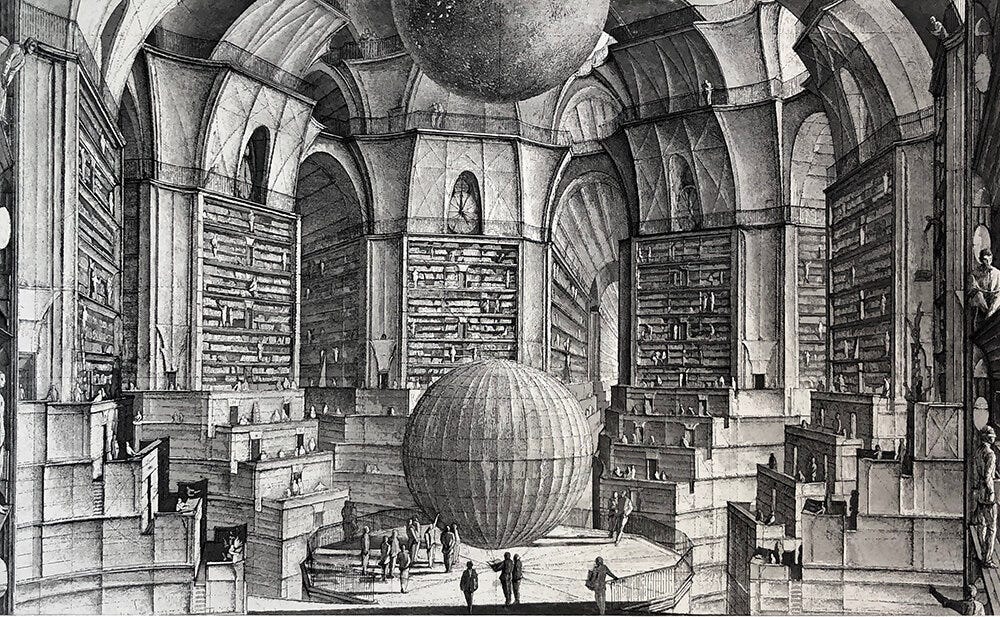
Conversely, a conversational mode of information does not have that grounded sense of shared “knowledge” or expertise that we expect from an archival mode. It would be more in line with oral traditions that are expected to evolve, adjust histories to current moments, and focus less on answers than how we get there.
I’m not necessarily arguing that an archival information system is better than a conversational one. There are, in fact, great advantages to both. But we’ve relied on an archival information system for centuries, while conversation has operated in a different sphere for us. It’s not that we don’t know how to operate within a conversational information system (we do it every day!), but we need to recognize it is fundamentally different from an archival system.
In Media Studies, we consider the creation of the printing press to be the start of a democratization of knowledge in the sense that the archive was no longer hoarded and related to the public only by scholars, elites, and priests. Our current Information Age has exploded that democratization even more, but beyond just expanding access to the archive, we also have the internet’s capability for us to add to it. We’ve fully entered into a Read-Write mode of information, and all kinds of wackadoodle ideas can be easily published and placed (somewhat) on the same level with everything else on the Web. We flattened the archive and expertise.
Back when I was teaching those first-year college students at the turn of the century, this flattening of the information hierarchy was the biggest concern. We were focused on teaching them how to judge sources and context to determine reliable information from the dubious. If we could at least get students to question and probe the credibility of the source of the content, then they could hopefully sift good information from bad.
Needless to say, there are all kinds of problems we can call out an archival mode of information for – biases, control, access, authority, authenticity, etc. And as much as the new Read-Write Web muddied our perception of the information archive, it also excitingly expanded perspectives and whose voices were “allowed” to be included. We’ve managed to balance that fairly well with a notion of transparency that has made Wikipedia reliable.
Every new form of media brings with it the predictable pearl-clutching that it will destroy our society (will someone please just think of the children!). Our reactions to LLMs are certainly following that expected pattern. But AI is breaking that tentative balance of our new chaotic web archive. Even beyond its hallucinations and eagerness to please, its black box formulations wreck our ability to judge sources or the veracity of where and how it is getting its information. It’s not just a matter of whether we can trust what it is saying is true, but that we don’t know the point-of-view and potential biases that are inherent to its information. In contrast, I can judge a publication’s POV based on its author or source.
Grokipedia highlights this problem with, as Renee DiResta outlines in the Atlantic: “855,279 articles, no human editors, and no way for users to request improvements beyond a suggestion box addressed to its eponymous chatbot author.”
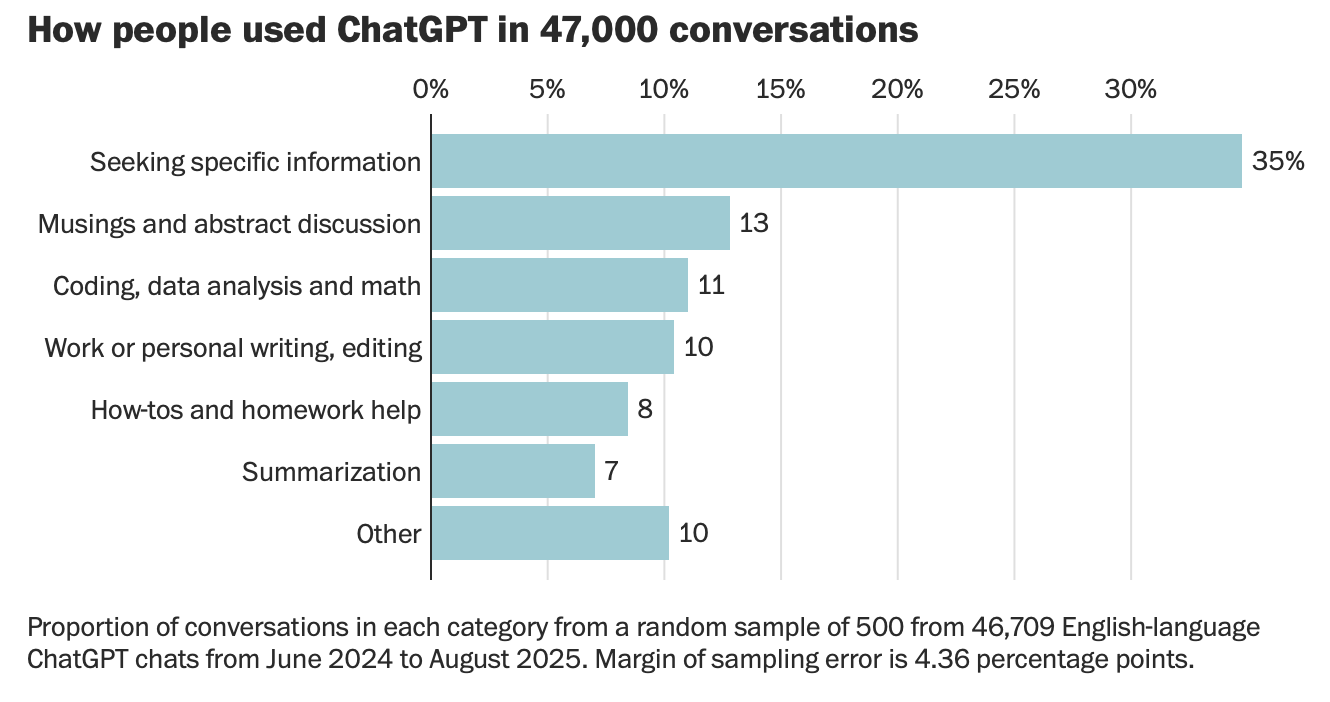
A new report from the Washington Post analyzing 47,000 ChatGPT conversations found that 35% of the conversations were seeking specific information. That far outweighs the next highest proportion of 13% for “musings and abstract discussion.” In the Generative Information Age, we understand the importance of asking the right questions, but we don’t properly know how to comprehend or use the answers that return.
We’re treating LLMs like an archive instead of conversational engines.
We do know how to operate in conversational informational systems, and how to understand them. Conversations, unlike the archive, are inherently both input and output, and from that back and forth, new ideas or insights might emerge. Even in conversation with an expert on a topic, where there may be deference to the other’s point of view, we wouldn’t consider talking with that expert as access to a full archive of knowledge around a subject, but as access to that person’s own experience and knowledge base.
Conversations are an excellent format for sparking insights, which is why some of the best use cases for LLMs remain facilitating brainstorming or seeking out our own potentially overlooked biases. LLMs are an amazing conversational tool, though we also have to realize the effect is ultimately solipsistic. Our conversations with AI are not truly a shared exchange of ideas, but are merely mimicking that exchange.
The challenge right now at the dawn of this new Generative Information Age is to establish how we should be properly using these tools. We need to teach AI literacy in the same way we were instructing digital literacy 20 years ago. When used as an archive, LLMs can be highly problematic. As a conversational medium, they become incredibly powerful and useful.
Zooming out though, it’s not simply about understanding the mode of conversational versus archival mediums. What happens to the very ways we think about knowledge when our information systems become fully generative rather than archival?
In the next Superposition, we’ll dig into those repercussions. Stay tuned.

As everyone is diving into all the obvious biases and problems with Elon Musk’s Grokipedia, Ryan McGrady puts the new AI encyclopedia in the context of information and knowledge control.
A fascinating interview from Nautilus with Steve Ramirez, author of How to Change a Memory: He Erased Memory in Mice. Then Thought About Erasing His Own.
We won’t go on another rant about the word of the year, but in case you haven’t been fully beaten down by tweens throwing around “Six Seven” everywhere, Dictionary.com has you covered.
Ever seen a video of a Peacock Spider? You’re welcome.
A new book that explores 600 years of Tarot card designs. Some of these decks are stunning, including Dali’s famous deck.
What did your hometown look like 750 million years ago? Here’s an interactive map that lets you see how the earth has changed.
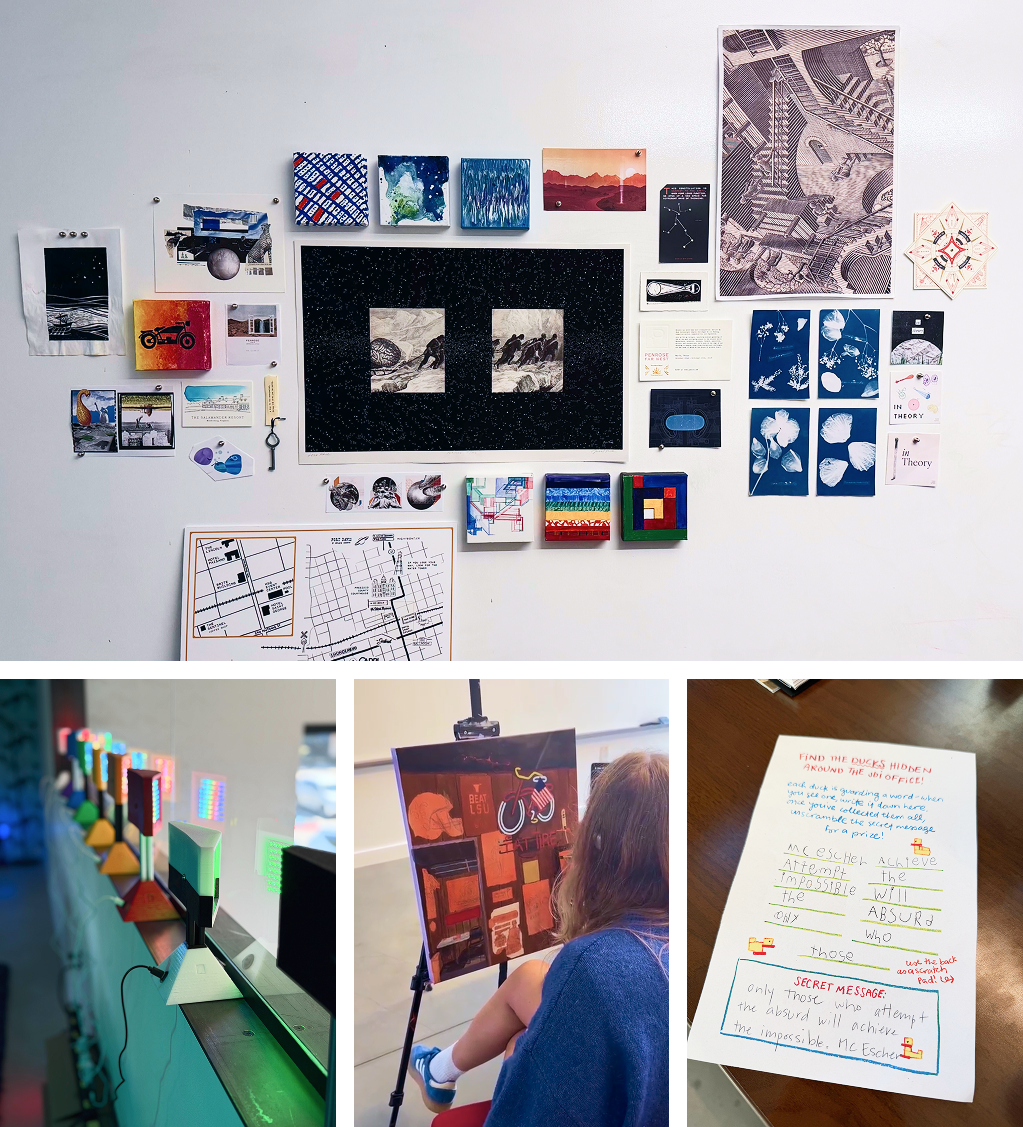
The past two weekends, our office was an official stop on the Austin Studio Tour. It’s one of our favorite events in Austin every year, and we had some incredible artists showcasing their work in our space. Enjoy some photos from the weekend, and check out the art of Lauren Luscombe, Axuro LTD, Marnie Jean, Haley Lancaster, and Kate Hellenbeck.

Next time on Superposition: “What happens if we imagine the Web as absolutely dynamic and generative, with a generative UI that constructs a webpage and content on demand based on what the visitor wants?”
Superposition is a production of JDI, designed and written by Shanna Gerlach and Doug Freeman
No posts
Comments
Nothing yet. Say the first thing.
Sign in to join the conversation.