
At the risk of sounding extremely cliche, I’ve recently decided I need a “season of yes.” I have had the most incredible time saying “no” more the past several months, and that’s been a good thing – I’ve set, reset, and maintained boundaries; I’ve prioritized my own stability and emotional security; I’ve established routines and traditions; taken care of myself and the people closest to me; worked on limiting my guilt over not being able to please everyone all the time. But, just like all polarities, there comes a time to switch back over, and ride the sine curve to the other side. My goal for the next however-long is to default to “yes” instead of “no,” to look for reasons to do new things rather than excuses not to, to try things and experiment and explore and fail.
On a macro level, culture seems to follow this same general wave: in times of crises and uncertainty, we return to routine, hunker down with the people we love, and take care of ourselves. But, again, this is a polarity: a transition to the other extreme is inevitable, welcome, and — right now — it’s imperative. Let’s try shit again.
- Shanna
by Doug Freeman
For the past few years, the common refrain in business is that we’ve been navigating through a VUCA world — an ocean of Volatility, Uncertainty, Complexity, and Ambiguity. Most organizations have been addressing this chaos with a plan to simply outlast the storms, before inevitably being able to move back to calmer and more predictable waters when the tides return to normal. This posture was certainly behind many of the reactions to COVID and even the polarized political disruptions that defined so much of the past decade in the US.
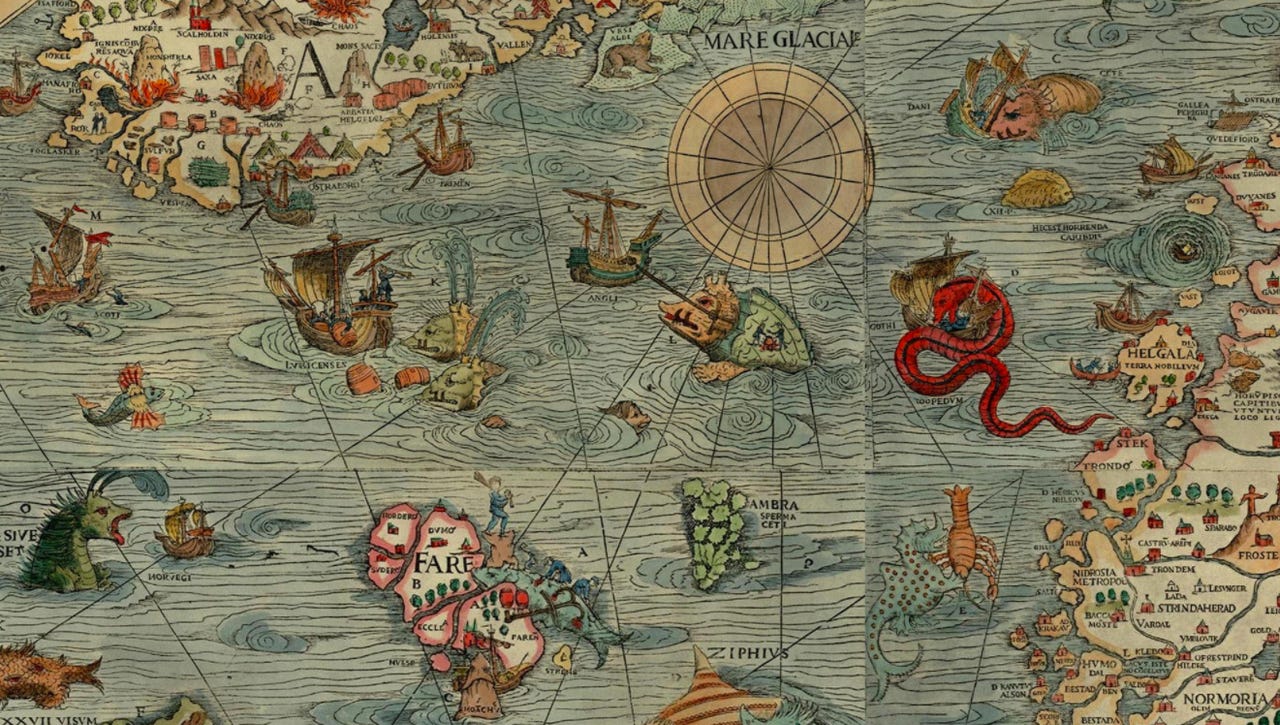
Now though, I’d argue that we’ve moved beyond simply surfing choppy VUCA waters and have sailed off the edges of our known maps into the “here be dragons” territory. We're not just navigating a period of disruption anymore, but experiencing the throes of a major shift. What lies on the other side of it will not be a familiar stability or “return to normalcy” but rather a world that operates quite differently from the rules of the past 80 years.
And it’s going to be extremely uncomfortable.
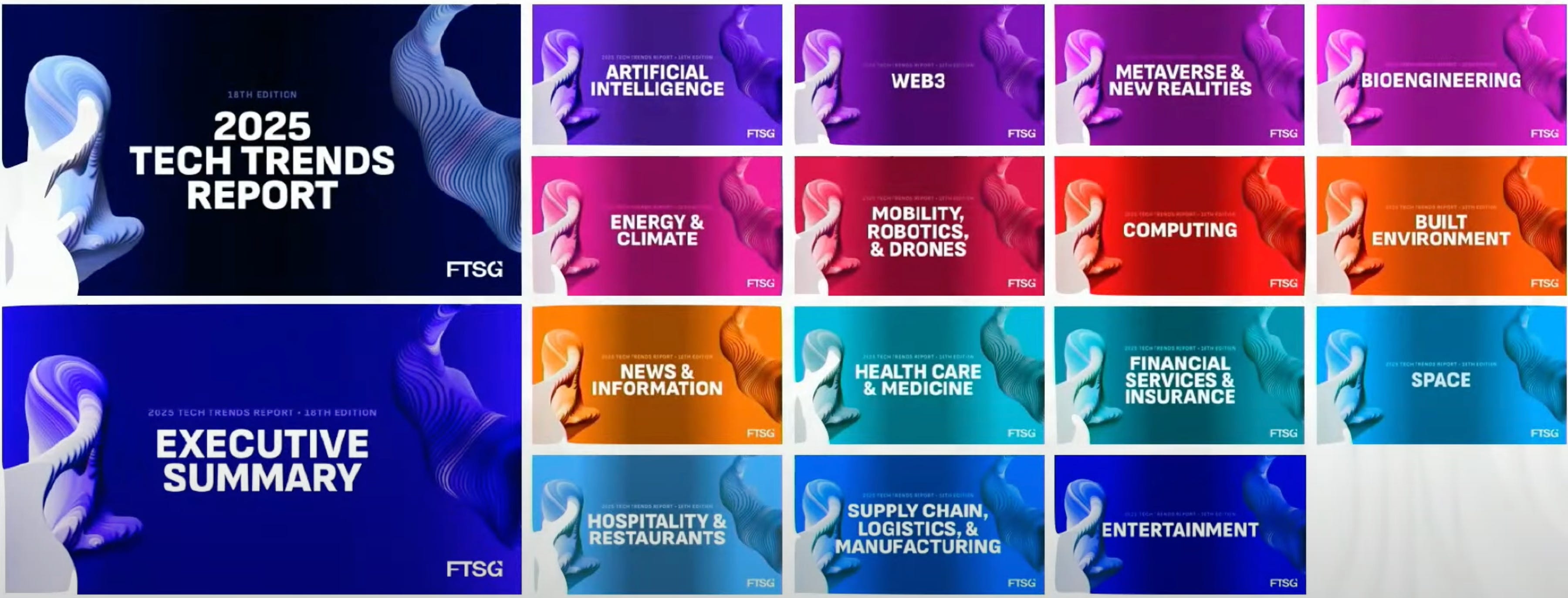
This idea has been rolling around my gut the past few months, but was reinforced at SXSW in March with Amy Webb’s annual Emerging Tech Trends Report. It’s one of my favorite presentations every year, a massive debut of what she and her Future Today Strategy Group have identified as the driving forces that will impact the world in the near and long-term. She traces emerging technologies and outlines scenarios for how their distribution and influence will play out.
The goal of Webb’s futurecasting is to prepare us for the disruptions that are coming so that we can identify and act on potential threats and opportunities. The past few years of these talks have gotten pretty wild, but with the added chaos of the new geo-political, economic, and social shifts we’ve experienced even this early into 2025, an additional uncertainty hung heavy over this year’s presentation. You can watch the full talk here or download the entire 1000 page report on the FTSG website.
While the insights on cutting edge technologies are always fascinating, this year’s keynote was memorable more for the dramatic stance that Webb took on our having passed the point of no return. She sees our current moment as one when we have “crossed the Rubicon” in a way that will have civilization-altering repercussions. As she writes in the opening executive summary of her report:
In the past year, humanity crossed multiple points of no return. This didn’t happen gradually, but in sudden, irreversible leaps that have fundamentally altered the trajectory of civilization. We’ve moved beyond our mental models, beyond biological constraints, beyond social norms—into territory we can neither fully explain nor comprehend. Just as the first telescopes revealed the vastness of space, today’s science and tech advances are revealing how much we don’t understand about our own potential….
Let me be clear: The decisions we make in the next five years will determine the long-term fate of human civilization. This isn’t hyperbole—it’s the sobering conclusion drawn from our best available data. The convergence of tech isn’t just changing how we work or live; it’s changing what it means to be human. We’re building systems that can reprogram biology, reshape matter at the atomic level, and process information in ways that defy classical physics.
To emphasize this point during her talk, she had the crowd sit on small wooden blocks throughout her whole presentation. The idea was that things are about to get really uncomfortable — as they already are in many aspects — and if you’re only focused on the immediate discomfort and disruption you’re experiencing, you’re going to miss the transformative shifts that are happening.
Webb focuses a lot on the biological revolution that is underway in the 21st century, which when combined with sensor and AI technologies, will completely disrupt how we think about our bodies and ourselves. She’s also been at the forefront of considering biological computing — what she calls “living intelligence” — as the next frontier that will push machine capabilities beyond our understanding.
In short, things are about to get really weird, and there is no going back.
I can’t help but think of this in relation to Benjamin Labatut’s book When We Cease to Understand the World. In the work, Labatut explores that moment of vertiginous excitement and fear of confronting scientific breakthroughs, what it must feel like to have the entire structure of the universe as you know it pulled out from under you. He induces this in the reader as well, mixing fact and fiction so that you’re not sure what is real.
Interestingly, the original Spanish title for the work is the wonderfully poetic Un Verdor Terrible, which echoes in my mind Yeats’ “terrible beauty.” Revolutions are dramatic and brutal, even scientific ones, but there is a “greenness” of hope and opportunity in what may emerge from it. Both things can be true, and we need to be able to hold that tension.
We are in a moment of unmooring, and cannot be sure what is beyond the horizon. The key is how well we can navigate into that unknown as things change, to remain flexible and open to possibility. We need the ability to question familiar frameworks and assumptions rather than try to shoehorn our understanding of these changes into them.
This isn’t simply about AI or climate change or the shifts we’re already anticipating, but rather being able to confront the “unknown unknowns” that will emerge, being able to see them more quickly and move into them.
To be clear, this is a much easier stance to take in a newsletter than in reality. Any kind of transformational shift, especially on the global level, will result in hurting a lot of people as the systems we have relied upon break down. My mother is fond of quoting the apocryphal ancient Chinese curse “May you live in interesting times,” and she’s been saying it a lot lately.
A friend of mine described this moment as the feeling of starting at a new school that doesn’t have grades. You’ve learned how to work and even excel in a system to achieve a top GPA, but now all the rules have changed. In this new Montessori environment we’ve entered, we have to figure out the new values and where to put our energy. But we also need to remember that while the rules may have been abandoned, we have to ensure we’re still propelled by core ethical principles, even as others may not.
Reactionary policies that attempt to prevent the flood of change will never work for long, and especially not in the tech and science-driven transformations that are coming. These transformations are not simply new gadgets, but advancements that utterly alter how we understand things like our very biology. And while some may try to hold back that deluge, it’s more important that we lean into the discomfort of the shifting waters and instead work to shape its flow towards the most valuable, equitable, and positive outcomes for humanity and our world.
There is opportunity to build better worlds in these moments but it requires flexibility and willingness to lean into the discomfort. We don’t know what ideas will work, but we need the audacity to try them, or even begin asking questions to rethink what we think we know. We need to break our reliance on the frameworks that have worked in the past, and even the systems that they’re designed to utilize, and begin designing and testing new blueprints for the world on the other side of the Rubicon.
We need to learn to cook instead of bake, to work without a recipe and with the ingredients we have. The old recipes won’t work anymore, anyway.
If we cling too tightly to the familiar models and what worked in the old systems, no matter how effectively, we’ll miss the opportunities to productively and ethically shape what will emerge in the new.
We have to get comfortable with not knowing, and with being wrong and going back to the drawing board. Science is, after all, more about questions than answers.
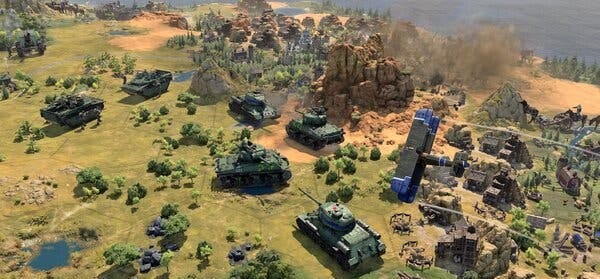
What can we learn from the dramatic, civilization-scale crises and transformations of Civilization VII? Yussef Cole’s recent review in the New York Times suggests there are lessons in working through seismic shifts as the game’s civilizations rise and fall. “Remember that the potential for change can work both ways. The civilization that makes it out of a crisis often won’t look anything like the one that went in.”
“How can AI be the centerpiece of a sustained competitive advantage when everyone has it? We argue that it simply cannot.” MIT’s Sloan Management Review on what happens when AI is ubiquitous and homogenized.
Mike Sowden’s “Everything is Amazing” with three stories of water that will blow your mind.
Producer, songwriter, performer, and artistic genius Jon Bellion in fantastic conversation with Ross Golan. His take on AI vs the human instinct to stay in motion and “choose to work and do the thing because working feels good” is both refreshing and nuanced. Start around 6 minutes for just that segment, or listen to the whole thing. His new album Father Figure comes out June 4th, and I can’t stop listening the singles that have come out so far.
During SXSW, Josh (JDI’s CEO) moderated a panel alongside Helen Protheroe and Christina Agapakis all about Storytelling in Science. The panel talked most about fostering more open collaboration, both among researchers and with other communities like the arts. The conversation also focused on how we can make science more engaging and accessible to the world, without compromising rigor.
What was most heartening about the experience was the full room of audience members from a wide variety of industries and domains. More people wanted to have this conversation than we anticipated, including a large number of non-scientists, and that’s a really good sign.
Listen to the conversation here.

Next time on Superposition: “Time and Attention may have become the chosen obsession of the web analytics gurus, but those online metrics are just the sad shadow of their IRL impact.”
Superposition is a production of JDI, designed and written by Shanna Gerlach and Doug Freeman
No posts
Comments
Nothing yet. Say the first thing.
Sign in to join the conversation.