
🪸 We’re Superorganism, the first VC for startups that benefit biodiversity. Each month we publish thoughts from the frontline, company updates, and a round-up of new happenings in the nature tech world.
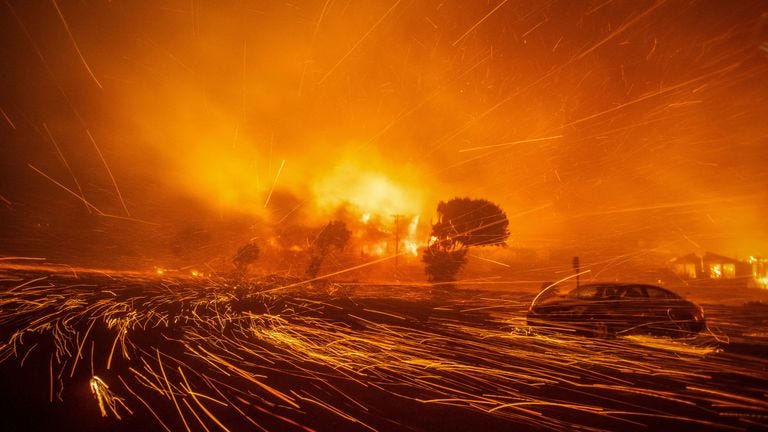
On January 7, sparks ignited across Southern California. Whipped by the hurricane-force Santa Ana winds, fires clawed through an overgrowth of vegetation left from the past season’s El Niño (one of the five strongest on record), then dried by the ensuing La Niña. The complex of several fires including Palisades and Eaton fires swiftly grew to become some of the most destructive fires in US history, claiming 29 lives and causing an estimated $150B+ in damages, 10x the previous record-holder, the 2018 Camp Fire.
The severity of megafires ties directly to climate change: drier vegetation, lower water levels and atmospheric moisture, stronger winds, longer hot seasons, and less snowpack. Climate change made events such as these LA fires 35% more likely than historic conditions.
But modern megafires have another critical dimension: human management of nature.
Until a few decades ago, California’s primary approach to fire was to prevent it entirely. For 150+ years, managers stopped most fires on the landscape, leading to a build-up of thick forests and understory vegetation. For thousands of years before this recent prevention regime, fires were common, with ecosystems and species adapted to periodic burning (in California, see redwoods, manzanita, and more). Now, a new school of fire ecology is embracing Indigenous wisdom and using beneficial fire to both support nature and prevent the worst megafires.
An increase in introduced species has led to our current situation, too. Eucalyptus, introduced to California in the 1850s, takes up water so fast that it can actually lower the local water table, and is extremely flammable due to its oil content. Non-native grasses can outcompete native grasses near roadsides and in meadows, and were implicated in the 2023 Hawaii fires.
Compounding these impacts is a growing human population building communities in historically fire-prone areas. In past megafires, homes have themselves become accelerants to spread more intense fires. With lower density relative to cities and greater fluidity between neighborhoods and forests, these housing arrangements make managing fires much trickier to manage than in dense urban infrastructure.
Wildfires hold a special place in our Climate x Biodiversity thesis, where we look for innovations at the overlap of both nature and climate. While fire can have beneficial ecosystem effects, the intensity of modern wildfires can be devastating for biodiversity, stripping soils, trees, and understory bare. Wildfires have a significant impact on the release of atmospheric carbon, too: when the carbon release of all wildfires in 2023 were aggregated, they were the world’s second largest emitter after China.
This month, we’re exploring some of the highest-leverage ways to reduce the causes and impacts of uncontrolled fire, to return beneficial fires to the landscape, and to return our ecosystems to pre-suppression conditions.
To get a better understanding of the interplay between fire and nature, we turned to our friends at Blue Forest.
Blue Forest is focused on advancing forest and watershed restoration through scientific research, financial innovation, and project development. In 2023, they successfully completed their pilot project, the Yuba I FRB, which protected 15,000 acres of the Tahoe National Forest in California. CEO Zach Knight has been laser-focused on how to restore forests to their fire-adapted baseline.
“We try to bring forests back to natural density in a way that restores ecological function,” says Knight. “That means we will have fire, but we’re going to have forests that are resilient to natural fire as it comes through because we’ve taken out the ladder fuel."
Ladder fuel is live or dead vegetation that connects the forest floor to the tree canopy, allowing fire to spread into the trees. Ground fires (which move through the soil) or surface fires (which burn vegetation on the ground) are more manageable, but when the fire moves into the treetops and turns into a crown fire, it moves more rapidly and is difficult to put out.
“Because no fire has come through to thin out saplings, typical forests in the US West now have 10-20x more trees per acre than their fire-adapted landscape would have historically,” says Knight. This creates more fuel, but it also dries out the landscape. Think of trees like straws drinking from the same water source. Fewer straws means more water available in the water table and the rivers and reservoirs downstream.
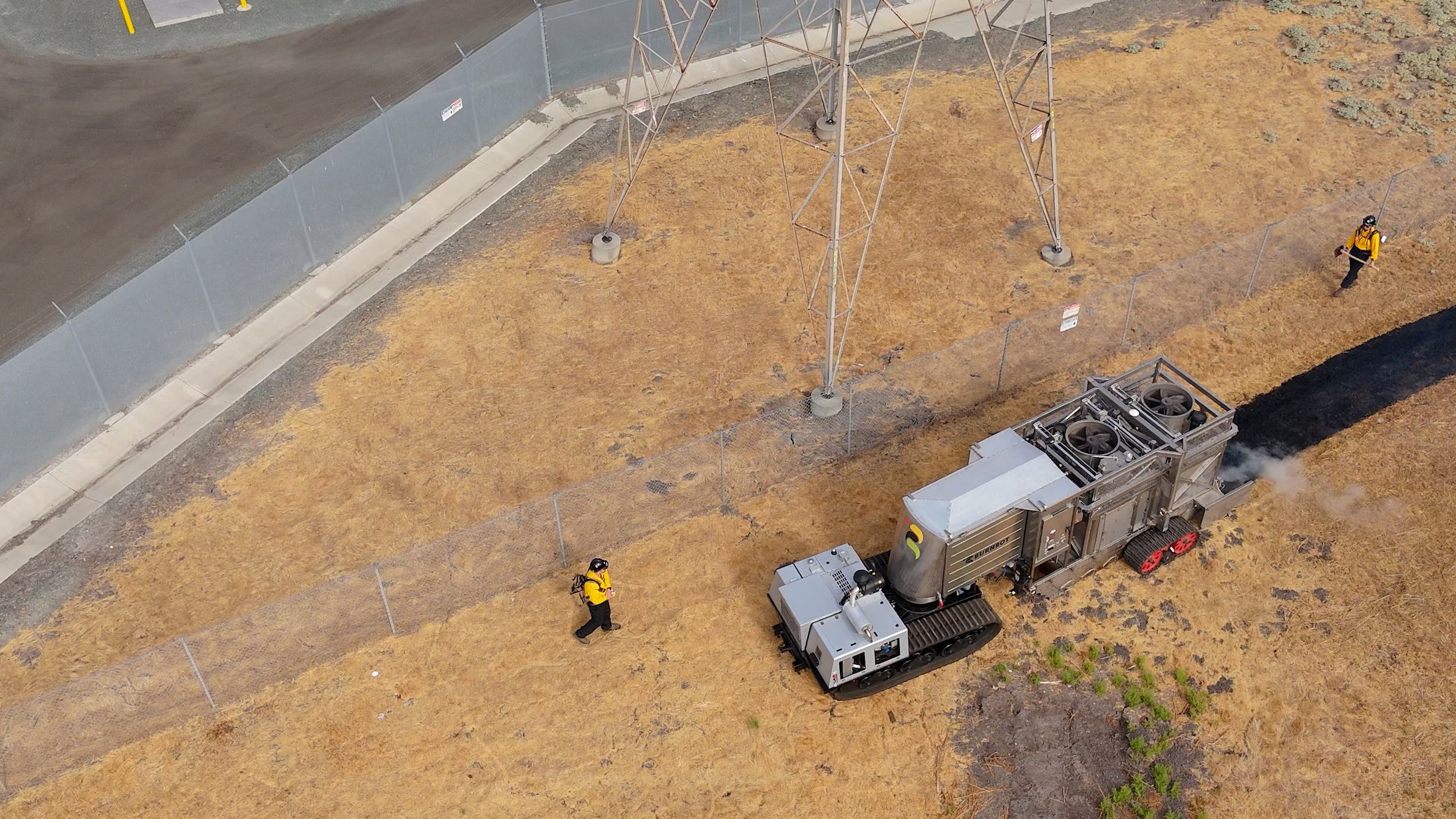
One promising innovation is BurnBot, a tele-operated remote-controlled masticator designed for vegetation management in fire-prone areas like Southern California. BurnBot's ability to conduct controlled burns and clear hazardous vegetation can help prevent catastrophic wildfires. By remotely operating the machinery, land managers can reduce fuel loads efficiently while minimizing risk to human workers, going where humans can’t and working year-round.
Water also plays a major role. Forests with higher soil moisture burn less readily, and healthy reservoirs are critical for fire-fighting. "65% of our developed water supply in California comes from snowpack in the Sierra, and it holds more than all the reservoirs in our state combined," says Knight. With an excess of smaller trees, less snow reaches the ground, further preventing snowpack. With snowpack already thinning due to climate change, forest management can again help ensure water security.
Several new tools are addressing the need for new forestry solutions:
Waterplan and Tova use hydrology data to improve water management
Cross-sector solutions like Blue Forest which reframe nature as critical infrastructure
And we’d be remiss if we didn’t include our favorite nature-based fire prevention workers, beavers. Without taking a dime in salary, beavers naturally create dams that in turn create wetlands that grow water tables, and slow the spread of fires. Some rewilding and reintroduction efforts have begun citing their fire-preventing benefits.

Not all fire prevention happens in the wildlands. A major component of wildfire mitigation is ensuring that when fires do occur, they don’t destroy entire towns. This means thinking strategically about how fire moves through a community, both from the surrounding landscape and from house to house.
For more on this, we spoke with Genny Biggs from the Moore Foundation, who leads their Wildfire Resilience Initiative.
“Fire is like rain,” Biggs quipped. “You don’t want too much, because you don’t want flooding. But you don’t want none.” Part of Moore’s work focuses on how we prepare communities before a fire hits, and lower the spread within communities once it eventually does.
This includes initiatives like fire pathways modeling, a concept pioneered by teams like Xyloplan, which helps identify where fires are most likely to enter a community. Strategically treating vegetation along these pathways (without needing massive firebreaks) is an example of how we can start to find solutions that lead to 80% of the impact for 10% of the cost.
Inside communities, the focus shifts to structure-to-structure ignition. Research from fire scientists like Michael Gallagher and Hussam Mahmoud has shown that small changes in home design and landscaping can have an outsized impact on whether a fire spreads through a neighborhood. Some of the highest-impact interventions for homeowners include:
Creating a Zone 0: Removing flammable vegetation and mulch from “zone zero” (0 to 5 feet from the home), which can act as kindling for embers.
Removing wooden fences: These can act like fuses, carrying fire from house to house.
Installing fine-gauge metal screens on vents: A simple, one-day project that prevents embers from entering attics.
Adding gutter guards: Dry leaves and debris in gutters are a prime ignition source.
Some initiatives working to prevent wildfire spread in communities:
WatchDuty provides real-time fire tracking by using crowdsourced data and official sources to provide immediate updates on fire locations, spread, and containment efforts.
Vibrant Planet uses advanced modeling and scenario planning, to help land managers, policymakers, and communities make informed decisions about fire mitigation
BurnPro 3D, a project out of UC San Diego, creates highly detailed 3D simulations, so fire managers can predict how prescribed fires will behave under specific conditions, allowing them to “steer” fire much like a cowboy herds cattle.
The biggest irony of wildfire management is that fire itself is one of our most powerful tools. Indigenous communities have long used cultural burning to manage landscapes, preventing the buildup of fuels that feed megafires. Practitioners like Ron W. Goode, Tribal Chairman of the North Fork Mono Tribe, are reviving these time-honored practices, while scholars like Dr. Melinda Adams are partnering with Northern California tribes to study these burns’ methods and ecological outcomes.
One thing is certain: we won’t stop all fires. Fire prevention, detection, and suppression each has its own suite of interventions, and Convective Capital is looking for solutions. Convective was founded in 2022 as the first VC fund dedicated to wildfires, and is on the front lines of fire tech.
Prevention
The best way to put out a megafire is to ensure it never is lit in the first place, but with over 100 million acres in California, that’s easier said than done. Past major wildfires have had origins as varied as lawnmower sparks, lightning strikes, someone driving with a flat tire, and a gender reveal party.
Fortunately, though, there’s low-hanging fruit. “In California, a lot of the extreme wildfires are caused by utilities. They only start 10% of fires, but around half of those get really bad,” says Jay Ribakove of Convective. Because of this, much of fire tech is based on how to help utilities prevent fire starts.
Companies like Overstory help utilities manage the vegetation by their power lines, preventing overgrowth from coming in contact with the lines. Overstory creates vegetation data by combining AI with remote sensing sources like satellite imagery and local information, and helps utilities build efficient, data-driven vegetation management programs.
Meanwhile, Gridware makes a sensor that listens to power lines to understand anomalies. When it detects an anomaly such as a tree-strike, it rapidly de-energizes the lines, pre-emptively shutting down that section of the grid to prevent a potential fire.
Detection
“We can minimize starts, but can’t prevent everything,” Ribakove told me. “There’s arson, lightning, barbecue, random spark from kids playing with rocks.” We’ll always have fires, and when we do, we need to know where they are, and respond rapidly.
The first and perhaps most critical intervention is early fire detection. The faster we can spot a fire, the greater the chance of keeping it small. The startup Pano addresses this challenge, using enhanced visual equipment and rapid data analysis supported by AI to identify smoke plumes and fires immediately in the field of view.
Several other startups like Dryad distributed sensors, Windborne weather balloons, and Um Gram E Meio are working on remote detection of fires.

Suppression
Responding to a raging fire is complex, with priorities shifting rapidly as a fire burns hotter or colder, as wind or weather conditions change, or as a fire approaches human communities.
“Once fires go from small to extreme wildfires, we can’t put them out very easily,” says Ribakove. “When people see heli-tankers with water or retardant, they think ‘that’s putting the fire out,’ but that’s really not true. It’s buying time for firefighters to go in and create firebreaks, and to do work to contain or redirect the fire.”
Startups like Rain are working to make autonomous flights for fire suppression a reality. But just as important are technologies to support firefighters and emergency response teams on the ground.
Another promising tool is Google’s FireSat, which provides near-real-time wildfire tracking at a global scale with high-resolution infrared imaging. FireSat can detect fires down to a single-acre resolution and update fire radiative power data every 15 minutes to help emergency responders understand how a fire is behaving in real time: where it’s burning hottest, where it’s spreading slowly, and where intervention is most needed.
With the potent combination of rapid climate change and a human-filled urban-wild landscape, some researchers have dubbed this geological era the Pyrocene: the era of fire. In California, many insurers have pulled out entirely, with others raising rates substantially. For some locations, homeowners’ insurance rates will soon eclipse mortgage rates, forcing new movements of people to either denser housing stock, or to less fire-prone regions.
And this era of fire is not confined to stereotypical hotspots. While Brazil, Australia, and Greece have experienced recent megafires, the combination of changing climate and human fire management has led to wildfires in Russia, Hawaii, and even NYC’s Prospect Park.
While people of privilege will be able to adapt and relocate, the worst of fire’s impacts will fall to the world’s most vulnerable. Beyond direct impacts, wildfires pollute through producing ash, smoke, and through aerosolizing toxic compounds from the built environment. Fire retardants used to put out megafires often come laden with PFAS, a “forever chemical” linked to cancers and lower fertility.
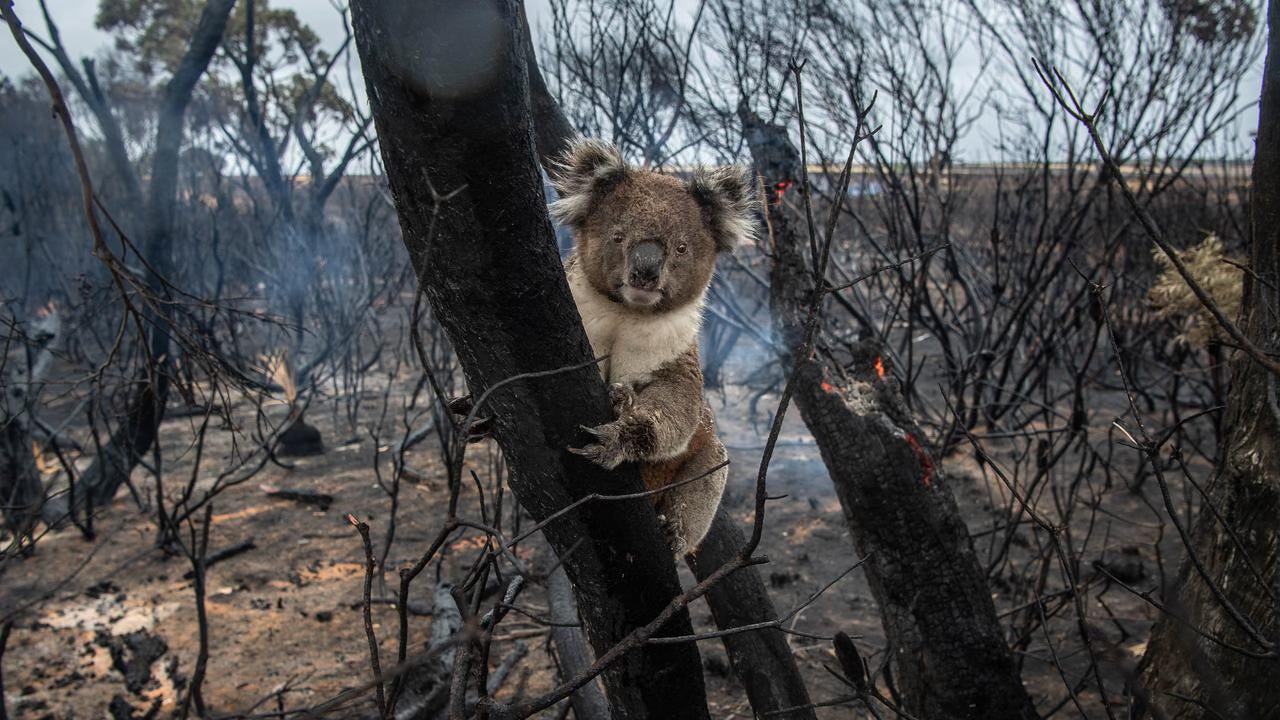
Of course, humans aren’t the only species impacted. Australia’s koalas were recently listed as endangered after 2019/2020 bush fires killed, injured or harmed 60,000 animals. Blazes have disrupted soil mycorrhizal networks, altered ecosystems, and even silenced birdsong.
Wildfires sit at a unique nexus between humans, climate, and nature. Managing them will be one the most difficult and important challenges of our modern era, as humanity has expanded into landscapes where fire will happen, particularly with climate change’s compounding effects.
“All this built-up biomass in forests, it’s gonna come off the landscape one way or another,” says Knight from Blue Forest. “That carbon is coming off the land either in a controlled way, or in a very uncontrolled way.” Maybe we can all take a page from the beavers’ book: embracing our role as ecosystem engineers would help us help nature, climate, and communities, all at once.
Did this post spark an idea? At Superorganism, we’re excited for firetech solutions that can use or benefit ecosystems as well as people. Reach out, and we’ll help you fan the flames.
Thanks to our friends at Blue Forest, Convective Capital, and the Moore Foundation for helping with this piece. Please reach out to support their work.
To support those affected by the LA wildfires, please find resources here.

Updates from our portfolio companies, and from us at Superorganism
🛰️ Array Labs has teamed up with Umbra and Raytheon to fast-track commercial launch of 3D data products collected from space. Read more.
🪵 Cambium is hiring for 6 open roles including VP of Engineering, Growth Marketing Specialist, and VP of Revenue. Check out the JDs here.
🌐 Cecil is onboarding new teams and rolling out access to Dynamic World. Mention Superorganism when you reach out for priority access to this dataset.
🍫 Planet A Foods is looking for a Head of Sales Europe. This month they produced the world’s first Dubai Bar with ChoViva, and dressed to the nines to be awarded the SG Pioneer Award. Congratulations Max and Sara!

🪴 Rosy Soil has a new Biochar Booster product for your plants, now available via their website or at Target. Grab some to make your plants happy!
🤫 A new stealth portfolio company teased their launch in the Wall Street Journal.
🪸 As for us at Superorganism in January, we…
Spoke and attended events on nature and biodiversity finance at Davos
Spoke at a Conservation International/XPrize-hosted event on biodiversity monitoring technologies
Want to join a Superorganism company? Check out our Jobs Board, with 48 active jobs currently available. Start your nature tech career today!
🛠️ Nature Tech
Colossal raises $200M to "de-extinct" the woolly mammoth, thylacine and dodo | VentureBeat
NatureMetrics secures $25m Series B funding to accelerate biodiversity monitoring technology solution | NatureMetrics
Oxyle raises $16M to lead the fight against "forever chemicals" contaminating our water. | Oxyle
Carbon project co-benefits for globally threatened Species | BeZero
William enjoys ‘best day’ spraying pond water at journalists | The Irish News
Can landscape regeneration be profitable? One of Australia's richest couples is trying to find out | ABC News
Database of 200+ ClimateTech events (Patrick Brown) | LinkedIn
🦧 Conservation
The full impact of Namibia's decade-long drought on its biodiversity | Faunas Biodiversity
Wreckreation and our national obsession to love wild places to death | Yellowstonian
California's monarch butterfly population plummets; fire wipes out Topanga habitat | LA Times
New database provides world’s most comprehensive data on river barriers and reservoirs | The Natural Capital Project
Siletz Tribe gets $1.56 million to reintroduce sea otters to coastal waters | KLCC
Deadly encounter: mountain lion attacks spark controversy | Yale E360
The Democratic Republic of Congo to create the Earth’s largest protected tropical forest reserve | World Economic Forum
Rare species discovered deep within Cambodian mountains | CNN
Kuno National Park to rewild cheetah cub in major conservation milestone | Deccan Chronicle
National Trust to restore nature across area bigger than Greater London | The Guardian
🌊 Oceans
An AI-powered robot and gaming are helping scientists identify new deep-sea species | Bloomberg
Coral bleaching has reached "catastrophic" levels on the Great Barrier Reef | Earth
Spanish fishers in Galicia report ‘catastrophic’ collapse in shellfish stocks | The Guardian
The ocean teems with networks of interconnected bacteria | Quanta Magazine
📜 US Policy
Green investors find a silver lining in Trump’s presidency | Bloomberg
Trump's halting of EPA limits on PFAS in drinking water "a tragic setback," Long Island environmentalist says | CBS New York
Trump revives California water wars as experts warn of turmoil | The Guardian
Donald Trump halts more than $300bn in US green infrastructure funding | FT
Trump moves to end federal environmental permitting tug-of-war | Bloomberg
Why does Trump hate this tiny fish so much? | Vox
Biden administration withdraws old-growth forest plan after getting pushback from industry and GOP | AP News
Biden establishes largest corridor of protected land by adding 2 new monuments | ABC News
🔬 Science
AI model creates new protein that simulates 500 million years of biological evolution | Earth
High prevalence of veterinary drugs in bird's nests | ScienceDirect
De novo designed proteins neutralize lethal snake venom toxins | Nature
Global surface temperatures are rising faster now than at any time in the past 485 million years | CleanTechnica
Scientists are tracking global wildlife’s contributions to humanity | Mongabay
Chipping in: biocompatible soft implants for animal tracking | Hackster.io
☁️ Climate
The world’s best hope to beat climate change is vanishing | Bloomberg
Climate tech funding fell 40% in 2024 as investors rushed to AI | Bloomberg
Climate change made LA 35% more primed to burn, scientists say | Bloomberg
UN Special Envoy Michael R. Bloomberg announces effort to ensure U.S. Honors Paris Agreement commitments | Bloomberg
Chart: 96 percent of new US power capacity was carbon-free in 2024 | Canary Media
'Make Carbon Dioxide Great Again' law would ban carbon reduction efforts in Wyoming | WyoFile
🏭 Industry and nature
Corporate commitments to nature have evolved since 2022 | McKinsey
Draft State of Nature Metrics for piloting | Nature Positive Initiative
It’s the most important name in sustainability. It’s battling for its survival. | WSJ
Which is worse for wildlife, wind farms or oil drilling? | BBC
Farmers’ discovery has major implications for all of America’s cornfields: 'It's wonderful to see' | The Cooldown
🤝 Friends of the fund
Unlocking climate tech capital for blue economy ventures | GreenMoney Journal
Scotland's missing lynx - Ben Goldsmith | Substack and Podcast
CXL is hiring! Managing director of Nucleic Acid Barcode Identification Tool | LinkedIn
We hit the temperature record. Now what? Reasons to (still) look forward to 2025 nature and climate action | Nature4Climate
How regenerative technologies help businesses and the planet | TIME
It would be a huge mistake for Labour to dam the beavers | The Spectator
The dodo bird is extinct. This scientist says she can bring it back. | Washington Post
Thanks for reading and for supporting Superorganism, and a special thank you to everyone who went above and beyond this month with introductions, diligence, advice, and help to founders:
Beth Axelrod, Hari Balasubramanian, Ashley Beckwith, Maddy Behr, Genny Biggs, Esben Brandi, Sarabeth Brockley, Patrick Brown, Teal Brown-Zimring, David Broz, Kat Bruce, Tim Coates, Vinicius Contieri, Helen Crowley, Joe Eliston, Andrew Farnsworth, Camila Ferraz, Steven Fox, Dan Gluesenkamp, Seema Gupta, Katie Hoffman, Taylor Holshouser, Will Jack, Jason Jay, Alivia Kaplan, Zach Knight, Kim Kolt, Daniel Kriozere, Aaron Leaman, Tony Lent, Mark Lewis, Michelle Li, Jay Lipman, Brock Mansfield, Jocelyn Matyas, David Meyers, Olivier Mougenot, Michael Neril, Sarah Nolet, Marthon Olsen, Reece Pacheco, Alex Prather, Sophie Purdom, Sathya Raghu, Tim Reed, Beth Shapiro, Jordan Soriot, Philipp Staudacher, Jonas Skattum Svegaarden, Ali Swanson, Amer Vohora, Tom Weller, Chris Wu, Daphne Yin.
Cover 📷: Mike Newbry
No posts
Comments
Nothing yet. Say the first thing.
Sign in to join the conversation.