
🪸 We’re Superorganism, the first VC for startups that benefit biodiversity. Each month we publish thoughts from the frontline, company updates, and a round-up of new happenings in the nature tech world.
The US federal drawdown has arrived, and we’re sharing a guide to the nature private sector in response.
Since January, the Trump administration has terminated over 20,000 probationary employees from the federal workforce. An additional ~75,000 federal employees accepted a “deferred resignation” program offering financial incentives to step down voluntarily by February.
All agencies have been asked to provide a Reduction In Force (RIF) plan by March 13, with an emphasis on deep cuts and “the maximum elimination of functions that are not statutorily mandated.” These could dwarf what we have seen so far, per Axios.
For nature, these cuts have been swift and deep, with impacts felt by:
The Fish & Wildlife Service - 420 employees, including those working on prescribed burns to prevent catastrophic wildfire
USAID - administrative leave for all 4,080 direct-hire staff and 1,600 further staff reductions for an agency directing over $350M per year to international conservation projects
National Parks Service - 1,000 employees, forcing staff to make tough tradeoff decisions on protecting park resources vs. visitor services
USDA - around 4,200 employees, including those responsible for seed banks and genetic repositories, and 3,400 from the Forest Service, raising the risk of wildfires
NOAA - 800 employees, one of the main government agencies responsible for providing climate, ocean, and weather data
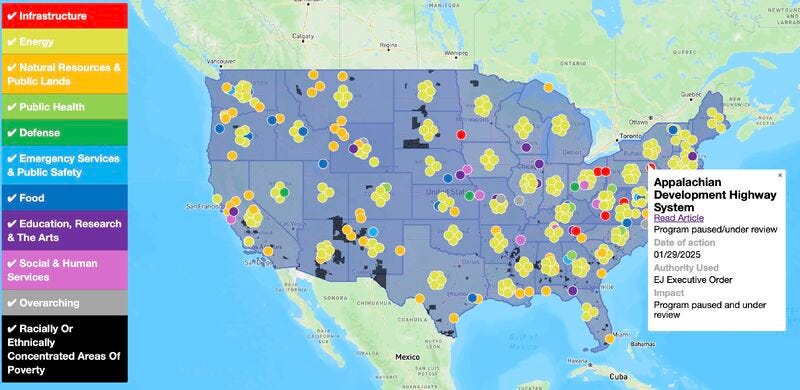
With a total of 2.4 million government employees (excluding military and postal service), this represents around a 3-4% reduction in workforce so far, with more cuts coming: the Environmental Protection Agency’s new head Lee Zeldin has suggested cuts could go as deep as 65% of staff, for example. What happens next for government employees, or the work they have been tasked with, remains uncertain. An impact tracker (going live later this week) is crowdsourcing the impacts these cuts have had to projects across the US.
Over the past few weeks, we have had several calls with former and current federal employees who are now considering a move to the private sector. However, many of them are facing a similar challenge: they don't know where to start.
To help ease this transition, this month, we put together a simple taxonomy for understanding where the private sector is increasingly intersecting with nature. While this list is far from comprehensive, our hope is it can give a good starting point for anyone trying to make sense of this emerging landscape. In each section, we’ve highlighted a few open roles to showcase a variety of what’s available.
If you are hiring, or have a list of resources you would like to share, please do so in the comments. And if you know someone impacted, please feel free to forward this month’s edition.
Nature tech startups are early-stage companies leveraging technology to benefit biodiversity. There are several ways that this can be defined, but we prefer a broad church: any use of tech to reduce the drivers of biodiversity loss, counts as nature tech. Typically these use new technologies to improve quality and speed, reduce costs, or provide new services to support nature and reduce overexploitation, land use change, pollution, climate change, and invasive species.
The startups are usually early stage and higher risk, but if your skills map to these startups’ needs, you can join on the ground floor of something that can grow rapidly, think big, and have real-world impact. Companies can be focused on materials, invasive species, foods, software, space tech, fintech, robots, and much, much more. As nature tech is fairly nascent, you can also look to climate tech for roles.
Most VC funds will host a jobs database for their portfolio companies. This can be a great place to find jobs in nature tech. Here’s ours, and you can check out the VC section below for other VCs with jobs boards.
Examples: Amini, Basecamp Research, Cambium, Cecil, Colossal, Foray, Funga, Inversa, NatureMetrics, Planet A Foods, Rosy Soil, Spoor, Sway, Ulysses
List: Nature Tech Memos has a public list of nature tech companies, as does the Nature Tech Collective and NatureTECH Observatory.
Jobs:
Sway - Channel Partner Manager
Cambium - VP of Sales
Cecil - Software Engineer
Colossal - Species Director, Head of Large Mammals
NatureMetrics - Account Manager, Conservation
Basecamp Research - Scientist, Gene Editing Technology
Terraspect - Multiple roles
Nature based solutions (NBS) are key mechanisms for the protection of nature. NBS can take several forms whether in ocean, freshwater, or land, including restoration, land management, and protection. One of the challenges of NBS is having a strong financial model to sustain them, which has driven new efforts across carbon, agroforestry, silvopasture, mixed use landscape such as timber, and more. Natural capital practitioners include organizations like project developers that are coordinating the strategy, as well as the on-the-ground staff and communities which are implementing the project itself. Some nature tech startups, such as Pachama, Funga, and Mombak, can also qualify as NBS practitioners.
Examples: Chestnut, Cultivo, Funga, Mombak, Pachama, Ponterra, Terrasos, Treeconomy
Jobs:
Oxygen Conservation - Visual Storyteller
Funga - Ecological Data Scientist
One of the most exciting trends from the past couple years has been the rise of large corporations assessing and managing their nature impacts. In many cases, these impacts happen in the supply chain, and increasingly large enterprises are working to address them. Initiatives like TNFD and regulatory pressures like EUDR and CSRD are motivating many, but critically, many see that nature risk could impact their core business models. 55% of the global economy is moderately or heavily reliant on nature, and businesses are beginning to understand that they must monitor nature in their value chain, or face disruption and major hits to their bottom line.
Beyond their direct business impacts, some businesses have made additional nature pledges, such as Apple’s Restore Fund, and the Symbiosis Coalition backed by Google, Meta, Microsoft, and Salesforce.
Examples: ABinBev, Equinor, Kering, NovoNordisk, Oji Holdings, Salesforce, Sumitomo
Lists: TNFD Adopters, Trellis jobs board
Jobs:
Novo Nordisk - Nature Restoration and Partnerships Lead
Hitachi Energy - Global biodiversity and climate resilience specialist
Cox Enterprises - Director Environmental Sustainability, Water and Biodiversity
This is a classic route for those transitioning into the private sector. Consulting can range from conducting environmental impact assessments, to helping prepare sustainability or compliance reports, to advising large companies on their nature strategies or impacts. Company types can range widely from big four consulting firms (McKinsey, BCG, and PwC all have dedicated nature teams, for example) to smaller specialty shops.
An open question will be how new federal cuts, and pressure to expedite environmental permitting reviews, will ultimately impact some of these businesses.
Examples: Biodiversify, Pollination, Tetra Tech, The Biodiversity Consultancy
List: Environmentanalyst’s Top 100 Environmental Consultancies list
Jobs:
The Biodiversity Consultancy - Strategic Director - Mining, Infrastructure and agriculture
McKinsey - Sourcing Strategist, Environment
Nature finance is all about channeling and managing capital towards nature. This could be done through existing markets like public markets, or it can be done through newer markets, like private natural capital investing. Some nature finance focuses on innovative new methods of creating financing for nature, such as debt for nature swaps, which allow a country to restructure their sovereign debt in exchange for reinvesting in their natural resources like marine protected areas. Other innovative finance mechanisms include payment for ecosystem services (PES) schemes, biodiversity credits, and nature-based carbon investing.
Many of the classic conservation NGOs have built innovative finance teams internally, as well. Groups like CI Ventures and NatureVest are two examples.
Examples: Blue Forest, Crossboundary, Clarmondial, Conservation Finance Alliance, Conservation Resources, EcoAdvisors, Ethic, Lyme Timber, NatureVest (TNC), Timberland Investment Group
Lists: Finance for Biodiversity members list, Symbiosis Coalition Funders List
Jobs:
Swedish Biocredit Alliance - CEO, Global Biocredit Standard (GBS)
Blue Forest - Sr. Manager of Development
Crossboundary - Multiple Roles
Inter-American Development Bank - Biodiversity and Natural Capital Unit Chief
Venture capital has entered a new era: investing to support biodiversity. While this could technically be thought of as a subset of nature finance, we think it deserves a call out (obviously we are biased!). Nature VC is dedicated to investing in early stage nature tech businesses. Typically, venture capital is looking for moon shots and “unicorns”: companies that are capable of achieving $1B valuation, or over $100 million in revenue per year, and eventually exiting via acquisition or going public. This type of funding isn't a fit for all businesses, but it can be a rapid accelerant to both business growth and biodiversity impact when it’s a good fit.
While we are one of the only venture funds dedicated entirely to biodiversity, there are quite a few other venture funds that invest in adjacent sectors, like oceans, climate tech, and regenerative ag. More on how we think about nature tech investing can be found here.
Caveat: these jobs are quite rare and therefore competitive. Do keep an eye out for roles when they pop up from firms that are investing in companies you admire, but don’t let that stop you. Many VCs trace their origins back to being founders or founding team (first 10-50 employees) at tech startups, to angel investing or advising startups on their own, or increasingly to being deeply plugged into a relevant startup community (e.g. AI, ag, or ahem, nature tech). Develop your expertise and start growing your network.
Examples: At One Ventures, Builders Vision, Cerulean VC, Just Climate, Pale Blue Dot, Planet A Ventures, Regen VC, Sand River, Superorganism, Systemiq Capital, TFT, Understorey Ventures, Wedgetail
List: Nature Tech Memos VC list
Jobs:
Superorganism - Head of Platform (more below!)
Regen VC - Chief of Staff
Voyager VC - Director of Finance and Operations
Planeteer Capital - Operations Lead
All these nature organizations need places to gather, and these groups focus on making that happen. Whether studios, accelerators, or networks, they bring together the nature tech community and help them be more than the sum of their parts. If nature tech startups are trees, these are the forests. These groups are largely focused around early stage companies and tech, and can also be focused on adjacent impact spaces like oceans, climate, or other.
Examples: Climate Vine, Conservation X Labs, Deep Science Ventures, Good Machine, Innovate 4 Nature, Marble, Nature4Climate, Nature Tech Collective, My Climate Journey, Schmidt Marine Technology Partners, 1000 Ocean Startups
List: Nature Tech Memos List of Accelerators
Jobs:
Adventure Scientists - Executive Director
Conservation X Labs - Multiple positions
Corporations working on nature internally have a unique set of needs and problems to solve. Bringing together these communities to learn from each other and provide a shared set of resources can lead to better benefits for all. Organizations in this segment focus on communal learning, producing whitepapers, driving policy, setting reporting standards, and spotlighting best practices.
Examples: Business For Nature, CDP, NatureFinance, Nature Positive Initiative, Taskforce on Nature-Related Financial Disclosures, Taskforce on Nature Markets, Science Based Targets
Jobs:
CDP - Multiple positions
Nature Finance - Program Administrator
This list is by no means exhaustive, and there are many other groups that we could have included: conservation organizations themselves, multilateral organizations like the UNEP, the World Bank, the GEF, and more. And that’s to say nothing of non-federal government opportunities: with the US federal government paring back their involvement, city, state, and international roles will take on new significance.
Rather than be comprehensive, we hope that we put some signposts in the ground to help job-seekers discern between different sectors.
As a firm that works to support biodiversity-positive startups, we have been fortunate to get to know several dedicated civil servants. A transition to the private sector won’t be right or viable for all, but for the private sector hiring now, this pool of talent runs deep. Hiring managers should not sleep on the opportunity to work with people who have dedicated their energy, skills, and time to making this country cleaner, better, and more beautiful.
For our part, after several years of running Superorganism, we are publishing our first-ever open role this week: a Head of Platform! This “ecosystem engineer” will help us to support and unlock the potential in our community of founders, mentors, conservationists and more. If you’re good with people, enjoy building and operating systems, can put on events, and are excited to help grow this nature tech ecosystem further, apply here by March 21. Know someone who would be a good fit? Please share the opportunity here.

Updates from our portfolio companies, and from us at Superorganism
🌳 Cambium announced its $18.5M Series A, accelerating their mission to divert wood waste, create circular alternatives to new timber, and plant new urban forests. Congratulations!
🌐 Cecil published The Hidden Power of Nature Data with MCJ Collective, as well as a case study with TransparenC.
🍫 Planet A Foods is hiring for multiple strategical important positions: Head of Sales Europe, Business Development Manager, Product Development Specialist (Fats & Oils), and Senior Research Scientist (Maillard Reaction & Flavor Chemistry).
🌰 Foray founder Ashley Beckwith ran a terrific TEDx talk on their plant cell line platform and tree seed fabrication.
🌿 Sway is hiring for a Channel Partner Manager! This full-time, senior-level role will oversee the entire partner lifecycle of Sway’s distributor network, from recruitment and onboarding to ongoing management and performance optimization.
💵 Terraspect is hiring for two Founding Engineers and a Founding BizOps team member. Check out the roles here.
🪸 As for us at Superorganism in February…
Held an annual team offsite
Spoke with students about nature tech investing at Stanford GSB and Wharton
Want to join a Superorganism company? Check out our Jobs Board, with 30 active jobs currently available. Start your nature tech career today!
💵 Nature Finance
COP16 nature summit agrees deal at 11th hour but critics say it is not enough | The Guardian
How insurance innovation could unlock billions for nature-based climate solutions | Reuters
Rewilding in wealthy nations could drive extinctions in species-rich regions, experts warn | University of Cambridge
Study says land restoration worldwide can be funded with tiny fraction of global GDP | Mongabay
Nature markets are nothing new — they are widespread, regulated and instructive | Nature
🦧 Conservation
Juvenile sea turtles don’t just drift—they swim | The Wildlife Society
The ‘Elegant’ Math Model That Could Help Rescue Coral Reefs | Quanta Magazine
Salmon seen in California's North Yuba River for first time in almost a century | SFGate
‘Absolutely concerning’: More CWD-killed elk found at second Wyoming feedground | WyoFile
Fish species thought to be extinct for 85 years rediscovered | ABC News
Britain has a new snake species – should climate change mean it is allowed to stay? | The Conversation
Despite Biotech Efforts to Revive Species, Extinction Is Still Forever | Yale E360
With Sea Ice Melting, Killer Whales Are Moving Into the Arctic | Yale E360
Headstarting program gives endangered amphibians, reptiles a boost | The Wildlife Society
California's monarch butterfly population plummets; fire wipes out Topanga habitat | LA Times
Hawaii Releases Millions of Mosquitos to Save Rare Honeycreeper from Extinction | Animals Around The Globe
🏔️ Land Use Change
The return of the buffalo is reviving portions of the ecosystem | Native Sun News Today
Global biodiversity loss from outsourced deforestation | Nature
Wreckreation And Our National Obsession To Love Wild Places To Death | Yellowstonian
How Seriously Should We Take the Sale of Federal Lands? Very Seriously, Experts Say | Outdoor Life
🌳 Climate and Nature
Plants losing appetite for carbon dioxide amid effects of warming climate | World news | The Guardian
The working capital playbook for climate startups | Sightline Climate
Birdlife soars on nature-friendly solar farms | University of Cambridge
🇺🇸 US Policy
Trump Quietly Plans To Liquidate Public Lands To Finance His Sovereign Wealth Fund | Center for American Progress
Most Voters in Eight Western States Support Conservation Over Oil and Gas Drilling on Public Lands: Poll | EcoWatch
Trump Killed a Major Report on Nature. They’re Trying to Publish It Anyway. | The New York Times
Trump spending freeze uproots urban tree-planting | E&E News by POLITICO
Across the world, conservation projects reel after abrupt US funding cuts | Mongabay
🐝 Ecosystem
Applications are now open for several environmentally focused accelerators:
March 24: Brainforest Venture Program
April 1: HatchBlue’s BlueCarbon+ Challenge
April 13 (with early applications encouraged): Clean Tech Open
🌾 Agriculture
Unmanned Crop Dusters Provide a New, Safer Way to Farm | Bloomberg
Pesticides have negative effects on non-target organisms | Nature Communications
Turning Farmland Back to Peatland: Can It Slow CO2 Emissions? | Yale E360
9% of England’s Farmland Needs to Be Converted Into Wildlife Habitats and Forests: UK Government Land Use Blueprint | EcoWatch
🔬 Science and Tech
Your Next Pet Could Be a Glowing Rabbit | WIRED
US wildfire suppressants rife with toxic heavy metals, study finds | The Guardian
Earth’s acid test: When did ocean acidity allow life to commence? | Yale News
Urban Heat: Can White Roofs Help Cool World's Warming Cities? | Yale E360
Thanks for reading and for supporting Superorganism, and a special thank you to everyone who went above and beyond this month with introductions, diligence, advice, and help to founders:
Leone Baron, Lyndsey Boucherle, Esben Brandi, Ed Casabian, Cheryl Dalrymple, Westley Dang, Adrian Dellecker, Carolina Echecopar, Simon Evill, Magnus Frohmann, Saloni Gupta, Quinn Harrison, Mark Lewis, Rafael Manyari, Iván Markman, Lauren Miller, Jahed Momand, Javier Monterroso, Reece Pacheco, Jonathan Palmer, Anton Pluschke, Chris Ramsay, Bailey Richardson, Rachel Rivera, Riley Rodgers, Matt Sechrest, Jeff Smith, Jordan Soriot, SerHan Tan, and Maynard Webb.
No posts
Comments
Nothing yet. Say the first thing.
Sign in to join the conversation.