
Samsung is known for being a consumer electronics company, but the stock is being re-rated for one reason: Memory is back. The stock is up 70% YTD and 287% in the last year. But here’s why I think they have more room to run:
Forget phones, Samsung is increasingly becoming a pure memory vehicle. In 2026, it is estimated that Memory will account for ~98% of TOTAL OPERATING PROFIT. Morgan Stanley estimates Samsung could generate $240.6B in operating profit in 2027.
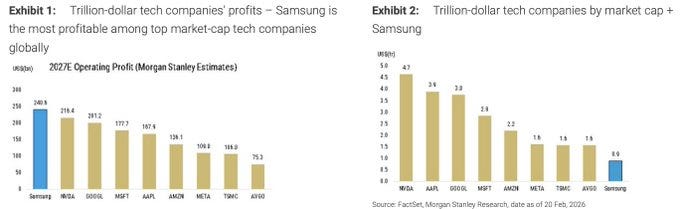
At those estimates, Samsung would rank as the most profitable company in the world by operating profit. That’s the scale of this cycle.
More bullish estimates coming from Macquarie last week estimated that Samsung would do $330.9B in Operating Profits, 37% higher then Morgan Stanley’s estimates.
So what’s happening inside memory that could justify numbers of this magnitude, and why is it happening right now?
As inference has scaled exponentially over the past months and years, memory capacity per system is compounding faster than almost any other component in the server stack.
Industry estimates say that global AI inference token volume has grown 5-10x year-over-year and some platforms also report of trillions of tokens used per day. This has increased memory requirements per query and contributed to persistent HBM and high-capacity DRAM shortages across data centers.
HBM production is limited by packaging bottlenecks and on the difficulty of stacking the memory chips efficiently. Regular DRAM supply is also tight because new factories take years to build, and more capacity is being shifted toward HBM from DRAM.
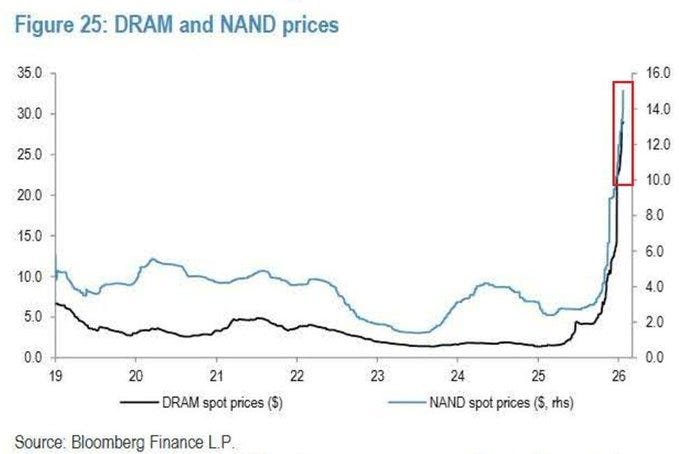
This imbalance gives Samsung, SK Hynix, and Micron meaningful pricing power as seen over the past few months. Even to the point now where contract negotiations are moving on a quarterly basis rather than long term fixed prices.
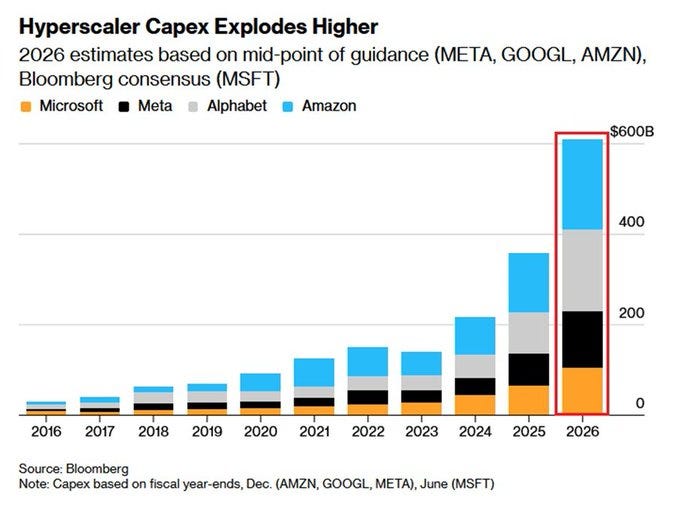
The Big4 (Amazon, Google, Microsoft, and Meta) are all stuck in the Prisoner’s Dilemma where if they don’t keep up the spend matching their competitors, they risk being left behind in the biggest technological revolution of our time. These companies have continued to say they are willing to pay more CapEx for every new generation of Nvidia chips (Blackwell, Vera Rubin, and now Feynman), each with a better form HBM in it.
Given this spend, UBS estimates that 1/3rd of the Mag7’s CapEx is going straight to the memory companies. This is DRASTIC and so for every future increase in CapEx, it allows us to understand where that money flows down to.
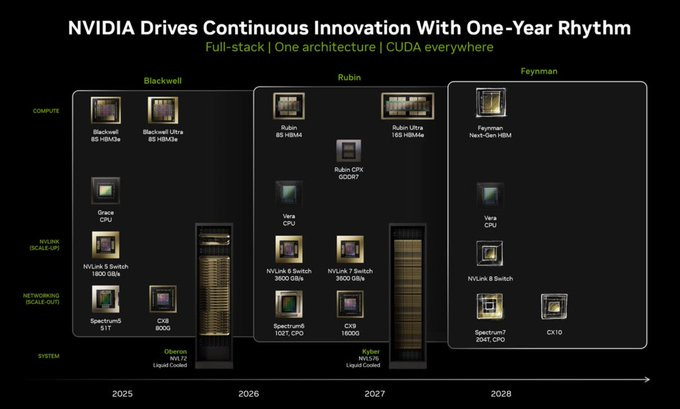
The move from NVIDIA’s GB200 (Grace Blackwell) to Rubin and eventually Rubin Ultra represents a major shift in rack design that significantly increases memory density. Total memory per AI rack is estimated to go from 30TB (Blackwell) to 75TB (Rubin) and then to over 360TB (Rubin Ultra), meaning each new generation requires far more installed DRAM capacity per system.
Breaking that down further. Estimates say that HBM per server will go from ~13TB to ~150TB and Conventional DRAM from ~17TB to ~215TB.
In other words, the bulk of incremental memory demand in AI infrastructure is coming from conventional DRAM capacity scaling, not just specialized HBM, which structurally benefits large-scale commodity DRAM suppliers like Samsung.
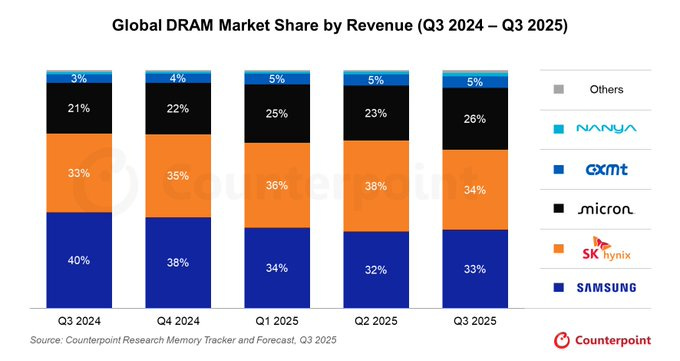
Also, Samsung and SK Hynix are near even in terms of DRAM market share by Revenue, so when AI servers need 5-10x more memory per rack, many of those extra memory chips come from Samsung and SK Hynix.
HBM gets the attention, but even estimates say that by 2027 over 80% of total DRAM bits will still be conventional DRAM. This is Samsung’s core strength, while SK Hynix is more concentrated in HBM.
And also, Samsung is expected to add the most DRAM capacity vs peers in 2026 and 2027 and set to gain by far the most market share YoY in 2026 in HBM4 as they lagged materially last year.
Reporting suggests that Samsung and SK Hynix are actively reallocating production away from lower-margin NAND and toward higher-value DRAM.
While Samsung holds the largest NAND market share, the incremental returns today are in DRAM and HBM, where supply remains constrained and pricing power is significantly stronger. Contract prices for DRAM and NAND are expected to rise in 1Q26 and 2Q26, with momentum continuing as bit supply growth lags AI-driven demand.
Macquarie noted that this dynamic also reinforces Samsung’s allocation strategy. Samsung looks to be prioritizing hyperscalers and AI infrastructure leaders while restricting supply to customers with elevated inventories. It overall lowers the risk of oversupply and helps sustain tighter pricing conditions across the cycle. This is the exact dynamic that historically collapsed memory pricing cycles in 2018-2019 and in 2021-2023.
A sidenote that tells a story about NAND demand from Apple: According to a semiconductor industry source, Samsung’s chip division pushed through aggressive memory price hikes, shifting to quarterly contracts to maximize margins. For Apple’s iPhone 17 LPDDR5X supply, Samsung reportedly opened negotiations with a 100% price increase expecting to settle around +60%, but Apple immediately accepted the full 100%, highlighting how tight memory supply is and how urgently OEMs are securing inventory.
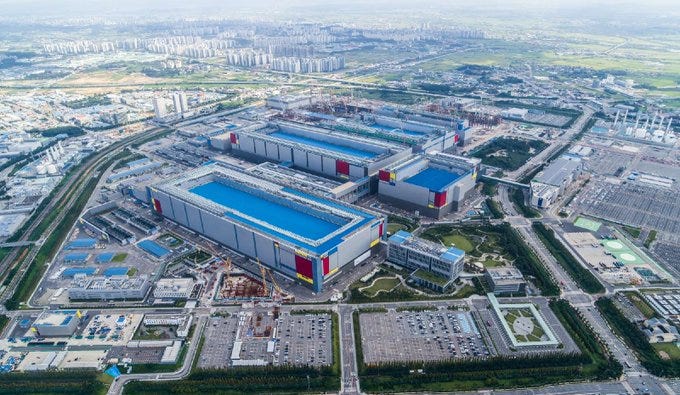
Samsung is adding more production: and it’s doing it at its massive Pyeongtaek semiconductor campus in South Korea, the home of its memory operations. Pyeongtaek is the largest semiconductor manufacturing complex in the world, designed as a multi-fab cluster that can scale advanced DRAM and HBM on leading-edge nodes.
P4 is already expanding there, and P5 is being completed more than six months ahead of schedule, now expected by Q3 2026 with full production running by late 2027. Compared to competitors, Samsung is projected to add the most new DRAM capacity in 2026 and 2027, positioning it to capture additional market share at a time when global memory supply remains tight and pricing power is strong.
Samsung is also reallocating capacity toward higher-value nodes. Reports indicate the company is shutting down legacy 2D NAND production at Hwaseong Line 12 (roughly 80,000–100,000 wafers per month) and converting it into 1c-node DRAM capacity aimed at next-generation HBM4 and server memory. Samsung is basically retiring lower-margin, legacy output to ease bottlenecks in advanced DRAM.
Even with this expansion, industry DRAM bit supply is unlikely to surge. New fabs require long lead times, and HBM production continues to crowd out conventional DRAM capacity. No meaningful supply will come online till according to most sellside analysts and industry sources till 2027/2028, meaning that high prices are likely to stay in the medium term.
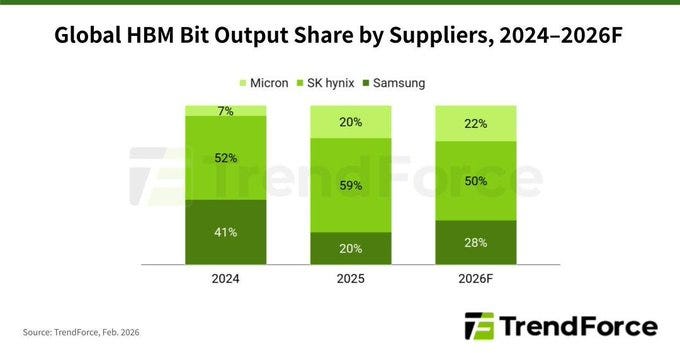
TrendForce expects Samsung’s share of total HBM bit output to rise from about 20% to 28% as the company ramps up wafers per month.
After falling behind last year at Nvidia, Samsung is projected to post the largest YoY gain in HBM4 share in 2026, supported also with reporting that Samsung was the first to ship HBM4 to Nvidia. Even small gains in HBM4 share are meaningful because these products carry significantly higher average selling prices than past memory cycles.
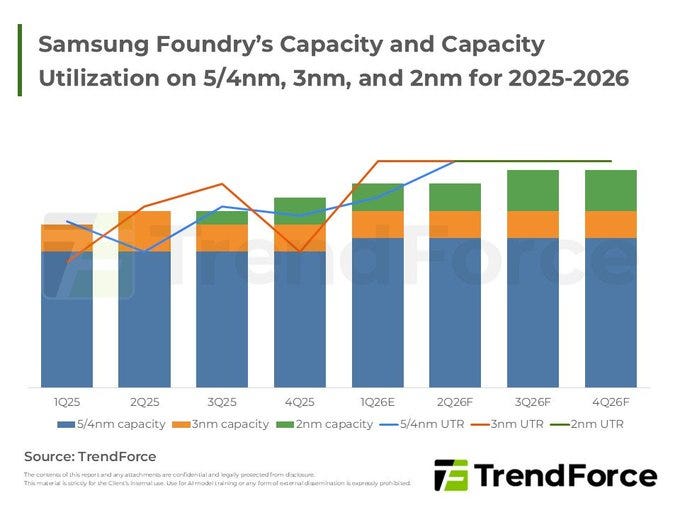
Utilization simply means how much of a chip factory’s capacity is actually being used. When factories are running closer to full capacity, companies spread their costs over more chips and make more money.
Last year, Samsung’s foundry business struggled with low yields (~50%) and poor utilization. Reporting from earlier this week said that Foundry utilization exceeded 80% in Q1’26 across 4nm, 5nm, and 7nm nodes in its P2 and P3 foundry production.
That is the highest level in over a year. This is the easiest way to gain market share and improve margins with that level of utilization.
This is where the thesis gets very interesting. Despite all of these catalysts I discussed earlier.
Samsung is trading at ~4.5x ex-cash 2026 EPS based on Macquarie’s earnings estimates. Macquarie’s estimates are one of the highest on the street, even at the midpoint of sellside estimates, you’re looking at a ~6-7x ex-cash 2026 EPS.
The stock is currently trading at roughly 6x forward earnings, compared to its five-year average forward P/E of approximately 12x. As of now, the ratio is near its -1 standard deviation and at the low end of its historical range.
Also, Samsung’s ‘26/’27 P/B stands at roughly a 40% discount to Micron.
Sellside Firms also agree with 93% of analysts rating the stock as a buy and noticeable higher then the current share price:
Macquarie (2/26/26): 340,000 Won Target
SK Securities (2/24/26): 300,000 Won Target
Nomura (2/25/26): 290,000 Won Target
Citi (2/24/26): 280,000 Won Target
The market is basically telling us that they believe this cycle is cyclical while the memory prices and commentary are largely saying the opposite.
All three major memory manufacturers are well positioned to benefit from this cycle. SK Hynix is expected to be a leading HBM4 supplier for Rubin, while Micron benefits from its U.S.-based footprint and a domestic premium. Rather than viewing this as a single-company call, I see strength across the group. Though I’m of the belief that South Korean players may see a larger valuation re-rating as the broader Korean semiconductor ecosystem and equity market benefit from the upcycle.
The key point is that this is not a zero-sum environment. Memory demand is expanding so fast that the total addressable market is growing much faster than individual share shifts. Even if market share is stable, absolute revenue and profits can rise a lot more because the pie got bigger.
AI spending could slow down suddenly on a headline. If hyperscalers reduce AI capex after the recent surge, memory demand growth would moderate.
Delays in data center buildouts due to power or supply chain constraints. If projects are delayed, memory orders could shift out rather than disappear.
Samsung could fall behind in next-gen HBM (HBM4) with shipping delays or technological delays. If competitors like SK Hynix maintain a lead in yield or customer adoption, Samsung could lose share in the highest-margin AI memory segment.
Weak execution in foundry. If yields or utilization in foundry remain inconsistent, margin recovery would slow down.
Market continues to think that this cycle is cyclical, not giving memory companies a deserving premium on earnings
Memory is back. But there is still more to go. Memory demand is scaling exponentially per AI rack, Conventional DRAM is seeing massive incremental bit demand, Pricing is inflecting sharply higher, Capacity additions are not expected till late 2027 into 2028 and the Valuation is bouncing off of historical trough multiples.
RAM and NAND contract prices are expected to rise roughly 100% QoQ in 1Q26, with momentum continuing amid supply shortages while there was reporting on Friday 2/27 that Samsung and SK Hynix informed their customers of plans to significantly raise DRAM prices again in Q2.
This dynamic creates a Demand compounding flywheel that will benefit the whole memory pipeline.
I believe that the recent price action is largely due to Korea being heavily exposed to LNG, the country in general having an influx of leverage being hit, the memory trade having a breather, and US investors FOMOing in.
However, nothing structurally has changed with these memory companies and I think that they will continue to ride higher. The fall in Samsung from 222,000 KRW to 172,200 KRW lowers the forward multiple and also gives the trade a healthy breather.
I think we continue to go higher and I personally added on this dip. Very excited for Mu earnings and GTC Conference in 2 weeks time. Those events will be a big indicator of where this trade goes in the near term.
Thanks again for reading!
No posts
Comments
Nothing yet. Say the first thing.
Sign in to join the conversation.