
Most organizational charts are read as snapshots. They show who reports to whom, how departments are grouped, and where authority is supposed to sit. They offer a district on one page, reduced to boxes and lines. That is useful, but it is also incomplete.
An organizational chart is not simply a picture of the district as it exists today. It is a forecast.
Every box represents an assumption about the future: how many students will arrive, how much revenue will be available, what work the district will be expected to perform, and which responsibilities matter enough to own a title, a reporting line, and a salary. A district builds its structure around those assumptions, but the structure often remains in place long after the assumptions have changed.
This summer made that visible. Austin ISD approved more than $200 million in reductions after its estimate of the current-year deficit grew from approximately $19 million to $95 million, nearly five times the amount projected when the budget was adopted. Chicago Public Schools announced hundreds of layoffs and five furlough days against a projected deficit of more than $730 million. Across several states, districts approved school closures and consolidations as enrollment continued to decline. At the same time, new laws assigned districts artificial intelligence responsibilities that do not appear on many existing organizational charts, including designated leadership, evaluation processes, disclosures, and parent opt-out procedures.
Read separately, these developments appear to be different stories. One is about budgets. Another is about enrollment. Another is about technology and compliance. Read together, however, they describe the same underlying event: organizational structures built around one set of conditions are being forced to operate under another.
The assumptions moved. The structure did not move with them until a deficit, a mandate, or an enrollment loss forced the issue.
The broad pressures facing districts are not difficult to see. Enrollment is declining in many communities. Revenue is becoming less predictable. New mandates are arriving faster than districts can absorb them. Technology is creating responsibilities that cut across academics, finance, human resources, communications, legal compliance, and information systems.
The difficulty is not recognizing that change is occurring. The difficulty is how organizations tend to respond to it.
Most districts patch. A new responsibility appears, so someone is named coordinator. A grant becomes available, so a position is created around it. Enrollment falls, so a vacancy is held open in the hope that the savings will be enough. A department takes on additional duties, but its authority, staffing, and reporting relationships remain largely unchanged.
Each decision may be reasonable in isolation. The problem appears when those decisions accumulate over time. What begins as a series of practical responses eventually becomes a structure that no one intentionally designed. The organizational chart starts to reflect old programs, temporary funding, inherited reporting relationships, and responsibilities that settled wherever someone was willing to carry them.
Patching feels safer than redesigning because each individual adjustment is small. It avoids the disruption and political difficulty associated with a larger structural conversation. Yet the apparent safety comes at a cost. Over time, the structure drifts farther away from the work it is expected to perform, and the distance between the two often remains hidden until it becomes expensive to close.
By then, the district is no longer deciding from a position of balance. The deficit determines which vacancies remain frozen. A compliance deadline determines where responsibility is placed. A state intervention or depleted reserve narrows the available choices. The district is still making decisions, but it is making them inside boundaries that someone or something else has already established.
In the organizational reviews we conduct at LEAN Frog, the most common finding is not simply that a district is overstaffed or understaffed. It is that the structure is answering a question the district stopped asking years ago. The chart may be a thoughtful answer, but it is an answer to conditions that no longer exist.
Redesigning organizational structure is not the same as conducting an annual layoff exercise, nor is it an effort to make the chart look cleaner. It is the discipline of matching the structure to the district’s forecast on purpose and revisiting it when the forecast changes.
That begins by sizing the structure to the work rather than to its history. Staffing created for a larger student population does not automatically shrink when enrollment declines. In most districts, the old structure remains in place until the financial pressure becomes too large to ignore. When reductions finally occur, they are often made quickly and position by position, without enough time to determine which work has disappeared, which work has moved, and which work has actually increased.
The better question is not simply whether the district has too many or too few employees. The better question is whether the current structure matches the students, responsibilities, service expectations, and risks the district now has and can reasonably expect to have.
That distinction matters because structural imbalance runs in both directions. Some functions may still be staffed for a district that no longer exists. Other functions may be overwhelmed because the work expanded while the organizational chart remained fixed. A sound review does not begin with a predetermined conclusion about headcount. It begins with the work and follows the work back to ownership, authority, capacity, and cost.
The same principle applies to new mandates. Cross-functional responsibilities are arriving faster than most traditional structures can absorb them. Artificial intelligence governance, student-data privacy, cybersecurity, immigration-access procedures, grant sustainability, and public-records compliance rarely fit neatly inside one existing department. Each touches several functions, and each creates the temptation to solve the problem by adding another coordinator.
Sometimes a new position is necessary. More often, the first requirement is not a new box but a clearer decision about ownership. Who has the authority to act? Who is accountable for implementation? Which departments must be consulted? Who communicates the decision, monitors compliance, and reports back to leadership?
Headcount may eventually be part of the answer, but it should not be the first answer. A district that creates a coordinator every time a new responsibility appears may eventually have more positions without having greater clarity. The work has been assigned, but authority remains fragmented and accountability remains difficult to locate.
A structure must also be strongest where the district’s assumptions are weakest. If the least reliable number in the organization is the multi-year financial projection, the solution is not merely to demand a better spreadsheet. Repeated and material forecast misses may point to a larger capability problem involving how assumptions are developed, challenged, updated, and communicated.
Forecasting does not belong to finance alone. Enrollment affects revenue and staffing. Human resources affects vacancy assumptions and salary projections. Facilities affects fixed costs and long-term capacity. Academics affects program commitments. Legislative decisions can change the entire picture after the district has built its plan. If those functions are operating from different assumptions, the district does not have one forecast. It has several disconnected versions of the future.
Structural investment may mean additional analytical capacity in the business office. It may mean assigning clearer ownership of enrollment forecasting. It may mean creating a regular process through which finance, human resources, academics, facilities, and executive leadership test the same assumptions together. The purpose is not to blame the office that produces the number. It is to build a structure capable of challenging the number before the district must live with it.
Structure is how an organization determines which of its own judgments it can trust.
There is a significant difference between closing or consolidating a school because the district planned for a sustained enrollment decline and doing so because a financial crisis has removed every other option. The same is true of staffing, departmental consolidation, and changes in reporting relationships.
When structural work begins early, leaders can sequence the change. They can decide which responsibilities need to move, which positions can change through attrition, and which transitions require additional capacity. They can explain the underlying conditions to the board and community before the decision becomes urgent. They can separate positions from people long enough to have a thoughtful conversation about the work.
When the same work begins under an immediate deficit, the district loses much of that freedom. The calendar shortens. The available options narrow. The need to produce savings begins to outrun the ability to redesign thoughtfully. The deficit starts holding the pen.
The eventual structural changes may look similar in both cases, but the process and consequences will be different. One is a deliberate adjustment to changing conditions. The other is a reaction to conditions that were allowed to make the decision.
Foresight does not eliminate difficult choices. It preserves the ability to make them while there is still room to choose.
One reason organizational structures drift is that districts regularly review the budget assumptions beneath them but rarely review the structural assumptions built into them.
Budgets are compared with actual revenue and expenditures every year. Enrollment projections are updated. Facilities plans are revised. Strategic priorities change. Yet an organizational chart may remain substantially untouched for five or ten years, even as the work around it shifts.
The structure should be placed on a recurring review cycle. At least once each year, leadership should identify the assumptions the current organization makes about enrollment, funding, workload, technology, compliance, service expectations, and leadership capacity. Those assumptions should then be compared with what is actually happening.
Where the two have separated, the district has found its redesign agenda.
The purpose is not to reorganize every year. Constant reorganization can produce its own version of chaos. The purpose is to prevent the structure from becoming invisible simply because everyone has grown accustomed to it. An org chart should not change every time the forecast moves, but the district should be able to explain why the structure still fits.
In Ahead of the Curve, I describe foresight as the practice of watching closely, reading the signs, and acting while there is still room to act. Structure is where that practice either becomes operational or remains theoretical.
A district can understand its demographic outlook and still be surprised by the consequences of declining enrollment. It can understand its financial exposure and still carry a staffing structure the forecast cannot support. It can recognize the significance of artificial intelligence and still leave responsibility scattered among technology, academics, legal counsel, and individual schools.
The insight may be correct. The presentation may be compelling. The warning may even be delivered early. But if none of it reaches the organizational structure, the district continues operating on the old assumptions.
Foresight that does not eventually change structure is informed worry.
The three system states I use in the book apply here. A structure built around assumptions that no longer hold, but left unchanged, moves toward stagnation. It keeps doing what it was designed to do even though that work no longer matches the environment. A structure torn apart reactively during a fiscal crisis, takeover, or sudden mandate moves toward chaos. Roles shift quickly, authority becomes unclear, and short-term survival replaces long-term design.
Balance is the third option, but balance should not be confused with stillness. A balanced system adjusts as conditions change without abandoning its purpose or losing its ability to function. The organization is neither frozen in the past nor thrashing in response to the latest pressure. It revises itself deliberately.
Most districts sit closer to stagnation or chaos than they would like to admit because the middle ground requires acting before anything forces the action.
A district does not need to announce a reorganization to begin this work. It needs an honest conversation about the forecast embedded in the current structure.
Place the organizational chart on the table and ask the cabinet to identify the assumptions beneath it. How many students does this structure expect the district to serve? What level of funding does it assume will continue? What workload is attached to each department? Which responsibilities are important enough to have a clear owner, and which responsibilities are currently being carried informally across several offices?
Then compare those assumptions with the district’s actual forecast. The discussion can be organized around four questions:
What did we assume when this structure was created?
What is true now, or likely to become true within the planning horizon?
What gap has developed between the structure and the work?
Who owns the decision to close that gap?
A simple working table can help the cabinet move from broad observations to specific decisions:
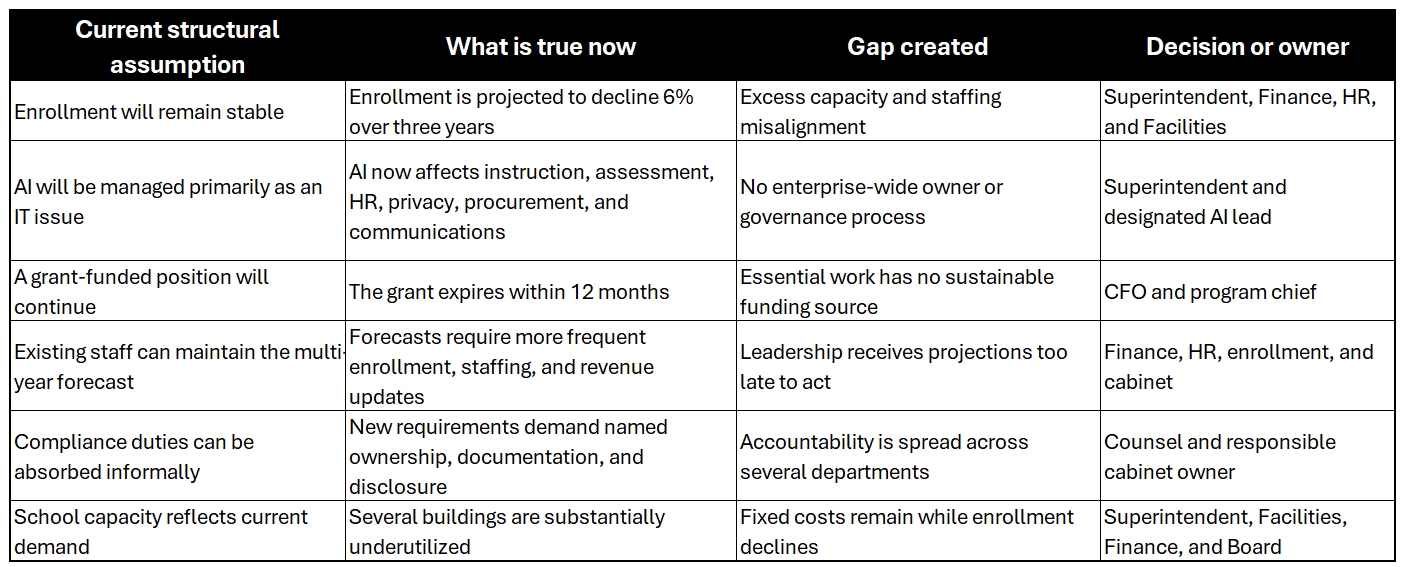
A district might discover that its structure assumes stable enrollment while projections show a six-percent decline over three years. It may find that artificial intelligence is still treated as an information-technology issue even though it now affects instruction, assessment, human resources, privacy, procurement, and communications. It may find that an essential service is supported by a grant that expires within twelve months, or that the multi-year financial forecast depends on information that finance, enrollment, and human resources update on different schedules.
The gaps will not all require new positions or eliminated positions. Some may require clearer authority. Others may require a process change, better analytical capacity, or a different reporting relationship. Some may expose work the district no longer needs to perform in the same way. Others may reveal important work that has no true owner.
The point is not to begin by asking which boxes should disappear. The point is to determine which assumptions are no longer true. Those gaps become the redesign agenda.
Share The Superintendent’s Field Guide
Most districts do not have an organizational-chart problem because someone designed the wrong structure. They have one because the structure was designed for a set of conditions that slowly disappeared.
That is an important distinction. It means the work is not about blaming the people who built the chart or assuming that every longstanding position is unnecessary. It is about being honest enough to recognize when yesterday’s logic is no longer a reliable guide for tomorrow’s work.
The difficult part is that redesign almost always feels premature until it suddenly feels overdue. When enrollment is only beginning to decline, when a grant still has another year, or when a new responsibility is being carried informally, it is easy to postpone the conversation. There is always another budget cycle, another vacancy, or another temporary solution.
Then the forecast catches up.
At that point, what could have been a design decision becomes a reduction decision. The district is no longer asking what structure it needs. It is asking what it can cut before the next board meeting.
My 2 cents is simple: do not wait for the deficit to authorize the conversation. The best time to redesign an organization is while leaders still have enough room to protect the work that matters, sequence the change, and explain why it is necessary.
That is not restructuring for the sake of restructuring. It is foresight made visible.
Take the current organizational chart and write down the forecast it assumes. Identify the students it expects, the revenue it counts on, the workload it assigns, and the responsibilities it considers important enough to own. Then identify the work it has left unowned, the temporary funding it has begun to treat as permanent, and the risks being managed informally because the structure has not caught up.
Set that assumed future next to the district’s real one.
Some of the gaps will be roles built around students or programs that are no longer present. Some will be new responsibilities without clear ownership. Some will be critical work supported by money that will not continue. Some will be forecasts the current structure cannot produce with enough reliability to guide decisions.
None of those gaps will correct themselves. All of them will be less expensive to address while the district still controls the calendar.
The org chart is a forecast. This year, more of those forecasts came due at once than usual. The districts that remain steady will not necessarily be the ones with the most certainty, because there is not much certainty available.
They will be the ones that chose to redesign on purpose, before certainty arrived to decide for them.
Comments
Nothing yet. Say the first thing.
Sign in to join the conversation.