
Across the country, many school boards have already adopted their fiscal year 2027 budgets. Others are finishing the last votes. Either way, the document may be final while several assumptions underneath it are not. A House proposal could claw back professional-development money districts expected this fall. A state reserve can look healthy while leaning on payments pushed into the future. An enrollment forecast can change as school-choice capacity expands.
The vote may be over. The numbers under it are still in pencil.
That is this cycle in one image. Forces became visible in early June, converged later that month, and then arrived as letters with dollar figures and statutes with effective dates. Now they have reached the numbers and rules underneath adopted budgets and fall operating plans. Several are still moving, and some are moving in opposite directions.
None of this is on fire. The useful posture is not alarm. It is recognizing that instability has recurred long enough to become an operating condition. The work is planning inside it rather than waiting for it to settle.
So the question this cycle is a sorting exercise. For every number and rule underneath the adopted budget and fall plan: Is it final, still moving, or being decided somewhere else after the board voted? And does the plan hold if it lands differently than assumed?
Congress enacted full-year fiscal year 2026 education funding in February. The new uncertainty is fiscal year 2027. On July 17, House appropriators introduced a continuing resolution that, if enacted, would keep federal agencies operating at current levels through December 4 while Congress continues work on full-year funding.
For districts, the most immediate exposure is separate from the stopgap. The House education bill would rescind about $1.6 billion in Title II-A money already appropriated and scheduled to reach districts in October 2026. For funding that would generally reach districts in the 2027-28 school year, the bill would cut Title I by about 10 percent, or $1.89 billion, eliminate the $2.2 billion Title II-A program, and eliminate roughly $890 million in Title III English-language acquisition grants. IDEA state grants would rise modestly.
The Senate has not advanced its version, so none of this is settled. But districts are facing two different planning windows: money expected this fall and formula funding for the following school year. The obligation to train staff and serve English learners remains even if the funding stream changes.
Operator’s Read: Treat the expected October Title II-A payment and the 2027-28 Title I, II, and III funding levels as separate risks - and treat both as in motion.
Operating Move: The CFO and federal programs director should model a fall 2026 Title II-A rescission and a second scenario for 2027-28 formula reductions. Tell the board clearly that these are House proposals, not enacted funding levels.
On July 7, the U.S. Department of Education approved Arkansas for a Returning Education to the States waiver, the fifth state to receive one after Iowa, Louisiana, Indiana, and Vermont. Arkansas may consolidate more than $8.8 million over four years from state-level activities funds in Title II-A, Title III-A, Title IV-A, and Title IV-B.
This is an important distinction: the waiver does not simply turn every district subgrant into a flexible state pot. It changes how the state may combine and direct the portions it retains for state activities. Arkansas also became the twenty-first state with Ed-Flex authority, which can allow the state to waive selected federal requirements for districts.
The direction is the signal. Louisiana can consolidate more than $18 million through 2029 and Vermont more than $4 million. States with different political profiles are using the same mechanism, suggesting the model may continue to spread.
Operator’s Read: The same federal program can become more flexible at the state level while remaining restricted at the district level.
Operating Move: The superintendent and federal programs director should watch whether the state applies, identify which state-run grants and supports could change, and avoid assuming the waiver automatically frees local formula allocations.
On July 10, a coalition of fifteen states sued the U.S. Department of Education and sought a preliminary injunction over a new effort to end school mental-health grants funded under the Bipartisan Safer Communities Act. The states argue that the department relabeled a cancellation previously blocked by a court, using a different regulation to reach the same result.
California put its exposure at nearly $200 million. Nationally, the programs were designed to add 14,000 mental-health professionals in high-need schools; first-year grantees reported serving nearly 775,000 students. The latest dispute is early, and the injunction timing may matter more to fall staffing than the eventual merits.
For a cabinet, this is money that appeared protected and is unsettled again just as districts decide whether to retain the people it supports.
Operator’s Read: Hold grant-funded mental-health positions as in motion until the court clarifies whether the latest termination effort can proceed.
Operating Move: The CFO, HR, and student services chiefs should identify every counselor, psychologist, and social-worker position tied to these grants and set a bridge-funding or hold decision date before fall staffing is locked.
Oregon House Bill 4079 directs school boards to adopt policies governing how districts respond when federal immigration authorities enter school property. The law takes effect September 30, 2026, which means the policy and operating procedures need to be ready by then.
The practical work goes beyond adopting language. Districts need a designated response chain, a process for reviewing warrants, clear limits on access to nonpublic areas, family-notification procedures, and an inventory of student information held by third-party technology providers.
For districts outside Oregon, this is still a useful template. The same operational questions will surface wherever state law, federal enforcement, student privacy, and building access meet.
Operator’s Read: For Oregon, this is a September implementation deadline; elsewhere, it is a protocol worth building before a local incident forces the issue.
Operating Move: Counsel and operations should assign primary and backup contacts, build a warrant-verification checklist, test family communications, and confirm what student records vendors hold and could be required to produce.
Chicago Public Schools eliminated 162 central and citywide positions for about $18 million in savings while working to close a $732 million deficit. The reductions matter, but they barely touch the size of the hole.
Austin is the sharper forecast warning. Its projected current-year deficit rose from about $19 million when the budget was adopted to $95 million - five times the original figure. The district then approved about $205 million in reductions affecting more than 500 positions, with reserves expected to fall to roughly half the level historically targeted by the district.
Richmond, Virginia, shows the same exposure from the state side. The district budgeted roughly $20.1 million from a House funding proposal and received about $11.2 million in the final state budget, leaving an $8.9 million gap. The through line is not simply that districts are cutting. It is that the planning assumptions are moving after adoption.
Operator’s Read: Treat the multi-year forecast as a claim to test, not a number to trust.
Operating Move: The CFO should stress-test fiscal year 2027 against conservative enrollment, attendance, property-value, and state-revenue cases and present the board with a range rather than one point estimate.
Pennsylvania enacted a $50.8 billion budget with more than $900 million in new education spending, including $565 million aimed at underfunded and high-tax-burden school systems. The education dollars are real.
The reserve story is softer. To keep the rainy-day fund intact, the state delayed two monthly Medicaid managed-care payments of roughly $1.3 billion each - about $2.6 billion shifted into a later period - while also drawing on special funds and unused agency balances.
The transferable lesson is not about Pennsylvania politics. A state budget can be legally balanced and still depend on timing decisions that make the cushion look stronger than the underlying cash flow.
Operator’s Read: A funded state number can still sit on a softer reserve if the cushion depends on delayed obligations rather than recurring revenue.
Operating Move: Pennsylvania CFOs should treat enacted school aid as real but avoid assuming the same timing maneuver is repeatable. Other districts should ask whether their state reserve is cash, recurring revenue, or a deferral.
Parents in California sued the Sunnyvale School District on June 22 after the district initially accommodated requests to avoid certain lessons and later reversed course. The allegations are the plaintiffs’ account in a newly filed complaint; the district has not yet had the case tested on the merits.
What makes the case worth watching is the operational question left after the Supreme Court’s 2025 Mahmoud decision: What must a real religious opt-out look like in daily practice? Notice, alternative instruction, staff guidance, and a reliable request process are the points most likely to expose the gap between policy language and implementation.
For most districts, this is not litigation to join. It is a prompt to test whether the local policy actually functions before a family discovers that it does not.
Operator’s Read: Treat a post-Mahmoud opt-out as an operating process, not a paragraph in policy.
Operating Move: Counsel and the academics chief should test notice, alternatives, recordkeeping, and staff instructions, while making clear that local legal advice governs how the Supreme Court decision applies.
A peer-reviewed cross-sectional study used complete data from 815 students across twenty secondary schools in England. It found minimal differences in student mental health and wellbeing between schools with restrictive and permissive phone policies.
The researchers estimated that restrictive schools cost about 94 pounds less per pupil to administer, largely through staff time, but the confidence interval included no savings. Because the design was observational and the data are English, it does not prove that a ban caused either the cost difference or the health result.
That still matters for districts launching bell-to-bell policies. Focus, fewer classroom disruptions, and clearer behavior expectations are defensible promises. A guaranteed mental-health improvement is not.
Operator’s Read: Do not sell a phone restriction on a mental-health outcome this evidence does not establish.
Operating Move: The superintendent and communications lead should define the policy’s intended outcomes before launch - attention, instruction, behavior, and implementation time - and measure those rather than promising a broad wellbeing effect.
Texas received nearly 275,000 applications for its first-year Education Freedom Accounts program, but barely a quarter of applicants were enrolled in public schools. That makes the immediate enrollment exposure smaller than the total application number suggests.
The affordability picture is mixed. A participating private-school student receives $10,474, but tuition, transportation, fees, and specialized services can still leave a gap. Application rates were lower in poorer districts, even though the program’s priority rules resulted in roughly four in five current awardees coming from households below 200 percent of the federal poverty level.
Year one is a baseline, not a ceiling. Switching can accelerate as families understand the program, awards are renewed, and new private-school capacity comes online.
Operator’s Read: Use confirmed public-school departures - not total applications - as the near-term enrollment baseline.
Operating Move: Strategic planning should track awards and confirmed private-school enrollment by attendance zone, then model a two-to-three-year adoption curve rather than treating the first-year application mix as permanent.
New laws in Idaho, Maryland, Oklahoma, and Virginia require state education agencies to issue AI guidance and local school boards to adopt aligned policies. Ohio and Tennessee already had district-policy requirements, bringing the group to at least six states. Illinois issued statewide guidance during the same period, but guidance is not the same as a mandate.
The new duties are concrete. Maryland requires a district AI coordinator, an evaluation rubric, and professional development. Oklahoma prohibits AI from being the primary tool for grading, discipline, or other high-stakes decisions; permits a parent opt-out without academic penalty; and requires annual disclosure of the AI tools in use and the student data they collect.
The tools are arriving faster than governance. As AI becomes embedded in platforms districts already license, the absence of a named owner becomes a decision in itself.
Operator’s Read: In six states, AI governance is now a compliance obligation with an owner and process - not a technology wish list.
Operating Move: Mandate-state superintendents should confirm effective dates, name the coordinator, and build the opt-out, disclosure, evaluation, and training processes. Elsewhere, assign ownership before vendor adoption becomes the de facto policy.
A ProPublica investigation analyzed directories in thirteen states with public private-school funding and found at least 1,500 more private schools listed than five years earlier, bringing the total in those states to more than 9,600.
The financial scale is rising with the school count. EdChoice estimated that states allocated $10.6 billion in the most recent year to programs that can pay for private schooling, a 29 percent increase from the prior year. ProPublica also found wide variation in oversight of school operators, safety, and academic performance.
The Texas application data describe the demand side: few immediate public-school switchers. The school-opening data describe the supply side: the capacity to attract more switchers is being built now. For districts, a new private school inside the attendance zone is an enrollment variable that can move faster than birth rates or housing.
Operator’s Read: The competitor that can change enrollment is the private capacity being built now, not only the voucher statute already on the books.
Operating Move: In states with broad eligibility, strategic planning should track new private-school openings, grade spans, tuition, capacity, and transportation reach inside the district footprint, just as it tracks housing development.
Share The Superintendent’s Field Guide
Last cycle, the paperwork became real: letters carried dollar figures and statutes carried effective dates. This cycle, that movement reached budgets already on the books. One federal payment expected this fall is exposed in a House bill. Future formula funding is unresolved. A state budget can be enacted while its reserve depends on delayed obligations. District forecasts are missing by multiples. At the same time, immigration-access procedures, AI policies, and opt-outs have to be operational before school opens.
This is the fourth cycle describing an environment that keeps getting less fixed. In Ahead of the Curve terms, the system is sitting in sustained chaos, not drifting back toward balance. The mistake is treating each version as a fresh surprise. It is the condition.
That changes the job. When instability was the exception, the work was spotting it early. When instability becomes the baseline, the work is building a plan that still holds when the inputs move.
Take the adopted budget and fall operating plan and mark every important number and rule honestly: final, moving, or decided elsewhere. Then name the owner, the decision date, and the contingency if it lands differently.
Use this as a cabinet working table. Replace the examples with the assumptions underneath your own adopted budget and fall operating plan.
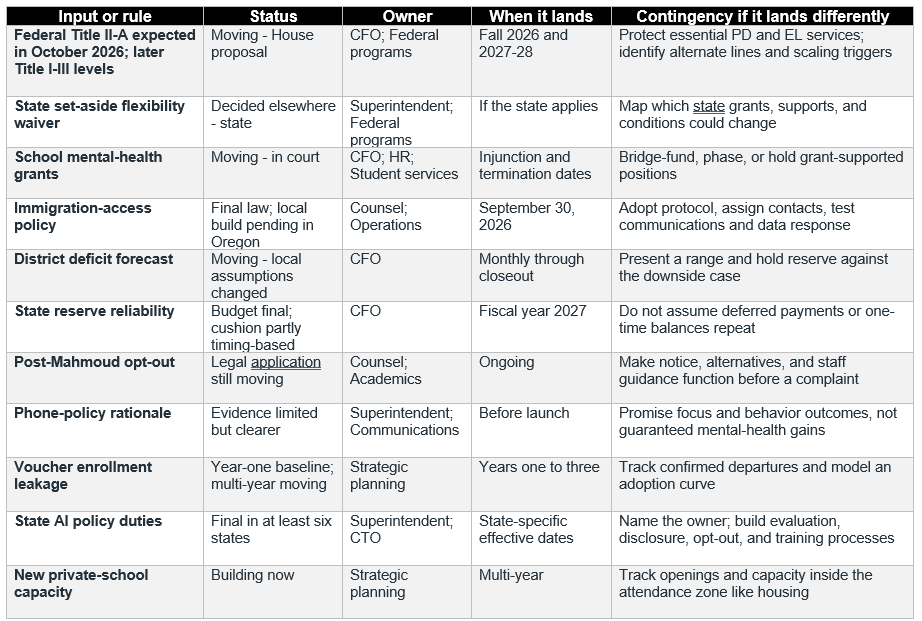
Quiet does not mean settled. It means there is still time to decide which numbers and rules the adopted plan can afford to be wrong about - and to write the contingency while revisions are still manageable.
The cabinets with the calmest fall will not be the ones with the most certainty. They will be the ones that stopped waiting for it.
Sources were checked July 19, 2026. Legislative proposals, litigation, implementation dates, and program participation can change after publication. Districts should confirm current requirements with counsel and the responsible funding agency before acting.
Comments
Nothing yet. Say the first thing.
Sign in to join the conversation.