
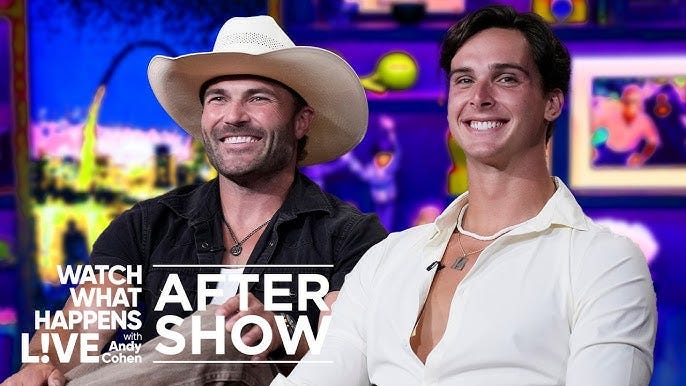
That’s right, folks. This so-called after show is now about to talk about an after show. Watch What Happens Live with Andy Cohen Season 23, Episode 119, which aired on July 20, brought together two cast members from very different corners of the Bravo universe. Cooper Dawson, the Below Deck Mediterranean deckhand whose relationship with Kat Johnson has become my season’s favorite storyline, and Steven McBee Jr., the oldest McBee brother carrying the full operational and emotional weight of his family’s ranch business while his father serves a federal sentence, are on the show tonight. They complemented each other in the way that WWHL sometimes manages when the booking decision turns out to be a real conversation rather than just two people sitting next to each other playing funny games. I did feel that Dawson was looking to Steve for acceptance, but at the same time, it wasn’t obvious, so it gets a pass. Plus, I get it. Chef Dave by the way, from an earlier Below Deck was at bar last night.
Steven McBee Jr. and the Allie Eklund Reckoning was great for me at least. The Allie Eklund situation has been one of the more complicated personal storylines running through The McBee Dynasty Season 3, and Steven Jr.’s willingness to address it directly on WWHL without deflecting or minimizing is the most significant thing to come out of his Clubhouse appearance. He and Allie Eklund broke up in April 2026, and the circumstances of that breakup included Steven publicly posting about cheating allegations on social media, a decision that produced a significant wave of fan backlash once the private texts involved became more widely known. He was asked about it on WWHL, and he did not try to relitigate the cheating question or reframe the public blowup as a reasonable response. He said directly that he regrets publicly insulting Allie, named it as the kind of thing hindsight makes obvious, and acknowledged the fan backlash as fair. The problem is an obvious one. They will never feel real if he approaches them that way.
he did go onto say last night that “hindsight’s always 20/20.” That is a phrase that can be used to deflect as easily as it can be used to own something, depending on the delivery. Steven Jr.’s delivery was the second kind. He was not suggesting that he made a reasonable decision at the time given the information he had. He was acknowledging that the decision to blast someone publicly was wrong and that he has processed why. He also addressed the specific episode of the season in which he traveled to Texas to meet Allie’s parents during the period when his father was spending his final days at home in Missouri before reporting to prison, a timeline that several viewers found difficult to watch. His explanation was that at the time, he genuinely believed he was meeting his future in-laws, and that his desire to move the relationship toward marriage so quickly reflected both the family pressure of watching his younger brothers settle down and a specific loneliness and urgency produced by his father’s situation. Cole McBee’s comment on the show that Steven “business trapped” Allie, by bringing her into the family ranch dynamic before the relationship had the foundation to support that kind of integration, is a characterization Steven did not fully dispute, which is more self-awareness than most people in his position would offer publicly.
The additional context that makes the WWHL appearance particularly meaningful is what has been building outside the episode itself. Cole told Bravo Insider that Steven is “doing good,” that he has been working on himself, and that he now meditates and has built a meditation deck on the property. Cole said, “He’s really trying to work on his calm self.” That image, of the oldest McBee brother who has been carrying operational responsibility for a business in financial difficulty while processing his father’s prison sentence and a public breakup, building a place to sit quietly and think, is one of the more human things the McBee story has produced. On Allie’s side, TMZ caught up with her outside Craig’s in West Hollywood in May and she was direct, there are no plans to speak again, she is not looking to reconnect, and she has had better days but is moving forward. The split is complete.
Steven’s current status, which he confirmed last night on WWHL, is single and laying low. When Andy pressed him about which Bravo personalities he found attractive, he named Ciara Miller from the Summer House universe and Mia Calabrese from Southern Hospitality, the latter being a, ex VIP server at Leva Bonaparte’s Republic nightclub in Charleston who operates comfortably in the specific high-energy, bottle-service world that Steven’s professional and social life already resembles. The compatibility read there is not complicated.
Mia, in a nutshell, would probably jump into that relationship in a minute. I wouldn’t be surprised if she has already sent him a DM by now.
The bigger question is whether Mia knows exactly how to handle that kind of wealthy, high-profile personalities and whether she could successfully navigate the McBee family dynamic, which, let’s be honest, seems to have a particular type. She might be able to do so without experiencing the kind of instability that Allie, who came from a very different world, ultimately faced.
Mia is also fast-paced and full of energy. I wonder whether she would eventually get bored living on a ranch 24/7. I also question whether she would be happy embracing the stay-at-home lifestyle, sitting on the couch with babies in her arms while the men are out working. That appears to be the family dynamic the McBee sons are looking for.
The scene last night with the women at home holding their children while the men were away working really stood out. It highlighted the traditional lifestyle that seems to define the McBee family’s expectations and relationships.
Ciara Miller is a different story. After everything that played out in the Summer House universe, including the West Wilson situation and the specific emotional fallout that followed, Ciara’s tolerance for public drama, social media blowups, and relationship chaos should be approximately at zero point zero. Setting that aside, to this day I still don’t understand West’s appeal. Beyond that, he has a passive-aggressive style that seems designed to draw women in by projecting hesitation and vulnerability. If that’s what he’s doing, I understand the strategy, but I find it annoying as fuck. It’s simply not something I like in a human that has a brain.
That said, setting aside the decision to be with someone like him, she seems to have a very clear sense of what she will and will not tolerate in a relationship. Steven’s history of airing relationship grievances publicly and broadcasting them on the internet strikes me as the kind of behavior she would recognize immediately and walk away from without a second thought.
The “crush list” was entertaining, though. At the same time, it seems like he could probably date several Housewives if he wanted to. Ironically, if he were simply more genuine and authentic, I think he would have no trouble finding a solid relationship. He could probably stand on a street corner for three minutes and end up with 14 dates, so I’m not worried about his love life.
Even so, watching him can be cringe-worthy. His behavior often comes across as awkward and unusual to me, yet somehow it fits perfectly with the improbable nature of these kinds of lists.
Cooper Dawson is now part of The Boatmance That I Think is Is Doing Fine Today. Cooper Dawson arrived at the Clubhouse as the season’s most uncomplicated good news story, and he maintained that status throughout the episode. His relationship with Kat Johnson, the charter guest who became genuinely significant to him across the BDM Season 11 charter season, has been the show’s warmest current thread, and when Andy tried to get Cooper to participate in the kind of hypothetical attraction questions that WWHL is built around, Cooper shut it down cleanly. He was not rude about it, and he was not performing reluctance. He just declined to answer in a way that would upset Kat, which is a specific kind of respect for a relationship that is still new enough to be treated carefully and that he clearly does not take for granted. He seems like a perfect man that does the rights things in life.
The Luke Brumer and Nathan’s sheets situation, which Aesha Scott had already addressed on her own WWHL appearance with appropriate disgust, came up again through Cooper, who confirmed that Luke went wrong in a direction everyone could see coming and that the crew’s response to the specific sheets situation reflected the same reaction the audience had watching it. We have said it many times, nothing they did was the right decision. I place responsibility on both of them because I still don’t understand why they had to get into someone else’s bed in the first place. That simply makes no sense.
Then there’s the issue of not changing the sheets, which was irresponsible on both of their parts. He bears more responsibility, but anyone who wasn’t being careless would have made sure the sheets were removed and washed immediately. I don’t know anyone who would have just left them there. Either one of them, or both of them, should have taken care of it. Or, made sure it got done. A seasoned pro or even better yet, an adult would even make sure it was exceuted for real.
I’m still mortified by the whole situation. Sheets are one thing, but bodily fluids did most likely soak through to the mattress. Let’s be realistic. It was one of the most thoughtless decisions adults could make. What’s even worse is allowing the sheets to remain there for two or three days. Then, I also believe tthink it is so hard to believe that no one cleaned the obvious stain on the mattress. The whole situation is simply disgusting. Cooper’s take was consistent with what has been documented from the boat, the behavior was disrespectful, the attempt to cover it up was predictable, and the combination of those two things produced exactly the kind of crew dynamic tension that the season has been building around.
Cooper Dawson is good television in the specific way that people who are genuinely enjoying an experience and have not yet been made cynical by it are good television. He showed up to WWHL clearly happy to be there, clearly invested in his relationship with Kat, and clearly not interested in performing anything more complicated than that. In the context of a Bravo season that has produced the Luke and Gen miscommunication spiral, the Josef charter and his 50,000-dollar tip aftermath, and Nathan and Joe’s broken friendship, Cooper’s straightforward boatmance is the most functional human relationship currently airing on Below Deck Mediterranean, and he is treating it accordingly.
Watch What Happens Live with Andy Cohen airs Sunday through Thursday nights on Bravo. The McBee Dynasty: Real American Cowboys airs Mondays at 9 p.m. ET on Bravo, with episodes streaming on Sunset and Peacock. Below Deck Mediterranean Season 11 airs Mondays at 8 p.m. ET on Bravo, also streaming on Sunset and Peacock.

The episode is titled “First Impressions and Final Farewells,” and it earns both halves of that title in ways that are genuinely difficult to watch, not because the production has done anything wrong, but because the actual events documented in this hour carry real weight. I also did not know of so called break up when I watched this episode last night. Steve McBee Sr. reported to federal prison on this episode. His family drove five hours through a bleak, wintry stretch of Missouri and South Dakota to bring him there. Steven Jr. cried on camera and called it “a top three hardest day in my life.” And before the family got on the bus, Steve Sr. called a company-wide meeting and unveiled an organizational chart that nobody in the room expected, naming his ex-wife Kristi McBee as interim president of McBee Farm and Cattle Co., the company his sons had been running under the assumption that one of them was going to take over.
That is the episode. Before getting into the review, though, there is a broader context worth establishing, because the episode cannot be separated from the specific industry the McBee family built their lives around, and that industry is the one that makes the entire viewing experience complicated in a way the show does not acknowledge. It is why I wanted to stop watching it and talking about it but I did not articulate it properly last week.
The Industry Underneath the Story is really my issue and its come to a head. The McBee family fortune is built on commercial cattle production, which is the industrial practice of breeding animals for the purpose of meat production. The show has largely glossed over that reality, only touching on it briefly.
Last week, however, watching the way they interacted with the pig really affected me. For some reason, it made me stop and remember that those animals are ultimately being raised for slaughter. Even the joking about the pig becoming a family pet felt different once that reality set in after seeing that tag in his ear. In a house. It made me think more deeply about the contrast between forming an attachment to an animal and the role it ultimately plays in commercial livestock production. This is not a secret or an edge-case reading of what the family does. They take calves away from their mothers almost immediately after birth, and I can’t imagine that being a good thing, yet it’s a common practice in the industry. That really freaks me out.
Last week, they met at the processing plant, and I remember thinking, “Ah... this is where it all that happens.” It was a stark reminder that the animals they raise ultimately end up being processed for meat. And, they do it themselves. They kill them as well as sell them off to be killed. That realization was pretty startling to me. Then there’s the excitement they seem to feel when they go hunting, which is also astounding to me.
Anyway, the beef tallow skincare line that becomes a major point of conflict in this episode is made, as the product’s own branding explains, from rendered beef fat. I have to admit, I find the concept rather nauseating because my first thought was that it sounded similar to the fat removed during liposuction, which I also find unsettling. That association immediately came to mind, even though the two are entirely different.
Setting that aside, Kacie built the brand around 100% grass-fed beef tallow as its primary ingredient, positioning it as a natural, clean-beauty alternative. The framing of rendered cattle fat as a “natural” ingredient is the specific kind of marketing alchemy that only works when the consumer does not think about where the ingredient comes from, which is from the same industrial process that breeds the cattle the McBee family raises and sends to slaughter. There is no version of the beef tallow skincare line that does not originate in the “born and bred to die” reality of the cattle business. As a matter of fact, I do respect them for using more parts of a deceased animal than would typically be used, since I assume those parts are often discarded. The face that Kacie presents to the camera may look genuinely good, and the product may deliver real results for people who use it, but the ingredient is what it is, at the same time, I can see how those ingrediants could make a face stand still smoothly. Calling it natural depends on a very specific and very selective definition of that word. It is natural cow fat which I guess is the very definition of it.
This is not a criticism of Kacie as an individual. She or they built something real, and the conflict this episode centers on makes it clear that Kacie, in particular, is fiercely protective of what she created. I agree with that.
Let’s say Allie was still in the picture today. In lieu of a salary, I would initially offer her 5%. Then, if they eventually got married or if the partnership proved effective after a year or two, I would consider an option to increase it to 10%, and that would be the limit. A 20% stake is outrageous, and it seems like they may have dodged a bullet.
The Prison Surrender. The bus ride to Yankton, South Dakota, where Steve Sr. is serving his sentence at FPC Yankton, is the episode’s most purely human sequence, and it works because nothing about it is performed. The family piled into a large bus together, the drive took approximately five hours through difficult winter terrain, and nobody in the vehicle appears to have spent the journey pretending that what they were doing was anything other than what it was. Steve McBee Sr., who was sentenced to 24 months in federal prison, two years of supervised release, and ordered to pay more than four million dollars in restitution after pleading guilty to one count of federal crop insurance fraud, is a complicated figure. He is out within 2 or 3 months from today.
And yet. Watching a family drive their father to prison is a genuinely hard thing to watch regardless of how the father got there, and the episode does not ask the audience to pretend otherwise. Steven Jr.’s breakdown on camera is real in the way that only certain things on reality television are real, something in him gave out, and the cameras caught it, and there is no version of that moment that is performance. He named it as one of the three hardest days of his life which I hope so at least. It is not everyday people go away to Federal Prison for however many years.
Steve Sr.’s Parting Bomb: Kristi McBee Gets the Keys. Before the family got on the bus, Steve Sr. called the entire operation together for a company-wide meeting with one announced purpose, to establish who was in charge while he was gone so that there would be no questions about the hierarchy. Steven Jr., who said in a confessional with the kind of confidence that precedes specific humiliations, “It’s an easy choice. Sorry boys,” was absolutely not handed the keys.
Steve Sr. put up the organizational chart and named his ex-wife Kristi McBee as interim president of McBee Farm and Cattle Co. Reporting to Kristi is Steven Jr. and the rest of the leadership structure. Brayden McBee was not on the chart at all. The room’s reaction was visible, immediate, and completely consistent with what you would expect from a group of adult men who had assumed they were about to receive power and were instead told that their mother was going to be their boss.
The decision has a logic to it that the episode eventually makes clear, even if it took the family a while to arrive there. Kristi McBee is not someone who was sidelined by the divorce and is now being given a ceremonial title. She is by leaps and bounds the only person in that crew that I trust. She built Lan-Tel Communications from nothing after her marriage to Steve Sr. ended, a company she describes in her own words as “a communications, underground construction, and concrete company.” She brought on a partner she trusts and grew it into a genuinely successful independent business. Steve Sr. reportedly told her she would fail at running it. She did not fail. The women in this family have a consistent pattern of being underestimated and then proving that the estimation was wrong, which the show acknowledges intermittently and which the org chart decision, coming from Steve Sr. rather than from any of the sons, suggests he knows.
Kristi’s response to being named interim president was to decline the active role. She told the cameras she has no involvement in the family cattle business and has no interest in acquiring any, that she prefers to focus on Lan-Tel Communications, and that she is not going to step into a management role in an operation she did not choose to be part of. She will serve as a structural backstop in cases of genuine emergency, but she is not running the day-to-day. The title is real. The involvement will be limited to what the situation actually requires. That is probably the smartest position available to her, and she took it without drama.
The Skincare Showdown and the Fourth Wall Break. The skincare conflict that has been building across several episodes reached its peak in Episode 6, and it is as messy as the season’s other business disputes but with a specific personal dimension that the cattle and org chart conflicts do not have.
Steven Jr. attempted to negotiate a 20 percent profit-sharing stake in the beef tallow skincare line for Allie Eklund, his then-girlfriend, in exchange for Allie marketing the product. This proposal was made to Kacie Adkison, who built the brand with Carrie and who responded to the proposal with the specific fury of someone who has been told that a product they created should be partially handed to a person who has been dating one of their family members for a matter of weeks. Kacie’s position was that she was not giving Allie a cut of something she built, that the suggestion was belittling to everything she had put into the brand, and that Steven was attempting to use his family position to redirect ownership of someone else’s creation toward his girlfriend as a relationship gesture. Her characterization of it as “trying to steal her company” reflects the intensity of her reaction, and while the framing is sharper than the technical reality of the proposal, the emotional truth of it is clear: she was not going to agree to it.
Steven’s response was to remove himself from the situation in the most visible possible way. He told the production crew to get the microphone off him, used language that is bleeped in the broadcast, and walked out. The fourth wall break, in which a cast member acknowledges the crew directly and demands they stop filming, is one of the rarest events in reality television precisely because it exposes the mechanics of the format in a way that no one involved can walk back. Steven broke that wall because he was out of options for managing the situation with the cameras still rolling, and the moment reads as an honest admission that the situation had exceeded what he was capable of handling on camera.
Like we alluded to above, we already know the splits today. They are at 33% each with Cole.
The Steven Jr. and the Relationship Pattern. The Allie Eklund situation is now resolved, they broke up in April 2026, as confirmed on his WWHL appearance, what the episode makes clear about how they arrived at the breakup is something that tracks with a pattern visible across his entire history with relationships.
He was ready to announce Allie was “the one” within two weeks of meeting her. He declared he was “ready for a wedding” on camera in Episode 2. He traveled to Texas to meet her parents during the week his father was making final preparations before prison, which is the kind of decision that only makes sense if you have collapsed the timeline of a relationship to the point where meeting your girlfriend’s parents feels more urgent than being present for a family crisis. He then attempted to give her a stake in his sister-in-law’s independent business. He has said his reasons were genuine and that he truly believed she was his future. That may be entirely true. It is also the behavior of someone who approaches relationships as a series of checkboxes to be completed as quickly as possible rather than as something that develops at its own pace, which is a pattern that tends to produce exactly the kind of compressed, intense, unsustainable connection that ends badly.
The advice that follows from all of this is simple and not particularly original, slow down, let actual relationships develop at the speed relationships develop at, stop treating every promising connection as an opportunity to fast-track a life outcome, and stop confusing the intensity of a new relationship with the substance of a lasting one. The cattle business needs his attention right now. It genuinely needs his attention. That is the place where his energy belongs, and the evidence of this season suggests he knows it.
Kristi McBee, for anyone who has been watching and wondering, is the most grounded person in this family’s orbit. She built a real business on her own, she walked away cleanly from a structure she did not want, and she is offering structural support without entangling herself in the operational chaos.
The McBee Dynasty: Real American Cowboys airs Mondays at 9 p.m. ET on Bravo, with episodes streaming on Sunset and on Peacock.
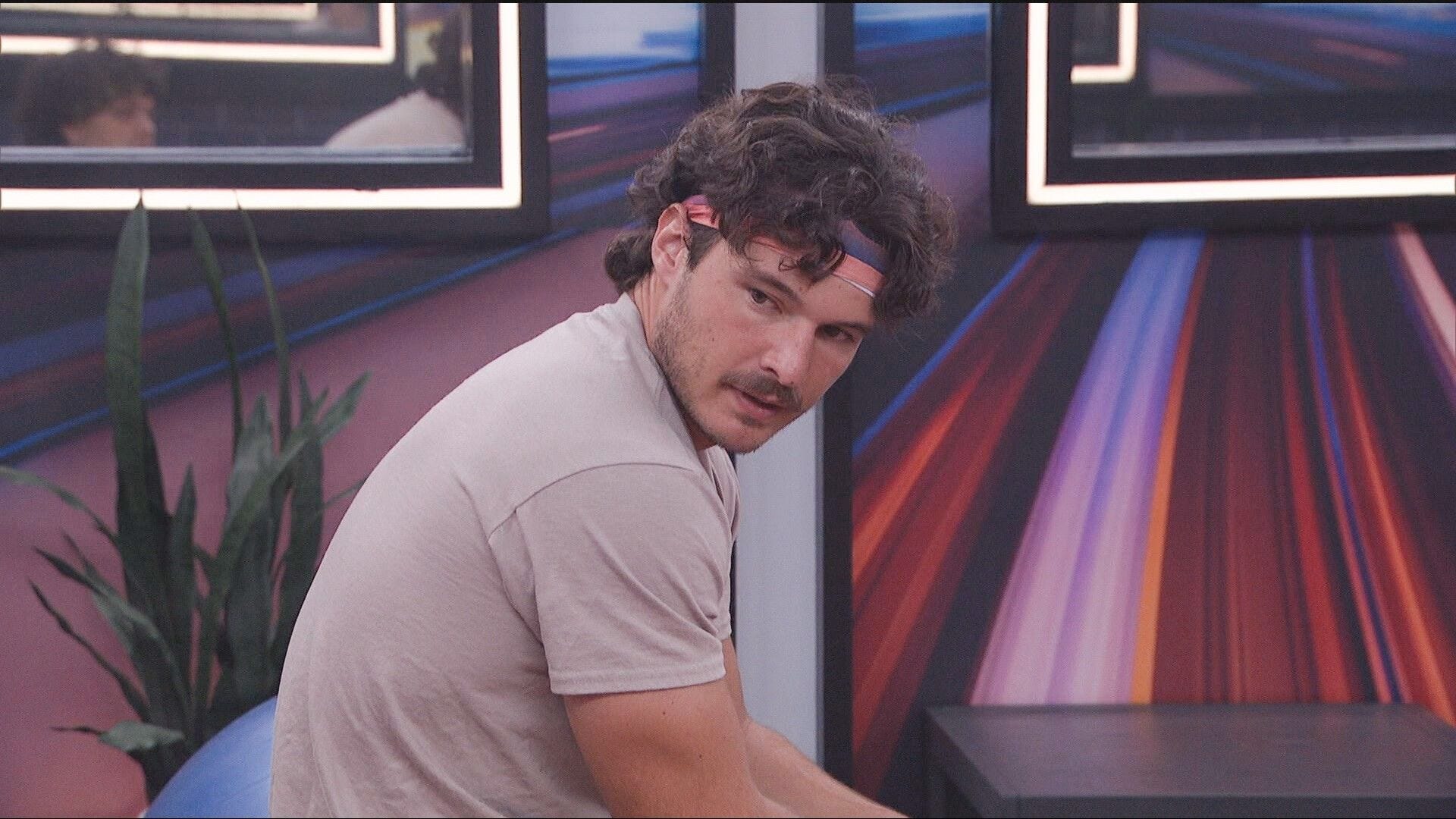
Live feed spoilers follow throughout this piece. If you are watching exclusively through the CBS broadcast and want to be surprised, stop here and return after Thursday’s eviction episode.
Sunday’s Episode 6 of Big Brother 28 delivered something that felt genuinely old-school in the best possible way, a nomination ceremony that turned into a screaming match, an egg detective costume, a backdoor plan that was already locked in by the time the cameras rolled back to their broadcast positions, and the specific chaotic energy of a house that has divided itself cleanly and is no longer pretending otherwise. By the time the episode ended and the live feeds delivered the subsequent days of fallout, Week 2 had produced more compacted drama than most Big Brother seasons manage in a month.
Rick Devens won the Week 2 Head of Household competition, a Wild West-themed endurance challenge that aired in Sunday’s episode, securing back-to-back power for the Toolshed alliance after Dee Valladares won Week 1. Devens described himself in the Diary Room as a “chaos missile,” which is both accurate and the kind of self-assessment that makes you wonder whether the man is entirely aware of what a chaos missile does to everything in its path, including the people on the launcher’s side. He is aware. He just does not appear to find it concerning.
The Egg Detective, the Time Capsule, and Angela’s Week. Before Devens could nominate anyone, the episode delivered a subplot involving the Time Capsule twist, in which viewers voted for a houseguest to receive the chance at either a power or a punishment from a sealed capsule. Angela Murray received the viewer vote and competed in the associated challenge. She did not win. Her takeaway was the “Egg Detective” costume, a callback to a punishment from a previous season that involves walking around in a hard-boiled egg detective outfit for an extended period while conducting house business as though this is entirely normal. Angela wore the costume with the specific stoicism of a BB26 winner who is not going to let a costuming setback compromise her strategic position, which is the only correct response to the Egg Detective punishment.
The episode then moved through the HOH’s social maneuvering in the days between winning the competition and the nomination ceremony. Rome Seymour attempted to negotiate his safety by going to Devens and offering up the names of his closest allies as trade. He said explicitly that as long as Lyric and Jason did not end up on the block, he was good with however Devens wanted to proceed. This was either a gesture of good faith or a spectacular miscalculation about what Devens was planning, and it was the second thing. Devens had already committed internally to the backdoor plan, which required Rome to not be on the block for the initial nominations and to not be drawn to play in the Veto competition. Rome handing over his alliance’s names while asking for safety for Lyric and Jason was, from Devens’ vantage point, free information and zero obligation.
Angela, whose strategic read on the house has been consistently sharp even when she is dressed as a hard-boiled egg detective, pushed Devens toward the bold move rather than the safe one. Her argument was that Rome had already assembled half the house around him, that the numbers were only going to get worse if nobody addressed it directly, and that the backdoor opportunity was available this week in a way it might not be later. She correctly identified Rome as the target that the alliance needed to remove before his social reach became unmanageable, and she made the case with the directness of someone who watched Devens almost beat her in a competition earlier that season and has fully calibrated that this man does not need encouragement to make big moves, he needs someone to confirm that the big move is the right one.
The Nomination Ceremony That Became a Screaming Match. Devens nominated Jason De Puy, Lyric Medeiros, and Melody Morris. He also, with the specific relish of someone who has been waiting for this moment, told Rome’s side of the house at the nomination ceremony that Rome had named Lala Kent and Melody as targets he was comfortable with, which was the information Rome had given him during his safety pitch. Using a person’s own strategic disclosures against them in a public ceremony is a ruthless move, and the episode captured the immediate aftermath with the energy of a house that had just watched something irreversible happen.
Jason, who had not been selected to play in the Veto competition during the previous week and was already carrying competitive frustration, went nuclear. He screamed at the cameras. He screamed at Angela, the Egg Detective, calling her a “messy bitch,” which Angela returned by describing his behavior as equivalent to fighting a girl and then immediately bringing the same energy back at him calling him a bitch was a low blow for someone trans. Lala began crying. Melody “openly seethed,” which is a phrase that captures the specific constrained fury of someone who knows they are on the block and knows that performing an emotional breakdown would only make their situation worse, but is also not entirely in control of what their face is doing. The nomination ceremony, which is typically a few minutes of formal announcements, became a public airing of grievances that stretched well past the point where production had planned to cut.
Jason later expressed to Rome that it “reverts to high school” in the Big Brother house. He then proceeded to demonstrate that he had not fully processed the implications of that observation by continuing to behave in ways that were not helping his case with the people who would be voting on Thursday.
The Veto Competition: Rome’s Chip Does Not Come Out. The Veto competition took place on Saturday. The six players were Devens as HOH, his three nominees, and Angela and Barrett Pfeiffer as the houseguests drawn to compete. Rome Seymour’s chip was not pulled. This is the specific outcome the backdoor plan required, and Devens described it afterward as the stage being set that if Rome did not get to play for the veto, and Devens won the veto, then Rome could be placed on the block as the replacement nominee without any possibility of defending himself through the competition itself.
Devens won the veto. He now held both the HOH title and the Power of Veto in the same week, an outcome that gave him total control over every variable of the week’s game and removed any uncertainty from the backdoor plan’s execution. He told Kamu Kirk in a late-night HOH room conversation that summarized the situation with precision, “If he’s up, we vote him out. Yeah, I think that’s the best move.” His plan was to use the veto to remove one of the female nominees, place Rome on the block, and let the BB Blockbuster competition determine whether Rome or Jason ultimately faced the eviction vote.
He acknowledged to Kamu that he had originally told Rome he would not be nominated even as a replacement, and that he was going to own the reversal directly. “He’ll be like, Devens is a liar. He lied to me, which is true,” Devens said. “I had told him after I won HOH, like, you’re good. I’m not nominating you, even on renoms. And I believed it, at the time, when I said it.” His plan was to tell Rome directly: “Dude, you’re right, it’s a lie. I’m sorry. It doesn’t matter if I changed it. But this is what it is.” That is the kind of confession that only works when the person confessing genuinely has the power to make the apology mean nothing strategically, which Devens does.
The Fake Showmance Breakup and Melody’s Countermove. Over the weekend, Lyric and Rome deployed what the feeds have confirmed was a deliberate strategy for a staged dramatic breakup intended to make Lyric appear available for alliance recruitment and to shift the house’s perception of their connection. Lyric was seen on the feeds kissing Rome and exchanging “I love yous” in private, while performing conflict with him in visible social settings. She used the manufactured distance to approach Dee Valladares, Chuk Anyanwu, and Haley Thogmartin about her individual game position, presenting herself as a free agent rather than Rome’s showmance partner.
The problem with a fake breakup strategy in a house with 24-hour cameras is that people who are watching those cameras are not deceived by it. The BB Junkies feed noted plainly that “not one person” in the house believed the showmance had actually ended. The performance was visible enough that it produced exactly the reaction its architects were hoping to avoid and, people noted it, confirmed to each other that it was staged, and factored the staging into their assessment of Lyric’s trustworthiness.
Melody made the most consequential move of the weekend by pulling Kamu aside and confirming explicitly that the Lyric and Rome breakup was fake, offering a final-two alliance as additional incentive for his help. Melody’s decision to blow up Lyric’s strategy is the kind of move that reality competition shows describe as “playing your own game,” which can be a euphemism for betrayal or a genuine assessment of survival options depending on context. In this case it was both. Melody correctly identified that her best available move was to provide the people with power a concrete reason to keep her over the alternatives, and she executed it by giving them something they could verify.
The Veto Ceremony: Monday Morning, Rome on the Block. At 9:04 a.m. on Monday, Devens informed Rome directly that he planned to use the veto to take Lyric off the block and that Rome would be the replacement nominee. Rome’s response, according to the feed logs, was to suggest that removing Lyric from the block meant Rome would not come after Devens for a week if he survived. That negotiation, offered by someone who was about to be placed on the block, reflects either genuine optimism about his chances of surviving the week or the specific bargaining posture of someone who has run out of better options. The veto ceremony followed. Devens pulled Lyric off the block and nominated Rome.
The final nominees facing the BB Blockbuster competition on Thursday are Rome Seymour and Jason De Puy. The Toolshed alliance currently includes Dee, Devens, Angela, Barrett, Drew Campbell, Kamu, Haley, and Chuk, and the alliance is unified on removing Rome. Jason has the theoretically plausible survival path of winning the BB Blockbuster and taking himself off the block, though Kamu argued to Devens in their conversation that Jason represents a genuine threat if he wins power and that his blowup with Angela after the ceremony was “mean, personal, and totally unnecessary.” The current read from the feeds is that Rome’s game is effectively over barring a significant Tuesday shift, and the feeds through Monday evening have not produced evidence of any shift of that magnitude.
Devens, who holds no vote as HOH and has already burned two competition wins in two weeks, is the most powerful player in the house at the moment and also, inevitably, the most visible target for the week when his HOH eligibility returns. The “chaos missile” has fired. What it hits on the way back down is the next question.
Big Brother 28 airs Sundays, Wednesdays, and Thursdays at 8 p.m. ET on CBS. Live feeds run on Sunset, Paramount+ and Pluto TV, with limited free windows on the official Big Brother YouTube channel.

Pickleball has spent the past several years quietly taking over the American backyard, and now the sport finally has the big, broad, unapologetically silly comedy it deserves. Apple Original Films is set to premiere The Dink globally from Apple TV on Friday, July 24, 2026, a summer sports comedy built around the collision of old school tennis pride and the paddle sport that has been steadily eating its lunch. Produced by Ben Stiller, who knows a thing or two about turning an underdog sport into a cultural moment after his work on Dodgeball, and led by a cast stacked with reliable comedic talent, the film arrives with the kind of pedigree that suggests Apple is treating this premise with far more care than a quick punchline about middle aged suburbanites and their paddles. Read More!

The fourth episode of Life, Larry and the Pursuit of Unhappiness, which aired Friday July 17 on HBO under the title “Deepthroat,” arrives as the season’s most explicitly political half-hour tonight, and it saves its sharpest material for last. The episode moves through four sketches covering four distinct periods of American history, and three of them do exactly what the show has been doing all season, place Larry David’s persona in a consequential historical setting and observe what happens when the most important thing going on around him is not, as far as he is concerned, the most important thing going on around him. The fourth sketch does something different. It uses the historical setting not as a frame for David’s social grievances but as a direct vehicle for contemporary political commentary, and the target is specific, the parody is unambiguous, and the personal dimension underneath it is genuinely complicated in ways the episode does not shy away from.
Before getting to that closing sketch and the full weight of what it contains, it is worth accounting for the first three, because “Deepthroat” is the show’s most balanced episode in terms of distributing its material across all four segments rather than building toward a single centerpiece.
Bob Woodward, the Parking Garage, and the Intelligence Nobody Asked For. The episode’s title refers to the famous pseudonym used by Mark Felt, the FBI associate director who served as Bob Woodward’s secret source during the Washington Post’s investigation of the Watergate scandal in 1972. The original parking garage meetings between Woodward and his informant, reconstructed in detail in All the President’s Men and subsequently identified in the historical record, are one of the most mythologized episodes in American journalism history, a series of late-night encounters that contributed to the resignation of a sitting president and established a model of sourced investigative reporting that has defined the profession ever since.
In the show’s version of events, Woodward meets his deep throat contact in the expected parking garage, in the expected shadow, and receives information that is not about Nixon or the cover-up or the money or the Saturday Night Massacre. He receives Larry David’s assessment of interpersonal dynamics within a professional environment. The informant has strong feelings about who is not listening during meetings, about the way certain people phrase their questions, about the social behavior of individuals whose names Woodward does not recognize and whose office etiquette Larry finds genuinely concerning. The gap between the expected content of the intelligence and the actual content is the sketch’s engine, and the episode plays it with the specific rhythm of a show that has had several weeks to calibrate exactly how long that kind of escalating disproportion can hold before it needs to release. Woodward, building toward what he assumes will be the revelation that breaks the story open, encounters instead a man with a detailed taxonomy of workplace grievances and the conviction that these grievances are equally newsworthy.
Ike Barinholtz as Henry Ford, and the Test Drive Nobody Wanted. The Henry Ford sketch is the episode’s most purely comedic section and serves the structural function of an episode’s middle, lighter than the material around it, faster in its rhythm, built on a single clear comedic premise executed with committed energy. Ike Barinholtz of all people plays Henry Ford preparing to demonstrate the automobile to the world, and Larry David plays a neighbor, described in the script and the show’s marketing material as a “local mensch,” whom Ford has made the mistake of inviting along for a test drive before the car was ready to be experienced by people who have opinions about vehicles.
The sketch understands something true about the test drive as a social experience: it is a situation in which one party is presenting something they are proud of and the other party is expected to respond with enthusiasm, and it therefore creates conditions of maximum vulnerability for the presenter and maximum power for the passenger. David’s character is not going to respond with enthusiasm. He is going to respond with observations about road feel, about turning radius, about the way certain mechanical decisions reflect poorly on the person who made them, and about the specific discomfort produced by the way the seat is positioned relative to the dashboard. Ford, who has built something that will fundamentally transform American society and the global economy and the physical landscape of the twentieth century, is being told that the ride is a bit rough and that the layout of the controls is not intuitive. Barinholtz commits to Ford’s mounting frustration with the specific discipline of a comedy actor who knows that the straight man’s reaction is where the scene actually lives.
The additional wrinkle that the show introduces, of the historical Henry Ford’s documented and vicious antisemitism, which is addressed directly within the sketch by having Larry David’s characteristically self-aware character notice and respond to the dynamic, gives the segment more texture than a simple “Larry complains about a car” premise would produce. The show has handled similar historically uncomfortable material across its first four episodes with varying degrees of success, and the Ford sketch manages to acknowledge the context without allowing it to flatten everything else happening in the scene.
James Buchanan and the Dating Neuroses That Transcend Time. The third sketch visits the 1850s presidency of James Buchanan, the only American president who never married, and situates David’s character in the vicinity of Buchanan’s romantic life with the specific assignment of observing what happens when someone with the full catalog of Larry David’s social pathologies attempts to participate in antebellum American courtship. The historical Buchanan’s relationship with William Rufus DeVane King, his housemate of many years and a relationship that contemporaries commented on with varying degrees of implication, gives the sketch an additional layer of historical context that the show uses carefully.
David’s dating neuroses, which have driven entire seasons of Curb Your Enthusiasm and which are recognizable and consistent enough that audiences can predict which specific anxieties will emerge in any given social situation, do not change when the social situation is positioned in the middle of the nineteenth century. They operate exactly as they always have, which is the point. The historical context does not transform the behavior. It reveals that the behavior was always a human constant rather than a product of contemporary life, and that someone living in any era would find exactly this kind of social interaction exactly this kind of difficulty. Buchanan’s presidential dignity and the formalities of 1850s social ritual provide a backdrop against which David’s modern anxieties read as simultaneously anachronistic and universal.
The Jonas Salk Sketch, Robert F. Kennedy Jr., and the Personal Dimension Nobody Expected. The closing sketch of Episode 4 is the one that will be written about most extensively, and for reasons that go well beyond the question of whether it is funny, though it is very funny. It is built around Jonas Salk’s development of the first successful polio vaccine, announced in 1955 and representing one of the defining achievements of twentieth-century medicine. Salk’s vaccine effectively ended the epidemic of polio that had paralyzed and killed children across the United States for decades, and the public response to its announcement was one of the genuine moments of shared national celebration in the postwar era.
Larry David plays Dora, Jonas Salk’s mother, in full drag. Judy Gold plays Evelyn, a neighbor to whom Dora is enthusiastically explaining her son’s achievement. The scene is set in a 1950s residential neighborhood, and the setup is recognizable as a Davidian version of the Jewish mother character, a type he knows from the inside and has rendered on screen across decades with the specific authority of someone whose personal history makes the portrayal both inherently credible and productively complicated.
Into this scene arrives a neighbor named Bobby, played by Gregg “Jeep” Perrie, whose credits include Mad Men, House of Lies, and the Terminator: The Sarah Connor Chronicles television series. Bobby interrupts Dora’s account of her son’s achievement to explain that the polio vaccine is going to kill people, that it is going to give them heart attacks, that the science is corrupted, and that nobody should trust what the establishment is saying about vaccines. His delivery deploys RFK Jr.’s documented speech patterns, his strained and raspy vocal quality, his particular rhetorical cadence, and his brain worm reference, which Kennedy disclosed publicly in legal documents and which has since become one of the more remarkable pieces of information to enter the political conversation. Perrie’s performance is not a vague impression. It is a specific, detailed, unmistakable parody of a specific, named public figure.
David’s Dora watches this escalate and tells Bobby directly: “If some idiot, some moron, ever put you in charge, that would be a dark day for humanity.” The reference to Kennedy’s current position as U.S. Secretary of Health and Human Services, a cabinet role from which he has promoted views about vaccines that the medical and scientific community has characterized as dangerous, is not subtle. Bobby is removed from the scene by two attendants who escort him away, his rant having reached a point where the other characters are treating it as psychiatric rather than political. The sketch closes on this image.
The personal dimension of this parody is something the episode’s coverage has made explicit in ways that give it additional weight. Larry David and Cheryl Hines, his co-star across twelve seasons of Curb Your Enthusiasm, have what sources have described as a genuinely warm professional relationship. David introduced Hines to Kennedy, which means he is personally connected to the marriage that makes the parody of Kennedy’s views a matter of navigating something close to him. Their friendship effectively ended when Kennedy aligned himself with the current political administration and adopted public positions on vaccines and public health that David has found not just wrong but specifically, historically wrong in the context of what the Salk sketch makes literal: a vaccine that saved millions of children, being dismissed in real time by a person now in charge of national health policy.
Cheryl Hines does not appear in this series. She is the only major Curb Your Enthusiasm cast member who does not. The episode is structured so that her absence is present in the room, acknowledged by the show’s decision to directly parody her husband’s public statements in the sketch where her absence is most conspicuous. That layering of personal history, professional relationship, and political satire is not accidental. It is the episode’s most ambitious piece of construction, and it works because everything required to understand it is available on the surface of the sketch rather than buried in subtext.
The broader critical assessment of “Deepthroat” situates it as the moment the season’s format begins to strain slightly under the weight of four consecutive weeks of “Larry being annoying” sketches while simultaneously producing its most pointed single sequence. The critics who have found the formula repetitive have a legitimate case. The critics who have found the Jonas Salk sketch genuinely bold also have a legitimate case. Both observations can be true simultaneously, which is precisely the kind of tension that a sketch comedy built on improvised dialogue and historical settings is going to generate when it reaches its fourth episode and is asked to justify its own continued existence while also attempting to say something timely and true about the country it is celebrating and interrogating in equal measure.
Life, Larry and the Pursuit of Unhappiness airs Fridays at 9 p.m. ET on HBO, with episodes streaming on Max. Episode 5, titled “Lincoln,” airs July 25.
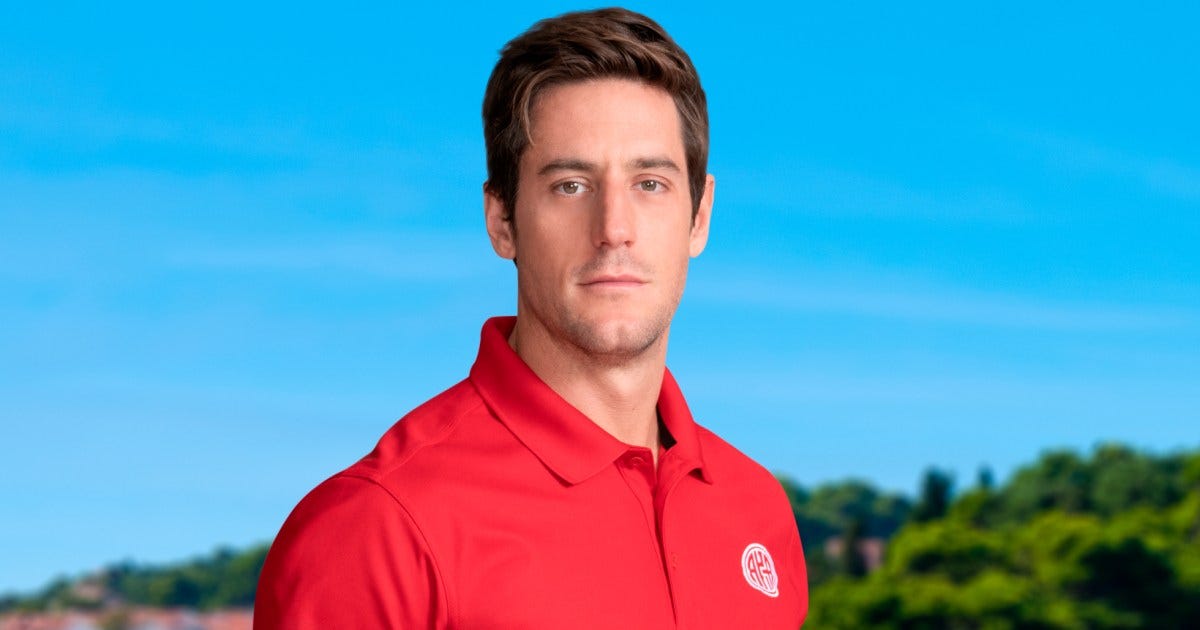
“Match Me If You Can” is the official title of Below Deck Mediterranean Season 11 Episode 7, and it refers to the charter guest’s primary objective for the week. Suzanne arrived aboard the M/Y Akira One with a matchmaker, an elaborate preference sheet, and the goal of finding love for herself and, separately, for her dog. These are the stated priorities. What actually happened during the episode was a medical emergency involving anaphylactic shock, a formal marine report filed against a deckhand for an incident involving a bosun’s bedsheets, and a tearful resignation speech delivered to Captain Sandy that cut to black before she could respond. The matchmaker storyline is, relative to everything else, the most straightforward part of the episode.
Nathan, the Sheets, and the Formal Report. The episode opened in the immediate aftermath of what happened last week, Nathan Gallagher learning, definitively and in specific detail, what Luke Brumer and Gen had done in his bed. The Bravo Daily Dish coverage confirmed that Nathan described to Captain Sandy what he had found in terms that left no ambiguity about the nature of the contamination. His sheets were not simply slept in without his permission. He woke up sick. He had been sleeping in a contamination Luke and Gen left behind and did not clean up, did not mention, and made no move to address until the situation became unavoidable.
Nathan told producers he could not even look at Luke anymore. The anger was not diffuse or abstract. It was the specific fury of someone who was violated in his personal space, in the place where he was supposed to be able to rest, and who discovered it not because Luke came forward but because the evidence made itself impossible to ignore. Luke, for his part, said in a confessional that he was “getting punished by a lot of people” and that things on the boat were “spiraling and spiraling and spiraling,” which is an interesting framing for a situation he created entirely through his own choices and subsequently chose not to address. The sense that the punishment was disproportionate to the crime requires a specific kind of selective reading of the timeline.
Captain Sandy sat Luke down and named what he had done “unprecedented” as a breach of yacht professional standards. She filed a formal marine report against him, which means the incident becomes part of his professional record and will be visible to other captains considering him for future charters. That consequence is more serious than anything the show itself can impose. Whatever happens with his time on Akira One, the marine report follows him. Before the episode’s crisis escalated further, Sandy was already communicating with her coordinator Norma about the availability of replacement deckhands, which tells you everything about where her assessment of Luke’s future on the boat was heading before he made any decision himself.
Luke’s confessional question to himself, asked after a day and a half of Nathan’s visible and sustained anger, was honest even if the framing around it was not: “If Nathan is still this ferocious and visceral with me, after a hundred apologies, can the charter season even go back to normal?” He answered it himself: “I don’t think so.” He then radioed for Captain Sandy. He went to the bridge. He told her: “I think the best thing for me is to leave.” The episode ended. The screen went black. Sandy’s response will air in Episode 8.
The specific irony that Luke offered his resignation on the same episode where Cooper Dawson went into anaphylactic shock is not lost on anyone who has been watching this season. Both situations required Captain Sandy’s immediate attention at the same time, one of them genuinely life-threatening and the other involving a deckhand’s decision to voluntarily create a crisis by choosing his own exit over waiting to be fired. That Sandy was managing both simultaneously, while also navigating a charter with a preference sheet about finding love for a dog, is the specific brand of simultaneously absurdist and actually-serious chaos that Below Deck Mediterranean produces at its best. She has not even flinched in any way but positive.
Cooper’s Medical Emergency: The Hazelnut Jar That Was Not a Hazelnut Jar. The medical emergency subplot of Episode 7 is the one that produced the most genuine fear in the episode, and the detail that makes it so specifically terrible is the translation problem. Chef Joy Lefaucheur prepared protein balls for the crew. She believed the jar she used contained no peanuts. The jar’s label was written in Greek. Cooper Dawson, who is severely allergic to peanuts, ate the protein balls and immediately began experiencing the early signs of anaphylactic shock, coughing, breaking out in hives, his throat beginning to constrict. He told producers he could “already feel a lump in my throat starting to form,” and then disclosed what he had not apparently mentioned at any earlier point: “I’m highly allergic to peanuts.”
When the jar’s Greek labeling was translated, it said explicitly that the product contained traces of peanuts. The gap between what Joy believed she was using and what she was actually using was a language barrier rather than negligence, and the distinction matters both medically and emotionally. Joy was devastated. She went to Captain Sandy with tears in her eyes, took full and immediate accountability for what had happened, and made clear that her concern was entirely for Cooper rather than for her own position. Sandy called the situation near-fatal and scrambled a local medic team to the yacht. The medic determined Cooper was stable enough to continue working with caution, and he was cleared to remain for the rest of the charter.
The contrast between Joy’s response to her mistake and Luke’s response to his mistake is the episode’s implicit moral argument, made without any character delivering a speech about it. Joy did nothing wrong in intention, was devastated by the outcome, and immediately focused all her energy on making sure Cooper was okay. Luke did something wrong deliberately, delayed addressing it for days, and when the consequences arrived, focused primarily on whether the punishment felt proportionate to him. The episode does not editorialize. The two storylines run simultaneously and the comparison is there for anyone watching to make.
Kat Johnston’s assessment of Luke, offered in an earlier episode but circulating widely in the context of this one, remains the season’s most concise critical evaluation, “Luke’s a toolbox. He’s not even a tool, he’s the box.” That’s clever.
The Charter: Matchmaking, Menu Pivots, and a Dog Looking for Love. The charter primary this week, Suzanne, arrived with a matchmaker named Amy who specializes in finding romantic partners for bachelorette clients. The preference sheet, which one recap described as “unhinged” upon transcription, included the full romantic matchmaking brief for Suzanne along with an apparently separate but equally earnest interest in finding a companion for her dog. This is the kind of charter detail that would be the episode’s most memorable element in a week without a medical emergency and a resignation cliffhanger, and it functions in Episode 7 primarily as ambient color around the more serious storylines.
What Suzanne contributed to the episode’s crisis level was her approach to the dinner menu. She tore apart Joy’s planned menu right before service, forcing a significant kitchen pivot under circumstances where the galley was already managing the emotional aftermath of the protein ball incident. Joy navigated the pivot with the professionalism that her response to the Cooper situation demonstrated, focused, immediate, and functional despite the pressure. The dinner service ultimately went forward, the matchmaker’s activities produced whatever they produced, and the dog’s romantic situation was addressed with the seriousness the preference sheet indicated it deserved. About the dog and it peeing on the carpet, remember that the dog was running around frantically, probably trying to find someone to take it to go to the bathroom. It eventually just had to go.
When it stared at the stew who gave Luke the hand job, remember, it’s a dog. It was likely looking for reassurance and trying to understand the situation. That is how dogs communicate.
Regardless, that woman is not right. She cannot even handle a dog.
Joe Bradley and Kayley Smith: The One Good Thing. Joe Bradley has spent this season building toward a reputation that is going to catch up with him, and the previews and earlier episode highlights suggest that trajectory has not been interrupted. Within the specific episode, however, the developing connection between Joe and Kayley Smith, the second stew, provided the only genuinely warm stretch of the hour. They spent their excursion together holding hands, laughing, and producing the specific easy energy of two people who like each other and are not making it complicated. It is the anti-Luke-and-Gen dynamic and the two people who are actually enjoying each other’s company rather than two people navigating the fallout of decisions made poorly and disclosed even more poorly. We know what Joe Bradley actually said. Oh wait, Kaylie was also on WWHL and talked about Joe today. Things seem good between them. that’s cool. I like them both a lot.
Honestly, she has a great personality. She is quick, and really seems to have it together.
Luke Brumer’s statement to Captain Sandy, delivered on that bridge with tears, ends the episode in a position where everything is still technically unresolved. Sandy had already been making calls about replacement deckhands before Luke walked up to the bridge, which means her decision had likely been made before he made his. Whether she accepts his resignation, declines it and fires him formally, or finds some third option that the next episode will reveal is a question that Monday’s broadcast will answer. The formal marine report is already filed regardless of outcome. That piece of his professional record does not disappear regardless of how the next episode resolves.
Below Deck Mediterranean Season 11 airs Mondays at 8 p.m. ET on Bravo, with episodes streaming the following day on Sunset and on Peacock.
Comments
Nothing yet. Say the first thing.
Sign in to join the conversation.