
✅ We should have a tradeable bottom coming up—below was my Forecast from last week’s June 7th Substack post:
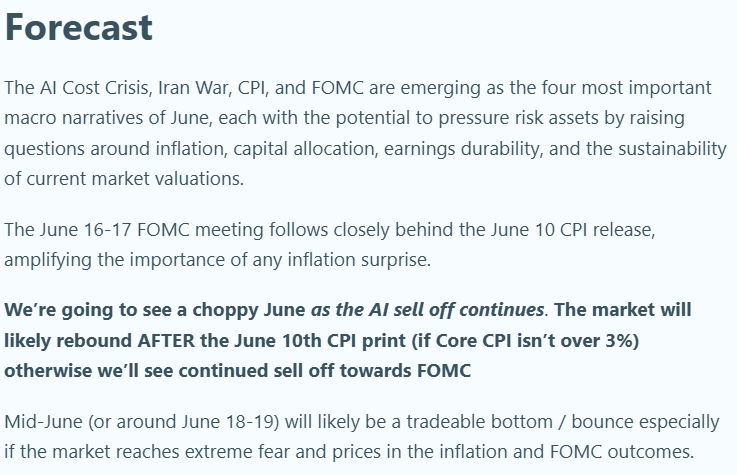
❌ The rotation to SaaS saw a more significant pullback than I expected. However, I still believe NOW 0.00%↑ is in a great position and I will be accumulating more especially if it falls towards $85.
💡Back in April 12th and Feb 8th Substack Posts below, I discussed how we’d see AI become the TINA trade—that has happened with the insane levels of concentration into AI infrastructure names especially the memory stocks.
171 + 301 = 472 new highs is a very strong number, showing wide participation.
Financials are dominant among new highs — especially regional banks, community banks, and bank-related ETFs (First Trust, Invesco KBW, etc.). This suggests improving sentiment toward interest-rate-sensitive and value-oriented financials.
Small-cap and factor ETFs are heavily represented in the highs (First Trust AlphaDEX series, VictoryShares volatility-weighted, Vanguard Russell small-cap ETFs, etc.). This points to rotational strength into smaller companies and systematic/value strategies.
Only 22 + 148 = 170 new lows — significantly fewer than highs.
The vast majority of new lows are small/micro-cap, speculative, and lower-quality names (many penny stocks, biotechs, SPAC remnants, and crypto-related names).
A handful of larger, higher-quality names are hitting lows, notably in software/SaaS: Adobe, Autodesk, Intuit, Salesforce, PTC. This suggests selective digestion in expensive growth software rather than broad tech weakness.
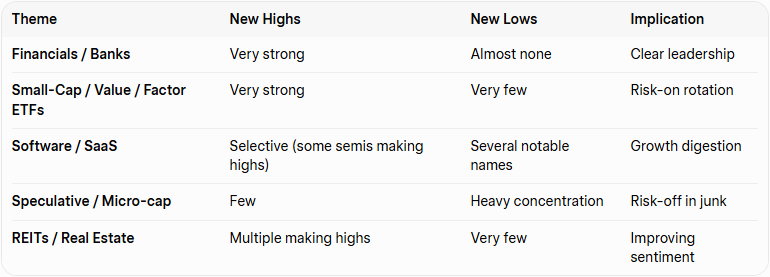
Healthy breadth beneath the surface. The market is not just a handful of mega-caps carrying everything — financials, small-caps, and factor strategies are participating in new highs.
Weakness is mostly confined to lower-quality speculative names and a few high-valuation software stocks digesting gains.
This pattern is consistent with a broadening, maturing bull market where capital is rotating out of the most expensive growth names into cheaper, more cyclical/value areas (especially financials and small-caps).
Bottom line: The data shows constructive underlying market health — strong participation in new highs, with weakness largely isolated to lower-quality segments and selective software names.
Which lines up with this X post below:

Norseman Market Timing@Norseman1
$NYSE new all-time high! Has now confirmed with it's A-D Line, which led for only the 13th time ahead of Price since 1950. Breadth leads... Price follows.

Norseman Market Timing @Norseman1
Yesterday the S&P 600 (small-cap) A-D Line made a new Bull Market high AHEAD of price — despite a nasty day across other parts of the tape. Very bullish IT/LT. As we keep repeating: this is a Bull Market doing Bull Market things. Major tops do NOT form while the A-D Line leads
2:59 PM · Jun 12, 2026 · 15.5K Views
4 Replies · 12 Reposts · 97 Likes
*This my personal blog and is not investment advice—I am not a financial advisor but a random person on the internet who does not have a license in finance or securities. This is my personal Substack which consists of opinions and/or general information. I may or may not have positions in any of the stocks mentioned. Don’t listen to anyone online without evaluating and understanding the risks involved and understand that you are responsible for making your own investment decisions.
The AI Cost Crisis Is Getting Harder to Ignore
The narrative around AI’s unsustainable cost structure is gaining traction. OpenAI, despite its dominant position, remains deeply unprofitable while committing to enormous capital expenditures on data center infrastructure. Reports now suggest the company is preparing to cut token prices by 40-50% — not because inference costs have meaningfully declined, but because enterprise customers are pushing back on high usage bills.
This creates a difficult setup: input costs (compute) are rising while output prices (tokens) face downward pressure. If realized, it would represent a classic margin squeeze at the foundation model layer.
More broadly, many businesses are discovering that current AI deployments are delivering insufficient economic returns relative to their costs. Usage is increasingly being rationed or shifted to cheaper “good enough” models. At the same time, competitive pressure is intensifying — not only from Anthropic but also from increasingly capable open-source alternatives that continue to close the performance gap at much lower price points.
When the marginal cost of intelligence keeps falling while the willingness (or ability) to pay remains constrained, the industry moves closer to a commodity dynamic. That shift has implications well beyond the frontier labs — it affects hyperscaler capex expectations, software company margins, and the broader AI infrastructure trade. If that gap doesn’t close before the capex bills do, the cost side of AI starts to look like the story of 2026.

Nicholas Mugalli@RealNickMugalli
OpenAI is reportedly about to cut token prices 40-50%. Preemptively. Because they think Anthropic is about to do the same. I need you to sit with this one, because I've been laying out the pieces for 3 months now and this is the piece that makes the ai trade lose steam maybe

Nicholas Mugalli @RealNickMugalli
As I was saying, with great confidence now that every SaaS company built on flat monthly subscriptions is about to hit the same wall. - Revenue—fixed (for the most part). $30/month per seat, forever. - AI compute cost: exponential. Every agent run, every long context window, https://t.co/OsvryUGKoh
1:28 PM · Jun 11, 2026 · 43.1K Views
19 Replies · 28 Reposts · 165 Likes
META and many companies are cutting down on token costs.

Jyoti Mann@jyoti_mann1
SCOOP: Meta plans to clamp down on skyrocketing AI costs inside the company by imposing limits on employees’ token usage, the company told staff in a memo on Tuesday, just weeks after it pushed them to adopt AI tools in their work.
6:59 PM · Jun 12, 2026 · 314K Views
36 Replies · 126 Reposts · 1.13K Likes
However, when looking at 2026 Q2 as a whole, total S&P 500 earnings are expected to increase by +22.2% from the same period last year on +10.9% higher revenues. How much of this is due to AI is not known.
Leopold Aschenbrenner of Situational Awareness Fund predicted the below 2 years ago. If governments (like the US) begin restricting frontier model deployment, that will slow commercialization and creates regulatory uncertainty. And many governments are increasingly viewing AI as:
Economic infrastructure
Military infrastructure
Cybersecurity infrastructure
Intelligence infrastructure
National competitiveness infrastructure

coffee@coffeedev
Crazy this was written two years ago, @leopoldasch truly was on point

2:00 AM · Jun 13, 2026 · 22.3K Views
13 Replies · 38 Reposts · 491 Likes
Reminder that this isn’t a crazy AI bubble just yet.

J.C. Parets@JC_ParetsX
We’re not even close to silly yet. Get comfortable.

11:31 PM · Jun 12, 2026 · 16.1K Views
15 Replies · 24 Reposts · 274 Likes
Microsoft is in an interesting spot (I am long and have been dollar cost averaging)

PlotLine@TradeTactician1
$MSFT has respected its multi-year ascending channel since 2022 and right now, it's doing exactly that. The dotted path says it all — I expect one more retest of support to carve out a higher low before the next leg up, similar to late 2022. Patience is the trade.

8:08 PM · Jun 12, 2026 · 9.87K Views
6 Replies · 6 Reposts · 153 Likes
The AI cost narrative will be short-term bearish but it’ll provide opportunities for investors to accumulate high quality AI stocks.
Comments
Nothing yet. Say the first thing.
Sign in to join the conversation.