
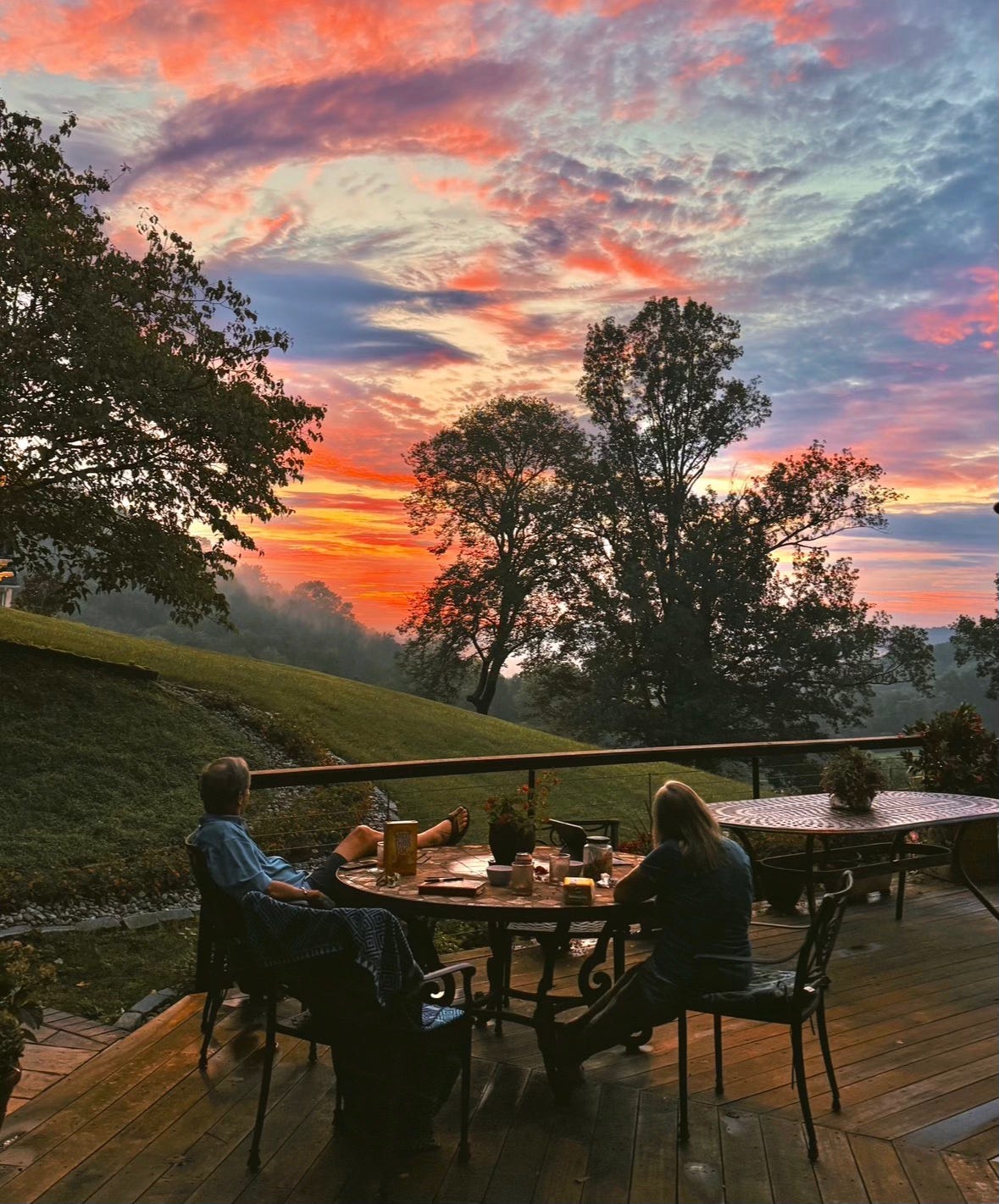
By the time I sit down on my parents’ back deck for dinner, I have crossed an ocean. There are more sensible ways to measure distance, but lately I find myself measuring it in dinners. I live thousands of miles away now, and I see my parents once or twice in a year. Which means I have begun doing the math. If I see them twice next year, and twice the year after, and if everyone stays healthy and the planes keep flying and life keeps cooperating, which life has never signed anything promising to do, how many of these evenings are actually left. It is a terrible calculation. It is also difficult not to make.
It would be easy to do what we’ve always done: dinner on the back deck with the familiar rhythm of catching up about the kids, work, somebody’s knee or back or growth, whichever friend has news. Cleanup with the TV on. Bed a little late. And in a few days, I get on a plane and cross the ocean again, and none of that is a complaint as it has fed me my whole life. But somewhere in the last few years, doing that awful math, I started to think the familiar rhythm, good as it is, was not going to be enough. I have my parents’ full attention on nights like this, night when it’s just the three of us and the cicadas and James Taylor playing as the soundtrack to the evening. Thankfully, I have a strong, open relationship with both of them. And sitting here, I found myself reaching for different questions than the ones we usually ask each other: not about their ailments and health or the neighbors, but about the people inside them. Their inner life. What do I actually want to know about their interior world, the part of them I’ve spent my whole life loving without necessarily knowing? Who are you, apart from being my mom? Who are you, apart from being my dad? What has remained unlived in you? What still surprises you? What do you still want?
I didn’t arrive at that question out of nothing. I was young enough that I remember being in the car with my dad after we’d collected the mail, driving back to the house, when “In the Living Years” came on and he turned it up. When the song ended he told me it always reminds him that he wished he’d asked his own parents questions before they died. Anything at all. There was a sadness in his statement, and I remember not understanding yet what I was hearing. I filed it away. I didn’t know I was going to need it.
I didn’t invent this instinct out of nothing. Dave Isay spent years making radio documentaries before he founded StoryCorps, and he has told the story of handing a boy a tape recorder and watching him climb into bed with his grandmother and ask her things he’d never asked before, simply because the machine gave him permission. When the grandmother died, that recording became one of the most important things the boy owned. Isay built an institution out of that instinct and titled a book about it Listening Is an Act of Love. There’s research behind the smaller version of the same idea, too. The psychologist Arthur Aron, working out of a lab at Stony Brook, found that two strangers could generate real closeness in forty-five minutes by working through a list of questions that got steadily more personal. One pair from his original study ended up married. It was never really about the questions themselves. It’s about the permission a good question gives someone to say the true thing instead of the easy thing.
So: back on the deck, on one of my few nights a year, I started bringing a questions with me. Not an interview, not an interrogation, just one or two questions asked the way my dad wished someone had asked him. A good question says something before anyone answers it. It says: I have not finished knowing you.
QUESTION: “When you look back on your life, what is something you wish you’d done but didn’t. It doesn’t have to be a regret, I told them. And it isn’t about anyone else. Just you”
My dad’s answer was dancing. It didn’t surprise me once I sat with it; he has spent a lifetime orbiting dance: the old musicals with Astaire and Kelly, years of going out dancing with my mom in their younger year. He’d recently watched The Life of Chuck, and couldn’t stop talking about the scene where a buttoned-down accountant, undone by a street drummer, turns out to have been taught to dance by his grandmother long before life made him practical. I now realize, my dad recognized something of himself in that scene.
My mom’s answer was the piano. Her grandfather was a composer and taught her to play difficult classical pieces she never learned to read on the page, working them out instead by ear and sight until they lived in her hands. What she wished she’d done wasn’t learn to play. She already had. It was closer to permission, the wish to have trusted what she already knew.
Here's what I keep coming back to. Neither of my parents became what they were describing. My dad never trained as a dancer. My mom never performed as a pianist. But whatever it was in each of them didn't disappear. It found another form and followed them around for 60 years, revealing itself sideways: the way my dad would dance with us girls to Michael Jackson and Billy Joel, the way my mom formed a lifelong love of movie scores, Jessica's Theme from The Man from Snowy River chief among them. I would never have understood the origin of those small, familiar things if I hadn't asked a question.
QUESTION: If you had to choose one song that represents who you are, that actually sees you, what would it be.
My mom named a classical piece and described the feeling of it, a valley, surrounded by flowers and filled with peace My dad chose a song called The Road to Paradise, by a Nashville songwriter he admires. I could have guessed he’d choose something like it before he said it, because for my dad’s meaning has always lived in the words.
What struck me wasn’t really which songs they chose. It was watching each of them reach for a different kind of truth about themselves, my mom toward a feeling, my dad toward a meaning.
The rest of the evening, we sat outside deep into the night going around the table sharing and listening to songs that claimed some part of us. It was a special night in how ordinary it was yet.. it was one we each left feeling seen and when our hearts full. A night I will always remember.
David Brooks spent years researching what makes people feel truly seen by another person, and one finding has stayed with me since I first read it: the longer two people are married, the less accurately they tend to read each other. Not because love fades, but because we stop updating the picture. We fall in love with someone and then keep loving a slightly outdated version of them, without quite meaning to.
Esther Perel calls the antidote to that a kind of curiosity toward your partner’s essential otherness, the willingness to keep finding the stranger inside the person who has become so familiar, instead of filing them away as fully known and therefore finished. John Gottman has a gentler name for the same practice. He calls it a love map, the ongoing, never-finished project of learning what’s inside someone else’s head.
My parents just celebrated their fifty-third wedding anniversary… 53 years married, 59 years together. We went out for dinner to celebrate, and somewhere between courses I asked more questions.
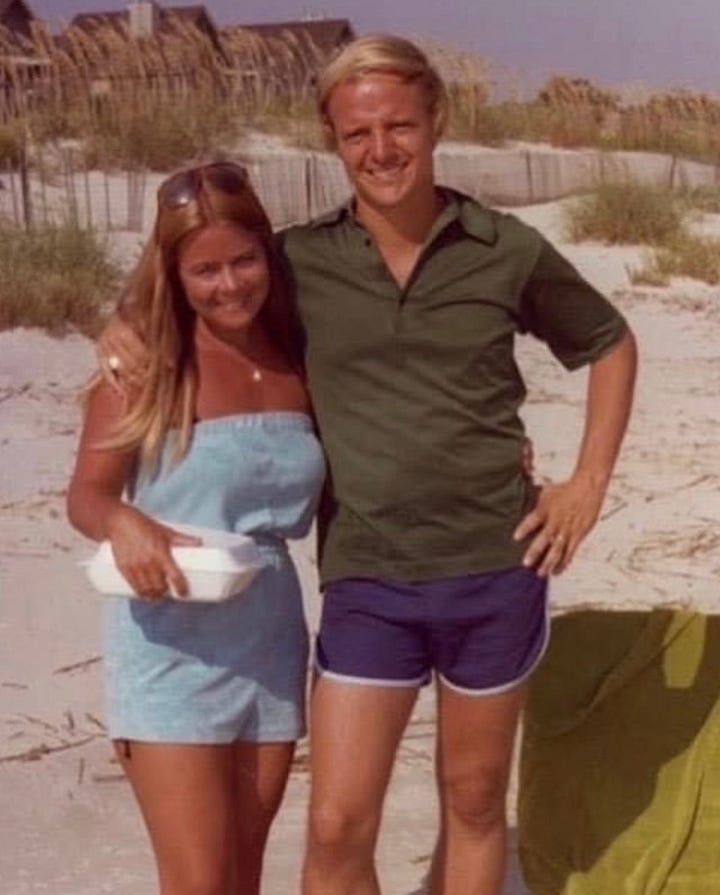

QUESTION: If there is truly no end to knowing another person, if the depth is endless even after almost sixty years, what are you still curious about when it comes to each other? What don’t you know yet? What do you still wonder?
My dad wondered what my mother still dreams about, not the plans they’ve already made together, but her own private, ongoing dreaming. My mom’s answer turned toward travel, the places she’d love to return to, the places she hasn’t been yet and still wants to see. She is one of the most content people I know, settled in her life in a way I’ve always admired, so it surprised me to learn that what she still dreams about is somewhere else entirely.
Most of the questions we ask older people point backward. Tell me about when you were young. Tell me about your parents. Tell me what happened. Those questions matter, and I’ll never stop asking them. But questions that point the other direction entirely carry a different weight. An aging person is not only a repository of memories. They still possess a future. It sounds obvious written down like that. I’m less sure we act like it’s true.
My dad has a song he loves, “People Get Old,” by Lori McKenna, and its whole ache lives right there in the title. I think of it now, it’s meaning and reflect on if you are lucky enough to keep the people you love around for a long time, you get to watch them get old. That was always going to be the deal. Nobody warns you how quietly (and quickly!) it happens, a little at a time, while you’re busy with dinner and the thrilling madness of life.
I think about my dad, however many decades ago, the sadness in his eyes and his voice, saying he wished he’d asked. It took me a long time to understand that the wishing wasn’t really about his parents specifically. It was about time, about the door that only stays open while someone is still alive to walk through it with you.
I can’t ask everything. Nobody can. There is no finishing this, and that was never the point. The point was the asking itself, showing up at the table, or the deck, with a real question instead of the usual five easy ones, and letting whatever came back allow me to see my parents in a richer, fuller light.
I used to think the reason to do this was so that someday, after my parents are gone, I would have more of their past to hold onto.
I don’t think that anymore.
We don’t ask only so that we’ll have more to remember later. We ask because they are alive now. Because my dad still wishes he could really dance. Because somewhere inside my mom there is a valley full of flowers, and she’s still playing the piano in it. Because after 59 years beside her, my dad wonders what she dreams about.
We cleared the table that night the way we always do. Nobody announced that anything important had happened. But driving into town the next morning, past the same fields I’ve been driving past my whole life, I thought about my parents, the way they have lived inside me my whole life, and felt something like tenderness rise up out of nowhere. My parents are not a finished story I need to get down before it’s too late. They are two people I am still, actively, gratefully, in the middle of meeting.
And perhaps intimacy isn’t finally knowing someone. Perhaps intimacy is remaining curious about someone we already love.
There’s a reason to do this beyond sentiment. The psychologists Marshall Duke and Robyn Fivush, at Emory, built a simple 20-question measure of how much children know about their own family’s history, things as plain as where their grandparents grew up or how their parents met. The children who scored highest weren’t just more knowledgeable. They tested as measurably more resilient, more confident, better able to withstand hardship, including, in one striking follow-up, the shared trauma of September 11th. Knowing where you come from turns out to be one of the more reliable predictors of how well you hold up when things get hard. Fivush’s lab has actually studied the very ordinary place where my own questions kept happening: they recorded families talking at the dinner table, and found that everyday meal was where most of a family’s intergenerational story got told, story by story, without anyone deciding to do it on purpose.
There’s a difference between a biographical question and an imaginative one, and it’s worth knowing which kind you’re asking. Where were you born and how did you meet Dad are biographical. They get you facts, and facts matter, but they don’t get you close to a person’s interior. What does peace look like inside you is a different kind of question. It doesn’t ask what happened. It asks what it’s like to be them.
Beyond the ones I’ve already told you about, here are others I’ve either asked or am saving for the next visit. They work for parents, grandparents, relatives, anyone whose way of seeing the world you don’t want to lose.
On looking back:
What’s something you were once completely sure of that you don’t believe anymore?
Is there a piece of advice someone gave you that turned out to be wrong?
What’s a version of yourself, at some age, that you’d like to go back and reassure?
What is one ordinary day from your life you would happily live again exactly as it happened?
On who they are, underneath the roles:
What’s a smell or a sound that instantly puts you back in your childhood?
What did you love as a kid that you never told anyone about?
What is something you have never thought to tell me because I never thought to ask?
On the people they’ve loved:
What’s something about the person you married that you didn’t understand until years in?
Who taught you the most about how to treat people, and what did they do that taught you that?
On what’s still ahead:
What do you hope I remember about you, specifically, not in general?
What’s something you’re still curious about, at your age, that might surprise people?
What do you still want to learn?
Ask one at a time. Let it sit. The point isn’t to get through a list, it’s to make room for an answer you didn’t expect.
Your phone’s voice memo app. The lowest bar is the truest one. Open the app already on your phone, ask if it’s alright that you record, and let the conversation happen. No equipment needed.
A notebook. If recording doesn’t feel natural, write down what they said as close to their actual words as you can manage, right after, while it’s still warm.
StoryCorps. A nonprofit built for exactly this. Free, structured around their own list of prompts, recordable in person at one of their booths or remotely through StoryCorps Connect. The recording is preserved at the American Folklife Center at the Library of Congress, which means it genuinely outlives the both of you.
StoryWorth. A subscription gift built around a year of weekly email prompts. The person answering can write back or, if that’s easier for them, dictate their answer by phone, and at the end of the year it’s bound into a hardcover book.
A photograph, taken while they’re answering. Not posed. Whatever their face is doing while they’re remembering the thing you asked about. That expression is its own kind of record, and years from now it will tell you as much as the transcript will.
There's a John Mayer song, "Stop This Train" that’s been sitting with me the whole time I’ve been writing this.. these lines in particular:
“once in awhile when its good
it'll feel like it should
and they're all still around and you're still safe and sound
and you don't miss a thinking till you cry when you're drivin' away in the dark.. “
I think that's close to what I've come to believe about all this. I'm grateful for what I've learned about my parents these last few visits. As I reflect on these moments, these nights.. I don't think the learning was ever really the whole point. The point might have been the deck itself. The specific evening. The two of them going quiet, actually considering something, instead of passing me the bread and asking about the kids. Whatever I found out, I got to be fully there for the asking of it. Maybe that's the gift underneath the other gifts. Not what I now know. The evening itself, while it was happening. The next one, too, whenever it comes.
bout the Author
Welcome - I’m Kyle, the soul behind Sudden Journeys. I’m a writer, photographer, and founder of Sudden Journeys. I’ve spent the last few decades exploring: guiding travelers, leading tours, living abroad, and paying close attention to what landscapes, rooms, and encounters awaken in us. I write about place and belonging, hospitality and gathering, the practice of attention through journaling, and the home life between departures. Originally from a small town south of Nashville; I divide my time between the English countryside, London, and wherever the road takes me next.

Stay a While
If this piece resonated, you’ll find more long-form essays, reflections on journaling and home life, notes on gathering and hospitality, and lived travel writing here on Substack. Paid subscribers receive deeper essays, photography notes, and more intimate reflections.
Let’s Connect
Ask me a question, submit feedback or suggest a topic here.
💬 Come say hi on Instagram or LinkedIn
🎙️ On the Echoes of Elsewhere podcast, exploring place, migration, and belonging
📞 Have questions about travel? Book a travel planning consultation or email me at kyle@mysuddenjourneys.com
🪩 If you feel moved to like, comment, or share, it helps this work find its way to others who might need it.♥️
Thanks for reading Sudden Journeys! This post is public so feel free to share it.
Comments
Nothing yet. Say the first thing.
Sign in to join the conversation.