
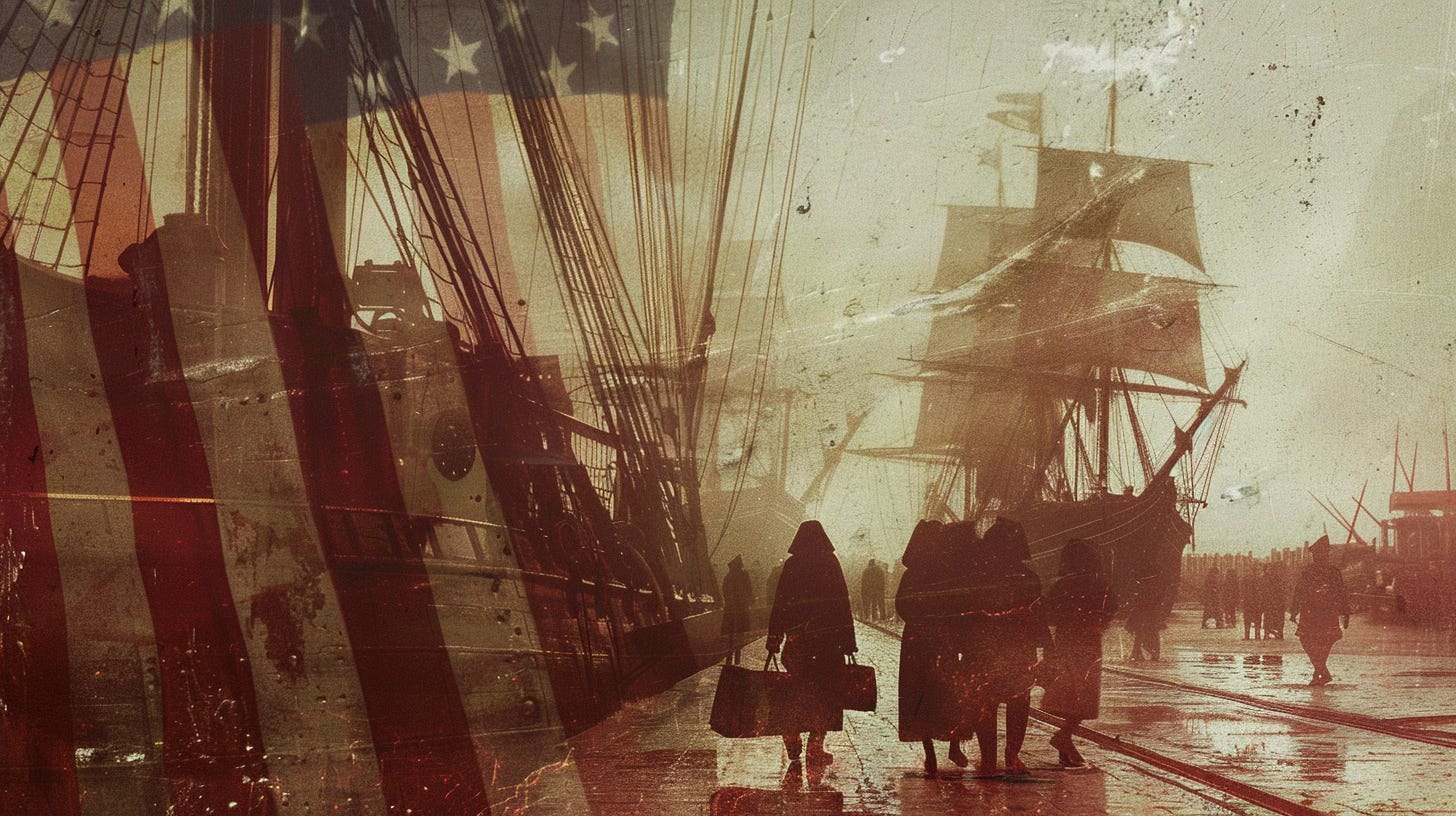
Back home, America turned two hundred and fifty today. Here, in England, it’s just an ordinary Saturday. Nobody’s grilling anything. No fireworks. No top 100 songs countdown on the radio. And yet I find myself, an ocean away, wanting to celebrate anyway.
I think we need this some years, the rejoicing in spite of the grief, not instead of it. It took a flood of World Cup fans arriving in the States this summer, wandering around wide-eyed and delighted, to remind a lot of us what’s actually good about the place, the parts we forget to notice because we’re too busy arguing about the rest. Not that those arguments aren’t real and valid! When I sit and ask myself what I actually miss about America, after nearly a decade away… hands down: it’s the people. There’s an openness in Americans, a willingness, that I haven’t found anywhere else (not at the scale that Americans reach), not in all the decades I’ve spent moving through other people’s countries. I can’t speak for all 330 million people. But I know that spirit when I meet it, and I do miss it. There’s a sort of relief that comes over me when I return and I think to myself… I’m home. I get this.
That spirit didn’t arrive with the Declaration. If you trace it back far enough, past the myths we tell schoolkids every July, it started with people who had nothing left but that same willingness, the openness to risk everything on somewhere else. One of them was a young man named John Washington, and if he hadn’t made one very small, very human decision on a broken ship in 1657, there’s a real chance none of it exists: not the flag, not the country, not the spirit I find myself missing tonight.
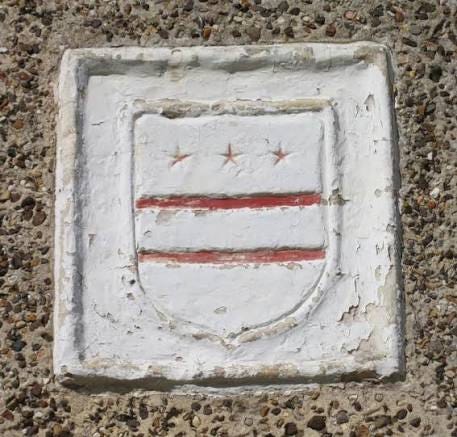
There is a house in the heart of the English countryside, in the county of Northamptonshire, called Sulgrave Manor. Over its door hangs a weather worn coat of arms granted to Lawrence Washington in 1592, two red bars under three stars. Today, the staff at Sulgrave Manor will tell you this same shield inspired the stars and stripes of the American flag two centuries later. Most actual historians say there’s no real evidence for that, just a good story that stuck. By the time John Washington was born, the manor and most of the family’s money were already gone, sold off generations before he arrived. What he inherited from Sulgrave wasn’t land. It was a name that had outlasted its fortune.
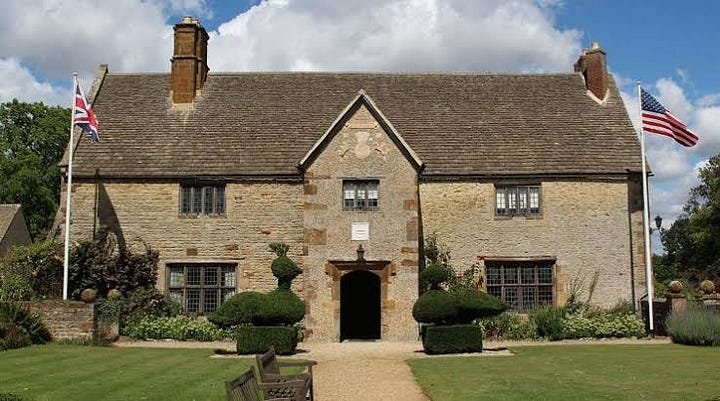
His father, Lawrence, was a rector loyal to a losing king. When Parliament’s men swept through Essex in the 1640s turning Royalist clergy out of their churches, they turned him out too, and he spent his last years poor. He died around 1652. Three years later, John’s mother followed him. By the time John stood on a dock in London in the winter of 1656, apprenticed to a merchant, boarding a ship called the Sea Horse bound for the tobacco wharves of Virginia, there was no one left standing on the shore to watch him go. No mother pressing a hand to his coat sleeve, asking him to stay. The truth, and I think the harder one, is that he left because there was nothing left to leave. His family’s name still hung over a door in Northamptonshire that no longer let him in.
John wasn’t trying to emigrate, not at first. He was a ship’s mate on a trading run, meant to carry English goods to Virginia and bring tobacco home. In February 1657, off the coast of what is now Virginia, a storm ran the Sea Horse aground in the Potomac. The ship could be repaired. The plan had always been to sail back. And somewhere in the weeks it took to fix a broken hull, a twenty-four-year-old man with no reason to return to a country that had already taken everything from his family, decided to stay instead. He married a local planter’s daughter named Anne Pope. He built a life on land that had never heard of Sulgrave.
I keep thinking about that decision since I first learned the story, because it is so small a detail. Nobody wrote it down as a turning point. There was no ceremony, no document that reads here is where everything changes. Just a man choosing, in the ordinary patience of a delayed voyage, not to go home. And because he made that choice, his son Lawrence was born in Virginia instead of England. And because Lawrence was born in Virginia, his grandson Augustine was too. And because Augustine married a young woman named Mary Ball, in 1732 they had a son named George. Take away one wrecked ship, one dead mother, one young man’s decision to stay rather than sail home, and there is no George Washington. No commander crossing the Delaware in a rowboat through ice. No first president standing under a portico refusing a crown. The country we’re marking two hundred and fifty years of today was, at its origin point, this contingent, this fragile. It came down to a storm and a choice a young man made when he had nothing left to lose by making it.
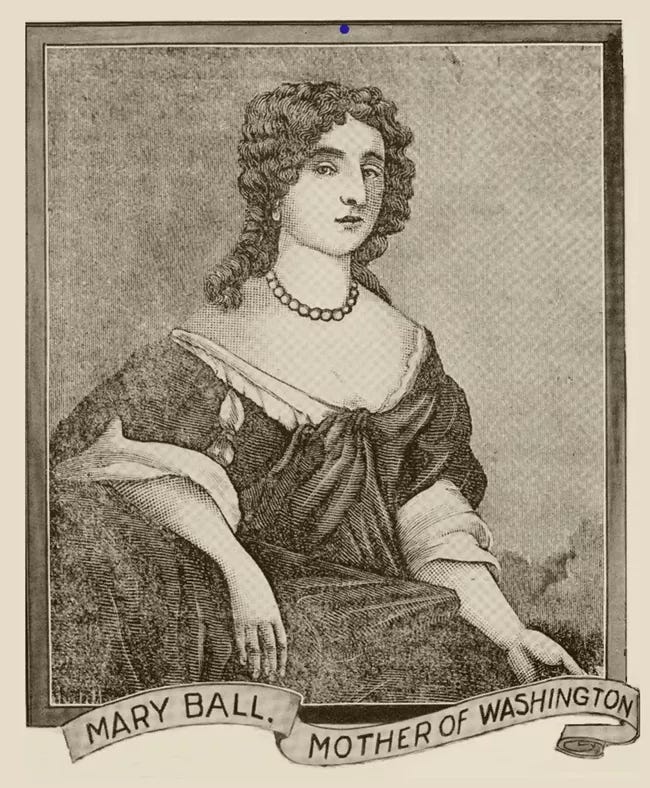
There’s a second near-miss buried in this same family, two generations later, and it turns on a mother again, this time one who was very much alive. When George Washington was fourteen, he wanted to join the Royal Navy, and his older half-brother and a family friend both pushed hard for it. His mother said no way. She feared losing George. And she had every right to worry. By then Mary Ball Washington had already lost her father by the time she was three, her mother by twelve, and her husband, Augustine, when George was eleven. I don’t think it’s a stretch to say a woman who has buried that many people by that age doesn’t refuse a boy a warship out of simple stubbornness. History hasn’t always been kind to her for it, biographers calling her difficult, small-minded, a drag on her son’s destiny, but her refusal may have saved more than it cost. Midshipmen died constantly and anonymously in the eighteenth-century navy, fever and shipwreck and nameless skirmishes, and there is a real chance the man who would go on to command a revolution instead drowns in his twenties off some coast nobody remembers, one more entry in a ship’s log. Twice in this one family, a decision nobody marked as historic at the time, one mother’s absence and one mother’s fear, turns out to be the reason there is a country left to argue about at all.
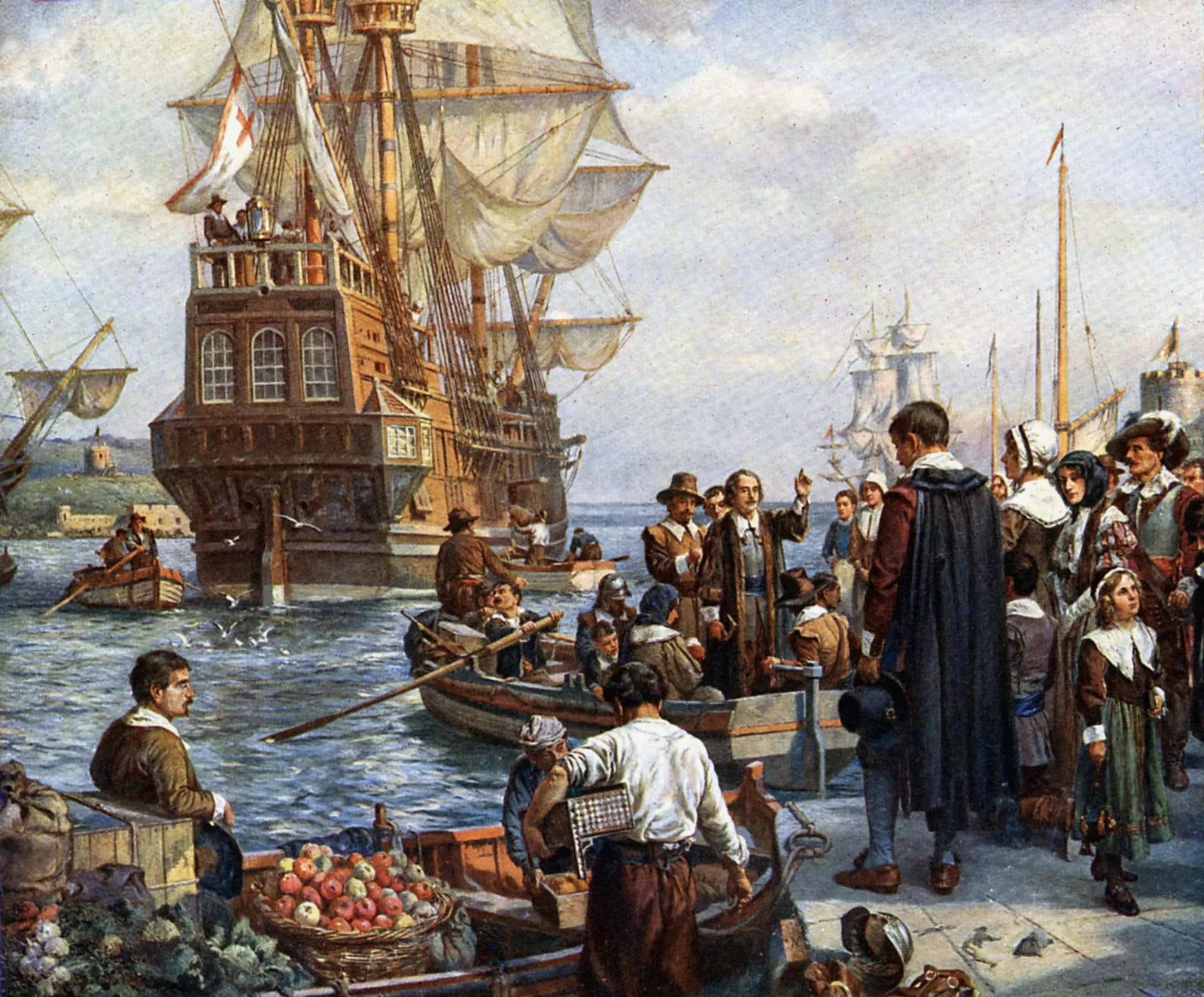
But here is the thing: his story isn’t really about him at all. John Washington was not unusual. He was one of what historians now estimate to be nearly 380,000 English (when the population at the time was around 2 million people) men, women, and children who crossed the Atlantic before 1700, one in every fifteen people alive in England in 1600. That’s not a footnote. That’s a nation emptying out. Most of them left in the same four decades John did, the 1620s through the 1660s. We tell the story of America’s beginning as though it starts with a small, devout band on a ship called the Mayflower, praying their way toward religious liberty. And they were real, and their story matters. But they were never the majority. In the years of heaviest migration, Puritans made up perhaps a quarter of the English who crossed. The rest of them, hundreds of thousands, were not fleeing a king’s church so much as they were fleeing hunger.
Picture England in the early 1600s the way it actually was, not the way the founding myth remembers it. The Tudor era had ended with the death of Elizabeth the I. Enter The Stuart era. Harvests failing in the 1590s and again in the 1620s. Grain prices climbing sixty percent in a single generation. Whole villages in East Anglia and the West Country gone quiet because the wool trade collapsed and the looms sat idle, the weavers who’d fed their families on that work suddenly with nothing. Let me say here - the wool industry was what this country revolved around for centuries. It was no small thing that this came to a halt. Common fields, land that had belonged to no one and everyone for centuries, fenced off overnight by men with money, families who’d worked that ground for generations turned out with nowhere to go. And on top of all of this, there was a population boom. England’s population had grown from three million to five million in less than a hundred years, more young people than there was land or work to hold them. And underneath all of it, a civil war tearing through the country, a king executed, a Commonwealth rising and falling, soldiers on the losing side of every battle needing somewhere else to be.
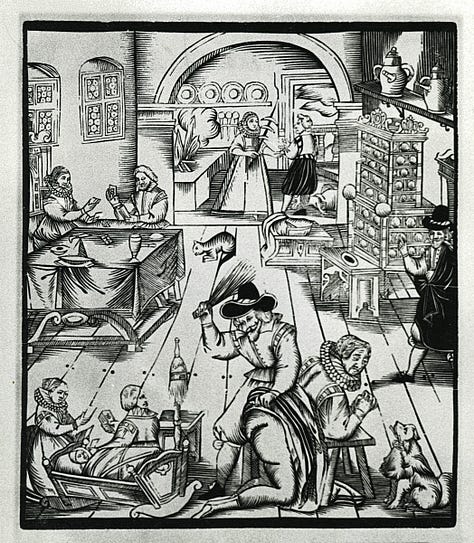
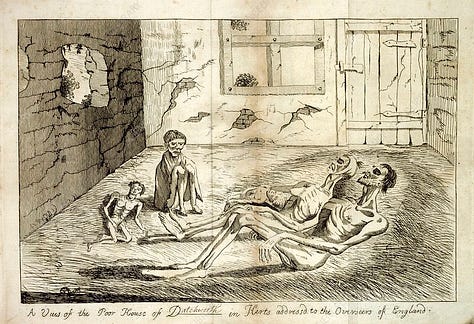
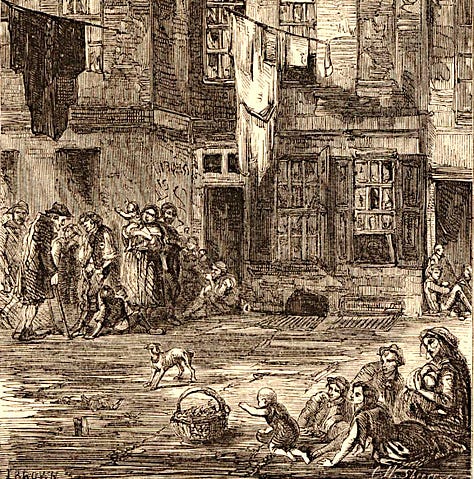
England was eating itself alive.
This is who got on the ships. Not idealists chasing a vision so much as people for whom England had simply stopped being survivable. Two out of every three English people who reached Virginia and the Caribbean before 1650 came over as indentured servants, signing away seven years of their lives for the promise of passage, food, and a small piece of land at the end of it, if they lived. Many didn’t. Only 1 in 10 survived their first winter. A servant named Richard Frethorne wrote home from Virginia in 1623 begging to be brought back, or else, he said, he was as good as dead already. And still they kept coming, because whatever waited for them across the ocean, it could not be worse than certain, permanent hunger at home. Others didn’t choose the voyage at all. Convicts, orphaned children on the street of London, and prisoners of war from Cromwell’s campaigns in Ireland and Scotland, shipped over as forced labor, sentences converted into years of servitude on a plantation they’d never asked to see.
I don’t want to spend long on the Puritans, because their story has been told and retold and that’s exactly the distortion I’m trying to undo here. It seems to be the only story we are told when it comes to the early American origins. What I want to sit with instead is the plain, staggering fact of what these people did. Most of them had never traveled more than a few miles from the village where they were born. Their entire world was the church spire they could see from their own village, the neighbors whose grandparents had known their grandparents. And then hunger, or eviction, or a lost war, or just the crushing weight of too many children and not enough land, pushed them onto a road to a port city they’d never seen but only heard of, and then onto a wooden ship having never experienced this landscape, and then onto an ocean with no edge they could imagine reaching. No guarantee waited on the other side. Only a chance…. a rumor of land. A hope and a prayer. Maybe tall tales and village gossip of someone who’d gone before, half of it warning them not to come, half of it promising that a man could be master of his own ground for the first time in his family’s memory.
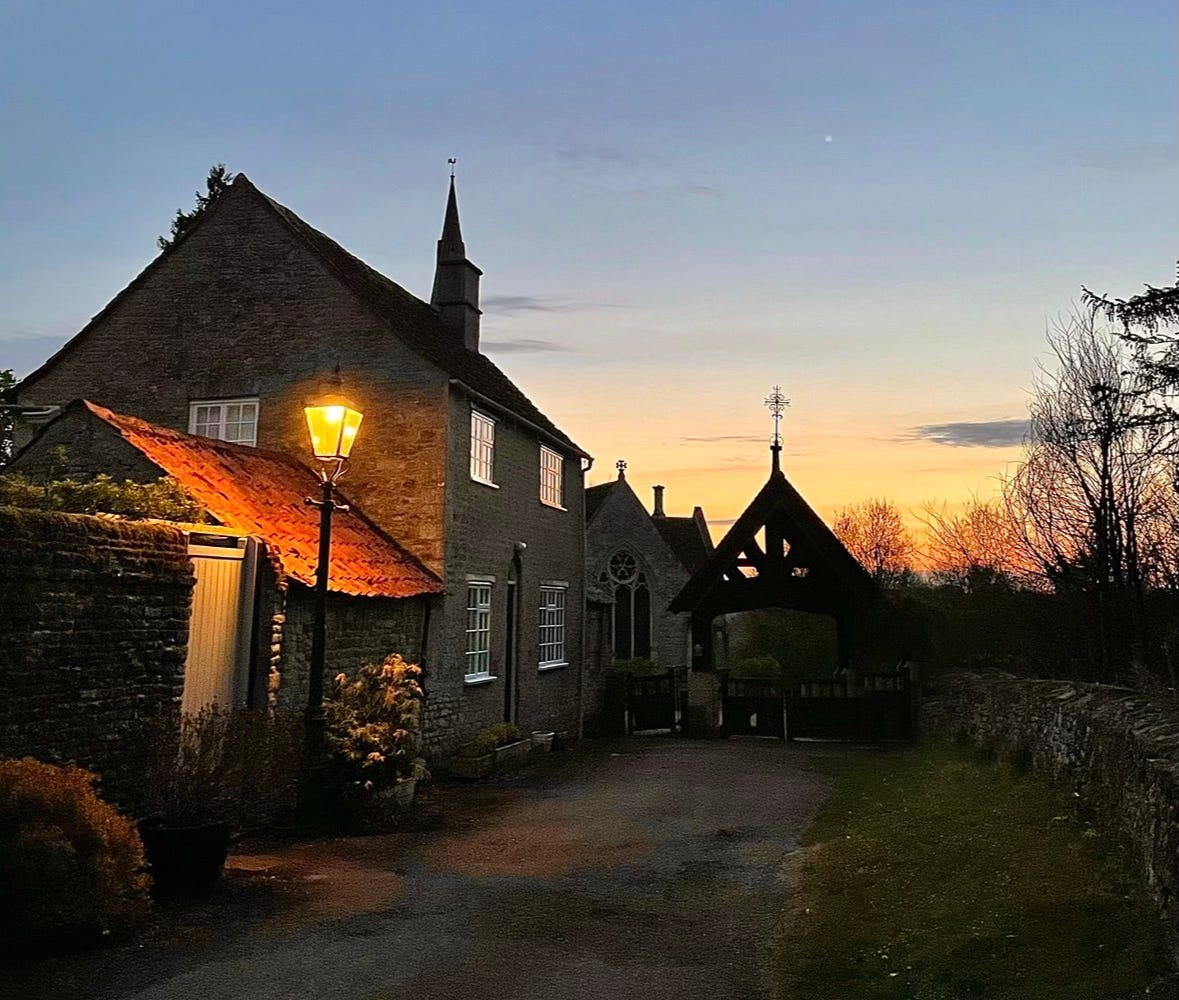
I live in a hamlet - smaller than a village in that there is no church or pub to claim - with more sheep than people. A short drive away sits a scatter of cottages called Achurch, a hamlet as small as mine, that most maps don’t bother naming them. Edmund Quincy left Achurch for Massachusetts in 1633, and generations later his family gave a president his middle name, John Quincy Adams, and married into the family that gave America Abigail Adams. In this same patch of countryside, a stubborn, much-imprisoned preacher named Robert Browne held the parish for forty years, the man later generations would call the father of the Congregational church and, because the ideas he was jailed thirty-two times over eventually crossed the ocean without him, the father of the Pilgrims. He’s buried in Northampton under nothing grander than a plaque. You could drive through this whole corner of the county I call home and see nothing but sleepy countryside and stone walls and sheep and never guess what it produced. And that is exactly what unsettles me about it, standing in these fields. This unremarkable place, where nothing ever seems to happen, once held people willing to walk away from everything they knew, cross the width of a country on foot, and board a wooden ship pointed at an edge they couldn’t see past.
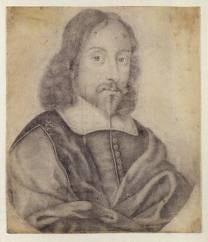

A story as old as time. People are still doing that. Tonight, somewhere. To lose this part of the story, the ordinary-village part, is to lose the thread of what actually made us American to begin with. That is the actual DNA of this country, not divine right and not conquest, though conquest came, and I won’t pretend it didn’t. It is risk. It is people who had so little to lose that the unknown became, however briefly, more bearable than the known. Sit with that. Most of us will never ever understand this kind of confrontation, this reality. Freedom, when you trace it back this far, was never a document or a granted right. It was a gamble people made with their own bodies, in the dark, on the water, with no promise it would pay out. Ninety years after John Washington chose to stay in a Potomac creek instead of sailing home, his great-grandson stood at the head of an army making the same kind of choice at a larger scale, staking everything on a risk with no guarantee.
Freedom rang because people paid for the ringing.
It required courage that had nowhere to hide behind and no safety net beneath it, and I think we’ve let the phrase “the land of the free” go soft with age, forgotten that under it there is always a body that took a terrible chance.
I don’t think this is a uniquely American virtue, and I don’t think it belongs only to the seventeenth century. Every person who leaves a place they know for a place they don’t, because staying has become unlivable, is making the same trade John Washington made on that grounded ship. I don’t believe people cross oceans or borders today to take something from someone else. I believe they cross continents and time zones because home stopped being a place that could hold them, and somewhere else became a chance worth the risk of everything familiar. That is not new. That is the whole story, the same one, told over and over in different centuries with different accents. We can’t forget this part of the story.
My own ancestors made this same trade, on both sides of my family, out of Norway and Germany, out of England and Scotland, all of them betting on the same thing: not comfort, but a way, an opportunity to build something where there hadn’t been one. Whether any of them lived to see the payoff, I don’t know. Some of them almost certainly didn’t. What they were actually buying without knowing it, was a chance for grandchildren or great-grandchildren they would never meet to stand somewhere freer than they ever had. That’s the part of freedom nobody puts on a monument, that most of the people who risk everything for it are risking it on behalf of someone who hasn’t been born yet.
I left America twice. Once, post 9/11, because I was trying to make sense of the world I was living. The second time, I was living in some version of the same reason, in reverse, an opportunity, a way, a kind of hope in the middle of a season of suffering, and ended up building a life in the English countryside my own ancestors once fled. Someone in my family decided to go. Generations later, someone in my family decided to come back. The direction changes. The wanting underneath it, a life you can’t quite picture yet but can feel the shape of, doesn’t.
And I won’t pretend the story stays clean once you follow it all the way through, because it doesn’t. The people who came in search of land came to land that was already someone’s, and what happened to the people who were already there was not opportunity or hope, it was theft and violence dressed up afterward as destiny. But I promise you, most of those coming didn’t know what would await them on a land that wasn’t theirs to begin with. The plantations these migrants built and inherited, the very ground John Washington’s descendants farmed into wealth, ran on the forced labor of people who never signed anything, who never chose the ocean at all. There is a dark heart inside this story, same as there’s a dark heart inside most origin stories, families included, nations included. Wanting to tell the truth about the courage it took to leave doesn’t mean looking away from what that courage was so often used to justify once people arrived.
And yet I don’t want the shame-only version of this story either, the one where every person who got on a boat becomes, in hindsight, a conquistador out to divid and conquer. Most of them weren’t. That’s just it. The men who built fortunes on stolen land and stolen labor were a small, powerful minority with the capital to invest in ships and patents. The people actually crossing the ocean in the hold, two out of every three of them, were indentured servants who arrived owning less than some of the enslaved people they’d eventually work alongside. They weren’t plotting to take a continent. They were starving, evicted, conscripted, or orphaned the way John Washington was, and they got on a ship because staying had already stopped being survivable. That doesn’t erase what they built into once they arrived, or what it cost the people already living on that land. It’s such a complex and layered history that required more unpacking than I have space to write. That’s the human experience. But they weren’t villains with a plan. They were ordinary and frightened and hopeful, in roughly the proportions any of us would be. If you’d been a starving weaver in East Anglia in 1625 with 6 mouths to feed and no hope in sight, I think you’d have gotten on that ship too. I know I would have.
That’s part of what I think we get wrong when we tell this story too cleanly. There was no one waiting on the shore to welcome anybody. John Washington didn’t step onto a dock to a brass band, he stepped onto mud and marsh and a country that didn’t know or want him yet. There’s a version of this same truth still told at Ellis Island, two and a half centuries later: someone arrived believing the streets would be paved with gold, and found instead there were no streets at all, only dirt, and that she was the one who’d have to pave them. That’s closer to the real shape of the whole story than any welcome mat. Nobody handed this country to anybody. People built whatever welcome exists here themselves, one arrival teaching the next how to survive it, one exhausted family clearing a little room for the family that came off the next boat.
I don't usually think much about Independence Day. I've never been the flag-and-fireworks kind of person. But this year, tangled up in my own complicated story of leaving one country for another, I keep landing on the same flag anyway, the one that flew over slave ships and also, later, over people spending centuries trying to force its stated promises to come true. The men who wrote "all men are created equal" owned men who weren't permitted to count as men under the law they'd just signed. That doesn't resolve. But the hypocrisy of the men who first wrote the words doesn't mean the words belong only to them. Every generation that has fought for what was promised and denied, abolitionists, suffragists, the civil rights movement, people still fighting some version of that fight now, has been staking a claim on those founding ideas rather than rejecting them. Stripes and stars were never a finished argument. They're still an open one.
That’s the thing I keep coming back to about the choice John Washington made on a grounded ship in a Virginia creek. He made one ordinary decision, the kind nobody marks as historic while it’s happening, and it opened a pathway he never lived to see the end of, the same way most of us do, if we’re lucky enough to matter at all. My own ancestors did something close to the same thing, landing on ground that wasn’t paved for them and paving it anyway, hoping some grandchild they’d never meet might one day walk down a street they’d never see finished. That’s what I actually want to mark today, two hundred and fifty years on. Not a plot of ground that broke from a king, though it is that too. The accumulated weight of ordinary people making choices they never lived to see the end of, paving the ground under the rest of us, one stretch at a time. Lest we forget that this is, under everything else we argue about, a nation of immigrants, made of people who left and people who stayed and people who are still arriving right now for some version of the same reason the 17th century English once did. That's not incidental to who we are. It's the whole of it. Two hundred and fifty years in, honoring that might be the truest way there is to celebrate it.
Happy Birthday America!
About the Author
Welcome - I’m Kyle, the soul behind Sudden Journeys. I’m a writer, photographer, and founder of Sudden Journeys. I’ve spent the last few decades exploring: guiding travelers, leading tours, living abroad, and paying close attention to what landscapes, rooms, and encounters awaken in us. I write about place and belonging, hospitality and gathering, the practice of attention through journaling, and the home life between departures. Originally from a small town south of Nashville; I divide my time between the English countryside, London, and wherever the road takes me next.

Stay a While
If this piece resonated, you’ll find more long-form essays, reflections on journaling and home life, notes on gathering and hospitality, and lived travel writing here on Substack. Paid subscribers receive deeper essays, photography notes, and more intimate reflections.
Let’s Connect
Ask me a question, submit feedback or suggest a topic here.
💬 Come say hi on Instagram or LinkedIn
🎙️ On the Echoes of Elsewhere podcast, exploring place, migration, and belonging
📞 Have questions about travel? Book a travel planning consultation or email me at kyle@mysuddenjourneys.com
🪩 If you feel moved to like, comment, or share, it helps this work find its way to others who might need it.♥️
Thanks for reading Sudden Journeys! This post is public so feel free to share it.
Comments
Nothing yet. Say the first thing.
Sign in to join the conversation.