
Late last week, I hit 30 weeks of pregnancy. The various apps continue to diverge in their baby-as-food comparisons (baby weighs as much as a cantaloupe and is the size of a Jarritos bottle) but all echo the same reminder that I’m roughly 70 days away from “meeting [my] baby.”1
Escalating fatigue is completely typical of the third trimester, and this week, I’m reaching the point where I have to respect my physical limits and scale down my training in a more significant way. I’ve put a freeze on my jiu-jitsu gym membership starting in January.
This week, as I’ve been forced to slow down, you’ll read my reflections on the theme of training in pregnancy. Most importantly, you’ll learn why and how I continued training jiu-jitsu for most of my pregnancy, even if to the disdain and discouragement of other people.
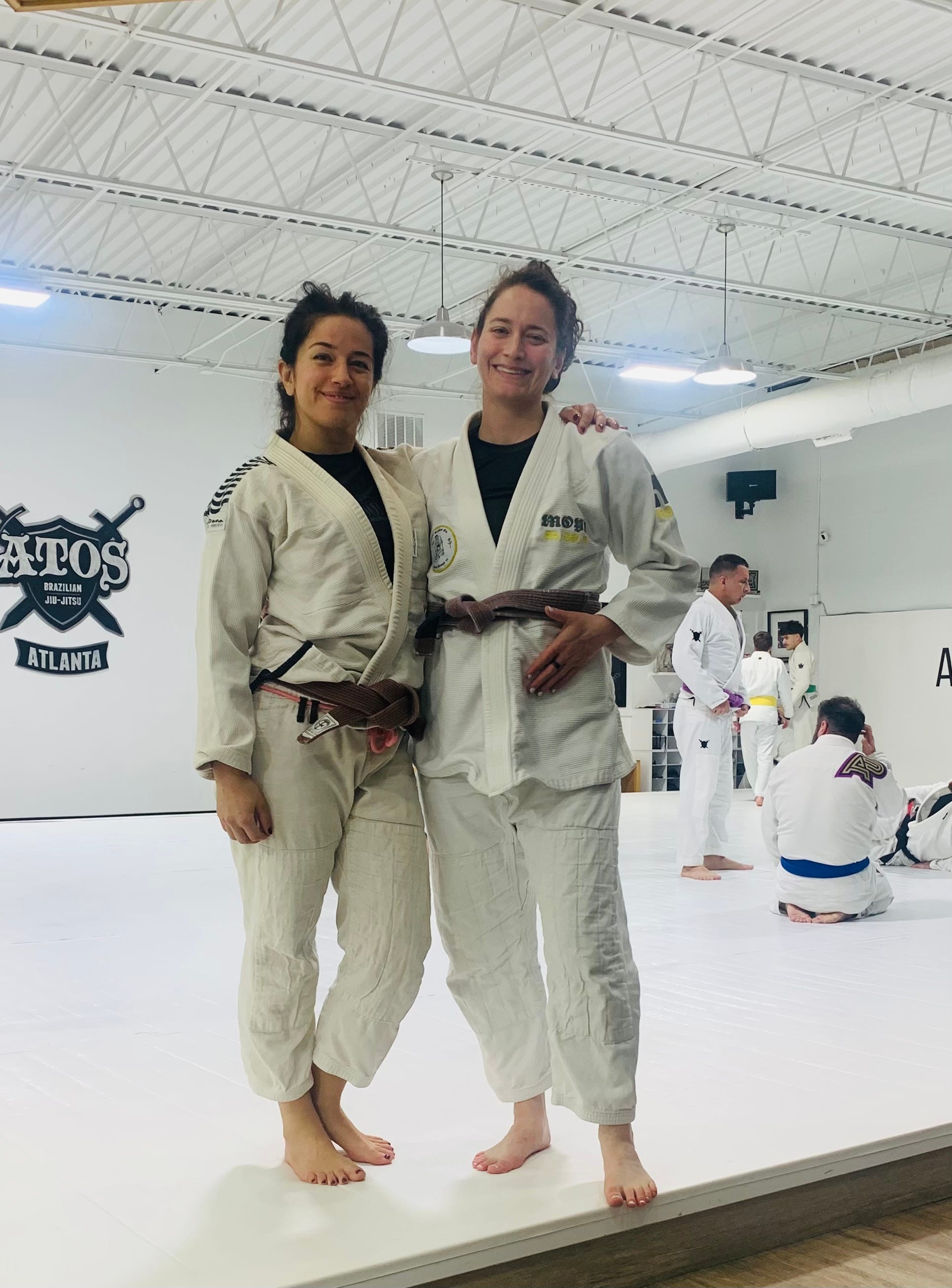
I’m a Brown Belt and have trained jiu-jitsu for the last eight-and-a-half years.
Because, on a long enough timeline, anyone can earn a belt by just continuing to show up, let me give you a sense of what my eight-and-a-half years have looked like:
For most of my time training, I was in the gym anywhere between four and six times a week, sometimes twice a day. At my first gym, the only person with a higher record of attendance at the time was the active UFC fighter training there.
When I was thirty years old, I quit my job for a year to dedicate myself to training and competing full-time, including relegating myself to being shark bait at one of the best gyms in the world.
I won the World Masters Championship–twice: once at Blue Belt in 2020 and once at Purple Belt in 2022.
I tore my ACL, MCL, and Meniscus in February 2024 and had knee surgery for the injury in April 2024. Plenty of people quit jiu-jitsu anyway, but plenty more quit after a knee surgery. I made a full return to sport one year later.
I don’t share this list to brag or self-indulge. I say this to reinforce that I know what it means to train hard, to train injured, and to come back from a serious layoff period.
And it’s exactly why it really grinds my gears to have people opine on my training as if they know what I’ve been through, as if they know my body better than I do, and as if they know what’s best for me and my child.
Every person who has seen me train through pregnancy has had a point of view that lies somewhere on the following spectrum.
On one end, there are the positive, supportive points of view:
“Wow, that’s awesome and badass.”
“Girl, you’re out here making us look bad for not working hard enough!”2
“Good for you for continuing to show up.”
“That baby is going to be a monster!”3
On the other end, there are the less generous, more critical points of view:
“You are crazy for continuing to train.”4
“I don’t get why you’re still here.”
“I wouldn’t let her train if she were my wife.”
I’m willing to bet those in the latter camp outnumber those in the former camp, but they usually don’t say it to my face.5
Take it from the reels and the comments section on social media of pregnancy-related fitness influencers: the general sentiment from mostly-male strangers on the internet is that a mom continuing to exercise during pregnancy is irresponsible.
Above: Box squats from December 7, 2025. Honestly, I get more scared hurting myself doing squats than I do showing up to drill jiu-jitsu, but this, too, is safe. I’m not trying to put up crazy numbers, and the box is there for safety.
On the whole, exercise is a good thing for humans and that doesn’t change during pregnancy. Specifically during pregnancy, it helps reduce risk of gestational diabetes, preeclampsia, and postpartum depression.6
There are some legitimate reasons a doctor might recommend avoiding exercise or avoiding certain types of exercise during pregnancy–usually when the pregnancy is considered high-risk or the mother’s symptoms or history requires additional caution.7
Most leading organizations (and doctors) recommend 150 minutes of exercise/week while pregnant, inclusive of cardiovascular activity and resistance training. Doctors generally warn against activities at collision and fall risks, since these are more likely to harm the fetus or mother.8
Most other guidance regarding exercise during pregnancy is a crapshoot and isn’t well-backed by data. Specifically, “there is insufficient data to counsel pregnant women on strenuous exercise, particularly athletes who wish to continue training during pregnancy.”9 10
Jiu-jitsu is not skydiving, ultra racing, or roller derby. Slow-paced pajama-wrestling with other women, the majority of whom have been training for years and are in their 30s and 40s, is fairly tame and less likely to hurt my child in the womb than higher-stress, harder-contact activities with a bigger fall risk. You do risk barreling into other sparring groups and freak accidents do happen, but I’d consider those things within the realm of tolerable risk and not specific to pregnancy. For me, avoiding these types of risks would be like avoiding going down the stairs because I’m afraid of tripping.
Jiu-jitsu can be unsafe for pregnancy–but not in the way I’m training it currently. I’m not getting thrown. I’m not keeping my heart rate elevated to extremes or for extended periods of time. I’m not inviting knees on my belly, drilling deep choke defenses, or otherwise putting myself in situations where mine or my baby’s health and safety are at overt risk due to hard contact or heavy impact. These are the typical ways jiu-jitsu *could* be unsafe for pregnancy and they’re fairly avoidable.
If I were earlier in my jiu-jitsu journey (not to mention, if I felt worse throughout my pregnancy), I probably would have stopped training much sooner. Years ago, I would have been less knowledgeable about setting constraints in my training and–due to being less experienced–less proficient in influencing the technical trajectory of a round of sparring. I got pregnant roughly eight years into my jiu-jitsu journey and was extremely consistent and serious for most of it. One of those years was a layoff year due to knee surgery, but I’d argue that navigating the year-long return-to-sport process made me more proficient in how to safely scale up my training intensity and communicate any must-have training accommodations with my drilling partners.
Broader medical guidance generally states that if you were doing something pre-pregnancy, it’s probably fine to continue in pregnancy so long as you adapt and de-risk accordingly. Nothing I’ve been doing in my pregnancy is a new physical practice. I’m adapting and doing things I’ve been doing anywhere from 5-8 years: it’s strength training, jiu-jitsu, and some cardio cross-training, and none of it has been a pivot from the usual fare. The intensity and the constraints are different, but the nature of the practice has remained the same.
Not training would have been worse for my physical and mental health than finding ways to continue training. While I have a few other social avenues and communities in Atlanta and I expect my social networks to grow and change following childbirth, for now, my training community is my largest one. Given the choice to stay home alone, be sedentary, and depressed when I could get out of the house, socialize, and still move around at the gym, why wouldn’t I go to the gym? I’ll be fairly home-bound in the weeks following birth anyway. Better to get out of the house while I can–not to mention before it requires extra steps with the newborn.
This is the standard I’d want to set for my child. If my son is tired and doesn’t want to train one day, I will be able to tell him, “I trained with you while I was pregnant. Stop whining.”
I’m willing to bet that no woman who likes to train enjoys the process of training while pregnant–even if she is enjoying pregnancy more broadly.
Slowing down and adapting is preferable to stopping, but it’s not fun to have to change your routine. It’s often demoralizing to go from making consistent—even if small—improvements to visibly backsliding while enduring the process of growing a human.11
As someone who is extremely competitive and was already sidelined for a year due to injury, I’ve particularly struggled with comparing myself to others who haven’t had to interrupt their training—even though starting a family is a gift and pregnancy as an “interruption” to training is as wonderful a reason as there can be.
All of this is to say that I don’t like training while pregnant.
If I could have a baby without having to change my training habits, I would—and I’m sure that many women would say the same.
It would be easier and more fun to sit on the couch, eat junk food, and rot in front of my TV, but I believe that…
continuing to move safely and
responsibly pushing myself as much as I still can
…is still better for both mine and my child’s health and wellbeing than the alternatives.
In the end, it’s an choice—one made daily between now and birth.
I may choose differently tomorrow, but today I continue to choose training while pregnant to not training at all.
Thanks for reading. See you next week,
EZ
I don’t love the turn of phrase of meeting the baby, partly because I find it cheesy and partly because he’s already made his presence known with a lot of kicking, which conveniently picks up every time I’m trying to rest.
Stranger at the local Crunch Fitness who saw me go through my knee surgery and has watched me continue lifting through pregnancy
Said with awe and in a complimentary way–not like, “That baby is going to come out with birth defects.”
My coach is the one who said this but has also been supportive in adapting certain drills in class during my pregnancy, has respected that I know my own limits, and that I’ll stop when I am ready to.
Or they tell my husband instead, who agrees with them and believes, “[I] should have stopped training weeks ago.” He didn’t like all my choices, but he’s had to respect them.
Link to source here from the Office of Disease Prevention and Health Promotion within the U.S. Department of Health and Human Services.
Link to article here from the NIH’s National Library of Medicine, titled, “Strenuous Exercise During Pregnancy: Is There a Limit?“
On the topic of deficient research and medical guidance, the main answer that seems to be missing re: training in pregnancy is “how long is long enough to be dangerous?” For example:
I’ve often heard the advice, “Don’t spend too much time on your back” due to concerns regarding restricted fetal blood flow, but no one has been able to define how much time is too much time on my back.
I’ve also received guidance to avoid keeping my heart rate elevated above 140 beats per minute for significant periods of time, but again–how much time is too much time? Why 140 bpm? Is there a study on this I can’t seem to find? If anything, the “avoid exceeding 140 bpm” guideline seems outdated and as if it’s since been replaced with “avoid going past a 6-8 RPE”–but again…what’s the time threshold at which a certain rate of exertion goes from salutary to risky to dangerous?
Along with “meet your baby,” “growing a human” is another pregnancy turn of phrase that I dislike, but I find it less cringeworthy because there’s a biological lens to it.
No posts
Comments
Nothing yet. Say the first thing.
Sign in to join the conversation.