
Hello and welcome back. I’m in week 31 of pregnancy, and I feel fatigued—though I think I’m more fatigued from scheduling and attending appointments than from growing and carrying the baby.
Between a hospital tour, a doula consult, a pelvic floor PT consult, a standard prenatal doctor’s appointment, and a “newborn care 101” class in the last week, preparing for a baby has become a meeting-heavy job on par with my actual full-time job.
On the theme of preparation: last week I wrote here about my approach to training jiu-jitsu through pregnancy. This week, you’ll read about training layoffs—specifically, how I’m preparing for my “maternity leave” from training jiu-jitsu in light of my last “unplanned leave” due to knee surgery.
If you’ve been following me for a while, you know I’ve navigated one hard training layoff before. If you haven’t, here’s the timeline you need to know:
I tore my ACL, MCL, and meniscus in a freak accident in a jiu-jitsu competition.
I had surgery for the injury in April 2024.
I had a rough return-to-sport journey that was longer than I, my peers, and my coach expected, not stepping back into a class to drill until January 2025.
I rebuilt my technical toolbox and broader bodily self-trust between January 2025 and June 2025.
By the time I got back to a semblance of “feeling like myself” in jiu-jitsu training in June 2025, I found out that I was pregnant. 1
The period from April 2024 to January 2025 sucked, big time.
Anyone who has personally experienced an ACL surgery (or knows someone who has gone through ACL surgery) can understand why that layoff period sucked. For those who are fortunate enough to never have had to think about ACL surgeries, it’s not rocket science:
A knee injury and the surgery are inherently debilitating.
The recovery from surgery is as much physical as mental, especially when a return-to-sport element is involved
If forced to summarize why the injury and surgery uniquely sucked for me, it comes down to four things:
How active I had been before the injury. It’s humbling to go from training five days a week to relearning how to walk.
How self-sufficient I had been before the injury. It’s miserable to go from confidently navigating the world to limping off the curb of a sidewalk.
How much jiu-jitsu had been a part of my identity and habits. It’s depressing to have a major part of you and your day taken away from you, not knowing when you might have it back—if ever.
How much jiu-jitsu had been my go-to form of in-person community.2 It’s isolating to be unable to participate in your go-to form of community—especially if those relationships formed in community don’t neatly transfer outside of it.3
Most of my time in the layoff, I was in a negative headspace and emotional space.
I was angry about how suddenly and how severely “everything” had been taken away from me.4
I was frustrated by how slowly I was healing despite consistently going to PT.
It was hard not to feel FOMO and envy of people I knew who never had a sidelining injury, and could continue training and improving without interruption.
When I did try to hold onto the community piece of jiu-jitsu by going to watch classes at the gym, I felt out of place and experienced a lot of shame: people always asked me, “So when do you think you’ll be back,” and my recovery was tortoise-paced, I could only answer, “I don’t know.”5
When I found out that I was pregnant, the thing I was most afraid of was falling back into a pit of negativity while sidelined from training. It’s the thing I’m most determined to avoid on this next layoff.
There are a few things that I expect my previous training layoff and my upcoming training layoff to have in common, including:
Some period of time where the gym is fully off-limits as wounds literally need to close and heal6
Some period where showering, dog-walking, and other basic occupational and lifestyle tasks will be difficult and require assistance
Some concept of medical clearance needed to return to activity
Not feeling like myself for a while–probably forgetting what “myself” even feels like
For the most part though, the differences between the layoffs should make this one less unpleasant. I’d put these differences into two categories: circumstantial differences and deliberate differences.
It’s not my first layoff. That’s a bit of a “no, duh,” one, but there’s some comfort in knowing a little bit of what I’m in for.7 While I don’t like it, having been through a bad layoff before gives me some self-trust and confidence: I have come back before and I can come back again
It’s unlikely to be as bad, on the surface, as the last layoff, because birth is a “routine activity.” People are biologically wired to return to normal living and activity after birth. We’ve been doing it for thousands of years. Birth is normal and essential to human civilization and the bedrock of our existence. Knee surgery is not.8
Unlike the ACL injury and surgery, the birth and postpartum period is a “non-spontaneous layoff” with a fairly faithful timeline. The big thing that got me about the ACL period was how sudden it was and how abruptly my lifestyle had to change, with no reliable sense of when things might improve. Thanks to the fact that this layoff is non-spontaneous, it’s a lot easier to prepare a better structure for ongoing socialization, activity, and support.9
There’s more than a screw and a scar to show for this next layoff. There’s life and joy and a human being at the end of it.
When I say “deliberate differences,” I mean things that I am deliberately intending to do differently in this training layoff that I didn’t do in the previous one.
I’ll continue to study jiu-jitsu technique when and how it makes sense to do so. When I feel like I’m up to it and could benefit from getting out of the house to watch class, I’ll do it. If not, I’ll stay home.10 While at home, I have a list of things I can study and work on that I believe will be easy to maintain or regain.11
I’ll work on a bigger personal project that has nothing to do with training to keep me busy but fulfilled. One goal I have prior to delivering the baby is to complete a fiction book outline. In the months following birth, I expect to spend my odd hours in between sleeplessness and nursing working on a first draft.
I’ll create community and support structures in and outside of my jiu-jitsu community—and be less ashamed in asking for help from them. See this entire post for more on that topic.
I’ll let myself enjoy the layoff time because there’s something real to enjoy about it. If there’s one consistent piece of advice I’ve gotten from people, it’s to appreciate and enjoy the phases of my child’s early development. Eventually, I’ll get the gift of bringing my son to training and generally being active along with him. Until then, especially in the early days, I’m living by the famed Ferris Bueller’s Day Off quotation while watching him grow: “’Life moves pretty fast. If you don’t stop and look around once in a while, you could miss it.”
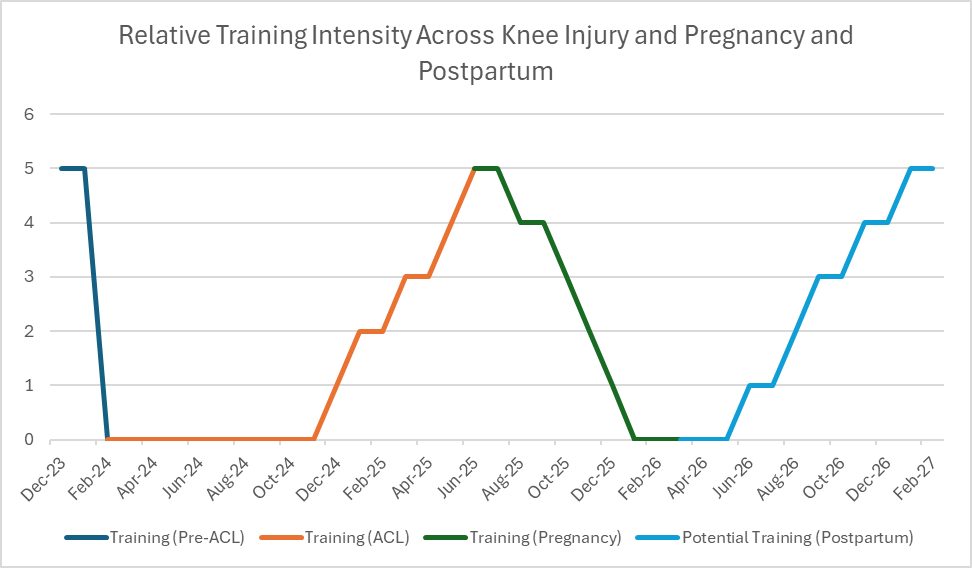
Breaking a decade-long hiatus of using spreadsheets for something other than project tracking, here’s a neat chart that basically maps out my relative training intensity over time across these two layoff periods.
I scored training intensity on a scale of 1-5, 5 being most intense. The line colors reflect actual training intensity for ACL and pregnancy periods and forecasted training intensity for postpartum.
Stay tuned ~1 year from now to see if the postpartum training predictions are accurate!
In the meantime, thanks for reading and see you next week.
EZ
I didn’t step back into a class for drilling until January 2025, didn’t get back to anything resembling hard sparring until April 2025 (one year post-op), and didn’t get back to my former training consistency until June 2025…at which point I had to think about imminently slowing down for the health of my baby.
Every job I’ve had since moving to Georgia has been a remote job. I have a monthly writing group I attend in person, but other than that, my sense of real-life community in Atlanta is disproportionately consists of jiu-jitsu people.
The most bittersweet thing I learned in the ACL recovery was this: who among my training partners could I have a relationship with—let alone a conversation with— outside of a jiu-jitsu training context
Dramatic, “woe is me” phrasing, I know, but that’s how it felt—and probably what I actually said—on my worst days of the layoff.
I’m certain that people assumed that I wasn’t trying hard enough to come back or that I wouldn’t come back at all. For anyone who assumed that, you know what they say about assumptions.
I’m hoping I don’t need a C-section, but even if I have a vaginal birth, pretty much everyone has some degree of tearing. Still, I don’t foresee either “post-partum wound” scenario being worse than the stitches and pins from the ACL surgery.
From the “training layoff” perspective. I will not pretend to “know what I’m in for” from the baby and motherhood transition perspective.
Unless you want to get into a Darwinian or evolutionary fitness kind of discussion here, and I’d prefer not to.
What that socialization, activity, and support plan structure currently looks like:
Support from other moms via a virtual and IRL postpartum group
At-home support via a postpartum doula and friends willing to come over and hang, walk dogs, and help out.
A book project to work on
Post-partum programming to see me through my first twelve weeks after birth
A Pelvic floor PT who has orthopedic experience with athletes and is extremely clear on the goals I have regarding my pregnancy and return to martial arts
Something to look forward to at the end of the “fourth trimester”: a trip to Boston to see friends and attend my ten-year grad school reunion
It goes without saying, but because someone will likely think it: if going out is an immune risk to my kid, of course I will stay home.
Gripping sequences is something I’ve been keen to study more intently. Fortunately, one undeniable benefit of “mom strength training” is continuous grip training: daily suitcase carries of an increasingly-weighty baby in a carrier.
No posts
Comments
Nothing yet. Say the first thing.
Sign in to join the conversation.