
(Just my personal recommendations & curiosities for cool products. Note — I don’t earn affiliate fees on these links.)

Duck Duck Duck
A code debugging Duck that talks back
IDEO is of course an iconic design studio. So I’m always curious what they come up with. Duck Duck Duck is a physical tabletop device that connects to your Claude coding session and offers commentary on what’s going on. Like you invoke Alexa or Google, you have to say “ducky” and it activates, connected to your Claude session. What fascinates me about this product and why I included it here: feels like a precursor to what might be arriving in the world of connected devices. IDEO is calling it embodied AI. “Most AI lives in a chat window. Duck Duck Duck doesn't. It sits next to you. It moves. It reacts” — IDEO.
Procreate
A catalyst for digital art
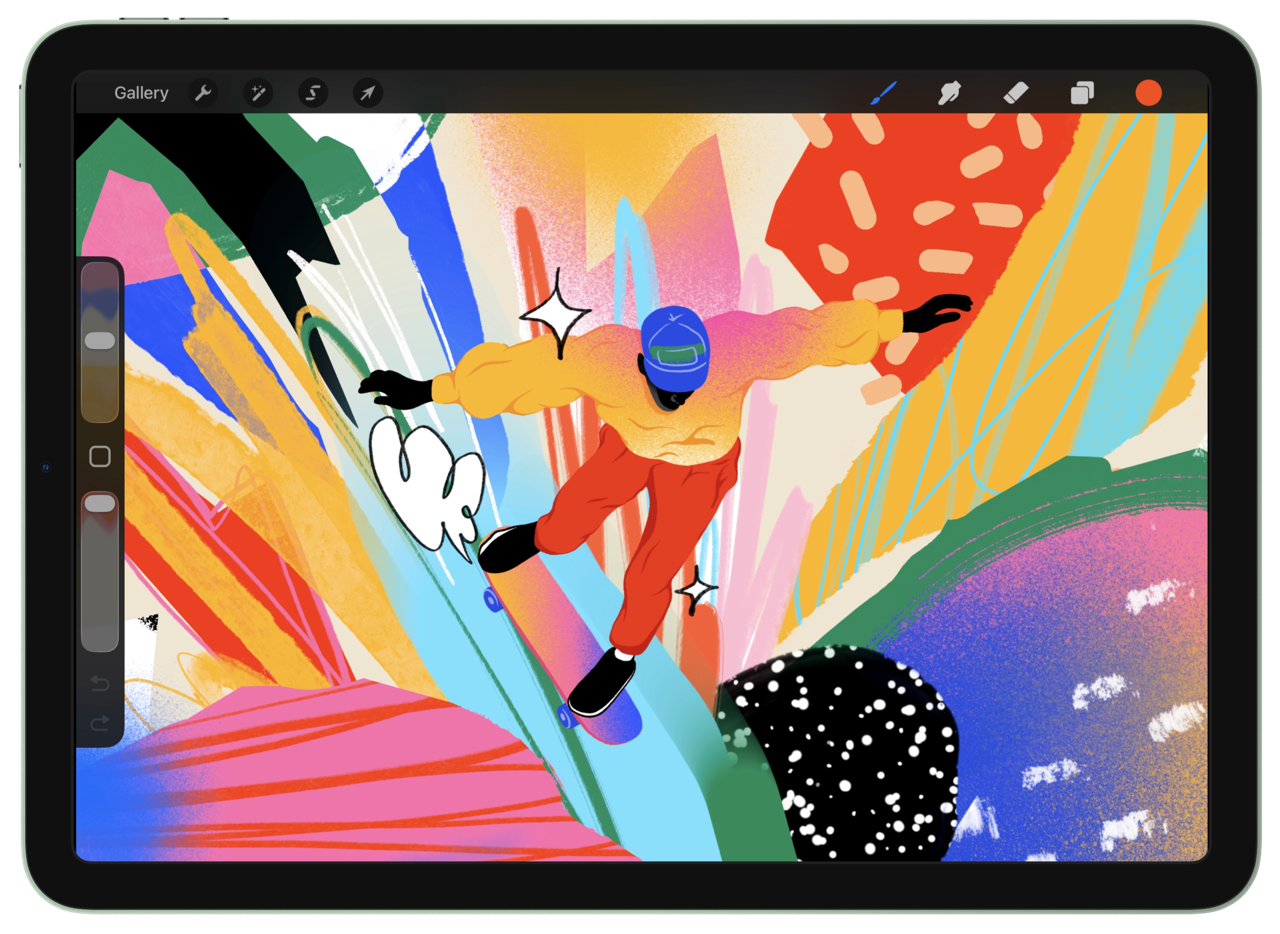
Procreate is an app that lets you make art on the iPad. You’ve probably heard of it before. Until recently, I always thought Procreate was an app only for professional artists. Not having any drawing skills of any sort (thanks to my school’s art teacher in Grade 4 who threw my art notebook on the floor every time he evaluated my work), I was afraid of the learning curve. But I was so wrong. A few days ago, I saw my wife’s 6 y/o niece make really cool art on the iPad while using Procreate for the first time ever. It felt like a thing of magic. And a couple of weeks prior, I saw my wife, a professional-grade artist on the analog medium (i.e. people would be happy to pay her to do art), use Procreate for the first-time to a very meaningful output (more on this in the column this week). A lot of nice creative tools originate in Australia, including Canva, but Procreate tops the list I think. One-time purchase on the iPad App Store.
Birds & Beans coffee
Coffee grown in agro-forests
Birds & Beans coffee beans have been in production for over 20 years. And it’s coffee that’s grown in forests that don’t harm the forest ecosystem. They call it bird-friendly coffee, which means that the forest where the coffee is grown is certified by The Smithsonian Migratory Bird Center as good habitat for wildlife. You can read up more on this here. Making good coffee beans doesn’t have to come at a cost of destroying the environment, and above all, Birds & Beans coffee which I’ve been brewing this week in my home (and have brewed plenty before) tastes pretty damn good.
A book from my shelf or one I aspire to own.

The Manual of Design Fiction
Julian Bleecker, Nick Foster, Fabien Girardin and Nicolas Nova
The Manual of Design Fiction is a definitive book about design fiction by a set of people whom I consider the foremost authority on design fiction. This book goes into the origins, evolution and practice of design fiction. It is a pragmatic field of study that I think has always been important, but now in the backdrop of big technological shifts, grows even more in relevance as a guide to imagining possible futures. Designs of the future have to be thoughtful in order for the world to be enjoyable, and with techniques grounded in doing than just philosophy, design fiction allows you to imagine futures with tangible prototypes.
I’ve been following Near Future Laboratory’s work for over a decade, and I got the first edition of this book when it published. I study it from time-to-time to aid my design work.
A figment of history.
No Artifact from the Past this week as writing this newsletter itself was a massive ordeal of getting over writer’s block in the spirit of consistency. See Issue #2’s artifact: the NASA Graphic Standards Manual.
Free-form thoughts.
AI Slop
The thing with AI slop is that it’s everywhere. Slop looks real, but is devoid of thinking. The Atlantic’s Eve Fairbanks wrote about this last week:
AI writing is almost impossible to edit, because even when it sounds plausible, a closer look will show that every element is equally off: The tone is bland; individual word choices are baffling; the structure lacks sense; key pieces of the argument are missing; facts are false. Working on AI text, as an editor, is like trying to operate on a body whose skin, muscles, veins, bones, and organs are all compromised. There’s nothing to leave intact, nowhere to begin.
I’ve always believed that AI is a tool, and it should be used as such — for research, for helping you with a passion, for brainstorming, for building a business with little resources, and so on. I wrote a note around this last year.
Not much has changed since then. When that tool makes it easy to generate slop at one tap of a button without doing any thinking, that’s not a good outcome for art, design, writing or any creative medium. The more time I spend in feeds, the more slop I see, and while it has gotten more people than ever to “write” and “create”, a big problem arises when AI manufactures a point-of-view despite the author not having one yet. Having a point-of-view requires thinking and it may have been developed over a period of months, years or decades — AI creates one in seconds. Once you get into the habit of generating slop without doing much thinking (and perhaps, even getting validation from folks on LinkedIn or Twitter), we’ve got a society that is basically manipulating language en masse to say nothing real.
Unlike what the handful of leaders of AI model companies love to say, that would be basically the opposite of a Rennaissance. It would be more akin to something like the Dark Ages? I have no doubt that people will rebel against slop as they already are in respectable publications.
The AI bubble?
Almost no one’s talking about the AI bubble anymore. S&P just had the longest winning streak. A substantial chunk of the profit margins and sources of “blockbuster” earnings for a handful of tech companies come from simply stakes in AI companies. The markets are readying up for some of the largest initial public offerings in tech of all time (i.e. Anthropic, OpenAI et al).
How much of this is real demand that will sustain, and how much of this is bubblenomics? I ask myself this question every week, and I’m sure well-meaning skeptics and tech commentators (like Benedict Evans) do as well.
Design is dead. Design isn’t dead. Design is dead. Design isn’t dead.
If you keep up with opinions on product design, this is how it oscillates every week. Someone pens an essay talking about how AI is getting so good at design, and then the next day, someone else writes how design & marketing will be the only job functions in tech to survive in the future. I don’t know what technological shift is the closest parallel to these sorts of discussions — the internet, the invention of the personal computer or the invention of the railroad. Probably, the personal computer. And yet, one of the most popular product categories right now seems to be "“personal computing, but for the AI era.” Y Combinator’s Summer 2026 “Request for Startups” has a lot of these themes.
From personal experience, with every new release of Anthropic’s latest AI model, I try to get it to design something just to see whether it is really good or not — I keep the problem fairly straightforward, like a small core artifact, but also not so straightforward like a mindless utility screen. It fails to produce basic good software every single time, let alone great. I’ve always believed design is a taste thing. If you don’t have good taste and haven’t spent time and effort developing it (usually, years and decades), no tool in the world could help you design things of value.
Solarday
In May, Solarday, the mindful productivity app for iOS I launched in November 2025, made it to App Store Editor-curated lists in the US & Canada. In the US, it was included in the Best New Apps & Updates, while in Canada, it was on Hot This Week, For about a week, it was also featured, along with original artwork designed by our new in-house digital illustrator (who also happens to be my wife) as “productivity for mindful people” right on top of the home page of the App Store.
As of today, it continues to be featured as the first app in the Boost Your Productivity list in Canada:
This is a list curated by Apple that also has products like Google Gemini, ChatGPT, Dropbox, Microsoft Copilot, 1Password, Notion and Docusign. I’m pretty sure Solarday is the youngest app on that list, and also the most intentionally different than the rest of the pack. Earlier last month, when I mentioned to an employee at the Apple Store that this app was locally made 5 mins away from that store in a tiny home office by a solo indie developer, they almost couldn’t believe it. It was a meaningful moment I’ll always remember.
Enjoy this summer week if you’re in the northern hemisphere, and if you’re in a place where it’s winter, summer will be back again, stay rest assured (winter has its own charms, however.)
Thanks again for reading this newsletter that takes a lot of thought to craft by hand. I will try my best to stay consistent through the season. 🙏🏾
—Siddharth
~ That's it for this edition. Slowly, but steadily. ~
No posts
Comments
Nothing yet. Say the first thing.
Sign in to join the conversation.