

Tin Can ☎️
A landline for children
Tin Can is kind of like a phone-based social network for kids. In the age of too much tech and too much screen time, kids aren’t immune from the perils of screens and smartphones, but how do you stay connected with friends or loved ones far away? Tin Can is a physical phone that works over wifi and doesn’t need a phone jack. The parent app lets you create an approved list of people that your kids can call — other Tin Can users for free; a $10/mo subscription to call other numbers. Missed calls don’t exist and you can set quiet hours. Found this interesting? See Physical Phones from Issue #4.

Is This Your Queen tee 👑
Thoughtful, post-colonial goods
Colonialism and its long-lasting effects have dictated the visual interpretation of queens and kings in the last few hundred years. Get a deck of cards anywhere and you can see the tell-tale signs. The New Delhi Company’s lifestyle brand redefines and reimagines this motif through their t-shirts and playing cards. With carefully crafted prose printed on the back, the Is This Your Queen tee is a beautiful and comfortable, 100% ring-spun cotton unisex tee that is made-to-order. These tees are as sporty as they are dressy. I loved wearing the Queen tee in multiple cities during sightseeing on my recent Italy trip. And I wore the King version under a suit on the day I got engaged roughly three years ago. That’s how special these tees are to me. And now, this Toronto-based boutique stocks a Yung Queen tee for kids too. Highly recommend.

Story Bookcase 📚
Bookshelves that don’t get in the way of the books
There’s one bookshelf design I keep coming back to, and it’s this style. It’s a nod to the original Sapien bookcase design by Milanese designer Bruno Rainaldi. The Story line is designed by Afteroom — a design studio run by a couple based in Taiwan. Whereas Sapien was more linear, Story rounds the edges more and comes in more colours. Made of mostly steel and aluminum, Story has been exclusively designed for furniture boutique Design Within Reach since 2017.
(Fun fact: When I used to live in downtown Toronto, I remember I got a quote from DWR for the short version of Sapien in 2016 and it used to be less than half the price of these bookshelves today! I’ve always regretted not getting it. Personally speaking, Design Within Reach has become design out of reach for me lately.)
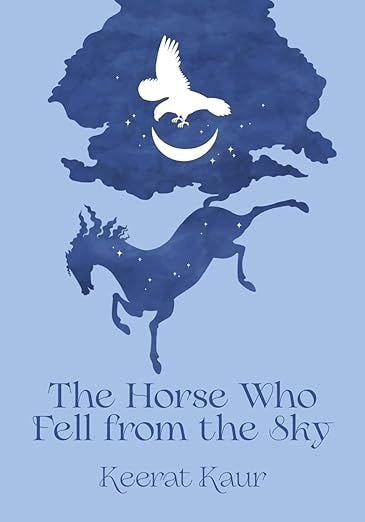
The Horse Who Fell from the Sky
by Keerat Kaur
This is the first-ever children’s book featured on Subgrid. The Horse Who Fell from the Sky is magical, awe-inspiring children’s book written by Canadian artist and author Keerat Kaur. It’s the story of Neela, a blue horse who falls from the sky into a strange new world and meets Baaz, the white hawk. Together, they navigate and help Neela make sense of the enchanting world that lies ahead for this curious horse. Beautifully illustrated from cover-to-cover, this is a book for all ages, including grown-ups as it serves as a reminder for holding on to your sense of wonder even in unknown worlds, and letting others help you see things you may have missed.
Keerat Kaur, of Sikh-Panjabi heritage, has also written Panjabi Garden, another beautifully illustrated book that serves as a delightful introduction to the Gurmukhi script and Panjabi language.
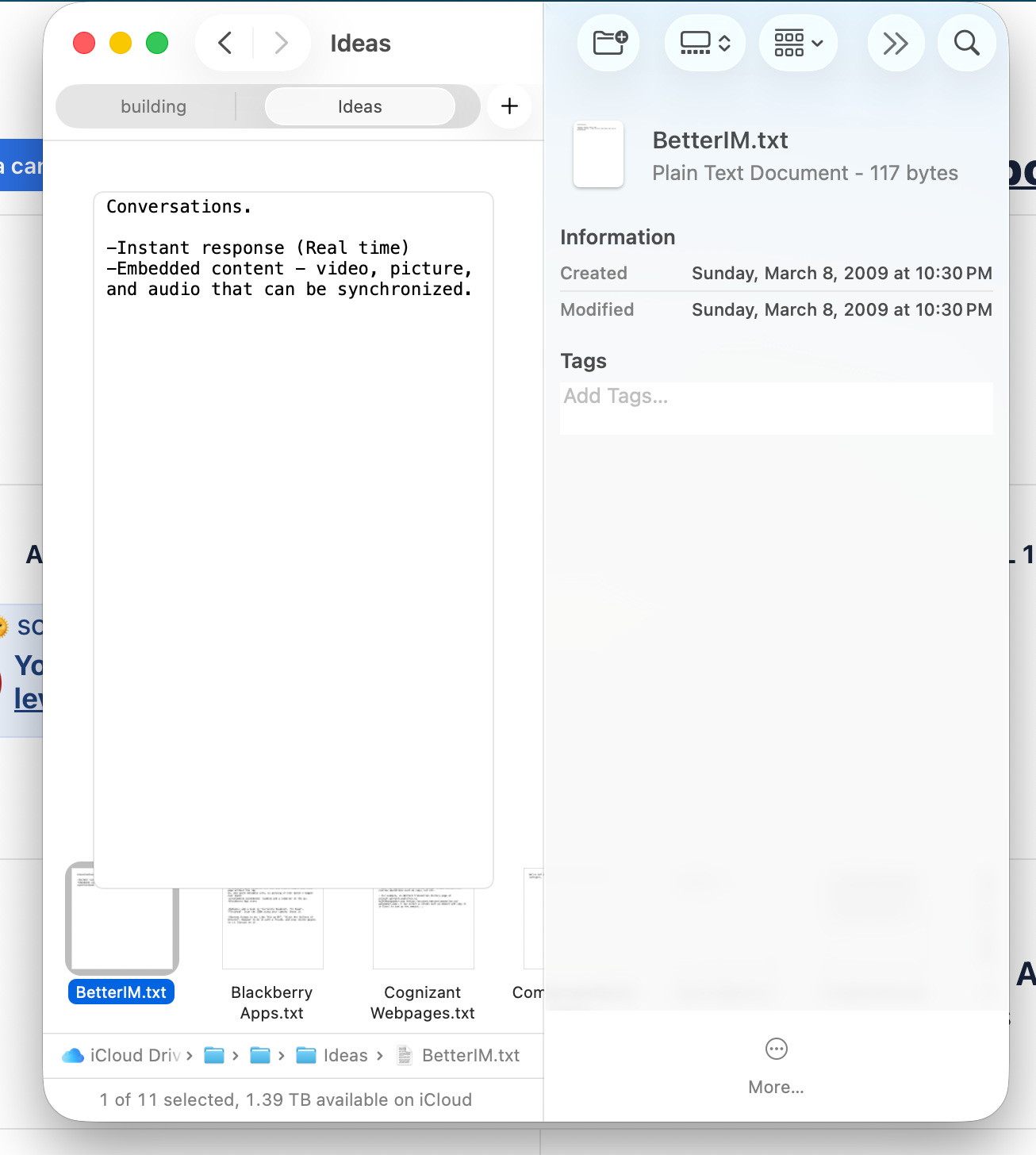
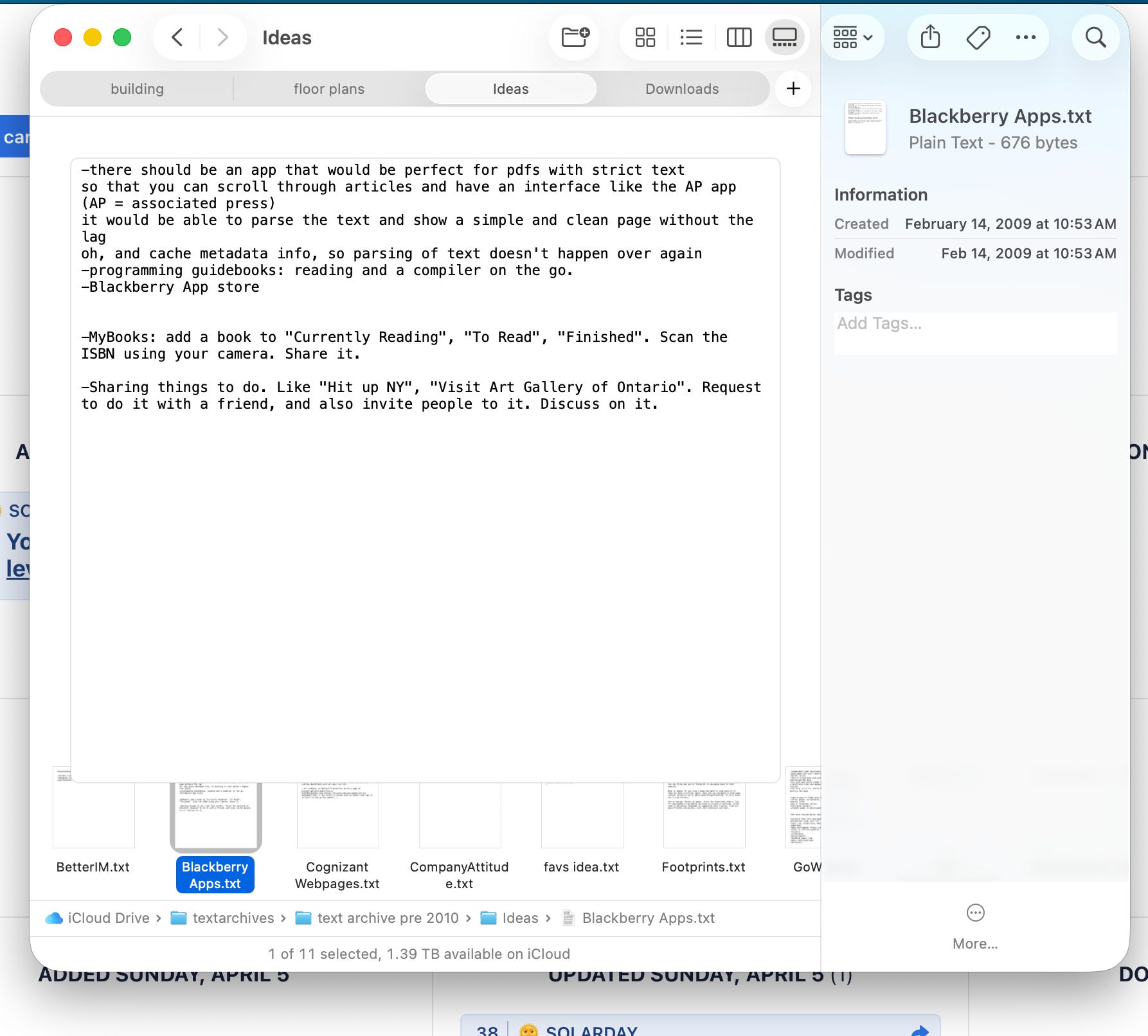
This week’s Artifact from the Past is a pair of text files from my archives in 2009, as the timestamps denote. That’s 17 years ago!
The first one, “Better IM”, from March 2009 expressed a need for better instant messaging on phones. At the time, BlackBerry Messenger, colloquially known as BBM, was the only way to do so. I was an iPhone 3G user (which had launched in Canada the prior year) even though I was interning at BlackBerry (Research in Motion, or RIM) in March 2009 (and yes, I really did take my iPhone to the interview and said “why can’t the BlackBerry be more like the iPhone?” — maybe they liked that). For work, I had multiple test BlackBerrys and unlike me, my coworkers all used BlackBerrys as their primary device. And iMessage, or the “blue bubble” as we know it, didn’t exist until 2011. So, I often felt a need in 2009 for a cross-platform instant messenger that would be faster and multi-modal and let me message between iPhones and BlackBerrys.
I never converted this idea into a product. But, who did? The founders of WhatsApp. WhatsApp was launched on the App Store in November 2009.. eight months after my notepad scribble.
Of course, there was a lot of complex engineering its founders did to make WhatsApp work, and the key insight they had was that your identity was your phone number which you already had, not some username you had to come up with.
Interestingly, at BlackBerry, my main project was actually building a new group chat app exclusively for BlackBerrys (one of my managers happened to be the inventor of BBM), so one could argue that I had some knowhow of what it took to build these things. But, the cross-platform bit was crucial, and the elegance of just keeping your phone number as identity was probably what led to WhatsApp’s quick adoption. Timing is also crucial with a lot of these things, especially when a new platform comes about (the iPhone App Store at that time.) In WhatsApp’s case, they were not only timely with their November 2009 release, but also were able to keep their lead over 17 years, by keeping the app interface always super familiar, fast and simple.
The other text file with some BlackBerry app ideas is also interesting. The first one is basically reader mode in browsers now. One of them is “Blackberry App store”. Apple’s App Store launched alongside the iPhone in 2008. It shouldn’t have been a lowly intern like me to feel the need for a nice App Store for BlackBerry in 2009, one year after Apple’s launched. It should’ve been the CEO or head of product of Research In Motion to have that realization.
But, alas, BlackBerry never fast-followed Apple on that. Not creating a better Services ecosystem was probably a big factor in their downfall. I had lots of good ideas, but outside of my team, my feature requests weren’t really heard by anyone. So, I don’t think it was an idea or capabilities issue.. it was a culture issue, which the movie BlackBerry (now on Netflix) captures in a witty way.
Anyhow.. just some random text files I stumbled upon while searching for something.
The latest Arc Prize Paper on AGI
Not much on connecting the dots this week, except that the state of AI software today reminds me a lot of clankers from Star Wars. A few days ago, I sat at a Starbucks for an hour and read a research paper from the ARC Prize Foundation that basically highlighted how far we are from “AGI” — artificial general intelligence. Apparently, on ARC-AGI-3 benchmarks, where humans can solve 100% of problems in unknown environments, the state-of-the-art models from AI labs like OpenAI and Anthropic scored a mere less than 1%.
I think it’s a good reminder of the fact that all these models are really good at manipulating language, just ok at reasoning (not great) and abysmal at creative problem-solving. A lot of what humanity has built or invented has come from creative thinking or doing things in ways that haven’t been done before. Today’s AI models love reproducing what’s been done before, and while that can be useful in lots of use cases (like coding), human-like intelligence is a whole lot more than that.
So, my recommendation to you is to not ask AI for life advice unless you just want to do what’s been done before. Sure, you can increase the temperature (the parameter that controls randomness / creative sampling of the responses from LLMs), but I’ve had pretty poor success with it even for simple problems like generating motivational quotes. People want AI to be more deterministic.. but how it will actually get closer to human capabilities will be through better, or rather, less bad non-determinism. In other words, hallucinations currently in AI responses aren’t all that bad.. unless you are asking for travel recommendations and it makes up a restaurant. Ben Thompson of Stratechery, a tech writer I like, often makes this point on his podcasts, but I don’t think enough people out there do.
What I’ve watched recently
Bait, a show written by actor Riz Ahmed, streaming on Prime Video. Dark, and at times, sad, but still funny.
Plastic Detox, a documentary about how much microplastics we consume in daily life, streaming on Netflix. Since watching this, I’ve been looking more closely at the material composition of stuff I interact with on a daily basis like clothes, utensils, and makes me wary of buying any cheap plastic items made to look good. I’m not sure how much of it is fear-mongering, but it certainly made me introspect (Marc Andreessen would look down on that.)
Have a good rest of the week.
—Siddharth
~ That's it for this edition. The future is unknown, but that’s exactly what humans are built for (while AI isn’t.. yet). ~
No posts
Comments
Nothing yet. Say the first thing.
Sign in to join the conversation.