

STVDIO maps the future of music with deep visual reports. Helping 4,900+ artists, music industry professionals and founders navigate music industry shifts with weekly visual maps.
Supported by Secretly Distribution: For more than 25 years, Secretly Distribution (SD) has been enabling independents to challenge the mainstream. SD is not only a full-service global physical and digital music distributor, but it also provides hands-on marketing, financial and technological support to some of the most exciting record labels and artists across geographies and genres. By supporting businesses who are self-reliant by choice, not just necessity, SD champions the musicians and creative works that drive culture forward. Listen to the latest SD releases on the Secretly Weekly playlist.
Spotify has dominated music streaming for almost 20 years now.
No-one else has even come close.
It doesn’t matter how many “Spotify is dying” articles people write. How many startups try to disrupt it. Or how many artists boycott the platform. It keeps growing.
Lately though, I’m starting to think it’s getting vulnerable.
Spotify is being threatened from five different angles, with competitors that are growing faster, and they can’t fight against them all.
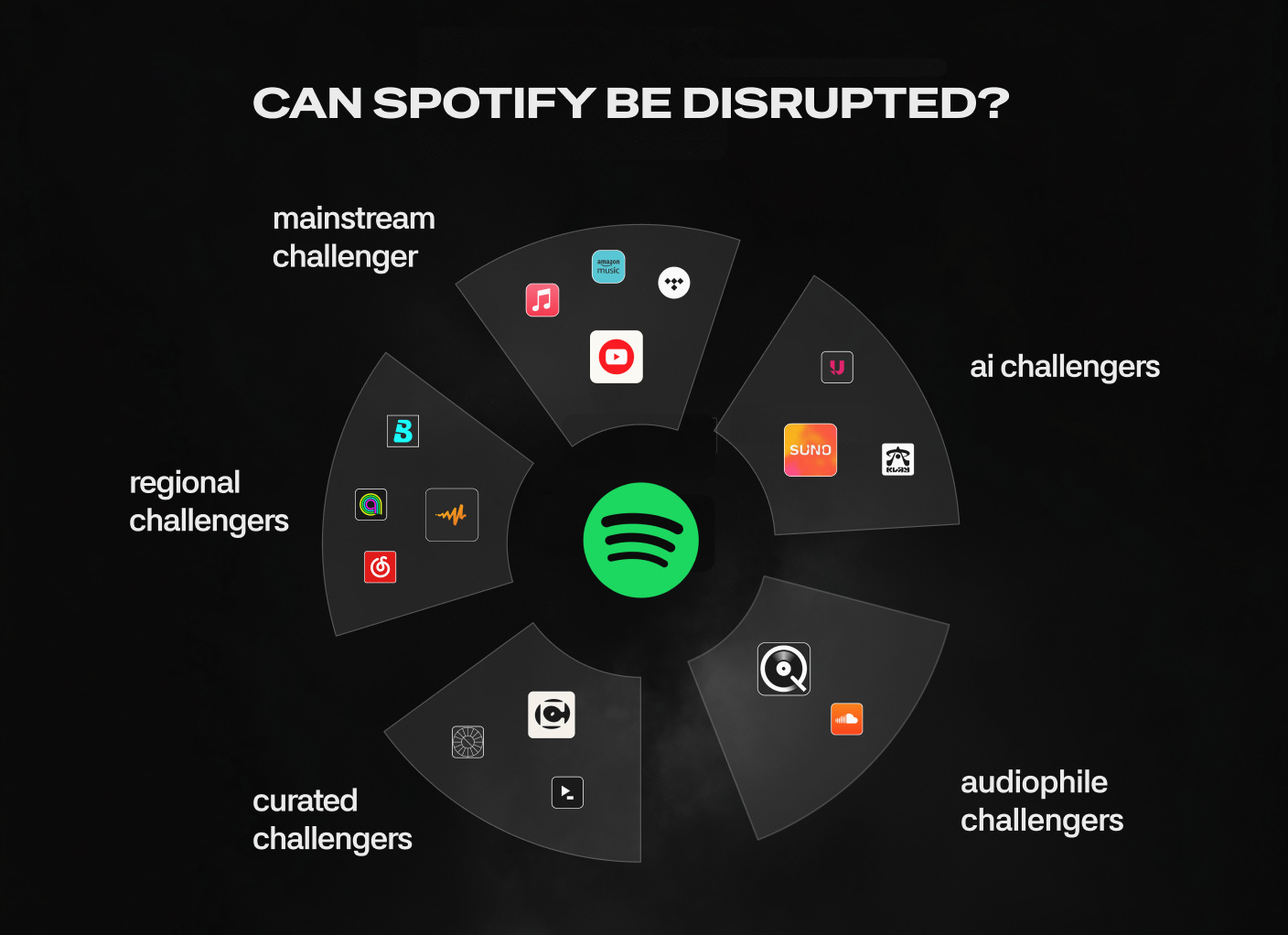
YouTube Music is now growing subscribers quicker than Spotify. Audiomack + regional platforms are winning in Africa and developing markets. Suno is gunning for interactive streaming. Qobuz is capturing the audiophiles.
It’s not “one thing” that could topple Spotify. It’s lots of smaller platforms coming from different directions.
You can tell Spotify is feeling threatened. Most of their new product initiatives are defensive, aimed at competing with these newer threats. (Video uploads to push back against with YouTube. AI remix tools to compete with Suno).
Let’s explain with real data.
For the first time, Spotify has a real challenger for the mainstream music streaming market: YouTube. According to Midia’s report last week, YouTube Music is now the fastest growing DSP, overtaking Spotify’s subscriber growth in Africa and the Middle East, and almost matching them in new subscribers across America and Europe.
Spotify fights back? Last week Spotify launched a direct video upload service, so artists can upload video content directly to Spotify. This feels like a direct response to YouTube’s rapid growth in music.
Suno is generating headlines for flooding the world with AI generated music. But the quieter story is that Suno is trying to take on Spotify itself.
Suno doesn’t just want to be the place you create music. It wants to be the place you create, listen and interact with music all at once: a new form of participatory music consumption.
Suno’s homepage is full of curated playlists and recommendations. It invites you to remix and reimagine your own versions. Suno’s investors even talk about switching from Spotify to Suno as their main listening tool - that’s the narrative their building.
Spotify is definitely rattled. At their last investor call, they were asked twice about how they plan to compete with these new products from Suno.
Spotify fights back? Spotify has cut deals with all the major labels to build out AI-remix tools, although none have been released yet.
The vast majority of streaming subscriber growth now comes from outside the US and Europe. Latin America, Africa, Middle East and Asia are the fastest-growing regions for music streaming, largely thanks to broadband expansion, mobile data plans, affordable smartphones, and a population that skews younger.
However, they aren’t all downloading Spotify. Many are prioritising other streaming services that put regional music front and centre.
For example, Audiomack has captured African music fans with its focus on Afrobeats, rap and other niche genres. It hit Apple’s number one music app in 21 different African countries. Audiomack now has 50 million monthly active users and 31% year-over-year growth (3x as much as Spotify). Others regional services include Boomplay and Anghami.
Qobuz is a high-fidelity streaming alternative that recently hit 1.2 million monthly active users, and grew subscriber revenue 45% in 2025.
Although it’s small, it’s growing over 4x faster than Spotify and taking hold among audiophiles and deep music fans for its artist-centric brand, high-fidelity audio and editorial curated playlists.
I think you can also put Soundcloud in this category for the younger, deep, music-obsessed audience. Not exactly audiophile, but deeper music fans.
Spotify fights back? In September last year, Spotify releases lossless audio streaming to its premium customers.
Instead of trying to capture the masses, a new wave of startups are drilling down into niche genres and communities.
Cantilever is a curated streaming service featuring only a handful albums at a time, and rotated regularly. Each album is featured with an editorial segment to give deeper context around the music.
Medallion is a similar service with curated albums, demos, and secret tracks from Pixies, Sigur Ros, Major Lazer and more. In both cases, the payouts are artist-centric so your subscription money goes only to the artists you listen to.
IDAGIO is a genre-specific streaming service, focusing solely on classical music. Jazzed is a similar platform with only jazz music.
Not anytime soon. Spotify’s dominance is still huge and they’re growing. But for the first time, they do have threats from multiple angles. It’s death by a thousand cuts rather than one big hit.
And it feels like Spotify is in fight mode, rather than leading the way. Their new product initiatives are all defensive and reacting to their competitors instead of innovating within music culture.
The opportunity is in the niches. The streaming economy is now so large that full business models can operate at the edges and steal market share away from the giants.
If you found this useful, please do forward it to your colleagues or share with your friends. If you have questions or thoughts, reach out to me on LinkedIn or by email at benjamin@stvdio.io. See you next week with another music industry report.
No posts
Comments
Nothing yet. Say the first thing.
Sign in to join the conversation.