

STVDIO maps the future of music with deep visual reports. Helping 4,900+ artists, music industry professionals and founders navigate music industry shifts with weekly visual maps.
Supported by Secretly Distribution: For more than 25 years, Secretly Distribution (SD) has been enabling independents to challenge the mainstream. SD is not only a full-service global physical and digital music distributor, but it also provides hands-on marketing, financial and technological support to some of the most exciting record labels and artists across geographies and genres. By supporting businesses who are self-reliant by choice, not just necessity, SD champions the musicians and creative works that drive culture forward. Listen to the latest SD releases on the Secretly Weekly playlist.
Old music is crowding out new music.
For seven years straight, old music has gained streaming share while new music has shrunk. Ted Gioia wrote about this four years ago, but it’s been getting worse.
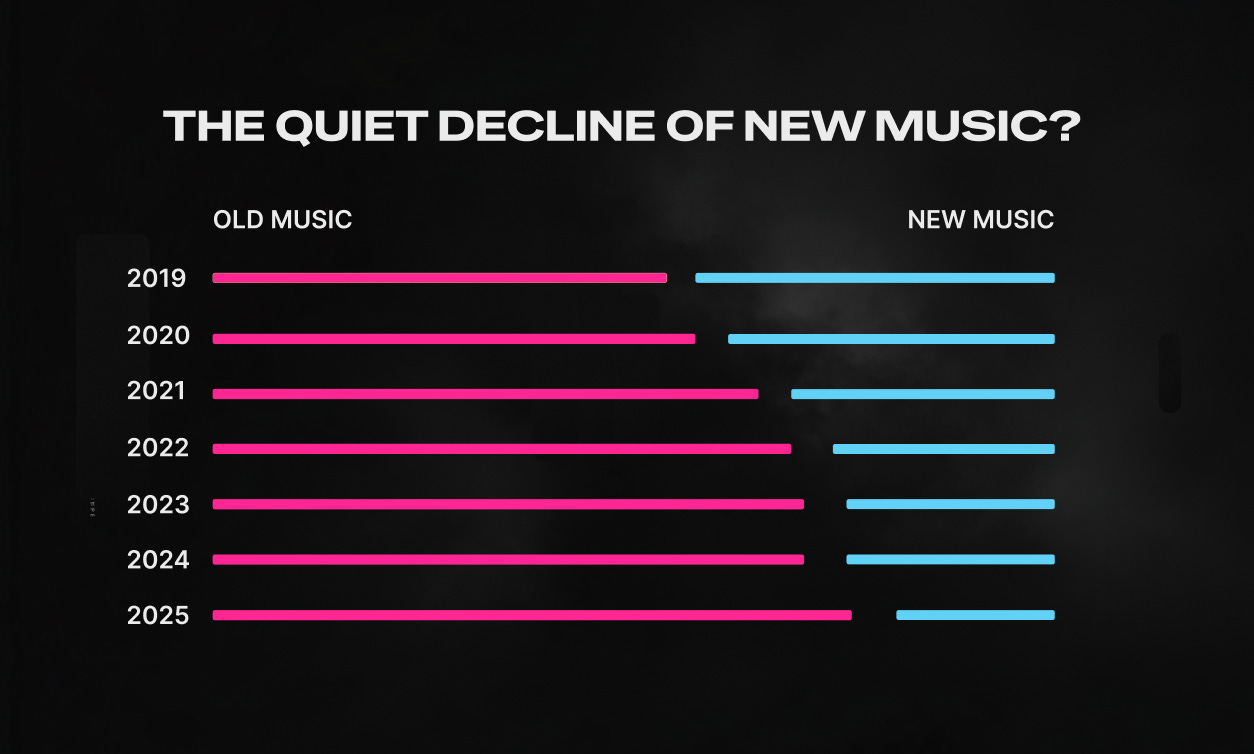
New music (defined as released in the last 18 months) dropped below a quarter of music consumption for the first time ever in 2025.
And the first few months of 2026 were particularly bad. New music made up just 3.5% of Spotify’s Global Top 50 in January according to Chartmetric (compared to 8.4% in 2023 and 9.4% in 2024).
As I write this, Spotify’s Global Top 50 is made up of Michael Jackson, Bruce Springsteen, Oasis, The Killers, Journey, Goo Goo Dolls, Shakira and Katy Perry classics. Only a few new records appear in the playlist at all.
Streaming algorithms favour familiar records and existing popular tracks. They want to keep you listening, not interrupt your flow with anything new or jarring.
These algorithms are self-reinforcing. So the more you listen to those older records, the more Spotify pushes them into other playlists.
Spotify playlists are increasingly “evergreen” by keeping strong-performers in the playlist for longer and relegating the weaker performers before they have chance to catch on. It’s much harder for new music to break into the algorithmic playlist rotation.
Meanwhile, Spotify continues to de-prioritise editorial playlists where human curators can place new music in context for discovery.
There’s been a feeding frenzy of catalog acquisitions in the last six years. Major labels and private equity companies have teamed up to acquire legacy records (Red Hot Chili Peppers just sold for $300m, Queen sold for $1.2 billion, Justin Bieber for $200 million).
Old catalog is lucrative in the streaming era precisely because it’s so predictable and sticky.
There’s also a flywheel effect. After acquiring old catalog, many of the labels and companies put fresh capital and resources into “exploiting” this catalog.
For example, Universal Music created a joint venture with WTSL to push its legacy records in new ways, through Netflix partnerships, fashion, TV, film etc. Record labels are re-engaging their older catalog in a way they rarely used to.
The music landscape is fragmented these days. There is no “mainstream” where we all agree on the “song of the summer” or the next big hit. There’s no big radio station that decides what we all listen to.
We all live in our own algorithmic bubbles. A song can blow up in one corner of the internet, but never make it to listeners on the other side of the internet. New music bubbles up in one niche but rarely takes over the mainstream.
Similarly, nostalgia and retro records can reappear faster in our social feeds.
There’s a tidal wave of new music hitting streaming services every day. It’s much, much harder to parse through it, curate it and come to consensus on great tracks.
When there’s too much new music to choose from, listeners often default to what they know and love.
There’s more new music than ever before, but it’s having less impact.
It’s harder than ever for new artists to break through and push out the old guard. The passive algorithms are feeding you familiar hits that keep you listening rather than challenging you with new music.
Incredible new music is still out there. You just have to work harder to find it now.
If you found this useful, please do forward it to your colleagues or share with your friends. If you have questions or thoughts, reach out to me on LinkedIn or by email at benjamin@stvdio.io. See you next week with another music industry report.
No posts
Comments
Nothing yet. Say the first thing.
Sign in to join the conversation.