
Hello,
This is the 2nd in a series of 3 posts on metabolic emergencies. Last month’s post covered hypoglycemia. Today’s post will cover two distinct causes of hyperammonemia with different laboratory findings.
As a reminder, early-bird registration for our 30-hour ABGC Board Review Bootcamp (June 11-July 23) for the Aug 2026 exam ends Mon June 1st at 11:59pm ET! If you are interested in taking the course, make sure to sign up before this time to take advantage of the $100 discount. Please also consider forwarding this email to anyone in your network who might be interested.
Feel free to reach out (daniel@studyrare.com) with any questions about the course or this post. I hope you have a great week!
-Daniel
A 3-day-old boy born at term presents with poor feeding, vomiting, and lethargy. He is hypothermic, hypotonic, and tachypneic. Labs show plasma ammonia 820 μmol/L (elevated), and a venous blood gas shows a pH of 7.52. Plasma amino acids show low citrulline and elevated glutamine. Urine organic acids show elevated orotic acid. Which of the following enzymes is most likely deficient in this patient?
A 4-day-old presents with lethargy and poor feeding. Her laboratory studies show elevated plasma ammonia, a pH of 7.18, and elevated propionylcarnitine (C3). Laboratory studies show elevated methylmalonic acid and methylcitrate. Which of the following most strongly distinguishes this patient from one with a urea cycle disorder?
Question 106: D) Ornithine transcarbamylase
Question 107: B) Anion gap acidosis
Hyperammonemia is a neonatal metabolic emergency
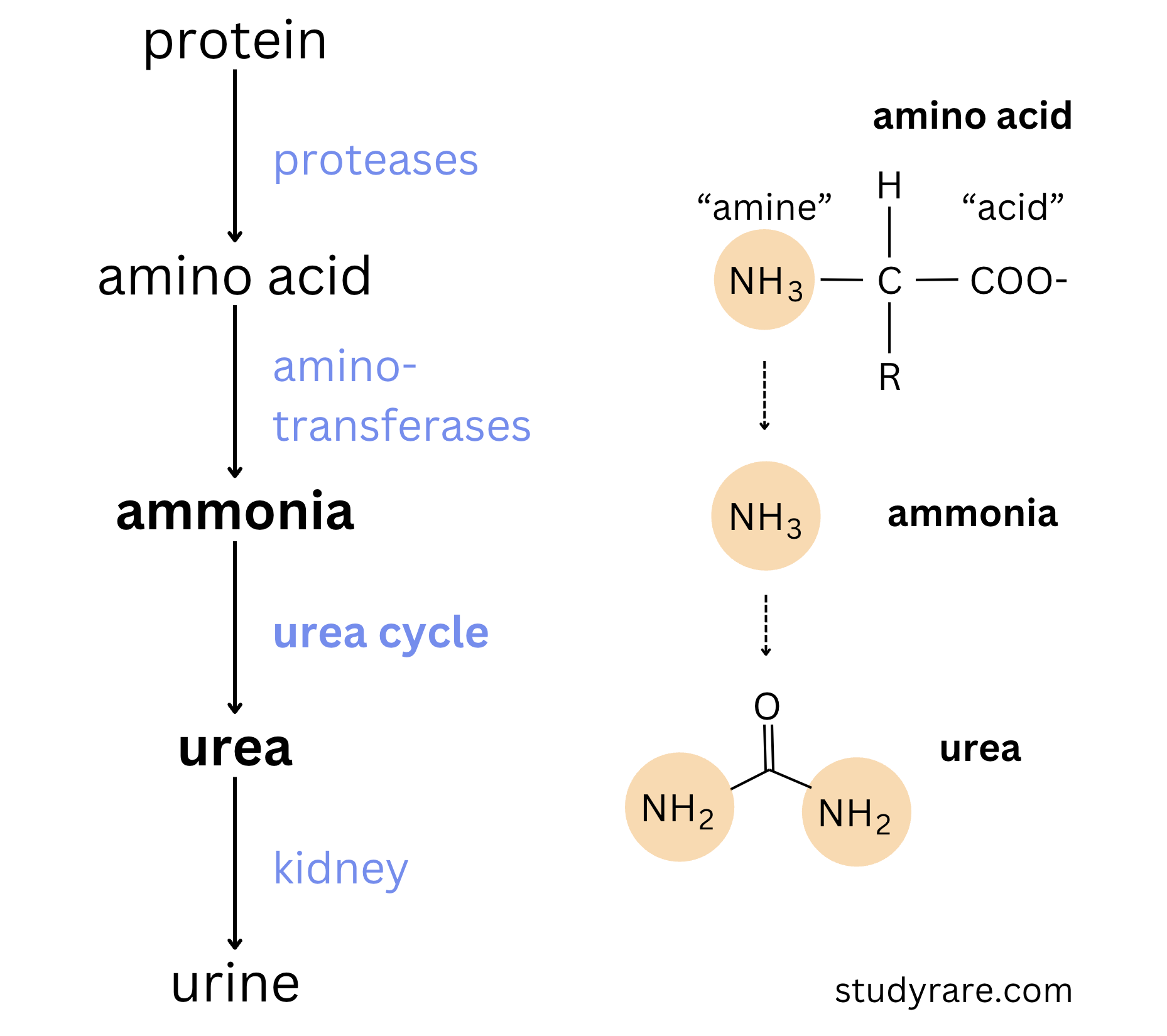
Ammonia is a toxic molecule that is produced continuously, both by the catabolism of dietary and endogenous protein and by intestinal bacteria. The liver clears it through the urea cycle, which converts ammonia to urea. Urea is then removed from the body in the urine. When the urea cycle is unable to keep pace, ammonia accumulates in the blood. This is dangerous because ammonia, unlike most metabolites, readily crosses the blood-brain barrier. Within astrocytes, ammonia is incorporated into glutamine, an osmotically active molecule whose accumulation draws water into the brain and produces cerebral edema, seizures, and coma. If it is not corrected promptly, hyperammonemia can progress to brainstem herniation and death.
The blood gas separates the two major causes of hyperammonemia
Both patients in this post are neonates with hyperammonemia who present in a similar fashion (poor feeding, vomiting, lethargy). The laboratory finding that separates them is the acid-base status on the venous blood gas, which divides the differential into two broad categories.
The first category is the urea cycle disorders (UCDs), in which the defect lies within the urea cycle itself (Question 106). Because ammonia stimulates the respiratory center, these infants hyperventilate and characteristically develop a respiratory alkalosis (pH > 7.45). The second category is the organic acidemias, in which an organic acid that accumulates upstream secondarily impairs the urea cycle (Question 107). These infants develop an anion gap metabolic acidosis from the accumulating organic acid. The presence or absence of acidosis can help narrow the differential diagnosis in a neonate with hyperammonemia.
The urea cycle
The urea cycle operates in the liver and spans the mitochondrial matrix and the cytosol. It comprises six enzymes and one allosteric activator (NAG):
NAGS (N-acetylglutamate synthase) produces N-acetylglutamate (NAG), a molecule that activates CPS1.
CPS1 (carbamoyl phosphate synthetase 1) combines ammonia and bicarbonate into carbamoyl phosphate. This is the rate-limiting step.
OTC (ornithine transcarbamylase) combines carbamoyl phosphate and ornithine to form citrulline.
ASS1 (argininosuccinate synthetase) combines citrulline and aspartate to form argininosuccinate.
ASL (argininosuccinate lyase) cleaves argininosuccinate into arginine and fumarate.
ARG1 (arginase) hydrolyzes arginine into urea and ornithine, regenerating the cycle.
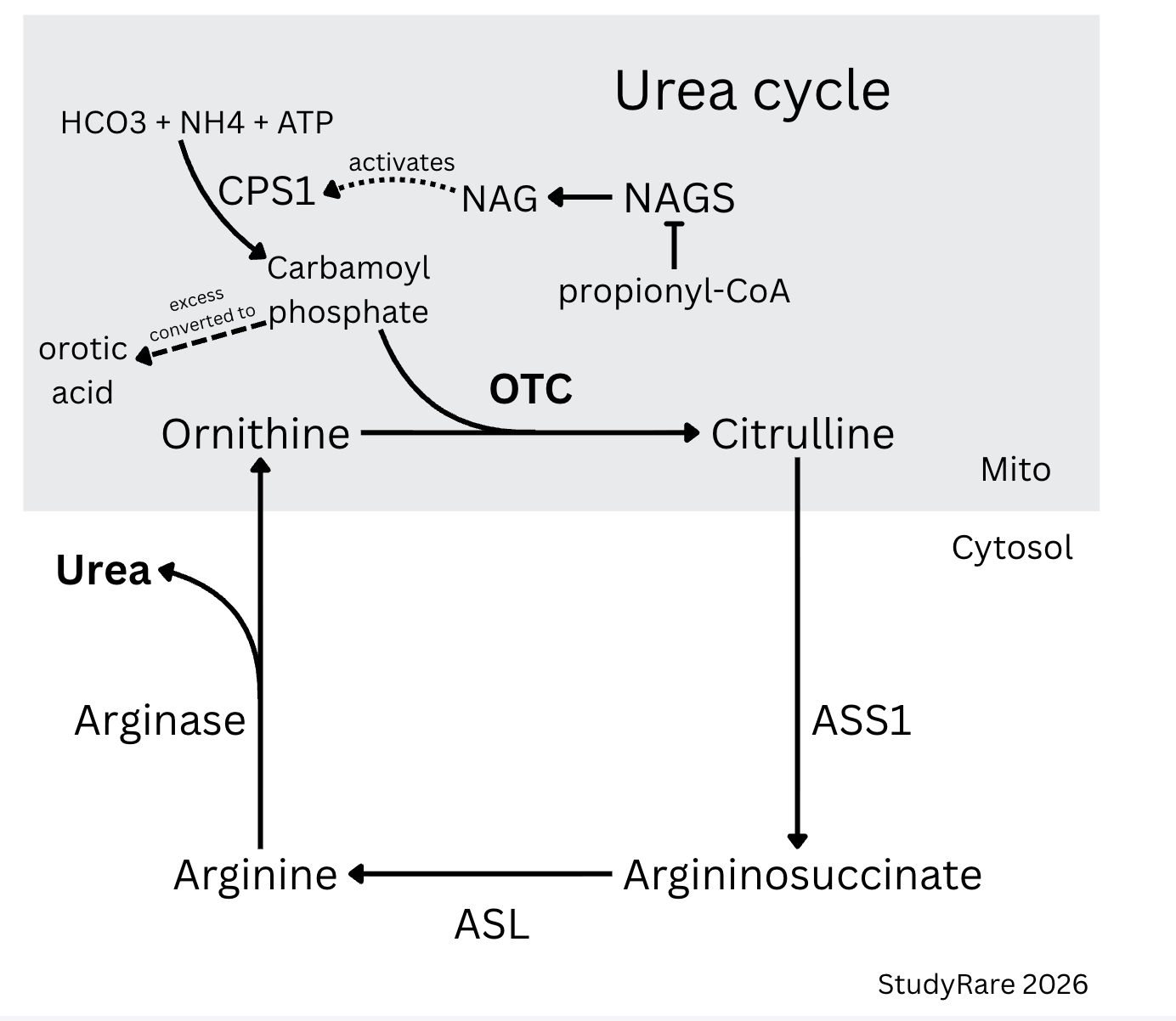
Loss of function of each of the enzymes in the urea cycle is associated with a separate disorder. All of the urea cycle disorders are inherited in an autosomal recessive manner, with the exception of OTC deficiency, which is X-linked.
Ornithine transcarbamylase (OTC) deficiency
The patient in Question 106 has OTC deficiency (Choice D). OTC is a mitochondrial enzyme that combines carbamoyl phosphate and ornithine to form citrulline. When OTC is deficient, carbamoyl phosphate accumulates and is converted to orotic acid (a pyrimidine precursor), which is excreted in the urine. The combination of a low plasma citrulline, elevated urinary orotic acid, and a respiratory alkalosis in a hyperammonemic neonate is essentially diagnostic of OTC deficiency.
💡 Remember that OTC converts Ornithine To Citrulline.
OTC deficiency classically presents in a healthy, full-term male infant who decompensates within the first several days of life. Because the gene is X-linked, heterozygous females can also become symptomatic, with severity determined by the degree of skewed X-inactivation in the liver. Some present in infancy, while others remain asymptomatic until they experience a stressor (e.g., large protein load, postpartum state, or severe illness). A family history of unexplained neonatal deaths among male relatives, or longstanding protein avoidance in the mother, can be an important clue.
Unlike many of the organic acidemias, OTC deficiency is not reliably detected by standard newborn screening, because the diagnostic finding is a low citrulline rather than an elevation. As a result, affected infants often decompensate before any screening result returns, which underscores the importance of recognizing the clinical picture.
Methylmalonic acidemia
The patient in Question 107 has methylmalonic acidemia (MMA), an organic acidemia caused by deficiency of methylmalonyl-CoA mutase or by defects in its cobalamin (vitamin B12) cofactor. Methylmalonyl-CoA is an intermediate in the catabolism of propionyl-CoA, which is itself derived from Valine, Odd-chain fatty acids, Methionine, Isoleucine, and Threonine (“VOMIT”). When the mutase is deficient, both methylmalonyl-CoA and propionyl-CoA accumulate.
This accumulation has two consequences. First, the accumulating organic acids consume bicarbonate and produce an anion gap metabolic acidosis. This acidosis helps distinguish MMA from a urea cycle disorder (Choice B), because urea cycle disorders are associated with respiratory alkalosis. Second, accumulated propionyl-CoA inhibits N-acetylglutamate synthase (NAGS), so that the activator of CPS1 is not produced and the urea cycle stalls. The hyperammonemia in MMA is therefore secondary and occurs despite urea cycle enzymes that are otherwise functional.
Additional features that support an organic acidemia rather than a urea cycle disorder include ketonuria (which is inappropriate in a young infant), neutropenia, thrombocytopenia, and an elevated lactate. The plasma acylcarnitine profile shows an elevated propionylcarnitine (C3), and urine organic acids show methylmalonic acid, 3-hydroxypropionate, and methylcitrate. Newborn screening detects most cases through an elevated C3 on the dried blood spot, although a neonate may decompensate before the results are available. These findings would not be present in a urea cycle disorder.
Acute management of hyperammonemia
Acute hyperammonemia is treated by stopping all protein intake for 24 to 48 hours, providing high-calorie dextrose (D10) with or without intralipid to reverse catabolism, and administering nitrogen scavengers (sodium benzoate and sodium phenylacetate, given IV as Ammonul) that provide alternative routes for nitrogen excretion. Hemodialysis is the most effective acute therapy and is indicated when ammonia exceeds 500 µmol/L or when the patient does not respond rapidly to medical management.
Incorrect answers
Question 106
Carbamoyl phosphate synthetase 1 (CPS1) deficiency (Choice A) also produces severe neonatal hyperammonemia with a low citrulline, but the urinary orotic acid is normal or low because no carbamoyl phosphate is generated to be diverted into pyrimidine synthesis. Argininosuccinate synthetase (ASS1) deficiency (Choice B) causes citrullinemia type I, in which the unprocessed substrate accumulates and produces an elevated, rather than low, plasma citrulline. Propionyl-CoA carboxylase deficiency (Choice C) causes propionic acidemia, an organic acidemia that would present with an anion gap metabolic acidosis and an elevated propionylcarnitine (C3), neither of which are described in the question stem.
Question 107
Hyperammonemia (Choice A) is a feature of both urea cycle disorders and the classic organic acidemias. Elevated blood urea nitrogen (Choice C) is not expected in either condition, because impaired ureagenesis in both UCDs and organic acidemias typically produces a low or normal BUN (note that chronic kidney disease can develop later in MMA but does not produce an elevated BUN in the acute neonatal presentation). The age of onset (Choice D) is likewise unhelpful, because both the classic urea cycle disorders and the organic acidemias typically present in the first few days of life, once protein feeding begins and the nitrogen load rises.
Learning Objective
Hyperammonemia is a neonatal metabolic emergency, and the acid-base status of a patient can help narrow the differential diagnosis in a patient with hyperammonemia. A respiratory alkalosis points to a urea cycle disorder, while an anion gap metabolic acidosis points to an organic acidemia. Acute management of hyperammonemia centers on stopping protein, giving dextrose-containing fluids, nitrogen scavengers, and hemodialysis for severe cases.
2025 ABMGG General Exam Blueprint | V. Single gene inheritance > d) Single gene disorders > Metabolic disorders
2023 ABGC Exam Content Outline | Domain 1C. Genetic Conditions. (OTC deficiency is listed on the ABGC self-study guide)
Additional resources
1. Urea cycle disorder overview (GeneReviews)
2. Ornithine transcarbamylase deficiency (GeneReviews)
3. Isolated methylmalonic acidemia (GeneReviews)
Comments
Nothing yet. Say the first thing.
Sign in to join the conversation.