
I have always had good triceps.
This is a humble brag, except there’s really no reason to be humble about it because I worked for those suckers. 😂
I also used to tell myself that having strong, defined triceps was somehow more admirable than having great biceps because triceps are more functional.
This may have been something I invented because my triceps always looked better than my biceps. Ahhh, genetics.
But anyway...
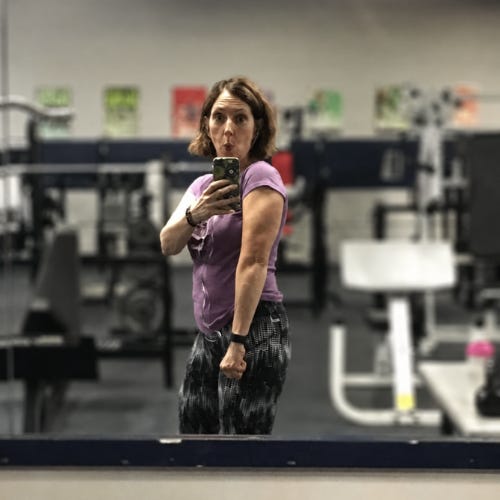
Imagine my surprise recently when I waved at someone… and my triceps KEPT WAVING when I stopped.
What in the actual F, I thought.
(I’ll tell you the actual F in a moment).
Years ago, I trained a woman who was 97 years old.
One day she asked me if there were exercises we could do to tone up the backs of her arms.
I remember feeling strangely sad about it.
She was 97, for crying out loud. At some point, I wondered, don’t we get a break from caring about this stuff?
Apparently not.
Now, years later, I understand her a little better.
Caring about your triceps is actually really smart from a survival and longevity standpoint.
Think about it: when your muscles are strong, you can remain independent and strong.
AND if you do the work to keep your muscles strong, you’re also doing the work to take care of your whole self. So caring is actually healthy and not just vanity.
Muscles all over our body start to shrink as we get older, starting in our 30s.
This works the opposite of compound interest… and a lot more like compound debt.
Now, keep in mind the numbers that follow are easy-to-follow hypotheticals… and that aging and sarcopenia (age-related muscle loss) don’t happen at a steady pace.
Let’s say you are carrying 100 pounds of muscle. Beginning in your 30s, you start to lose muscle at around 0.5% to 1% a year (that rate picks up after 50 with the hormonal changes of midlife).
Year 1, you have 99 lbs of muscle.
Year 2, 98.01 lbs.
Year 5, 95.09 lbs.
Year 10, you’re down to 90.44 lbs.
You can see how it picks up speed over time.
The good news and most important takeaway? You can slow that down with the right workouts.
The trick is to give your muscles a reason to stick around. You have to challenge them regularly, and they will grow and get stronger to match the challenge (same thing goes for your bones).
If you look at most “evidence-based” resistance training workouts, you normally see a lot of big movements called “compound exercises.”
Those exercises – presses, rows, push-ups, pulldowns, squats, deadlifts, etc., -call on more muscles.
Isolation exercises – like those that target your triceps – sometimes aren’t even included. Which is adequate, because smaller muscle groups like your arms do get worked during some compound exercises.
But we do not want adequate, do we?
You can do this circuit on its own, or add it to the end of another workout once or twice a week.
Start with just 1 round of the circuit and build up to 2-3 over time.
To keep it challenging as you get stronger, use heavier weight vs. more reps. You should really be feeling those last few repetitions!
I would rather you ramp up the intensity by adding weight so that you have to do a couple FEWER reps to finish the set with good form.
The goal is to build muscle and strength. This workout includes movements that target all 3 heads of your triceps muscles… and I set it up as a circuit so you’ll feel the burn (which, in my experience, is super motivating for my clients). Plus, you’ll be able to get more work done in less time.
Format: 1-3 rounds, one exercise after the other.
1. DB Overhead Triceps Extension
10–12 reps
Tempo: 2 seconds down, 2 seconds up
Rest: 45 seconds before next move
10–12 reps
Tempo: 2 seconds down, 2 seconds up, 1 second hold
Rest: 45 seconds before next move
5-10 reps (if this is too challenging, turn these into incline diamond pushups by placing your hands on a bench or platform)
Tempo: 2 seconds down, 2 seconds up
Rest: 60–90 seconds before starting the next round
Often when we admire someone’s “toned” arms, what we are really noticing is leanness and skin texture.
We can’t spot-reduce fat from the backs of our arms, and strength training can’t prevent every change that happens to our skin as we get older.
But that doesn’t mean you just have to let it happen. Nutrition, sleep, stress management, and skin care can all play a role.
(Bonus: all the things that help keep your triceps tight are also the things that make you feel better every day.)
Let me know if you give that circuit a try! It’s a keeper.
Wendy
PS: If you want to build muscle, get stronger and train with a clear plan, I can help.
I offer one-on-one coaching online and in person at Bangor-Brewer Athletic Club, with progressive strength training designed around your goals and experience.
Want to know more? Drop me an email or click here for more.
Comments
Nothing yet. Say the first thing.
Sign in to join the conversation.