
You’ve had your follow up DEXA. The results have returned and you hear the spine has increased in density BUT your hip has stayed exactly where it was.
You’re disappointed, when reading the letter you see something like “stable at the Femoral neck”. Not “5% increase at the femoral neck” as you were hoping for.
When I have been looking into why this is the case, I thought this should really be explained to people.
As I’ve been mentioning in my recent articles, the DEXA scans are not consistent everywhere you go, and even your position during the scan can slightly change the results.
Anything up to a 3% change either way, meaning an increase or decrease in density could be error.
Your spine and hip are both bones. But they have significantly different anatomy.
The vertebrae have much more trabecular bone, this is the honeycomb type structure within the cortical bone. In comparison the femoral neck has a much higher proportion of cortical bone which is the denser outer shell.
Trabecular bone makes up around a quarter of your total skeletal mass, but accounts for approximately 60% of the total bone surface. It has a much higher metabolic rate than cortical bone, meaning it has a higher turnover rate.
New here?
I’m a UK physiotherapist, writing honest bone health education. I cite every claim so you can check it yourself.
Join 7,200+ women today
More surface, faster turnover, more remodelling space. This means that the spine will respond to any changes quicker than the hip, this goes both ways. You lose bone density quicker here but can also gain it sooner.
The drug data makes this clear. In studies of denosumab, bone density rose 12.6% at the trabecular spine, 4.4% at the total hip, and 2.9% at the femoral neck.
The same drug, used on the same person but a significantly higher effect in the spine compared to the hip.
If you’re on medication and after your first repeat DEXA your spine has improved whilst the hip did not. That is the expected result. Do not be disheartened at this.
I had been thinking that lumbar spine density would respond quicker to exercise modalities for reasons stated above. However, a meta-analysis reviewing exercise for bone mineral density in post-menopausal women carried out by Kelley, Kelley and Kohrt found: .
Femoral neck: 28 effect sizes, 1,632 participants, standardised effect g = 0.288, confidence interval 0.102 to 0.474, p = 0.002. A clear, statistically robust benefit.
Lumbar spine: 28 effect sizes, 1,504 participants, g = 0.179, confidence interval −0.003 to 0.361, p = 0.05. Smaller, borderline, and the confidence interval crosses zero.
They described that although the improvements at the femoral neck and lumbar spine were small they had a significant effect on the twenty-year relative risk of osteoporotic fracture. With the femoral neck reduced by 11% and the spine reduced by 10%.
The meta-analysis stated above was carried out prior to the LIFTMOR study being completed and published.
LIFTMOR gets quoted constantly and misread almost as often as it found the spine went up 2.9%, while the control group lost 1.2%. The femoral neck went up 0.3%. That figure has a confidence interval of −0.5% to 1.0%, so the honest version is that the hip didn't gain. It held, while the controls lost 1.9%, which matters enormously. Belinda Beck said afterwards she'd expected the hip to respond more, given what they were loading it with. 8 months of the heavy bone-targeted training, and the site under a loaded barbell barely shifted on the scan.
The use of resistance training and reactive force (impact/jumping) cannot be overstated. Finding your current starting point and gradually increasing the intensity of both of these are going to have a positive effect on your bone density and significantly reduce your fracture risk (if done safely).
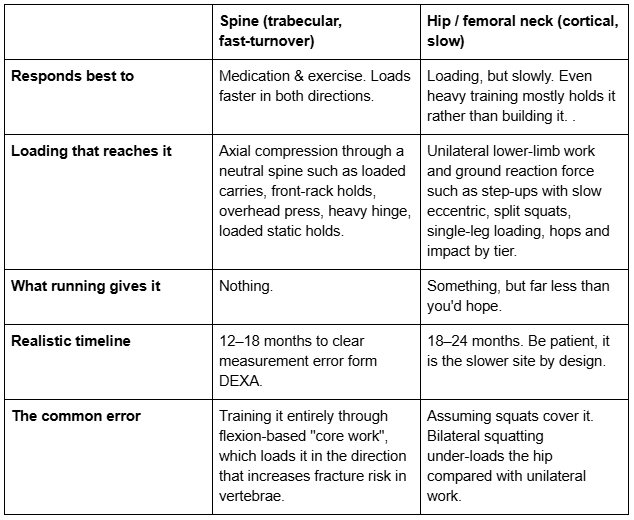
Not for you right now if:
You’ve had any fracture in the last 12 weeks
new or unexplained back pain
unexplained height loss
a fall in the last six months that hasn’t been assessed
progressive spinal loss you haven’t had investigated.
Self-screen:
Can you single-leg stand 20 seconds unaided?
Can you get to the floor and up without your hands on furniture?
Have you fractured from standing height or less?
Do you know your T-score at both sites, not just the worse one?
Tiers
Tier 1, osteopenia, no fracture history: full program.
Tier 2, osteoporosis, no fracture history: full resistance work, impact staged as in the table.
Tier 3, prior fragility fracture: clinician clearance first, resistance only, no impact, no loaded spinal flexion.
Free posts tell you what the evidence says. Paid posts tell you what to do on Monday morning.
This week, paid members get the 2 session program to add into your week. If you want your next DEXA to move, this moves it (eventually).
Comments
Nothing yet. Say the first thing.
Sign in to join the conversation.