
Last time I got you to sit in a chair, cross your arms, and count. That number decides where you start. If you skipped it, go back and do it, because everything below keys off the result.
Before the plans, one thing I have to say.
You’re reading a bone health newsletter, so you’d expect me to tell you that squats build hip bones.
The femoral neck (the narrow section at the top of your thigh bone, and the site of the hip fractures that have a huge impact on independence) is the hardest place in the body to add bone.
The LIFTMOR trial which is the best we have. 101 postmenopausal women with osteopenia or osteoporosis. Eight months of supervised high-intensity training, five sets of five at over 85% of their one-rep max, twice a week. Squats, deadlifts, overhead press. The femoral neck result?
Up 0.3%.
Not 3%. Zero point three. Meanwhile the spine gained 2.9%, and the control group doing gentle home exercise lost 1.9% at the femoral neck.This is the key take away although the increase of 0.3% is minimal, the comparison to the control group is much more impressive. The Heavy weight training group was actually +2.2% increased hip bone density.
Read that properly. The gold-standard programme, heavy and supervised for eight months, roughly held the femoral neck still while the women not doing it lost bone.
Nobody is squatting their way to a dramatically stronger hip bone. However they are maintaining and improving massively in comparison to what they would without weight training.
So why train legs?
Hip fractures often need a trauma such as a fall first. Bone determines whether the hip breaks when you land. Leg strength determines whether you land at all, and it’s what you have the most control over, you can decide whether to train and improve your strength or not. Train the legs and you’re attacking the event, not just the material.
Six weeks of this makes your legs meaningfully stronger and cuts your fall risk. It will not measurably change your femoral neck density. Anyone telling you six weeks of squats will, isn’t being fully truthful, we know that improving bone density through training takes months and years not weeks. But you have to start somewhere so why not set a 6 week goal?
Not subscribed?
Most bone-health advice is fear-marketing or supplement ads. This isn’t. Every claim here is cited. Join 7,000+ women reading the physio’s honest opinion on what actually builds bone. Free below.
Already reading free?
You’ve seen the science. Paid is where you get the plan: the exact protocols, the progressions, and the training templates that turn “I should lift” into a week you can follow. If you’re serious about your DEXA score, this is the upgrade.
Not ready to upgrade?
Send this to one woman who’s been told her bones are “just ageing.” That’s how this list grows, one reader who needed it, passing it to the next.
Osteosarcopenia is the condition combining weak bone and weak muscle, in 324 hip fracture patients, one-year mortality ran at 15.1% with osteosarcopenia against 5.1% with osteoporosis on its own.
The word matters because it’s a two-part diagnosis. And you’ve just read that one of those parts barely shifts with exercise.
The other part shifts enormously.
Training your leg muscles to improve strength, size and power is combatting sarcopenia at its core. By improving your muscle function and quality, you then start to benefit the bone by challenging it even more. Not only by increased weight bearing but also by the forces your muscle can apply to bone in day to day life.
Diagnosed osteoporosis, a fracture in the last year, or you scored zero: start the home track at Week 1, and get your GP or a physio to look at you before the loaded weeks.
Recent or unexplained back pain, night pain, unexplained weight loss: GP first, before any of this.
Everyone else: This is an example plan, not specific for any individual.
No loaded end-range spinal flexion. The squat itself is safe and actively encouraged by the Royal Osteoporosis Society. Rounding your back under load is not the same thing as squatting.
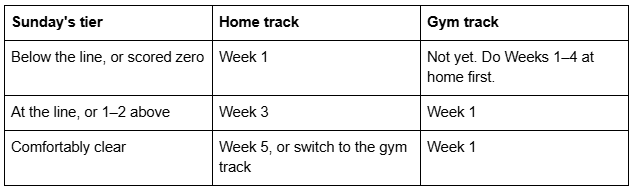
Two or three sessions a week, on non-consecutive days. Six weeks either way.
Equipment: your dining chair, a bottom stair or step, and a rucksack you can load with books or water bottles. A litre of water is a kilo, which makes a rucksack the cheapest adjustable dumbbell you’ll ever own.
Comments
Nothing yet. Say the first thing.
Sign in to join the conversation.