
If I asked you what makes you stronger, you’d probably say one word:
Exercise.
It’s only half true.
Exercise doesn’t make you stronger. It gives your body a reason to get stronger.
The real work happens afterwards.
Every workout is a message to your body. Recover properly, and your body answers by coming back a little stronger, a little fitter, a little more resilient than before.
That process is called adaptation. Once you understand it, training after 50 makes a lot more sense.
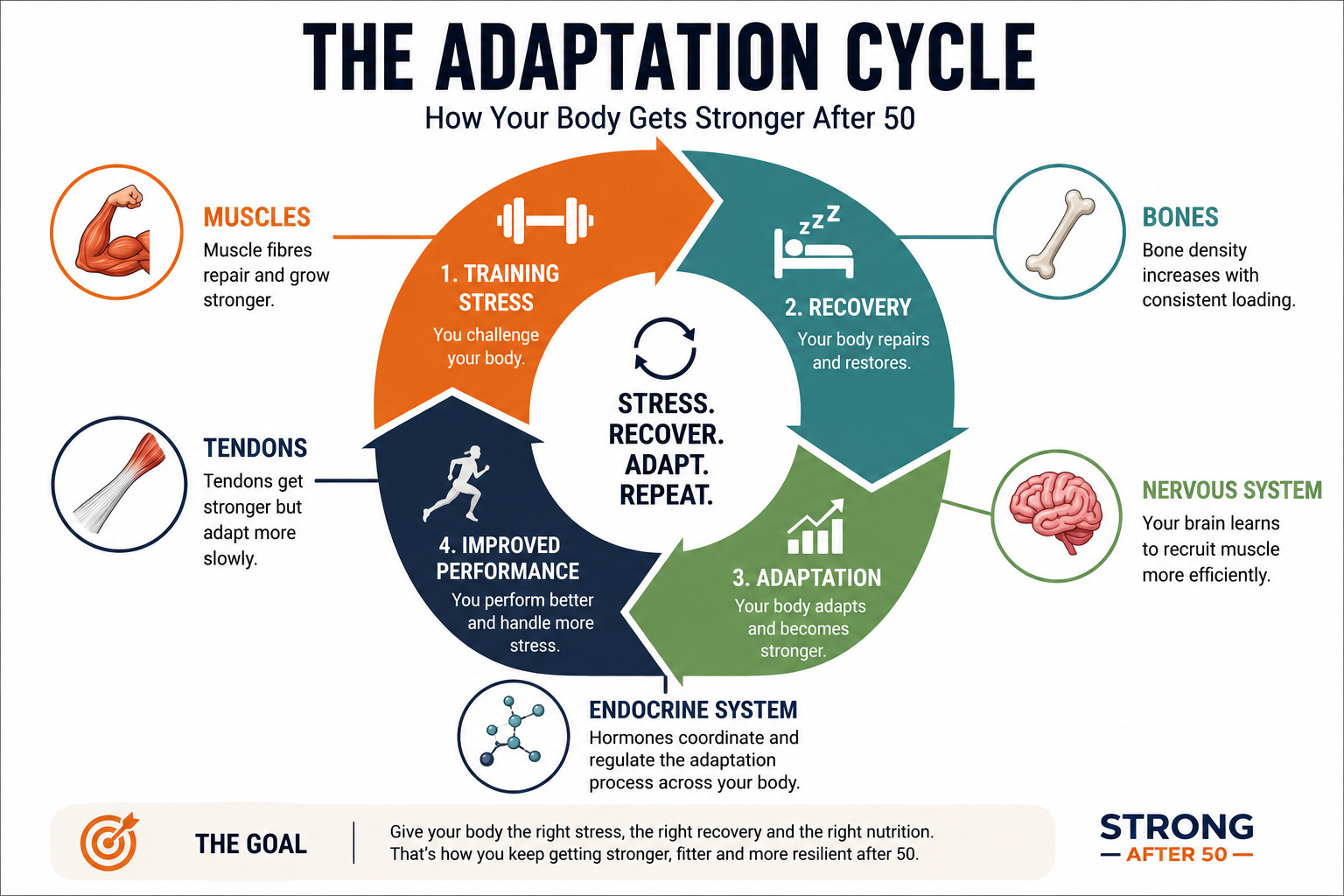
Every workout follows the same loop:
Training Stress → Recovery → Adaptation → Improved Performance → Repeat
Skip a step and progress stalls.
Most people pour everything into the training half. I do it too. My progress slows, so my instinct is to do more, to train like I did at 40.
Then I remind myself: my adaptation has slowed, but it hasn’t stopped. I can still get stronger. I just have to recover.
Training is only the trigger. Recovery is where your body does the work.
The biggest myth in fitness is that only your muscles respond to training.
They don’t. Every workout hits several systems at once, and each one adapts at its own speed.
1. Muscles. The obvious one. Lifting signals your body to build new muscle protein, so the fibres come back a little bigger and stronger. It’s why gradually adding weight over time works. Muscles adapt fast, often within days.
2. Tendons. Tendons connect muscle to bone and carry the force you produce. But they have a poor blood supply, so they rebuild slowly through collagen remodelling, a process that takes weeks or months, not days.
That’s why your muscles can feel ready for heavier weights long before your tendons are. And it’s why so many people over 50 end up with Achilles, elbow or hamstring problems after ramping up too fast.
3. Bones. Bone is living tissue. Every time you lift, climb stairs, run or skip, you load it, and that loading tells your bones to lay down more density over time.
It’s one of the reasons strength training is one of the best defences against osteoporosis as you age.
4. Your Nervous System. Strength isn’t only about bigger muscles. It’s also your brain learning to use the muscle you already have.
When you start lifting, your nervous system adapts first, recruiting more muscle fibres, smoothing out movement, improving coordination. That’s why beginners get noticeably stronger before they look any different.
5. Your Endocrine System The one nobody thinks about. This is your body’s hormone network. When you train, it releases hormones that tell different tissues how to respond: mobilising energy, managing inflammation, supporting repair.
They work together, coordinating the whole adaptation process across muscle, tendon, bone and nerve.
One thing does change with age: recovery.
Not because your body stops adapting. It doesn’t. But some tissues adapt slower. Muscle responds a little less readily. Tendons take longer. Sleep gets patchier. Life stress climbs.
None of that stops you getting stronger.
It just means recovery becomes part of the plan, not something you leave to chance.
✅ Lift with purpose, not just to pile on volume.
✅ Eat enough protein to support repair.
✅ Treat sleep as seriously as your training.
✅ Build recovery days into every week.
✅ Progress gradually and give tendons time to catch up to muscle.
The goal isn’t to survive today’s workout.
It’s to turn up to the next one stronger than the last.
After 50, the people who keep getting stronger aren’t the ones training the hardest. They’re the ones who understand the cycle:
Stress the body. Recover well. Adapt. Repeat.
Stay Consistent
Rod
No posts
Comments
Nothing yet. Say the first thing.
Sign in to join the conversation.