
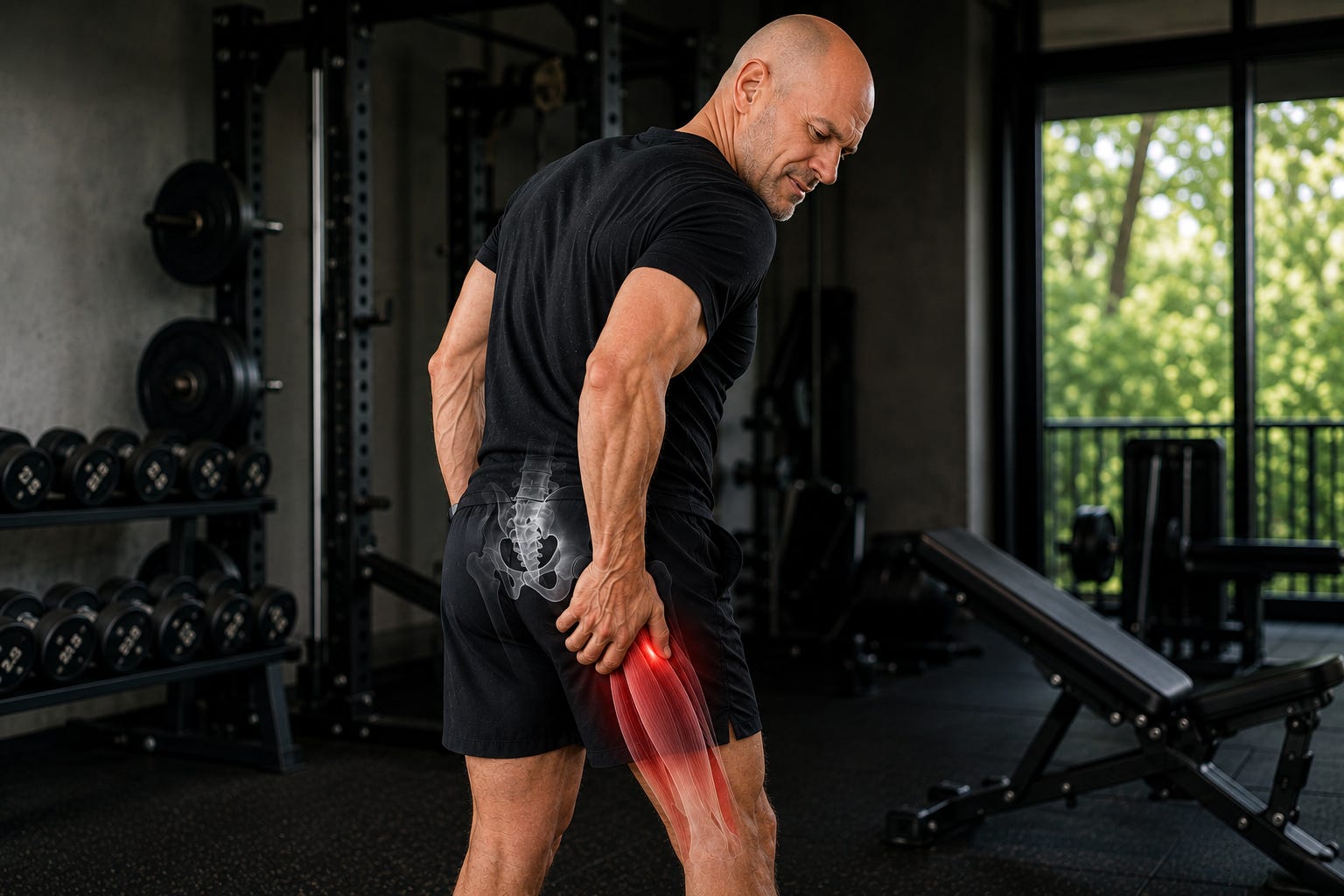
High hamstring tendon injuries are a pain in the butt, literally.
They are often described as a deep ache just under the butt cheek, right where you sit. The usual culprit is the proximal hamstring tendon, where the hamstring attaches to the ischial tuberosity, better known as the “sit bone”.
It is a classic overuse injury in active people over 50. Running, sprinting, hill training, deadlifts, Romanian deadlifts and lunges can all overload the tendon, particularly if your training volume or intensity increases too quickly.
The one that catches many people out is sitting.
Long periods in the car, at your desk or even on the couch can compress the tendon against the sit bone. That can lead to a deep ache just below the buttock, and in some cases discomfort can travel down the back of the leg.
If the pain is sharp, worsening, associated with numbness, or travelling down the leg, it’s worth getting assessed by a professional.
A painful tendon does not become healthier because you keep pulling on it. It becomes healthier by gradually adapting to load over time. This is why progressive loading sits at the centre of most successful tendon rehabilitation protocols.
Tendons generally adapt more slowly than muscle, partly because they have a poorer blood supply. That is one reason this type of injury can hang around. But complete rest is not the answer.
Professor Keith Baar, one of the world’s leading tendon researchers, explains the idea well:
“If you don’t load it, the cells don’t know which direction to make collagen.”
In simple terms, load gives the tendon a signal. It tells the tissue what it needs to adapt to. Without that signal, the tendon has little reason to become stronger.
When the tendon is particularly painful, isometric contractions can be a useful starting point. These are exercises where the muscle works, but the joint does not move much.
One common approach is to hold an isometric contraction for around 30 seconds, rest for two minutes, then repeat for five rounds. Depending on symptoms, this can often be done daily in the early stages.
A isometric hamstring bridge.
Lie on your back with your knees bent and feet flat on the floor. Lift your hips slightly into a bridge position, then gently dig your heels into the floor as if you are trying to drag them back toward your butt, without actually moving them.
Hold for 30 seconds, then rest for 2 minutes.
Repeat 5 times.
Keep the effort moderate at first. A good guide is discomfort around 2 to 3 out of 10, with no big flare-up later that day or the next morning.
In the early stage, reducing compression matters too. Shorter sitting periods, stand up more often, and walking will all improve the tendon health.
As pain reduces, rehab usually progresses to heavier, slower strength exercises such as Romanian deadlifts, split squats and hip thrusts. Over time, when the tendon rebuilds to its full capacity you can return to all activities but applying the same progression.
The strength protocol above should continue, to maintain tendon health over the long term, but the isometric holds can be reduced to 10secs for maintenance.
Too little load and the tendon has no reason to adapt. Too much load and it gets cranky again.
Tendons do not heal when ignored. They improve when they are loaded intelligently, consistently and progressively.
Stay Consistent
Rod
No posts
Comments
Nothing yet. Say the first thing.
Sign in to join the conversation.